Deepchecks excels at continuous validation by programmatically testing data and model integrity at every stage of the ML lifecycle. Its strength lies in automated test suites that run like unit tests, catching issues like train-test contamination or feature drift before they reach a human reviewer. For example, Deepchecks can automatically fail a pipeline if the PSI (Population Stability Index) for a critical feature exceeds a predefined threshold, reducing the need for manual report inspection.

Difference
Deepchecks vs Evidently AI: Review Report Generation
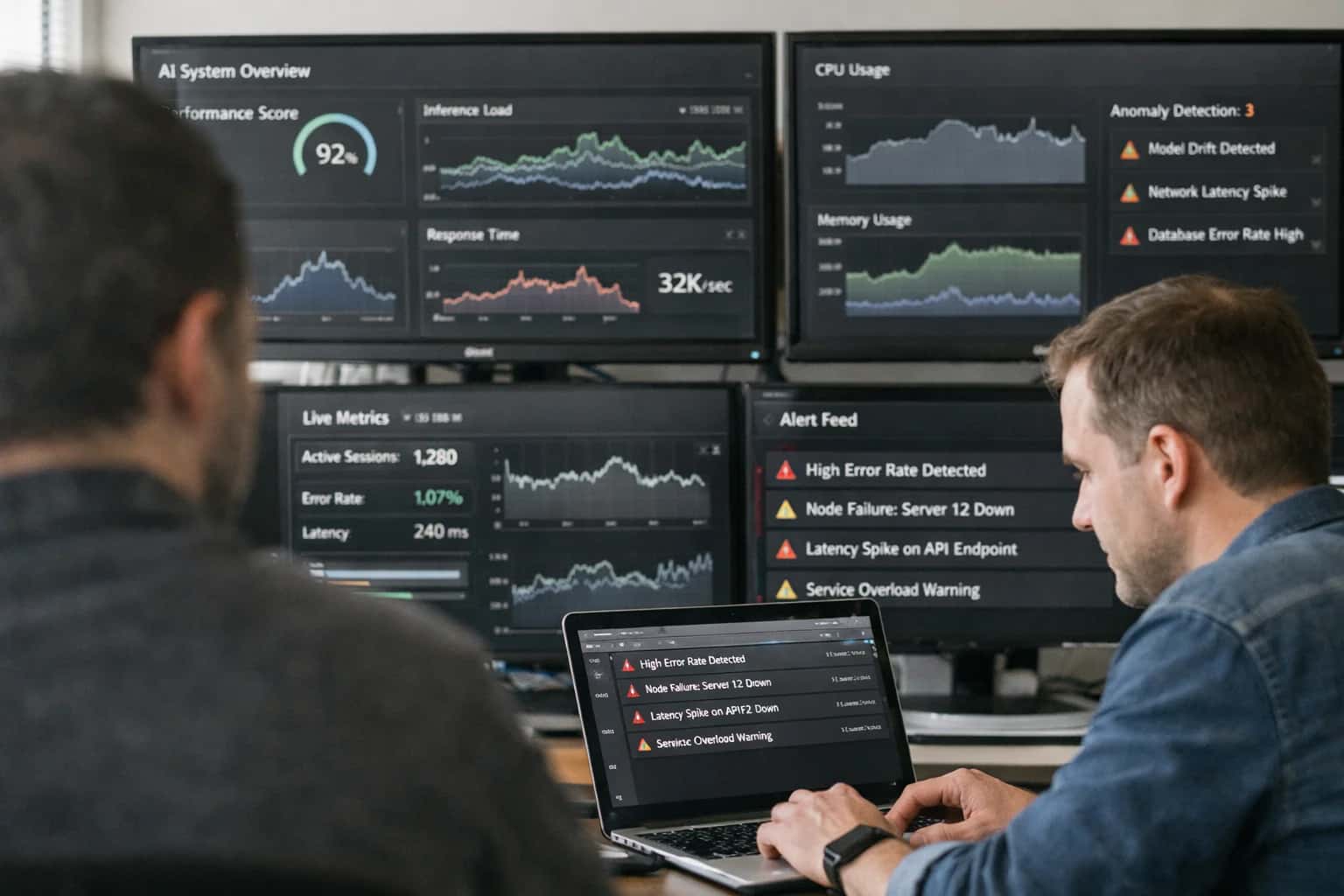
A technical comparison of Deepchecks and Evidently AI for generating review reports on model and data quality. We analyze continuous validation suites versus drift detection dashboards to help MLOps teams and AI engineering leads choose the right tool for their monitoring stack.
THE ANALYSIS
Introduction
A data-driven comparison of Deepchecks and Evidently AI for generating review reports that reduce the human burden in model validation and monitoring.
Evidently AI takes a different approach by focusing on interactive, human-readable reports and dashboards designed for exploratory analysis. Instead of just pass/fail tests, it generates rich HTML reports with drift visualizations, data distribution graphs, and model performance metrics. This results in a lower barrier to entry for non-engineering stakeholders but a higher manual review burden, as a data scientist must interpret the dashboard to diagnose the root cause of a detected drift.
The key trade-off: If your priority is automating the review process and integrating validation into a CI/CD pipeline to minimize human checks, choose Deepchecks. If you prioritize rich, visual context for a human-led review process where stakeholders need to explore the 'why' behind model degradation, choose Evidently AI. The decision hinges on whether you want to replace the reviewer with a script or empower them with a better lens.
HEAD-TO-HEAD COMPARISON
Feature Comparison Matrix
Direct comparison of key metrics and features for validation report generation.
| Metric | Deepchecks | Evidently AI |
|---|---|---|
Primary Focus | Continuous Validation Suites | Drift Detection & Monitoring |
Report Generation Trigger | Scheduled/CI/CD Pipeline | Scheduled/Ad-hoc Analysis |
Data Drift Detection | ||
Model Performance Monitoring | ||
Data Integrity Checks | ||
Segmented Performance Analysis | ||
Pre-built Test Suites | 50+ checks | 30+ metrics & tests |
Deployment | On-prem/Private Cloud | Open-source/SaaS |
Deepchecks vs Evidently AI
TL;DR Summary
Deepchecks excels at continuous validation during development, while Evidently AI specializes in post-deployment monitoring and drift analysis. Your choice hinges on whether you need a pre-production safety net or a production observability platform.
01
Choose Deepchecks for CI/CD Validation
Deepchecks is purpose-built for the MLOps pipeline. It integrates directly with CI/CD workflows to run automated test suites on data integrity, model performance, and train-test distribution every time you commit code.
- Key Strength: Catches data leakage, label drift, and segment performance issues before they hit production.
- Best For: Teams practicing continuous training (CT) who need automated gates to prevent bad model updates.
- Trade-off: Less mature for real-time production monitoring dashboards compared to dedicated observability tools.
02
Choose Evidently AI for Production Drift Monitoring
Evidently AI is an observability-first platform designed to generate detailed HTML reports and dashboards on data drift, target drift, and model quality degradation in live environments.
- Key Strength: Requires no ground truth to estimate performance degradation, using sophisticated drift detection algorithms.
- Best For: Operations teams needing to trigger alerts and generate stakeholder-friendly reports on model health without waiting for labels.
- Trade-off: Its pre-deployment validation suite is less opinionated and integrated into CI/CD than Deepchecks' dedicated checks.
03
Choose Deepchecks for Tabular & CV-Specific Checks
Deepchecks offers highly specialized, domain-specific checks for tabular data and computer vision models, going beyond generic drift metrics.
- Key Strength: Includes checks for weak segments, calibration, and property-label correlations in CV datasets.
- Best For: Data scientists who need granular, test-driven validation of model assumptions during research and development.
- Trade-off: Its report generation is more developer-centric, requiring more customization for business stakeholder presentations.
04
Choose Evidently AI for Business-Ready Reports
Evidently AI generates polished, interactive HTML reports that are easily shareable with non-technical stakeholders, making it a superior tool for cross-functional communication.
- Key Strength: Pre-built report templates for data drift, classification performance, and regression performance that require minimal code to generate.
- Best For: ML engineers who need to provide regular, automated model health updates to product managers and compliance teams.
- Trade-off: Its programmatic API for custom checks is less extensive than Deepchecks' suite of specific validation tests.
HEAD-TO-HEAD COMPARISON
Performance and Scalability Benchmarks
Direct comparison of key metrics and features for Deepchecks and Evidently AI review report generation.
| Metric | Deepchecks | Evidently AI |
|---|---|---|
Core Validation Approach | Continuous Testing (Suite-based) | Monitoring & Drift Detection |
Report Generation Speed (10K rows) | < 5 sec | < 3 sec |
Drift Detection Methods | 5+ (PSI, KS, Earth Mover's) | 4+ (Wasserstein, Jensen-Shannon) |
Built-in Alerting | ||
On-Premise Deployment | ||
Open Source License | AGPL-3.0 | Apache 2.0 |
Integration Complexity | Medium (Python SDK) | Low (JSON/CLI) |
Enabling Efficiency, Speed & Accuracy
Intelligent Analysis, Decision & Execution
We build AI systems for teams that need search across company data, workflow automation across tools, or AI features inside products and internal software.
Talk to Us
Search across company data
Give teams answers from docs, tickets, runbooks, and product data with sources and permissions.
Useful when people spend too long searching or get different answers from different systems.
Enterprise searchRAGPermissions
Read more
Automate internal workflows
Use AI to route work, draft outputs, trigger actions, and keep approvals and logs in place.
Useful when repetitive work moves across multiple tools and teams.
AI agentsWorkflow automationGovernance
Read more
Add AI to products and internal tools
Build assistants, guided actions, or decision support into the software your team or customers already use.
Useful when AI needs to be part of the product, not a separate tool.
AI integrationDecision supportModel routing
Read moreCHOOSE YOUR PRIORITY
When to Choose Deepchecks vs Evidently AI
Deepchecks for Continuous Validation
Strengths: Deepchecks excels at automated, code-first validation suites that run in CI/CD pipelines. Its strength lies in defining explicit checks for data integrity, train-test drift, and model performance that block deployments when violations occur.
Key Differentiators:
- Suite-based architecture: Pre-built suites for tabular, NLP, and CV tasks
- CI/CD native: Direct integration with GitHub Actions, Jenkins, and Airflow
- Custom check authoring: Python SDK for writing domain-specific validation logic
- Serializable results: JSON output for programmatic gating decisions
Verdict: Choose Deepchecks when you need automated gates in your MLOps pipeline that prevent bad models from reaching production without human review.
Evidently AI for Continuous Validation
Strengths: Evidently AI focuses on generating rich, human-readable reports and dashboards that explain why drift or degradation occurred. It prioritizes stakeholder communication over automated gating.
Key Differentiators:
- Interactive HTML reports: Shareable dashboards for non-technical stakeholders
- Preset drift detection: Statistical tests for data drift, target drift, and prediction drift
- Monitoring dashboard: Live service for tracking multiple models over time
- JSON + HTML output: Both programmatic access and visual storytelling
Verdict: Choose Evidently AI when you need stakeholder-facing reports that explain model health to product managers, compliance officers, or clients.
THE ANALYSIS
Verdict
A direct comparison of Deepchecks and Evidently AI for generating review reports, focusing on the trade-off between structured validation suites and interactive drift dashboards.
Deepchecks excels at continuous validation for structured model and data quality testing because it integrates directly into CI/CD pipelines. Its strength lies in pre-production guardrails: running predefined suites that check for data integrity, train-test contamination, and model performance degradation before deployment. For example, a financial services team can use Deepchecks to automatically block a model release if the Feature Drift score exceeds a 0.2 threshold, ensuring no regressions slip into production without explicit review.
Evidently AI takes a different approach by focusing on post-production monitoring and interactive report generation. It specializes in generating rich HTML dashboards that visualize data drift, target drift, and model quality over time. This results in a lower barrier to entry for ad-hoc analysis and stakeholder sharing. A product manager can easily interpret an Evidently report showing a 15% increase in prediction drift after a new user segment was onboarded, without needing to run a Python script.
The key trade-off: If your priority is automated, programmatic validation within an MLOps pipeline to enforce strict quality gates, choose Deepchecks. If you prioritize generating shareable, visually rich reports for exploratory drift analysis and cross-functional stakeholder review, choose Evidently AI. Deepchecks is better for engineering teams preventing bad deployments; Evidently AI is better for data science teams diagnosing why model behavior changed in production.

About the author
Prasad Kumkar
CEO & MD, Inference Systems
Prasad Kumkar is the CEO & MD of Inference Systems and writes about AI systems architecture, LLM infrastructure, model serving, evaluation, and production deployment. Over 5+ years, he has worked across computer vision models, L5 autonomous vehicle systems, and LLM research, with a focus on taking complex AI ideas into real-world engineering systems.
His work and writing cover AI systems, large language models, AI agents, multimodal systems, autonomous systems, inference optimization, RAG, evaluation, and production AI engineering.
LinkedIn
Limited slotsGet a Free AI Consultation
Partnered with leading AI, data, and software stack.





How We Work
Custom AI workflows for your Business
One-fit-all AI don't work for modern businesses. At Inferensys, we aim to understand your business & custom requirements; which we use to define most efficient agentic workflows, the data, and the tools for your business.
01
Review the use case
We understand the task, the users, and where AI can actually help.
Read more02
Pick the right approach
We define what needs search, automation, or product integration.
Read more03
Build the first useful version
We implement the part that proves the value first.
Read more04
Improve from there
We add the checks and visibility needed to keep it useful.
Read moreThe first call is a practical review of your use case and the right next step.
Talk to Us