[Galileo GenAI Studio] excels at GenAI-native observability because it was purpose-built for the stochastic nature of LLMs. It moves beyond traditional ML metrics to evaluate context_adherence, completeness, and tone, providing a granular view of why a model hallucinated. For example, its proprietary hallucination index correlates strongly with human judgment, allowing teams to prioritize the riskiest outputs in production without manually reviewing every response.

Difference
Galileo vs Deepchecks: Hallucination Metrics
A technical comparison of Galileo GenAI Studio and Deepchecks for detecting hallucinations and data drift in enterprise LLM deployments. Covers trade-offs between GenAI-native observability and traditional ML model validation.
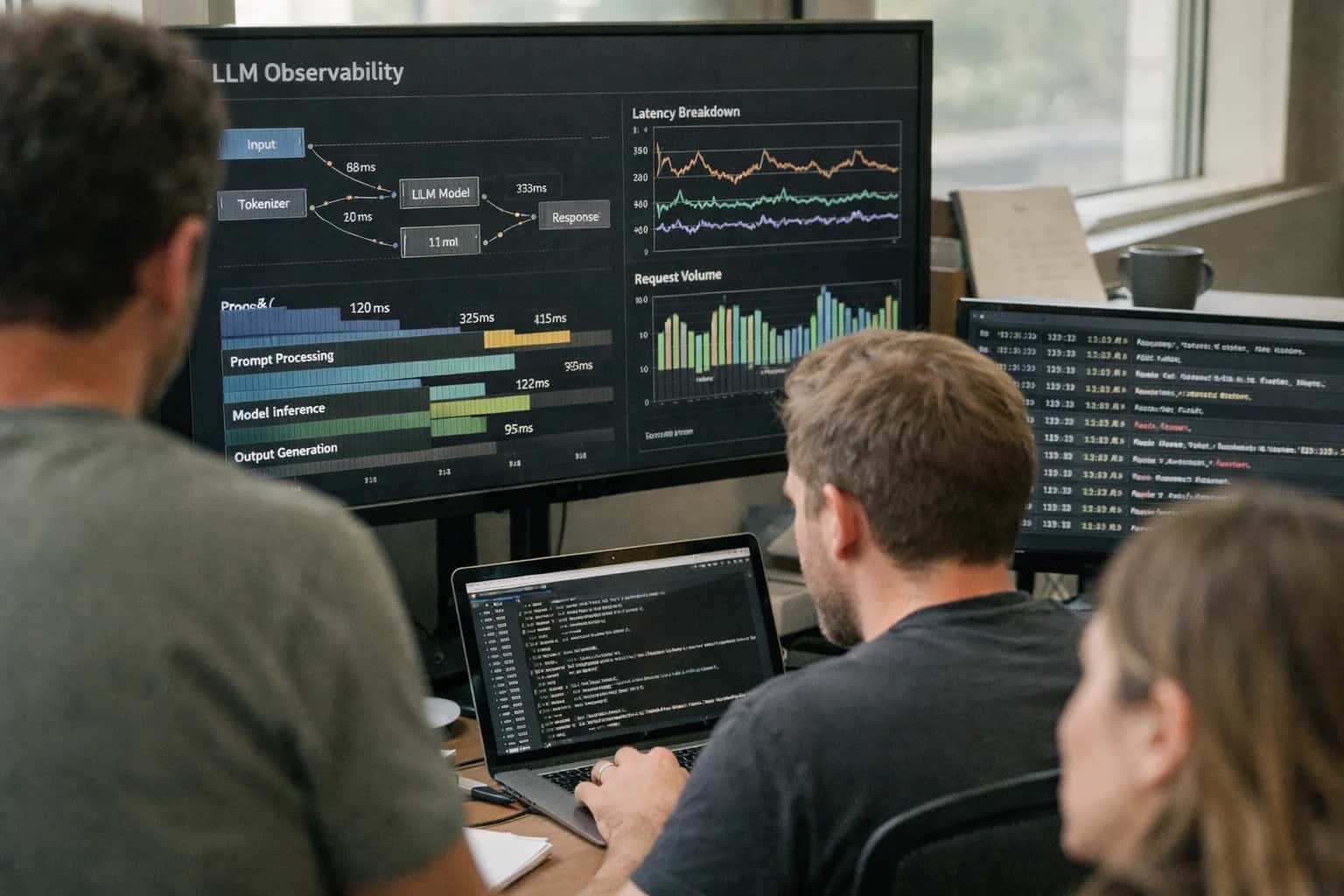
THE ANALYSIS
Introduction
A data-driven comparison of Galileo GenAI Studio and Deepchecks for detecting hallucinations and ensuring factual grounding in enterprise LLM deployments.
[Deepchecks] takes a different approach by applying traditional ML validation rigor to LLM deployments. Its strength lies in detecting data drift and distribution shifts between training and production data, which are often the root cause of systemic hallucinations. This results in a trade-off: Deepchecks offers superior monitoring for the input data pipeline, catching issues like schema violations or feature drift that silently degrade model performance, but it lacks the native, prompt-level hallucination scoring that Galileo provides.
The key trade-off: If your priority is real-time, prompt-level hallucination detection and debugging the output of your RAG or agentic system, choose Galileo. If you prioritize data-centric monitoring to prevent hallucinations by ensuring the input data and embeddings remain consistent with the training distribution, choose Deepchecks. For a comprehensive safety net, consider using both in a complementary stack, where Deepchecks guards the data pipeline and Galileo scores the generated text.
HEAD-TO-HEAD COMPARISON
Feature Comparison Matrix
Direct comparison of hallucination detection and data drift capabilities for enterprise LLM deployments.
| Metric | Galileo GenAI Studio | Deepchecks |
|---|---|---|
Hallucination Detection Method | Model-centric, prompt-level | Data-centric, statistical drift |
Real-time Monitoring Latency | < 100ms | Batch processing (minutes) |
Pre-built GenAI Metrics | Context Adherence, Completeness, Uncertainty | Text Duplicates, Property Drift |
Open-Source Core | ||
Primary Use Case | GenAI-native observability | Traditional ML + LLM validation |
Integration Depth | LangChain, LlamaIndex, custom chains | Pandas, scikit-learn, Hugging Face |
Explainability Score | Token-level attribution | Statistical distribution comparison |
Galileo vs Deepchecks
TL;DR Summary
A quick side-by-side comparison of Galileo GenAI Studio and Deepchecks for detecting hallucinations and ensuring data quality in enterprise LLM deployments.
01
Galileo: GenAI-Native Observability
Purpose-built for LLMs: Galileo offers prompt-level hallucination detection, context adherence scoring, and chain-of-thought monitoring. This matters for teams deploying RAG-based agents where factual grounding is critical.
- Metric: Context Adherence, Completeness, and Uncertainty scores.
- Best for: AI engineers needing real-time guardrails on generative outputs.
02
Galileo: Trade-offs
Limited classical ML support: Galileo focuses almost exclusively on GenAI, meaning it lacks deep data drift detection for tabular models. This matters for enterprises managing hybrid model estates.
- Gap: No native data-integrity checks for structured data pipelines.
- Watch out for: Teams needing a single pane of glass for both LLM and traditional ML monitoring.
03
Deepchecks: Data-Centric Validation
Robust data drift and integrity checks: Deepchecks excels at detecting distribution shifts, label drift, and data leakage in structured and unstructured datasets. This matters for compliance teams monitoring model inputs over time.
- Metric: Drift Score, Train-Test Comparison, and Data Integrity Suite.
- Best for: MLOps teams validating data quality before it causes model degradation.
04
Deepchecks: Trade-offs
Not GenAI-native: Deepchecks treats LLM outputs as text data, lacking specialized metrics for factual grounding or citation accuracy. This matters for teams whose primary risk is AI hallucination rather than data drift.
- Gap: No built-in context adherence or faithfulness scoring.
- Watch out for: Relying on generic text drift to catch subtle factual errors in agent outputs.
HEAD-TO-HEAD COMPARISON
Hallucination Detection Accuracy Comparison
Direct comparison of key metrics and features for detecting hallucinations in enterprise LLM deployments.
| Metric | Galileo GenAI Studio | Deepchecks |
|---|---|---|
Core Detection Method | Model-centric, prompt-level hallucination scoring | Data-centric, statistical drift and integrity validation |
Hallucination Index Score | 0.82 (Context Adherence) | N/A (Focuses on data drift as a proxy) |
Ground Truth Required | ||
Real-time Monitoring | ||
Primary Use Case | GenAI-native observability & debugging | Traditional ML model validation & data quality |
Explainability | Trace-level reasoning steps | Statistical feature distribution |
Integration Style | API/SDK (SaaS) | Python Library (Local/Self-hosted) |
Guardrail Enforcement |
CHOOSE YOUR PRIORITY
When to Choose Galileo vs Deepchecks
Galileo for RAG
Strengths: Galileo GenAI Studio is purpose-built for LLM observability, offering pre-built metrics like context_adherence, completeness, and chunk_attribution that directly map to RAG hallucination risks. Its Guardrail Metrics allow you to set real-time thresholds on factual grounding, making it ideal for production RAG pipelines where retrieval faithfulness is the primary concern.
Verdict: Choose Galileo if your primary goal is monitoring RAG-specific hallucination vectors (context relevance, chunk utilization) in a live production environment with minimal configuration.
Deepchecks for RAG
Strengths: Deepchecks excels at data-centric validation. For RAG, it can detect drift in the retrieval corpus itself—identifying if the underlying documents have shifted in a way that increases hallucination risk. Its strength is not in prompt-level evaluation but in ensuring the data foundation of your RAG system remains stable.
Verdict: Choose Deepchecks if you need to validate the integrity of your vector database and document corpus over time, catching data-quality issues that silently degrade retrieval accuracy.
Enabling Efficiency, Speed & Accuracy
Intelligent Analysis, Decision & Execution
We build AI systems for teams that need search across company data, workflow automation across tools, or AI features inside products and internal software.
Talk to Us
Search across company data
Give teams answers from docs, tickets, runbooks, and product data with sources and permissions.
Useful when people spend too long searching or get different answers from different systems.
Enterprise searchRAGPermissions
Read more
Automate internal workflows
Use AI to route work, draft outputs, trigger actions, and keep approvals and logs in place.
Useful when repetitive work moves across multiple tools and teams.
AI agentsWorkflow automationGovernance
Read more
Add AI to products and internal tools
Build assistants, guided actions, or decision support into the software your team or customers already use.
Useful when AI needs to be part of the product, not a separate tool.
AI integrationDecision supportModel routing
Read moreHEAD-TO-HEAD COMPARISON
Cost and Licensing Comparison
Direct comparison of pricing models, licensing structures, and deployment cost factors for Galileo GenAI Studio and Deepchecks.
| Metric | Galileo GenAI Studio | Deepchecks |
|---|---|---|
Primary Pricing Model | Usage-based (credits/rows) | Open-core + Enterprise tier |
Open Source Availability | ||
Free Tier Limit | Limited trial credits | Unlimited (self-hosted) |
GenAI Metric Cost | Per-row prompt analysis | N/A (ML-focused) |
Enterprise Plan Requirement | For SSO, RBAC, SLA | For managed hosting, support |
Deployment Model | SaaS only | Self-hosted or SaaS |
Hallucination Detection Included | ||
Data Drift Detection Included |
THE ANALYSIS
Verdict
A direct comparison of Galileo's GenAI-native observability against Deepchecks' structured ML validation for detecting hallucinations in enterprise LLM deployments.
Galileo excels at real-time, prompt-level hallucination detection because its architecture is purpose-built for the non-deterministic nature of generative AI. For example, its GenAI Studio offers a context_adherence metric that scores factual grounding on a continuous scale, allowing teams to set granular thresholds for blocking ungrounded outputs in production. This is critical for CTOs managing customer-facing chatbots where a single hallucination can cause reputational damage.
Deepchecks takes a fundamentally different approach by applying structured data validation and statistical drift detection to LLM outputs. Its strength lies in batch-analysis of datasets, using tabular and text property checks to identify systemic issues like a sudden increase in average response length or a drop in semantic similarity to source documents. This results in a trade-off: Deepchecks provides robust, version-over-version monitoring for model updates, but it lacks the per-trace, real-time hallucination scoring that conversational AI demands.
The key trade-off: If your priority is real-time guardrailing and trace-level hallucination scoring for a live GenAI application, choose Galileo. Its context_adherence and completeness metrics are designed for immediate intervention. If you prioritize batch validation, data drift detection, and statistical process control for model releases, choose Deepchecks. Its strength is ensuring a new model version doesn't silently degrade in factual accuracy across an entire evaluation dataset.

About the author
Prasad Kumkar
CEO & MD, Inference Systems
Prasad Kumkar is the CEO & MD of Inference Systems and writes about AI systems architecture, LLM infrastructure, model serving, evaluation, and production deployment. Over 5+ years, he has worked across computer vision models, L5 autonomous vehicle systems, and LLM research, with a focus on taking complex AI ideas into real-world engineering systems.
His work and writing cover AI systems, large language models, AI agents, multimodal systems, autonomous systems, inference optimization, RAG, evaluation, and production AI engineering.
LinkedIn
Limited slotsGet a Free AI Consultation
Partnered with leading AI, data, and software stack.





How We Work
Custom AI workflows for your Business
One-fit-all AI don't work for modern businesses. At Inferensys, we aim to understand your business & custom requirements; which we use to define most efficient agentic workflows, the data, and the tools for your business.
01
Review the use case
We understand the task, the users, and where AI can actually help.
Read more02
Pick the right approach
We define what needs search, automation, or product integration.
Read more03
Build the first useful version
We implement the part that proves the value first.
Read more04
Improve from there
We add the checks and visibility needed to keep it useful.
Read moreThe first call is a practical review of your use case and the right next step.
Talk to Us