
Differences
Latency Breakdown and Bottleneck Detection
Latency Breakdown and Bottleneck Detection
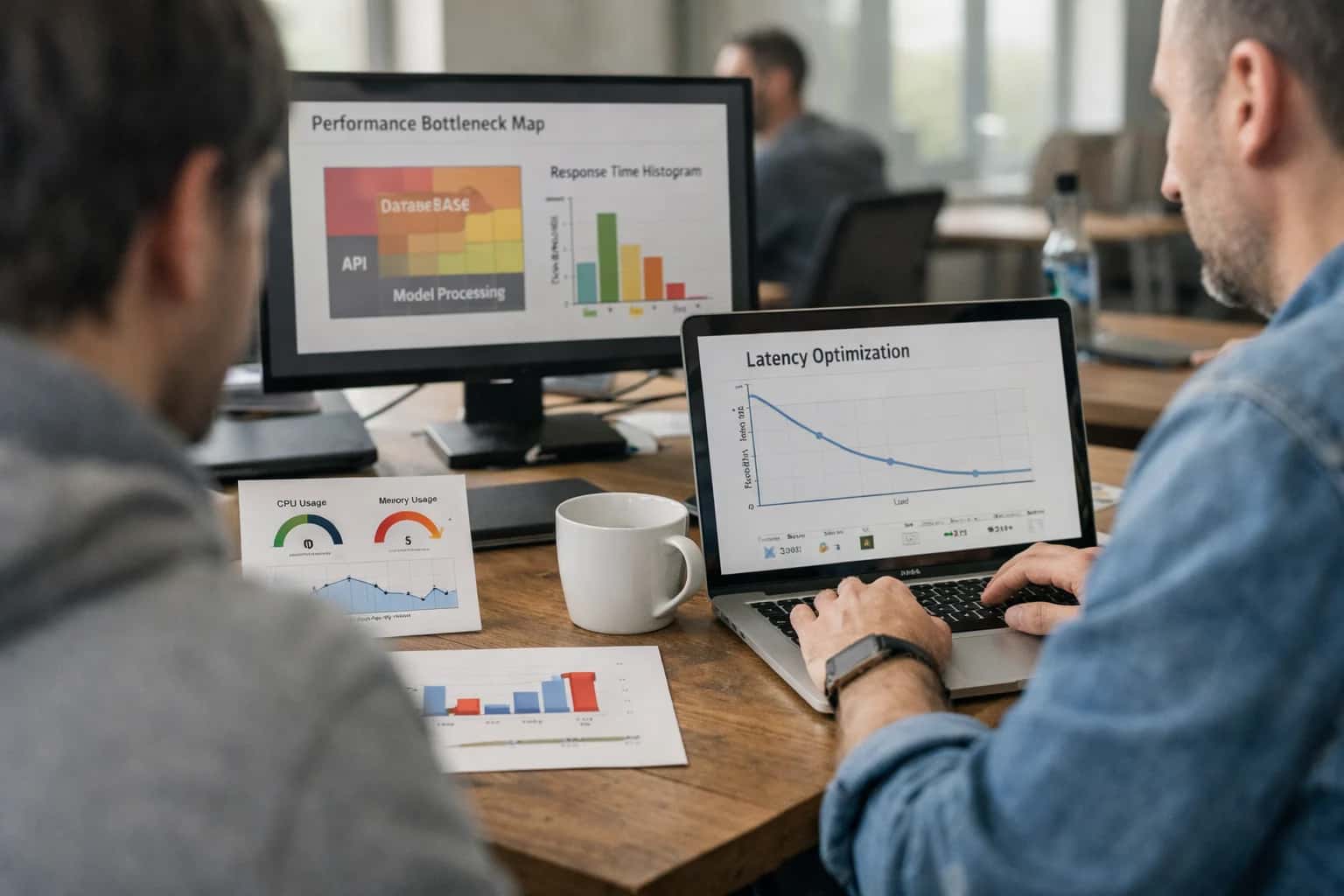
Comparisons related to agent step latency analysis, bottleneck detection, and model call performance profiling. Target: Performance engineers optimizing agent response times.
LangSmith vs Arize Phoenix: Agent Step Latency
Compare LangSmith and Arize Phoenix for tracing and profiling latency at each step of an agent workflow. Evaluate their ability to pinpoint bottlenecks in LLM calls, tool executions, and reasoning loops, focusing on trace visualization and root-cause analysis for performance engineers.
Datadog LLM Observability vs New Relic AI Monitoring
A head-to-head comparison of Datadog and New Relic for monitoring AI agent performance. Analyze their capabilities in end-to-end latency tracking, bottleneck detection across distributed agent services, and integration with existing infrastructure monitoring for SRE teams.
OpenTelemetry Agent Tracing vs Custom Span Ingestion Pipelines
Evaluate the trade-offs between using a standardized framework like OpenTelemetry and building a custom pipeline for ingesting agent spans. Compare implementation overhead, flexibility for custom agent attributes, and long-term maintainability for latency breakdown analysis.
Honeycomb vs Grafana Tempo: High-Cardinality Agent Traces
Compare Honeycomb and Grafana Tempo for analyzing high-cardinality data from agent workflows. Focus on their ability to query and visualize latency across thousands of unique tool calls, model parameters, and user sessions to identify performance outliers.
SigNoz vs HyperDX: Open-Source Agent Observability
An open-source showdown between SigNoz and HyperDX for agent latency monitoring. Compare their tracing UIs, bottleneck detection features, alerting on p99 latency, and total cost of ownership for teams avoiding vendor lock-in.
Helicone vs Lunary: LLM Gateway Latency Monitoring
Compare Helicone and Lunary specifically for monitoring latency introduced at the LLM gateway layer. Evaluate their granularity in tracking time-to-first-token, model provider latency, and caching effectiveness for high-volume agent deployments.
Portkey vs Langfuse: Model Call Performance Profiling
Analyze Portkey and Langfuse for profiling the performance of individual model calls within an agent. Compare their features for breaking down latency by model, prompt, and parameters, and their ability to optimize routing and fallback strategies.
Pyroscope vs Parca: Continuous Agent CPU Profiling
Compare Pyroscope and Parca for continuous profiling of agent code to find CPU-bound bottlenecks. Evaluate their effectiveness in pinpointing inefficient functions, memory allocation issues, and framework overhead that contribute to end-to-end latency.
Grafana k6 vs Locust: Agent API Load Testing Bottlenecks
A comparison of Grafana k6 and Locust for load testing agent APIs to identify performance bottlenecks under stress. Analyze their scripting flexibility, protocol support (HTTP, WebSocket), and reporting to determine maximum throughput and breaking points.
GPT-4o vs Claude 3.5 Sonnet: Time-to-First-Token Latency
Benchmark GPT-4o against Claude 3.5 Sonnet for time-to-first-token (TTFT) latency, a critical metric for perceived agent responsiveness. Compare performance across different prompt lengths and output types to guide model selection for latency-sensitive agent steps.
vLLM vs TensorRT-LLM: High-Throughput Serving Bottlenecks
Compare vLLM and TensorRT-LLM for serving open-source models in high-throughput agent environments. Analyze their memory management, continuous batching efficiency, and token generation speed to identify the optimal inference engine for minimizing queueing delays.
Groq LPU vs NVIDIA H100: Token Generation Throughput
A hardware-level comparison of Groq's LPU inference engine against NVIDIA H100 GPUs for agent workloads. Focus on tokens-per-second throughput, batch processing capabilities, and cost-per-million-tokens to determine the most efficient architecture for latency-critical applications.
Redis vs Dragonfly: Agent Semantic Cache Retrieval Speed
Evaluate Redis and Dragonfly as a semantic cache layer for agents. Compare their sub-millisecond data retrieval speeds, scalability under high connection counts, and impact on reducing latency for repeated or similar agent queries.
Pinecone vs Qdrant: Vector Search p99 Latency in Agents
Benchmark Pinecone and Qdrant on p99 latency for vector search operations within RAG-based agents. Compare their performance under scale with different index types and filtering complexity to identify bottlenecks in the retrieval step of an agent workflow.
Temporal vs AWS Step Functions: Long-Running Agent Workflow Delays
Compare Temporal and AWS Step Functions for orchestrating long-running, multi-step agent workflows. Analyze the overhead each platform introduces for task scheduling, state management, and signaling, and its impact on end-to-end workflow completion time.
Modal vs Banana Dev: Serverless GPU Cold Start Analysis
A comparison of Modal and Banana Dev focusing on GPU cold start times for serverless agent inference. Measure the latency from request to first token for containerized models, a critical factor for scaling agent workloads on demand without pre-warming costs.
Streaming Token Generation vs Batch Response: Perceived User Latency
Analyze the impact of streaming vs. batch token generation on perceived user latency in agent applications. Compare time-to-first-token, user wait times, and overall task completion speed to determine the best approach for interactive agent experiences.
ReAct Agent Loop vs Plan-and-Execute Agent: End-to-End Task Speed
Compare the end-to-end task completion speed of a ReAct (Reason+Act) agent loop against a Plan-and-Execute architecture. Analyze the latency overhead of iterative reasoning and tool calls versus upfront planning to guide architectural decisions for time-sensitive tasks.
Partnered with leading AI, data, and software stack.





How We Work
Custom AI workflows for your Business
One-fit-all AI don't work for modern businesses. At Inferensys, we aim to understand your business & custom requirements; which we use to define most efficient agentic workflows, the data, and the tools for your business.
01
Review the use case
We understand the task, the users, and where AI can actually help.
Read more02
Pick the right approach
We define what needs search, automation, or product integration.
Read more03
Build the first useful version
We implement the part that proves the value first.
Read more04
Improve from there
We add the checks and visibility needed to keep it useful.
Read moreThe first call is a practical review of your use case and the right next step.
Talk to Us