
Differences
Agent Replay and Regression Testing
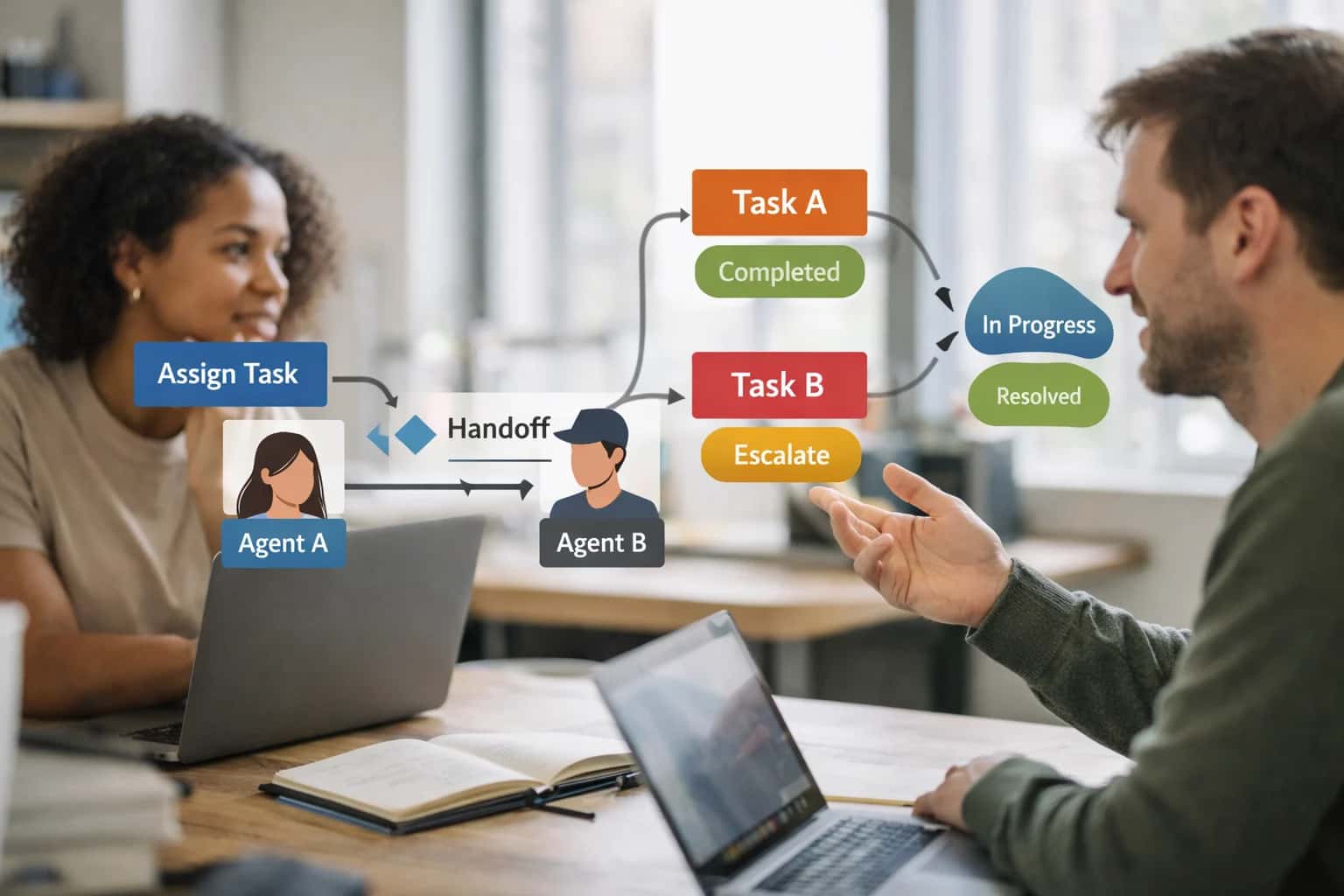
Agent Replay and Regression Testing
Comparisons related to deterministic agent replay engines, workflow regression suites, and golden test set management. Target: QA directors and MLOps engineers preventing agent degradation.
LangSmith vs Arize Phoenix: Agent Regression Testing
Compares LangSmith's native LangChain tracing and dataset replay against Arize Phoenix's open-source span ingestion and evaluation framework for detecting agent workflow degradation. Focuses on deterministic replay fidelity, golden test set management, and integration with CI/CD pipelines for MLOps teams.
Galileo Agentic Evaluations vs Braintrust: Workflow Regression Suites
Evaluates Galileo's hallucination and quality scoring against Braintrust's eval-driven development platform for agent regression testing. Compares custom metric definition, human review queues, and the ability to catch policy violations before production deployment.
AgentOps vs LangFuse: Replay Engine Capabilities
Compares AgentOps's session replay and debugging interface against LangFuse's open-source tracing and evaluation backend. Focuses on execution path reconstruction, step-by-step state inspection, and the cost of storing full agent trajectories for compliance and QA.
Deepchecks vs WhyLabs: Agent Behavior Drift Detection
Compares Deepchecks' structured validation and testing approach against WhyLabs' statistical monitoring for detecting silent agent degradation. Focuses on continuous regression testing, distribution drift in tool-call patterns, and integration with existing MLOps pipelines.
Fiddler AI vs Arize Phoenix: Explainable Agent Auditing
Compares Fiddler's explainability and fairness monitoring against Arize's trace-based evaluation for auditing agent decisions. Focuses on root cause analysis of unexpected tool calls, bias detection in agent trajectories, and generating audit-ready reports for compliance teams.
Datadog LLM Observability vs LangSmith: Production Agent Monitoring
Compares Datadog's infrastructure-centric LLM monitoring against LangSmith's application-centric tracing for agent regression testing. Focuses on correlating agent performance with system metrics, SLO tracking, and the trade-off between operational visibility and workflow-level debugging.
Weights & Biases Prompts vs LangFuse: Prompt Regression Testing
Compares W&B Prompts' prompt versioning and evaluation against LangFuse's prompt management and tracing for agent regression suites. Focuses on A/B testing prompt changes, tracking prompt drift impact on agent success rates, and integrating prompt experiments into CI/CD.
Braintrust vs Deepchecks: Eval-Driven Agent Development
Compares Braintrust's experiment tracking and eval logging against Deepchecks' validation-first approach for agent testing. Focuses on custom scorer implementation, synthetic test case generation, and the workflow for shipping agent updates without regressions.
LangSmith vs Galileo Agentic Evaluations: Trajectory Scoring
Compares LangSmith's user feedback and annotation queues against Galileo's automated quality metrics for scoring agent trajectories. Focuses on the balance between human evaluation cost and automated metric reliability for preventing workflow degradation.
Arize Phoenix vs Datadog LLM Observability: Open-Source vs SaaS
Compares Arize Phoenix's open-source, self-hosted tracing against Datadog's fully managed SaaS platform for agent observability. Focuses on data residency requirements, total cost of ownership at scale, and the depth of agent-specific replay features available in each model.
AgentOps vs Braintrust: Session Replay vs Eval Suites
Compares AgentOps's visual session replay and debugging against Braintrust's structured evaluation framework for agent QA. Focuses on the speed of debugging a single failed agent run versus systematically preventing regressions across a test suite.
WhyLabs vs Fiddler AI: Statistical vs Explainable Monitoring
Compares WhyLabs' statistical anomaly detection for agent behavior against Fiddler's explainability-first monitoring. Focuses on detecting subtle data drift in agent inputs versus explaining why a specific agent decision violated policy for regulated industry compliance.
Deepchecks vs Galileo Agentic Evaluations: Structured Validation vs Automated Scoring
Compares Deepchecks' tabular and structured data validation against Galileo's LLM-native quality scoring for agent regression. Focuses on testing deterministic agent components versus evaluating the quality of free-form reasoning steps in complex workflows.
LangSmith vs AgentOps: Trace Debugging vs Session Replay
Compares LangSmith's detailed span-level tracing against AgentOps's high-fidelity session replay for debugging agent failures. Focuses on the granularity needed for root cause analysis versus the speed of visually reconstructing a multi-step agent execution.
Partnered with leading AI, data, and software stack.





How We Work
Custom AI workflows for your Business
One-fit-all AI don't work for modern businesses. At Inferensys, we aim to understand your business & custom requirements; which we use to define most efficient agentic workflows, the data, and the tools for your business.
01
Review the use case
We understand the task, the users, and where AI can actually help.
Read more02
Pick the right approach
We define what needs search, automation, or product integration.
Read more03
Build the first useful version
We implement the part that proves the value first.
Read more04
Improve from there
We add the checks and visibility needed to keep it useful.
Read moreThe first call is a practical review of your use case and the right next step.
Talk to Us