Custom Supply Chain AI excels at deep, proprietary optimization for unique, high-value workflows because it is built from the ground up on your specific data and constraints. For example, a custom reinforcement learning model for multi-echelon inventory can achieve 99.5% forecast accuracy for a niche product line, directly optimizing for your unique cost and service-level trade-offs. This approach, often led by firms like RTS Labs, provides a defensible competitive advantage but requires significant investment in data engineering, MLOps, and ongoing maintenance.

Comparison
Custom Supply Chain AI vs. o9 Solutions AI Platform
A technical decision framework for CTOs and engineering leads evaluating a fully custom AI stack against the integrated planning and AI co-pilot capabilities of the o9 Solutions platform for digital supply chain transformation.
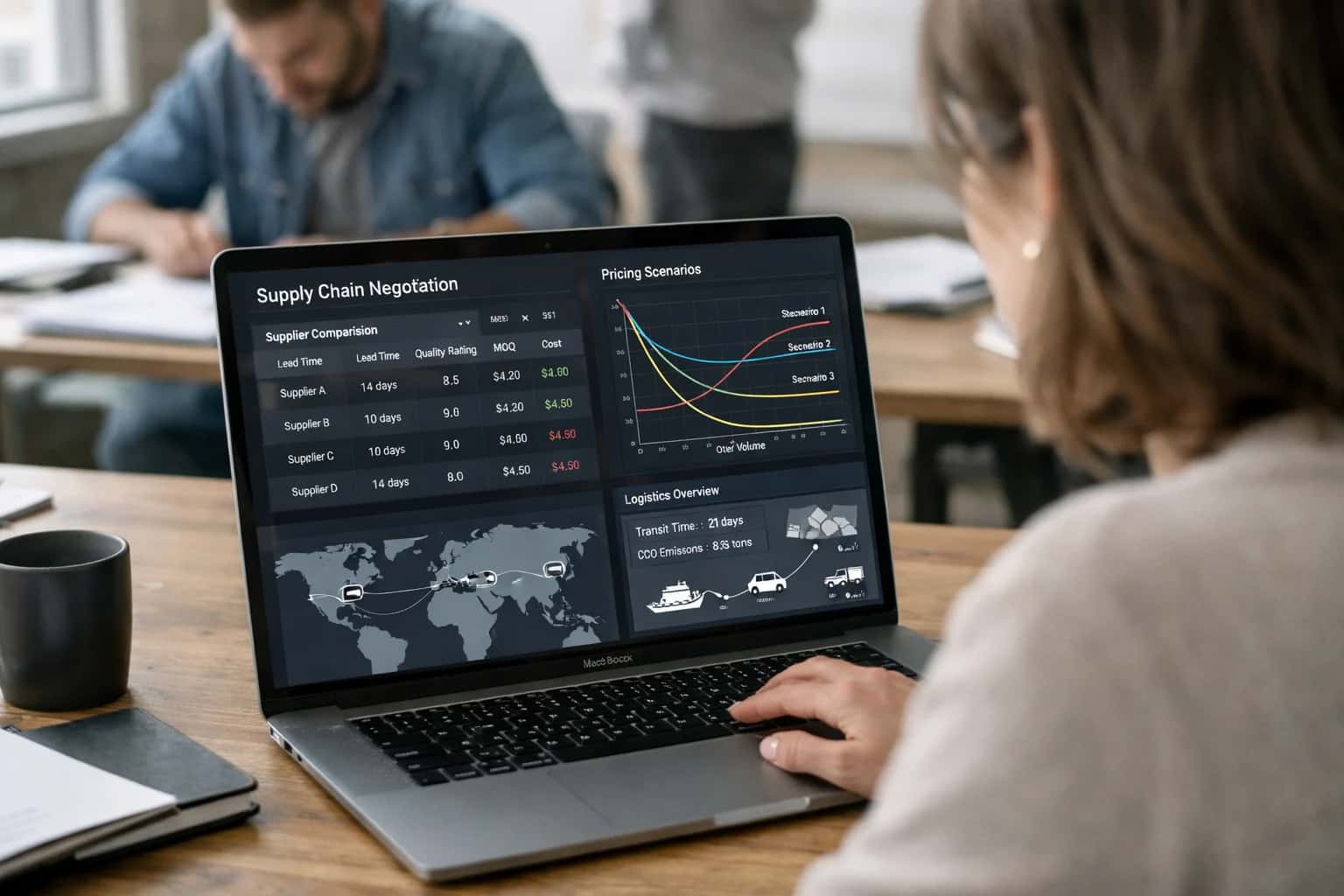
THE ANALYSIS
Introduction
A decision framework for enterprises choosing between a fully custom AI stack and the integrated planning, analytics, and AI co-pilot capabilities of the o9 Solutions platform.
The o9 Solutions AI Platform takes a different approach by offering an integrated, pre-built digital brain for supply chain planning. Its strategy combines a unified data layer with embedded AI co-pilots for demand sensing, scenario simulation, and S&OP. This results in a faster time-to-value (often operational in 6-9 months) and lower initial development cost, but trades off some degree of flexibility, as you must work within the platform's defined data model and algorithmic frameworks for core planning functions.
The key trade-off: If your priority is owning a unique, high-performance AI capability that is a core differentiator for your business (e.g., a novel dynamic routing algorithm or a proprietary supplier risk score), choose a Custom AI approach. If you prioritize accelerated, enterprise-wide deployment of AI-augmented planning with robust simulation and collaboration tools out-of-the-box, choose the o9 Solutions Platform. For more on the foundational technologies powering these systems, explore our pillar on LLMOps and Observability Tools and Knowledge Graph and Semantic Memory Systems.
HEAD-TO-HEAD COMPARISON
Custom Supply Chain AI vs. o9 Solutions AI Platform
Direct comparison of key metrics and features for supply chain planning and analytics.
| Metric | Custom Supply Chain AI | o9 Solutions AI Platform |
|---|---|---|
Time to Deploy Core Capability | 6-18 months | 3-6 months |
Implementation & 3-Year TCO | $2M - $10M+ | $1.5M - $5M |
Demand Forecast Accuracy (MAPE) | Configurable, 5-15% | Pre-built, 8-12% |
Native Integration with ERP (SAP/Oracle) | ||
Integrated Planning & Analytics Workbench | ||
AI Co-pilot for Scenario Planning | ||
Full Control Over Model Architecture & Data | ||
Primary Use Case Fit | Unique, Proprietary Processes | Integrated Business Planning (IBP) |
Custom Supply Chain AI vs. o9 Solutions AI Platform
TL;DR Summary
Key strengths and trade-offs at a glance for enterprises choosing between a fully custom AI stack and an integrated platform for digital supply chain planning.
01
Custom AI: Unmatched Flexibility
Tailored to unique workflows: Build agents that precisely match proprietary processes, data models, and KPIs. This matters for companies with highly differentiated supply chains or those needing to embed AI into legacy, non-standard systems.
02
Custom AI: Proprietary Advantage
Own the IP and data: The resulting models, algorithms, and insights are a competitive asset, not a shared platform feature. This matters for firms where supply chain optimization is a core, defensible competency.
03
o9 Solutions: Integrated Planning
Pre-built process orchestration: Leverage native integrations across demand, supply, inventory, and revenue planning within a single platform. This matters for enterprises seeking rapid time-to-value without complex multi-system integration projects.
04
o9 Solutions: AI Co-pilot & Analytics
Out-of-the-box intelligence: Access embedded analytics, scenario simulation, and AI co-pilots for planners. This matters for organizations that lack deep in-house data science teams but need advanced prescriptive and predictive capabilities.
CHOOSE YOUR PRIORITY
When to Choose: Decision Scenarios
Custom Supply Chain AI for Unique Workflows
Verdict: Choose Custom. If your competitive advantage depends on proprietary processes—like a novel multi-echelon inventory policy or a dynamic routing algorithm for a unique fleet—a custom AI stack is non-negotiable. You gain full control over the model architecture (e.g., using reinforcement learning for MEIO or fine-tuning a small language model for anomaly detection) and can integrate niche data sources (IoT sensors, private APIs) without platform constraints. The trade-off is a longer time-to-value and significant in-house MLOps investment.
o9 Solutions AI Platform for Unique Workflows
Verdict: Choose o9 for Integrated Planning. The o9 platform excels when your primary need is to unify and optimize established planning processes (demand, supply, S&OP) across a complex organization. Its core strength is providing a single, integrated digital twin of the supply chain with embedded AI co-pilots and scenario simulation. It is less suited for highly novel, non-planning workflows that fall outside its core functional modules. For a deep dive on integrated vs. custom planning, see our comparison on AI-Powered Demand Sensing: Custom Models vs. Kinaxis RapidResponse.
Enabling Efficiency, Speed & Accuracy
Intelligent Analysis, Decision & Execution
We build AI systems for teams that need search across company data, workflow automation across tools, or AI features inside products and internal software.
Talk to Us
Search across company data
Give teams answers from docs, tickets, runbooks, and product data with sources and permissions.
Useful when people spend too long searching or get different answers from different systems.
Enterprise searchRAGPermissions
Read more
Automate internal workflows
Use AI to route work, draft outputs, trigger actions, and keep approvals and logs in place.
Useful when repetitive work moves across multiple tools and teams.
AI agentsWorkflow automationGovernance
Read more
Add AI to products and internal tools
Build assistants, guided actions, or decision support into the software your team or customers already use.
Useful when AI needs to be part of the product, not a separate tool.
AI integrationDecision supportModel routing
Read moreTHE ANALYSIS
Final Verdict and Recommendation
A decisive framework for choosing between a bespoke AI solution and an integrated platform for digital supply chain planning.
Custom Supply Chain AI excels at proprietary advantage and deep workflow integration because it is engineered specifically for your unique data, processes, and competitive differentiators. For example, a custom agent built with frameworks like LangGraph can achieve sub-second latency for dynamic transportation adjustments by directly interfacing with legacy TMS and WMS systems via Model Context Protocol (MCP) servers, avoiding the data homogenization required by platforms. This approach allows for granular optimization, such as improving On-Time-In-Full (OTIF) rates by 15-20% through hyper-personalized logic.
The o9 Solutions AI Platform takes a different approach by providing an integrated planning, analytics, and co-pilot suite built on a unified data model. This results in a trade-off: faster time-to-value and lower initial development cost, but less flexibility to deviate from o9's prescribed digital planning processes. Its strength lies in scenario simulation and collaborative planning across finance, supply chain, and commercial teams, leveraging pre-built models for demand sensing that can be deployed in weeks, not months.
The key trade-off centers on control versus speed. If your priority is owning a defensible, adaptive AI capability that evolves with your most complex and unique supply chain challenges—such as custom predictive maintenance for a specialized fleet—choose a Custom AI stack. If you prioritize rapid standardization, cross-functional alignment, and leveraging pre-validated AI models for core planning functions like integrated business planning (IBP), choose the o9 Solutions Platform. For related comparisons on this strategic choice, see our analyses of Custom-Built AI Agents vs. Blue Yonder Luminate and Custom AI for Predictive Fleet Maintenance: Custom vs. Platform.

About the author
Prasad Kumkar
CEO & MD, Inference Systems
Prasad Kumkar is the CEO & MD of Inference Systems and writes about AI systems architecture, LLM infrastructure, model serving, evaluation, and production deployment. Over 5+ years, he has worked across computer vision models, L5 autonomous vehicle systems, and LLM research, with a focus on taking complex AI ideas into real-world engineering systems.
His work and writing cover AI systems, large language models, AI agents, multimodal systems, autonomous systems, inference optimization, RAG, evaluation, and production AI engineering.
LinkedIn
Limited slotsGet a Free AI Consultation
Partnered with leading AI, data, and software stack.





How We Work
Custom AI workflows for your Business
One-fit-all AI don't work for modern businesses. At Inferensys, we aim to understand your business & custom requirements; which we use to define most efficient agentic workflows, the data, and the tools for your business.
01
Review the use case
We understand the task, the users, and where AI can actually help.
Read more02
Pick the right approach
We define what needs search, automation, or product integration.
Read more03
Build the first useful version
We implement the part that proves the value first.
Read more04
Improve from there
We add the checks and visibility needed to keep it useful.
Read moreThe first call is a practical review of your use case and the right next step.
Talk to Us