High-Fidelity Physics Models excel at providing precise, deterministic predictions for individual critical assets because they are grounded in first-principles engineering. For example, a physics-informed neural network (PINN) simulating turbine blade degradation can predict Remaining Useful Life (RUL) with an accuracy of ±5%, enabling precise, condition-based maintenance scheduling. This approach is ideal for predictive maintenance for fleet assets where failure modes are well-understood and the cost of error is high.

Comparison
High-Fidelity Physics Models vs Lightweight Agent-Based Twins
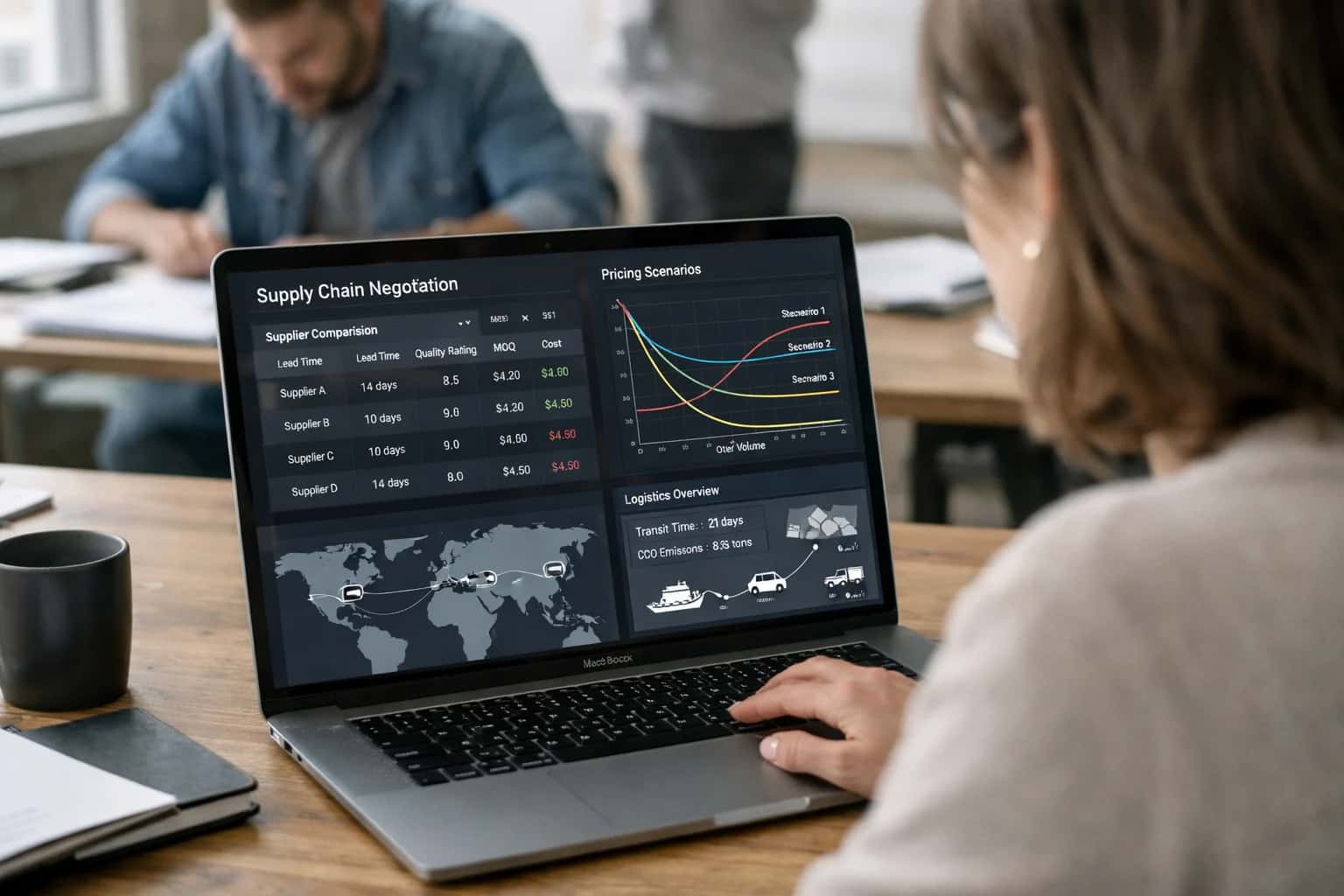
A technical comparison for CTOs and engineering leads evaluating digital twin fidelity for supply chain management. We analyze physics-based simulations for single assets versus scalable agent-based models for entire networks.
THE ANALYSIS
Introduction: The Fidelity vs. Scalability Dilemma in Digital Twins
A foundational comparison between detailed physics-based simulations and scalable agent-based models for supply chain digital twins.
Lightweight Agent-Based Twins take a different approach by modeling entities (e.g., trucks, warehouses, orders) as autonomous agents following simple behavioral rules. This results in the emergent simulation of complex system-wide behaviors, such as scenario simulation for port congestion or supplier failure. The trade-off is a loss of granular, physical accuracy for a massive gain in scalability, allowing you to model an entire supply network with thousands of interacting nodes in near real-time.
The key trade-off: If your priority is maximizing asset uptime and predicting precise failure timelines for high-value equipment, choose a physics-based model. If you prioritize understanding network resilience, testing disruption scenarios, and optimizing for On-Time-In-Full (OTIF) metrics across a complex system, choose an agent-based approach. For a deeper dive into operationalizing these models, see our guides on MLOps for Maintenance Models vs SimOps for Digital Twins and Predictive Maintenance APIs vs Simulation-as-a-Service APIs.
HEAD-TO-HEAD COMPARISON
High-Fidelity Physics Models vs Lightweight Agent-Based Twins
Direct comparison of digital twin fidelity for single-asset simulation versus scalable supply network modeling.
| Metric | High-Fidelity Physics Models | Lightweight Agent-Based Twins |
|---|---|---|
Primary Use Case | Single Asset Degradation & Failure Prediction | Network-Wide Disruption & Resilience Testing |
Simulation Fidelity | Sub-1% Error vs. Physical Benchmarks | ~85-95% Behavioral Accuracy |
Scenario Execution Time | Hours to Days | Seconds to Minutes |
Model Calibration Effort | High (Requires Domain Experts) | Moderate (Uses Historical Data) |
Scalability (Number of Entities) | 1-10s | 1,000s-100,000s |
Integration with Live IoT Data | ||
Prescriptive Action Generation | ||
Typical Deployment | On-Premise/Edge for Critical Assets | Cloud for Orchestration |
High-Fidelity Physics Models vs. Lightweight Agent-Based Twins
TL;DR: Key Differentiators
Core trade-offs between simulation fidelity for single assets and scalability for network-wide analysis.
01
High-Fidelity Physics Models: Pros
Unmatched accuracy for single assets: Uses first-principles physics (e.g., finite element analysis, computational fluid dynamics) to model wear, stress, and failure modes with <5% error margins. This matters for predicting Remaining Useful Life (RUL) of critical, high-value equipment like jet engines or turbines, where a false negative is catastrophic.
02
High-Fidelity Physics Models: Cons
Extreme computational cost and rigidity: A single simulation can require hours on HPC clusters, costing $100s per run, and models are brittle—any change in asset configuration or operating environment requires costly re-calibration. This fails for dynamic, multi-asset systems like a logistics fleet where conditions change minute-by-minute.
03
Lightweight Agent-Based Twins: Pros
Massive scalability for network effects: Models thousands of entities (trucks, warehouses, orders) as autonomous agents with simple behavioral rules, enabling simulation of entire supply networks in minutes on commodity cloud hardware. This matters for testing disruption scenarios (e.g., port closures) and optimizing for OTIF (On-Time-In-Full) metrics across the network.
04
Lightweight Agent-Based Twins: Cons
Lower granularity for physical prediction: Agents operate at a logical, not physical, level. They can't predict a specific bearing failure; they model systemic bottlenecks. This requires supplementing with IoT sensor data for asset-level health, creating a hybrid architecture. It's less suitable for precision engineering tasks.
CHOOSE YOUR PRIORITY
When to Choose: Decision Guide by Persona
High-Fidelity Physics Models for Asset Reliability
Verdict: The definitive choice for predicting single-asset failure. Strengths: These models, such as Physics-Informed Neural Networks (PINNs), integrate domain knowledge (e.g., thermodynamics, fluid dynamics) with sensor data to predict Remaining Useful Life (RUL) with exceptional accuracy. They excel in explainable AI (XAI) for maintenance alerts, providing defensible root-cause analysis for high-value assets like turbines or ship engines. This is critical for compliance and minimizing unplanned downtime. Trade-off: High computational cost and long development cycles for model calibration. Best for predictive maintenance for fleet where precision outweighs speed.
Lightweight Agent-Based Twins for Asset Reliability
Verdict: A secondary, network-focused tool. Strengths: Agent-based models can simulate the cascading impact of a single asset failure across a network. While not as precise on the physics of failure, they help answer "what happens to our OTIF if this pump fails?" Useful for contingency planning. Trade-off: Less accurate on the specific failure mechanism. Use to complement physics models, not replace them, for holistic reliability planning. For deeper insights, see our guide on Sensor-Based Anomaly Detection vs Digital Twin Simulation.
Enabling Efficiency, Speed & Accuracy
Intelligent Analysis, Decision & Execution
We build AI systems for teams that need search across company data, workflow automation across tools, or AI features inside products and internal software.
Talk to Us
Search across company data
Give teams answers from docs, tickets, runbooks, and product data with sources and permissions.
Useful when people spend too long searching or get different answers from different systems.
Enterprise searchRAGPermissions
Read more
Automate internal workflows
Use AI to route work, draft outputs, trigger actions, and keep approvals and logs in place.
Useful when repetitive work moves across multiple tools and teams.
AI agentsWorkflow automationGovernance
Read more
Add AI to products and internal tools
Build assistants, guided actions, or decision support into the software your team or customers already use.
Useful when AI needs to be part of the product, not a separate tool.
AI integrationDecision supportModel routing
Read moreTHE ANALYSIS
Final Verdict and Recommendation
A data-driven conclusion on choosing between high-fidelity physics models and lightweight agent-based twins for digital supply chain management.
High-Fidelity Physics Models excel at providing precise, deterministic predictions for individual, high-value assets because they are built on first-principles engineering (e.g., finite element analysis, computational fluid dynamics). For example, in predictive maintenance for a jet engine, these models can forecast Remaining Useful Life (RUL) with over 95% accuracy by simulating material stress and thermal degradation, directly reducing unplanned downtime and maintenance costs. This approach is critical for safety and capital-intensive operations where a single failure has catastrophic consequences.
Lightweight Agent-Based Twins take a different approach by modeling the entire supply network as a system of autonomous, interacting agents (e.g., trucks, warehouses, suppliers). This results in a trade-off: you sacrifice granular physical accuracy for massive scalability and emergent behavior simulation. A single simulation can model 10,000+ entities to test disruption scenarios—like a port closure—and measure network-wide KPIs such as On-Time-In-Full (OTIF) rate impact within minutes, which is impossible for computationally intensive physics solvers.
The key trade-off is fundamentally between precision for a single node and intelligence for the entire network. If your priority is maximizing uptime and lifespan of critical, isolated assets (e.g., a turbine, a press line), choose a High-Fidelity Physics Model. Its deterministic outputs are essential for prescriptive maintenance. If you prioritize supply chain resilience, dynamic scenario testing, and system-wide optimization under constant disruption, choose a Lightweight Agent-Based Twin. Its ability to simulate complex interactions and agent behaviors provides the strategic foresight needed for modern SCM. For a holistic strategy, consider a hybrid architecture where physics models inform the health parameters of key assets within a larger agent-based network simulation, as discussed in our guide on Sensor-Based Anomaly Detection vs Digital Twin Simulation.
High-Fidelity Physics Models vs Lightweight Agent-Based Twins
Why Work With Us
Key strengths and trade-offs at a glance for digital twin fidelity in supply chain management.
01
High-Fidelity Physics Models: Unmatched Precision for Critical Assets
Specific advantage: Simulates physical degradation (e.g., bearing wear, thermal stress) with <5% error against real-world sensor data. This matters for predictive maintenance for fleet where a false negative on a single asset (e.g., a cargo ship engine) can cause catastrophic downtime and multi-million dollar losses. Ideal for modeling Remaining Useful Life (RUL) of high-value, complex machinery.
<5% Error
Simulation Accuracy
Single Asset Focus
Scope
02
High-Fidelity Models: High Cost & Computational Demand
Specific trade-off: Requires detailed CAD models, material properties, and high-performance computing (HPC), leading to simulation times of hours and costs of $10k+ per model. This matters for organizations that need to scale simulations across hundreds of assets or require rapid, iterative scenario testing. The complexity makes integration into real-time supply chain visibility AI dashboards challenging.
Hours
Simulation Time
$10k+
Per-Model Cost
03
Lightweight Agent-Based Twins: Scalable Network Simulation
Specific advantage: Models thousands of interacting entities (trucks, warehouses, suppliers) with <1 second per simulation step, enabling rapid what-if analysis for OTIF resolving capabilities. This matters for simulating entire supply networks to test disruption scenarios (port closures, demand spikes) and optimize for resilience, a core function in logistics and supply chain visibility AI.
<1 sec/step
Simulation Speed
1000s of Entities
Scalability
04
Agent-Based Twins: Abstracted Fidelity & Calibration Needs
Specific trade-off: Uses simplified behavioral rules instead of first-principles physics, which can miss nuanced failure modes of individual assets. Accuracy depends heavily on calibration with historical operational data. This matters for use cases requiring precise inventory forecasting accuracy at the SKU level or diagnosing the root cause of a specific machine failure. Requires robust SimOps practices.
Behavioral Rules
Modeling Basis
Data-Dependent
Accuracy Driver

About the author
Prasad Kumkar
CEO & MD, Inference Systems
Prasad Kumkar is the CEO & MD of Inference Systems and writes about AI systems architecture, LLM infrastructure, model serving, evaluation, and production deployment. Over 5+ years, he has worked across computer vision models, L5 autonomous vehicle systems, and LLM research, with a focus on taking complex AI ideas into real-world engineering systems.
His work and writing cover AI systems, large language models, AI agents, multimodal systems, autonomous systems, inference optimization, RAG, evaluation, and production AI engineering.
LinkedIn
Limited slotsGet a Free AI Consultation
Partnered with leading AI, data, and software stack.





How We Work
Custom AI workflows for your Business
One-fit-all AI don't work for modern businesses. At Inferensys, we aim to understand your business & custom requirements; which we use to define most efficient agentic workflows, the data, and the tools for your business.
01
Review the use case
We understand the task, the users, and where AI can actually help.
Read more02
Pick the right approach
We define what needs search, automation, or product integration.
Read more03
Build the first useful version
We implement the part that proves the value first.
Read more04
Improve from there
We add the checks and visibility needed to keep it useful.
Read moreThe first call is a practical review of your use case and the right next step.
Talk to Us