ThoughtRiver excels at providing detailed, clause-level risk scoring and negotiation guidance because its AI is built on a proprietary legal taxonomy. For example, its platform can assign a specific risk score to a 'Limitation of Liability' clause based on your playbook and suggest precise, alternative language, which is critical for high-value, negotiated agreements in procurement and M&A. This granularity makes it a powerful tool for legal teams needing to guide business counterparts through complex negotiations.

Comparison
ThoughtRiver vs LawGeex
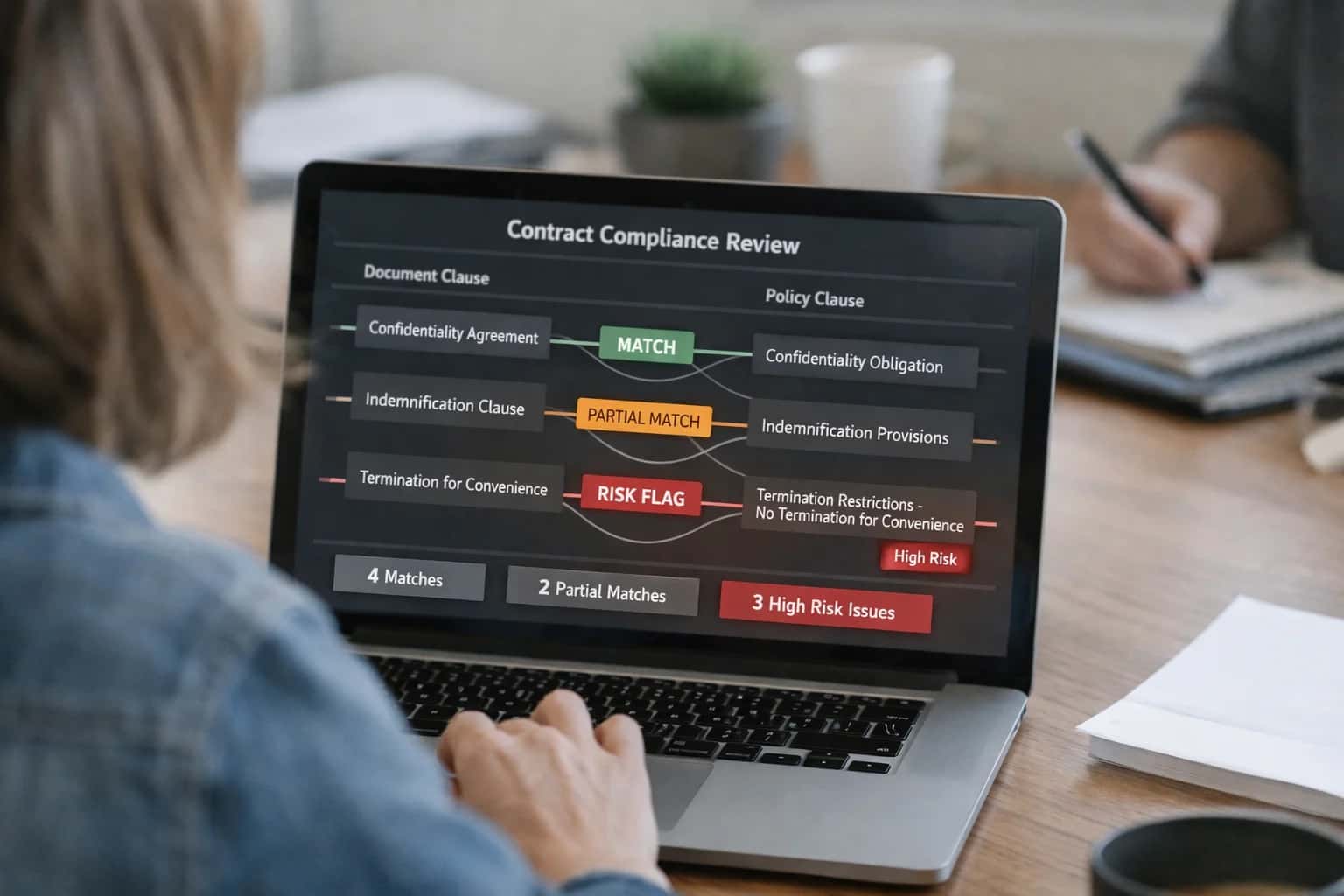
A technical comparison of two leading AI contract pre-signature review platforms. We evaluate risk scoring accuracy, negotiation guidance, and integration capabilities to help procurement and legal teams automate compliance checking against playbooks.
THE ANALYSIS
Introduction
A data-driven comparison of ThoughtRiver and LawGeex, two leading AI platforms for pre-signature contract review and compliance automation.
LawGeex takes a different approach by focusing on high-volume, standardized compliance checking. Its strategy is to automate the review of routine contracts like NDAs and vendor agreements against pre-defined corporate policies with a binary 'approve/flag' outcome. This results in a trade-off of less granular negotiation support for superior speed and scalability, often processing contracts in minutes with reported accuracy rates above 94% for policy adherence.
The key trade-off: If your priority is deep, advisory-level risk analysis for complex, high-stakes contracts, choose ThoughtRiver. Its strength lies in being a negotiation co-pilot. If you prioritize high-throughput, automated compliance for standardized, lower-risk agreements to free up legal bandwidth, choose LawGeex. For a broader view of the AI legal tech landscape, explore our pillar on AI-Driven Contract Analysis and Redlining (Legal Tech) and related comparisons like Spellbook vs goHeather for in-Word drafting.
HEAD-TO-HEAD COMPARISON
ThoughtRiver vs LawGeex
Direct comparison of AI contract pre-signature review platforms for automated compliance and risk scoring.
| Metric | ThoughtRiver | LawGeex |
|---|---|---|
Primary Use Case | High-value, complex contract review (e.g., M&A, procurement) | High-volume, standardized contract review (e.g., NDAs, procurement) |
Core AI Methodology | Rule-based + NLP for risk scoring and guidance | Deep learning for clause classification and deviation detection |
Risk Scoring Granularity | Per-clause and per-contract score with narrative | Pass/Fail against playbook with flagged deviations |
Negotiation Guidance | Detailed, clause-specific fallback language suggestions | High-level playbook rule references and alerts |
CLM Integration | API-based, major platforms (e.g., Icertis, Agiloft) | Native integrations & API (e.g., Salesforce, DocuSign) |
Human-in-the-Loop Workflow | Integrated review queue with collaborative annotation | Batch review dashboard for legal team oversight |
Jurisdiction Awareness | ||
Custom Playbook Build Time | 2-4 weeks (consultant-led) | < 1 week (self-service templates) |
ThoughtRiver vs LawGeex
TL;DR Summary
Key strengths and trade-offs for AI contract pre-signature review platforms at a glance.
01
Choose ThoughtRiver for Complex Procurement
Deep risk scoring and negotiation guidance: ThoughtRiver's AI provides granular risk assessments against custom playbooks and suggests specific negotiation positions. This matters for procurement teams managing high-value, complex supplier agreements where mitigating third-party risk is critical.
02
Choose LawGeex for High-Volume Compliance
Streamlined, automated approval workflows: LawGeex excels at fast, binary compliance checks against standardized playbooks, routing contracts for approval or escalation. This matters for legal ops teams processing hundreds of NDAs and standard contracts monthly, where speed and consistency are paramount.
03
ThoughtRiver's Strength: Integration Depth
Native CLM and ERP connectors: ThoughtRiver offers deep, pre-built integrations with systems like Icertis, SAP Ariba, and Coupa. This matters for enterprises embedding AI review directly into existing source-to-pay or CLM workflows, minimizing user context switching.
04
LawGeex's Strength: User Experience & Speed
Intuitive dashboard and rapid review: LawGeex prioritizes a clean, business-user-friendly interface with clear dashboards and typically delivers review results in minutes. This matters for decentralized business teams (e.g., Sales, HR) who need self-service contract review without legal training.
CHOOSE YOUR PRIORITY
When to Choose Which Platform
ThoughtRiver for Procurement
Verdict: The superior choice for high-volume, standardized contract intake. Strengths: ThoughtRiver excels in procurement by focusing on pre-signature risk scoring against predefined corporate playbooks. Its AI is trained to identify deviations in common clauses (e.g., liability caps, termination rights) and provide clear, prioritized negotiation guidance. This accelerates the initial review cycle for procurement teams managing hundreds of NDAs, MSAs, and SOWs. Integration with upstream sourcing tools and CLM systems like Icertis or Agiloft is a core strength, enabling a seamless flow from request to executed contract.
LawGeex for Procurement
Verdict: A strong alternative, particularly for organizations with complex, multi-jurisdictional compliance needs. Strengths: LawGeex offers robust compliance checking against a vast library of regulatory and internal policy rules. Its platform is highly effective for global procurement teams that must ensure contracts adhere to GDPR, CCPA, or industry-specific regulations. The system provides detailed audit trails and explanations for its flags, which is critical for demonstrating due diligence. However, its negotiation guidance may be less prescriptive than ThoughtRiver's for purely commercial terms.
Enabling Efficiency, Speed & Accuracy
Intelligent Analysis, Decision & Execution
We build AI systems for teams that need search across company data, workflow automation across tools, or AI features inside products and internal software.
Talk to Us
Search across company data
Give teams answers from docs, tickets, runbooks, and product data with sources and permissions.
Useful when people spend too long searching or get different answers from different systems.
Enterprise searchRAGPermissions
Read more
Automate internal workflows
Use AI to route work, draft outputs, trigger actions, and keep approvals and logs in place.
Useful when repetitive work moves across multiple tools and teams.
AI agentsWorkflow automationGovernance
Read more
Add AI to products and internal tools
Build assistants, guided actions, or decision support into the software your team or customers already use.
Useful when AI needs to be part of the product, not a separate tool.
AI integrationDecision supportModel routing
Read moreTHE ANALYSIS
Final Verdict
A decisive comparison of ThoughtRiver and LawGeex based on risk scoring methodology, negotiation guidance, and enterprise integration.
ThoughtRiver excels at providing detailed, clause-level risk analysis and actionable negotiation guidance because its AI is trained to understand the nuanced intent and business impact of contract language. For example, its platform can flag a specific indemnification clause as 'high risk' based on a configured playbook and suggest alternative, pre-approved language, directly accelerating the negotiation cycle for procurement and legal teams.
LawGeex takes a different approach by prioritizing high-volume, binary compliance checking against standardized playbooks. This results in exceptional speed and consistency for routine reviews—processing an NDA in under 5 minutes—but offers less granular guidance for complex, negotiated agreements where context and trade-offs are critical.
The key trade-off: If your priority is deep, contextual risk analysis and negotiation support for complex, high-value contracts, choose ThoughtRiver. Its strength lies in being a co-pilot for deal-making. If you prioritize high-speed, automated compliance screening for a large volume of standardized agreements (like NDAs, DPAs, or MSAs), choose LawGeex. Its model is optimized for efficiency and scale in pre-signature review workflows. For a broader view of the AI legal tech landscape, explore our pillar on AI-Driven Contract Analysis and Redlining or compare other tools like Spellbook vs goHeather for in-Word drafting.

About the author
Prasad Kumkar
CEO & MD, Inference Systems
Prasad Kumkar is the CEO & MD of Inference Systems and writes about AI systems architecture, LLM infrastructure, model serving, evaluation, and production deployment. Over 5+ years, he has worked across computer vision models, L5 autonomous vehicle systems, and LLM research, with a focus on taking complex AI ideas into real-world engineering systems.
His work and writing cover AI systems, large language models, AI agents, multimodal systems, autonomous systems, inference optimization, RAG, evaluation, and production AI engineering.
LinkedIn
Limited slotsGet a Free AI Consultation
Partnered with leading AI, data, and software stack.





How We Work
Custom AI workflows for your Business
One-fit-all AI don't work for modern businesses. At Inferensys, we aim to understand your business & custom requirements; which we use to define most efficient agentic workflows, the data, and the tools for your business.
01
Review the use case
We understand the task, the users, and where AI can actually help.
Read more02
Pick the right approach
We define what needs search, automation, or product integration.
Read more03
Build the first useful version
We implement the part that proves the value first.
Read more04
Improve from there
We add the checks and visibility needed to keep it useful.
Read moreThe first call is a practical review of your use case and the right next step.
Talk to Us