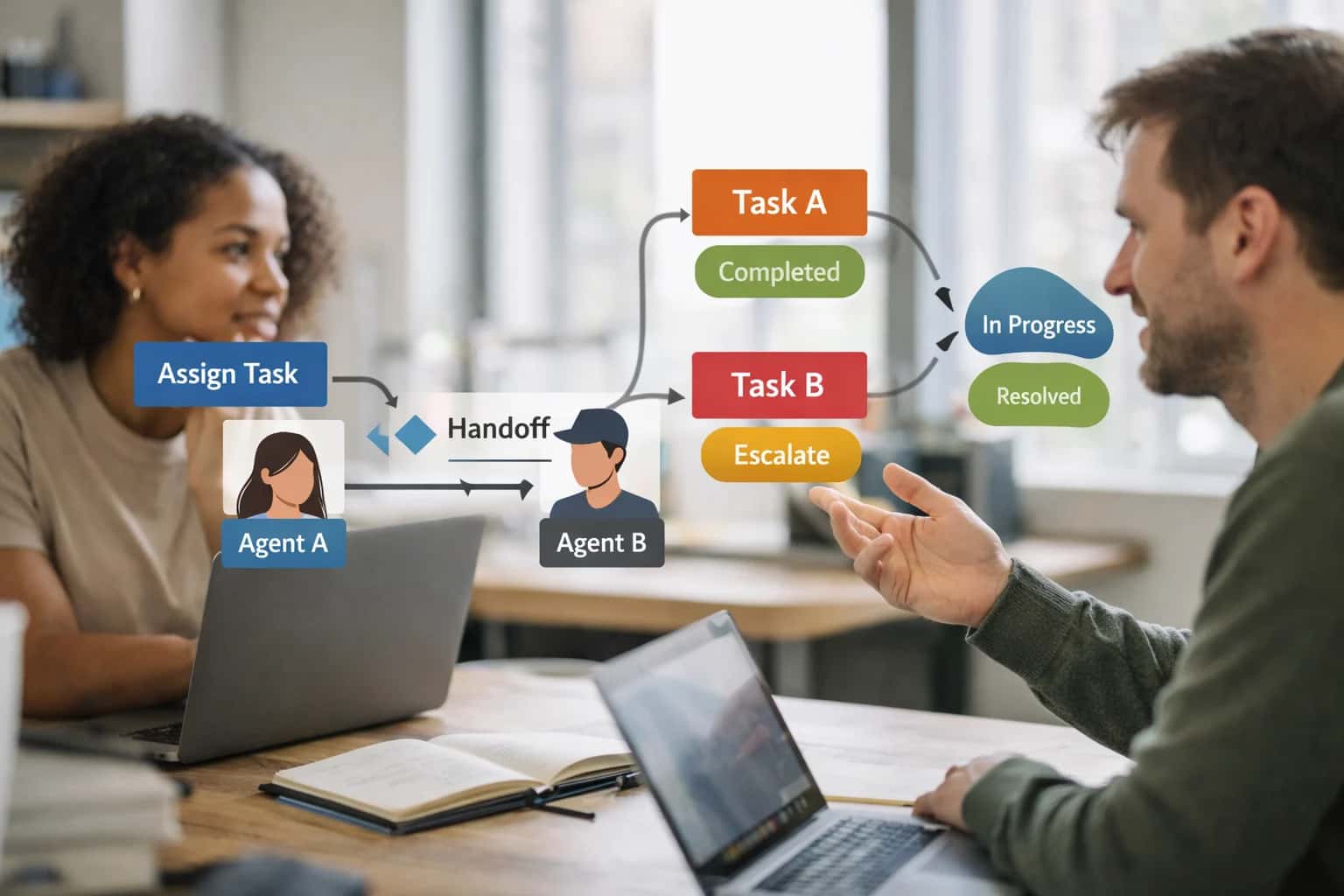
LangGraph excels at building deterministic, complex multi-step workflows because it models agent logic as an explicit, cyclic state graph. This graph-based paradigm provides developers with fine-grained control over execution flow, error handling, and human-in-the-loop interventions. For example, a customer support agent built with LangGraph can be precisely engineered to escalate to a human after three failed tool-calling attempts, with the entire conversation history and agent state persisted in a State object. This makes it ideal for scenarios requiring auditable, step-by-step reasoning and robust recovery paths, such as in financial compliance or operational runbooks.

Comparison
LangGraph vs Semantic Kernel
A technical comparison of LangGraph's explicit, graph-based workflow orchestration versus Semantic Kernel's planner-based, goal-oriented agent orchestration for Python and .NET ecosystems.
THE ANALYSIS
Introduction
A foundational comparison of LangGraph's explicit state machine model versus Semantic Kernel's declarative planner-based architecture for orchestrating AI agents.
Semantic Kernel takes a different approach by employing a goal-oriented, planner-based strategy. Developers define capabilities (plugins) and semantic descriptions, and the framework's planner dynamically generates a sequence of actions to fulfill a high-level user request. This results in a trade-off of less predictable control flow for greater flexibility and developer speed. The planner can reason over available tools and compose novel plans, which is powerful for exploratory or creative tasks. However, this dynamism can make debugging specific execution paths more challenging compared to LangGraph's explicit graphs.
The key trade-off is between control and abstraction. If your priority is predictable execution, detailed observability, and complex conditional logic—common in regulated industries or mission-critical processes—choose LangGraph. Its explicit graphs align with classical software engineering principles. If you prioritize rapid prototyping, adaptive behavior, and deep integration within the .NET ecosystem or Microsoft's Copilot stack, choose Semantic Kernel. Its planner abstracts away the step-by-step orchestration, allowing agents to dynamically figure out 'how' to achieve a stated goal.
HEAD-TO-HEAD COMPARISON
LangGraph vs Semantic Kernel Feature Comparison
Direct comparison of key architectural and operational metrics for two leading agentic workflow orchestration frameworks.
| Metric | LangGraph | Semantic Kernel |
|---|---|---|
Core Programming Model | Explicit State Graphs | Planner-Based Orchestration |
Primary Language Support | Python | Python, C#, Java |
State Management | Built-in, In-Memory | Planner-Managed, External |
Human-in-the-Loop (HITL) Integration | ||
Native .NET Ecosystem Integration | ||
Managed Cloud Service Offering | Azure AI Foundry | |
Open-Source License | MIT | MIT |
LangGraph vs Semantic Kernel
TL;DR Summary
Key strengths and trade-offs at a glance for two leading agentic workflow frameworks.
01
Choose LangGraph for Explicit Control
Graph-based state machines: LangGraph uses nodes and edges to define deterministic, debuggable workflows. This matters for complex, multi-step processes like customer support escalation or data ETL pipelines where you need to visualize and control every state transition.
02
Choose Semantic Kernel for Goal-Oriented Agents
Planner-based orchestration: Semantic Kernel uses AI planners to dynamically decompose high-level goals (e.g., 'Plan a marketing campaign') into a sequence of tool calls. This matters for scenarios with unpredictable paths where you want the system to reason about how to achieve an objective, not just follow a preset graph.
03
Choose LangGraph for Python-First Ecosystems
Deep LangChain integration: Built as an extension of the LangChain ecosystem, it offers seamless compatibility with hundreds of tools, retrievers, and LLM providers. This matters for teams already invested in LangChain or building rapid prototypes with a rich, Python-centric toolset.
04
Choose Semantic Kernel for .NET & Hybrid Stacks
Native C# and Python SDKs: Semantic Kernel is a first-class citizen in the Microsoft ecosystem, ideal for enterprises standardizing on Azure, .NET, and Copilot extensions. This matters for integrating agentic logic into existing .NET microservices or building plugins for Microsoft 365.
CHOOSE YOUR PRIORITY
When to Choose LangGraph vs Semantic Kernel
LangGraph for Agents
Verdict: The superior choice for building complex, stateful, and cyclic multi-agent systems.
Strengths: LangGraph's core abstraction is a state graph, making it ideal for modeling deterministic workflows with cycles, human-in-the-loop checkpoints, and persistent agent memory. It provides fine-grained control over the execution flow (e.g., using conditional_edges). This is critical for autonomous agents that must follow structured reasoning paths, recover from errors, and maintain context across long-running tasks. Its integration with LangChain's extensive tool ecosystem is a major advantage.
Semantic Kernel for Agents
Verdict: Best for goal-oriented, planner-based agents within the Microsoft ecosystem. Strengths: Semantic Kernel's planner is its standout feature. You define high-level goals (e.g., "Send a birthday email"), and the planner dynamically assembles a sequence of available plugins (tools) to achieve it. This is excellent for creating flexible, goal-driven assistants without manually scripting every step. Its native integration with .NET and Azure AI services (like Azure OpenAI) makes it the default choice for teams deeply invested in the Microsoft stack. For a comparison with other planner-based approaches, see our analysis of CrewAI vs LlamaIndex Agent Framework.
Enabling Efficiency, Speed & Accuracy
Intelligent Analysis, Decision & Execution
We build AI systems for teams that need search across company data, workflow automation across tools, or AI features inside products and internal software.
Talk to Us
Search across company data
Give teams answers from docs, tickets, runbooks, and product data with sources and permissions.
Useful when people spend too long searching or get different answers from different systems.
Enterprise searchRAGPermissions
Read more
Automate internal workflows
Use AI to route work, draft outputs, trigger actions, and keep approvals and logs in place.
Useful when repetitive work moves across multiple tools and teams.
AI agentsWorkflow automationGovernance
Read more
Add AI to products and internal tools
Build assistants, guided actions, or decision support into the software your team or customers already use.
Useful when AI needs to be part of the product, not a separate tool.
AI integrationDecision supportModel routing
Read moreTHE ANALYSIS
Final Verdict
Choosing between LangGraph and Semantic Kernel hinges on your team's need for explicit control versus declarative planning.
LangGraph excels at building deterministic, stateful agent workflows because of its explicit, graph-based programming model. For example, its StateGraph abstraction allows engineers to define, visualize, and debug complex reasoning loops with precise control over tool execution and human-in-the-loop checkpoints, making it ideal for mission-critical processes where every step must be auditable. This approach is central to modern Agentic Workflow Orchestration Frameworks.
Semantic Kernel takes a different approach by employing a planner-based, goal-oriented strategy. Its core strength is in abstracting workflow logic; developers define available functions and high-level goals (e.g., 'draft a report'), and the planner dynamically generates and executes a sequence. This results in a trade-off of less granular control for faster development of adaptive agents that can handle unforeseen sub-tasks without pre-defined graphs.
The key trade-off: If your priority is predictable execution, deep observability, and fine-grained governance for high-stakes operations, choose LangGraph. Its graph paradigm is a natural fit for complex, multi-agent coordination protocols. If you prioritize rapid prototyping, adaptive behavior, and deep integration within the Microsoft ecosystem (especially .NET), choose Semantic Kernel. Its planner automates the orchestration logic that you would otherwise have to code explicitly in LangGraph.

About the author
Prasad Kumkar
CEO & MD, Inference Systems
Prasad Kumkar is the CEO & MD of Inference Systems and writes about AI systems architecture, LLM infrastructure, model serving, evaluation, and production deployment. Over 5+ years, he has worked across computer vision models, L5 autonomous vehicle systems, and LLM research, with a focus on taking complex AI ideas into real-world engineering systems.
His work and writing cover AI systems, large language models, AI agents, multimodal systems, autonomous systems, inference optimization, RAG, evaluation, and production AI engineering.
LinkedIn
Limited slotsGet a Free AI Consultation
Partnered with leading AI, data, and software stack.





How We Work
Custom AI workflows for your Business
One-fit-all AI don't work for modern businesses. At Inferensys, we aim to understand your business & custom requirements; which we use to define most efficient agentic workflows, the data, and the tools for your business.
01
Review the use case
We understand the task, the users, and where AI can actually help.
Read more02
Pick the right approach
We define what needs search, automation, or product integration.
Read more03
Build the first useful version
We implement the part that proves the value first.
Read more04
Improve from there
We add the checks and visibility needed to keep it useful.
Read moreThe first call is a practical review of your use case and the right next step.
Talk to Us