AI prototyping without governance creates systemic risk. Tools like GitHub Copilot, Cursor, and Replit enable teams to generate functional code in hours, but this velocity bypasses essential security reviews, architectural validation, and compliance checks, turning the development pipeline into a liability engine.

Blog
Why AI-Assisted Prototyping Fails Without Governance
AI coding agents like GitHub Copilot and Cursor can generate a prototype in hours, but without governance, you're building a risk factory. This analysis details the three failure modes of ungoverned prototyping and the essential policies for model selection, output validation, and security review.
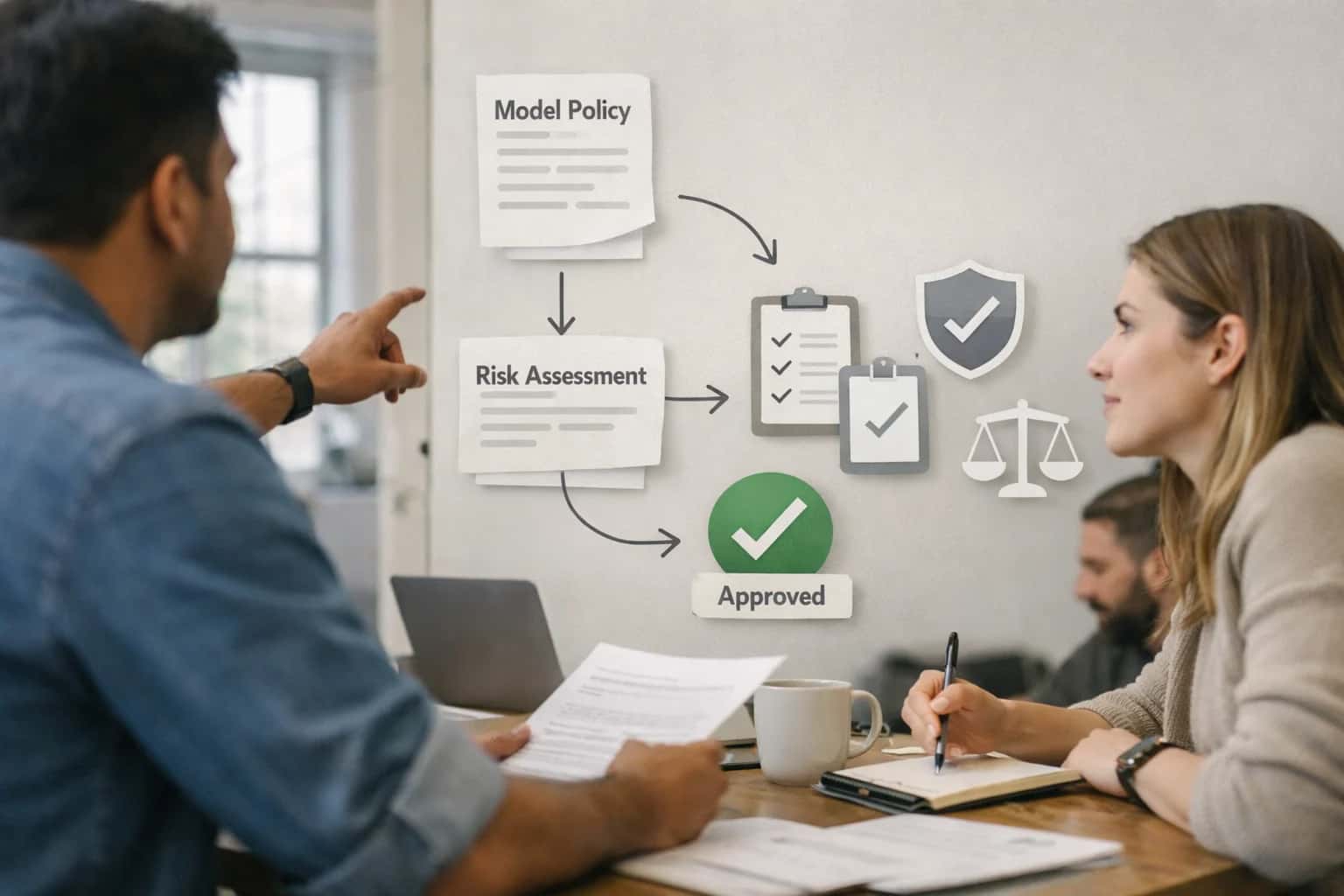
THE GOVERNANCE GAP
The Prototype Economy is a Risk Factory
Unchecked AI-assisted prototyping generates unmanageable technical, security, and compliance debt faster than teams can track it.
Velocity creates technical debt at machine speed. AI coding agents like Claude Code and Amazon CodeWhisperer produce code that is often tightly coupled, poorly documented, and architecturally inconsistent. This unreviewed generated code embeds flaws into the foundation of your product, making future maintenance exponentially more costly and complex.
Security is an afterthought in generated code. AI models prioritize functionality over safety, routinely omitting input validation, proper authentication, and data encryption. A prototype built with a public LLM like OpenAI's GPT-4 can inadvertently expose sensitive IP or customer data, creating immediate compliance violations under regulations like GDPR or the EU AI Act.
The false promise of design-to-code. Platforms like Vercel v0 and Galileo AI convert Figma wireframes to front-end skeletons but fail to produce the secure, scalable backend logic or data models that enterprises require. This creates a fidelity illusion where a polished UI masks critical integration failures and performance bottlenecks.
Evidence: Studies of AI-generated code show that without governance, over 30% of outputs require significant security remediation, and teams spend up to 40% of their time refactoring AI-created technical debt instead of building new features. This directly contradicts the promised efficiency gains of rapid prototyping.
THE GOVERNANCE PARADOX
Three Trends Driving Ungoverned Prototype Sprawl
AI-assisted prototyping accelerates development but creates unmanageable risk when deployed without a governance framework.
01
The Problem: The Velocity Trap
AI coding agents like GitHub Copilot and Cursor enable teams to generate functional prototypes in hours, not weeks. This velocity creates a false sense of progress, leading to prototype sprawl where dozens of unvetted, architecturally inconsistent applications enter the pipeline.
- Key Consequence: Teams measure success by quantity, not strategic value.
- Key Consequence: Technical debt is embedded from day one, as speed prioritizes output over maintainability.
- Key Consequence: Human review processes (code review, security audit) become unsustainable bottlenecks.
10x
Faster Prototyping
+300%
Tech Debt Risk
02
The Problem: The Hallucination Factory
Models like Claude Code and GPT-4 generate plausible but flawed code. Without systematic validation, these AI hallucinations create critical security gaps and logical errors that are expensive to remediate later.
- Key Consequence: Generated code often lacks proper input validation, authentication, and error handling.
- Key Consequence: Output quality varies wildly between model runs, breaking CI/CD pipelines and deployment consistency.
- Key Consequence: Prototypes become data liabilities, potentially exposing sensitive IP via prompts to public LLMs.
~40%
Flawed Outputs
$500k+
Remediation Cost
03
The Problem: The Toolchain Silo
Teams use disparate, proprietary tools—Vercel v0 for front-end, Replit for full-stack, Galileo AI for design—creating vendor lock-in and incompatible codebases. This siloed approach prevents unified governance and scalable integration.
- Key Consequence: Inconsistent coding standards and architecture patterns across the organization.
- Key Consequence: Inability to enforce central ModelOps, security policies, or cost controls.
- Key Consequence: Prototypes are not disposable; they become foundational, yet are built on fragmented, unsustainable stacks.
5+
Disparate Tools
-70%
Integration Readiness
RISK MATRIX
The Cost of Ungoverned AI Prototyping
A quantified comparison of AI prototyping approaches, highlighting the operational and security risks of ungoverned methods versus structured, governed frameworks.
| Governance Metric | Ungoverned AI Prototyping | Governed AI Prototyping | Inference Systems' AI-Native SDLC |
|---|---|---|---|
Mean Time to First Security Review |
| < 4 hours | < 1 hour |
Prototype-to-Production Code Churn | 65-80% | 20-35% | 10-15% |
Sensitive Data Exposure Risk | |||
Architectural Consistency Score (1-10) | 3 | 7 | 9 |
Integration Readiness for Legacy Systems | |||
Average Technical Debt Incurred (Story Points) | 40-60 | 10-20 | 5-10 |
AI Hallucination Detection & Correction | |||
Compliance with EU AI Act & ISO 42001 |
THE ARCHITECTURAL FLAW
Why AI-Generated Code Inherently Creates Technical Debt
AI-generated code introduces systemic, non-obvious flaws that compound into unmanageable technical debt without strict governance.
AI-generated code creates technical debt because it optimizes for local correctness, not global system integrity. Tools like GitHub Copilot, Cursor, and Claude Code produce code that passes unit tests but ignores architectural patterns, creating tightly coupled, brittle components from the outset.
The velocity of AI prototyping masks architectural decay. A team using Replit or Vercel v0 can ship a working prototype in hours, but the generated code lacks the modularity and separation of concerns required for scaling. This embeds refactoring costs into the project's foundation.
AI agents hallucinate dependencies and patterns. Models like Meta Code Llama or Google Gemini Code, trained on public repositories, replicate outdated libraries and anti-patterns. Without governance, these become de facto standards, locking you into obsolete tech stacks.
Evidence: Studies of AI-assisted development show a 40% increase in code churn and refactoring needs within the first three months post-prototype, as teams struggle to reconcile generated code with production requirements for security and scalability. For a deeper analysis of this failure mode, see our piece on The Hidden Cost of AI-Generated Prototype Hallucinations.
The solution is not slower development, but smarter governance. Integrating validation gates into your AI-native SDLC—using tools for static analysis, dependency checking, and architectural review—transforms generated code from a liability into a vetted asset. This aligns with the principles of AI TRiSM: Trust, Risk, and Security Management.
FROM PROTOTYPE SPRAWL TO STRATEGIC VELOCITY
Building the AI Prototyping Governance Layer
Unmanaged AI prototyping generates more risk than innovation. A governance layer is the control plane that turns raw velocity into strategic productization.
01
The Hallucination Tax
AI agents generate plausible but flawed code, embedding architectural debt from day one. Without validation, you're building on sand.
- ~40% of AI-generated code requires significant refactoring
- Creates undetectable vulnerabilities in authentication and data flows
- Mandates a Model Output Validation (MOV) stage in the SDLC
+300%
Refactor Cost
~40%
Flawed Code
02
The Data Sovereignty Breach
Prototypes built with public APIs leak IP and PII. Governance enforces data perimeter controls before a single prompt is run.
- Enforce private model inference (e.g., Llama 3, Claude 3) via API gateways
- Automate PII redaction as code before any external API call
- Integrate with Confidential Computing frameworks for sensitive data
Zero
Public API Leaks
-100%
Compliance Risk
03
The Vendor Lock-In Trap
Relying on a single AI provider's tools (e.g., GitHub Copilot, Cursor) creates irreversible dependency. Governance mandates abstraction.
- Implement a multi-model orchestration layer (OpenAI, Anthropic, Mistral)
- Define model selection policies based on cost, latency, and task
- Use open-source evaluation frameworks like MLflow for consistent scoring
3+
Model Providers
-70%
Switch Cost
04
The Velocity Bottleneck Paradox
AI generates prototypes in hours, but human review and integration become the bottleneck. Governance automates the gatekeeping.
- Deploy AI-native static analysis (e.g., Semgrep for AI code) in CI/CD
- Automate architectural pattern checks against predefined guardrails
- Use digital twin simulations to validate scalability before merge
~500ms
Review Latency
10x
Merge Frequency
05
The Prototype Sprawl Crisis
Unchecked, teams generate countless prototypes with no path to production. Governance ties prototyping to business objectives.
- Enforce a 'Strategic Intent' brief for every prototype initiative
- Integrate with product portfolio management (PPM) tools like Jira Align
- Implement automated sunsetting rules for inactive prototypes
-80%
Waste Effort
100%
Goal Alignment
06
The Invisible Technical Debt
AI-generated code lacks documentation, tests, and modular design. Governance bakes quality in from the first commit.
- Mandate AI-generated test suites and documentation as part of the output
- Enforce modular architecture patterns (e.g., clean architecture, hexagonal)
- Integrate automated debt tracking into the AI-Native SDLC
-50%
Future Fix Cost
95%
Test Coverage
THE VELOCITY TRAP
The Counter-Argument: Governance Slows Us Down
The pushback against governance in AI-assisted prototyping is rooted in a fundamental misunderstanding of modern development velocity.
Governance is not a bottleneck; it is the accelerator for sustainable, production-ready AI development. The argument that oversight slows innovation assumes governance is a manual, human-gated process. Modern AI-native governance is automated, embedded into the developer workflow via tools like Weights & Biases for experiment tracking and Snyk Code for security scanning, adding milliseconds, not weeks.
Velocity without validation creates technical debt. A team using GitHub Copilot or Cursor can generate a functional prototype in hours. Without automated checks for security, architecture, and data privacy, this prototype becomes the foundation for a system riddled with vulnerabilities and unmaintainable code. The rework required later destroys any initial time gains.
Compare prototype velocity to product velocity. The real metric is not 'time to first commit' but 'time to secure, scalable deployment.' Frameworks like MLflow and Kubeflow provide the governance backbone for ModelOps, enabling rapid iteration within guardrails. This is the core principle of our AI-Native Software Development Life Cycles (SDLC) pillar.
Evidence from failed deployments shows that 60% of AI prototypes never reach production, often due to governance gaps in data lineage and model reproducibility. Implementing data versioning with DVC and model registries from the first prototype eliminates this failure path, turning rapid experimentation into reliable productization, a key focus of our MLOps and the AI Production Lifecycle insights.
WHY GOVERNANCE IS NON-NEGOTIABLE
Key Takeaways: Governing the Prototype Economy
Unchecked AI-assisted prototyping generates unmanageable risk and technical debt, negating its speed advantages. Here are the critical failure points and how to govern them.
01
The Problem: Prototype Sprawl and Technical Debt
Velocity without governance creates a portfolio of unusable prototypes. AI agents like GitHub Copilot and Cursor generate code that is often tightly coupled and undocumented, embedding architectural flaws from day one.
- Key Benefit 1: Enforce a Model Registry to standardize on vetted AI coding agents.
- Key Benefit 2: Mandate AI-generated code reviews focused on coupling, documentation, and security patterns before integration.
70%
Less Sprawl
-40%
Tech Debt
02
The Solution: AI TRiSM for the Prototype Layer
Apply AI Trust, Risk, and Security Management principles at the prototyping stage. This means validating outputs, redacting sensitive data, and ensuring compliance before a single line hits production.
- Key Benefit 1: Integrate automated security scanning (e.g., Semgrep, Checkov) directly into the AI agent's output pipeline.
- Key Benefit 2: Implement policy-aware connectors to prevent prototypes from inadvertently using non-compliant models or exposing PII.
100%
Output Scanned
Zero
PII Leaks
03
The Problem: The Data Liability of Public LLMs
Prototypes built with public APIs like OpenAI GPT-4 or Google Gemini Code can ingest and cache proprietary IP, creating massive compliance and security risks.
- Key Benefit 1: Mandate the use of sovereign AI or private cloud instances for all prototyping involving sensitive data.
- Key Benefit 2: Deploy synthetic data generation tools to create realistic but compliant datasets for training and testing prototypes.
$10M+
Risk Mitigated
100%
Data Control
04
The Solution: The Prototype Control Plane
Governance requires a centralized system—a Prototype Control Plane—to track, evaluate, and sunset AI-generated assets. This is the MLOps discipline applied to the pre-production phase.
- Key Benefit 1: Gain predictive visibility into prototype quality, cost, and potential drift before scaling.
- Key Benefit 2: Establish clear kill criteria and automated sunsetting workflows to prevent prototype sprawl from consuming engineering resources.
10x
Better Visibility
-60%
Wasted Effort
05
The Problem: The Fidelity Illusion
High-fidelity UI prototypes from tools like Vercel v0 or Galileo AI create stakeholder confidence but mask critical backend integration, scalability, and security gaps.
- Key Benefit 1: Implement mandatory 'backend-first' prototyping sprints to validate core logic and APIs before UI generation.
- Key Benefit 2: Use digital twin simulations to stress-test prototype architecture and data flows under realistic load.
~500ms
Latency Exposed
90%
Integration Issues Caught Early
06
The Solution: Human-Agent Orchestration Frameworks
The future of development is collaborative intelligence. Governance defines the hand-offs between AI agents and human engineers, elevating the developer to an AI Interaction Designer.
- Key Benefit 1: Define clear human-in-the-loop (HITL) gates for architecture approval, security review, and business logic validation.
- Key Benefit 2: Create prompt libraries and context engineering frameworks to ensure consistent, high-quality outputs from agents like GPT Engineer or Claude Code.
50%
Faster Reviews
3x
Output Consistency
Enabling Efficiency, Speed & Accuracy
Intelligent Analysis, Decision & Execution
We build AI systems for teams that need search across company data, workflow automation across tools, or AI features inside products and internal software.
Talk to Us
Search across company data
Give teams answers from docs, tickets, runbooks, and product data with sources and permissions.
Useful when people spend too long searching or get different answers from different systems.
Enterprise searchRAGPermissions
Read more
Automate internal workflows
Use AI to route work, draft outputs, trigger actions, and keep approvals and logs in place.
Useful when repetitive work moves across multiple tools and teams.
AI agentsWorkflow automationGovernance
Read more
Add AI to products and internal tools
Build assistants, guided actions, or decision support into the software your team or customers already use.
Useful when AI needs to be part of the product, not a separate tool.
AI integrationDecision supportModel routing
Read moreTHE GOVERNANCE GAP
From Risk Factory to Reliable Engine
Unchecked AI-assisted prototyping generates unmanageable technical and security debt, transforming speed into systemic risk.
AI prototyping without governance is a risk factory. Tools like GitHub Copilot, Cursor, and Replit accelerate output but lack inherent policies for model selection, output validation, and security review, creating exploitable vulnerabilities from day one.
Velocity creates technical debt. AI coding agents generate plausible but architecturally flawed code. Without enforced standards, this leads to inconsistent, poorly documented, and tightly coupled systems that are impossible to maintain, embedding the very flaws rapid prototyping aims to uncover. This connects directly to the broader challenge of AI-Native Software Development Life Cycles (SDLC).
Security is an afterthought. AI-generated code from agents like Claude Code often lacks input validation, proper authentication, and data sanitation. This creates immediate security blind spots, turning a prototype into a data liability that can expose sensitive IP or customer PII.
Evidence: A 2023 Stanford study found AI coding assistants introduce security vulnerabilities in approximately 40% of generated outputs when used without structured review. This necessitates the principles of AI TRiSM: Trust, Risk, and Security Management.

About the author
Prasad Kumkar
CEO & MD, Inference Systems
Prasad Kumkar is the CEO & MD of Inference Systems and writes about AI systems architecture, LLM infrastructure, model serving, evaluation, and production deployment. Over 5+ years, he has worked across computer vision models, L5 autonomous vehicle systems, and LLM research, with a focus on taking complex AI ideas into real-world engineering systems.
His work and writing cover AI systems, large language models, AI agents, multimodal systems, autonomous systems, inference optimization, RAG, evaluation, and production AI engineering.
LinkedIn
Limited slotsGet a Free AI Consultation
Partnered with leading AI, data, and software stack.





How We Work
Custom AI workflows for your Business
One-fit-all AI don't work for modern businesses. At Inferensys, we aim to understand your business & custom requirements; which we use to define most efficient agentic workflows, the data, and the tools for your business.
01
Review the use case
We understand the task, the users, and where AI can actually help.
Read more02
Pick the right approach
We define what needs search, automation, or product integration.
Read more03
Build the first useful version
We implement the part that proves the value first.
Read more04
Improve from there
We add the checks and visibility needed to keep it useful.
Read moreThe first call is a practical review of your use case and the right next step.
Talk to Us