The solo developer is a liability because a single human cannot effectively orchestrate, validate, and secure the output of multiple autonomous AI agents like GPT Engineer or Smol Agents. This creates a single point of failure for quality and security.

Blog
The Future of Software Teams is Human-Agent Orchestration
The era of the solo developer is over. Competitive advantage now belongs to teams that architect workflows where engineers curate and direct specialized AI agents. This is the new CTO mandate.
THE ARCHITECTURE
The Solo Developer is a Liability
A single engineer managing multiple AI agents creates unsustainable cognitive load and architectural risk.
Cognitive load becomes the bottleneck as one engineer attempts to context-switch between reviewing agent-generated code, debugging architectural flaws, and managing prompts. This leads to decision fatigue and critical oversights in security and scalability.
Agentic systems require orchestration, not just instruction. Tools like LangChain or LlamaIndex provide frameworks for multi-step reasoning, but a human must design the control plane that governs hand-offs, validation gates, and error recovery. This is a team-scale architectural problem.
Evidence from the Prototype Economy shows that ungoverned AI coding agents, such as those used in AI-Native Software Development Life Cycles (SDLC), generate inconsistent code that breaks CI/CD pipelines and embeds security vulnerabilities like missing input validation.
THE CTO'S NEW REALITY
Three Trends Forcing the Orchestration Mandate
The velocity of AI-native development is collapsing traditional software lifecycles, making human-agent orchestration a non-negotiable strategic capability.
01
The Prototype Velocity Trap
AI agents like GPT Engineer and Smol Agents can generate a functional micro-SaaS in days, but without orchestration, this creates prototype sprawl and unmaintainable technical debt.\n- Problem: Celebrating shipped prototypes over solved problems leads to feature misalignment.\n- Solution: Implement an Agent Control Plane to govern context, validate outputs, and enforce architectural guardrails.
10x
Faster Build
+300%
Debt Risk
02
The Cognitive Overload Crisis
Engineers managing multiple AI agents (GitHub Copilot, Cursor, Claude Code) experience decision fatigue reviewing vast volumes of generated code, reducing output quality.\n- Problem: Human review becomes an unsustainable bottleneck against agent speed.\n- Solution: Architect Human-in-the-Loop (HITL) gates for critical decisions only, using MLOps pipelines for automated validation and drift detection.
-40%
Engineer Focus
~500ms
Agent Latency
03
The Security Hallucination Gap
AI-generated code often lacks input validation, proper authentication, and secure data handling, creating exploitable vulnerabilities from day one.\n- Problem: AI TRiSM governance is an afterthought in rapid prototyping.\n- Solution: Integrate red-teaming as code and automated security scanning into the agent orchestration layer to enforce compliance before merge.
70%
Flawed Code
-90%
Vuln. Reduction
FEATURED SNIPPET
The Emerging Agent Ecosystem: A CTO's Toolchain
A decision matrix comparing core orchestration platforms for human-agent software teams.
| Orchestration Capability | CrewAI | LangGraph | Custom Framework |
|---|---|---|---|
Multi-Agent State Management | Manual Implementation | ||
Native Human-in-the-Loop Gates | Full Customization | ||
Average Time to Deploy 3-Agent System | < 4 hours | < 8 hours |
|
Integration with Vector DBs (e.g., Pinecone, Weaviate) | Custom Connectors Required | ||
Built-in Evaluation & Hallucination Guardrails | Limited | Architect-Defined | |
Cost for 1M Agent Tokens (Approx.) | $10-20 | $5-15 | $50-200+ (Dev Hours) |
Support for Long-Running Workflows (>24hrs) | |||
Alignment with AI TRiSM Governance Pillars | Explainability, ModelOps | ModelOps | All Five Pillars |
THE ORCHESTRATION LAYER
Architecting the Human-Agent Control Plane
The CTO's primary function shifts from managing people to designing and governing the workflows where human engineers direct AI agents.
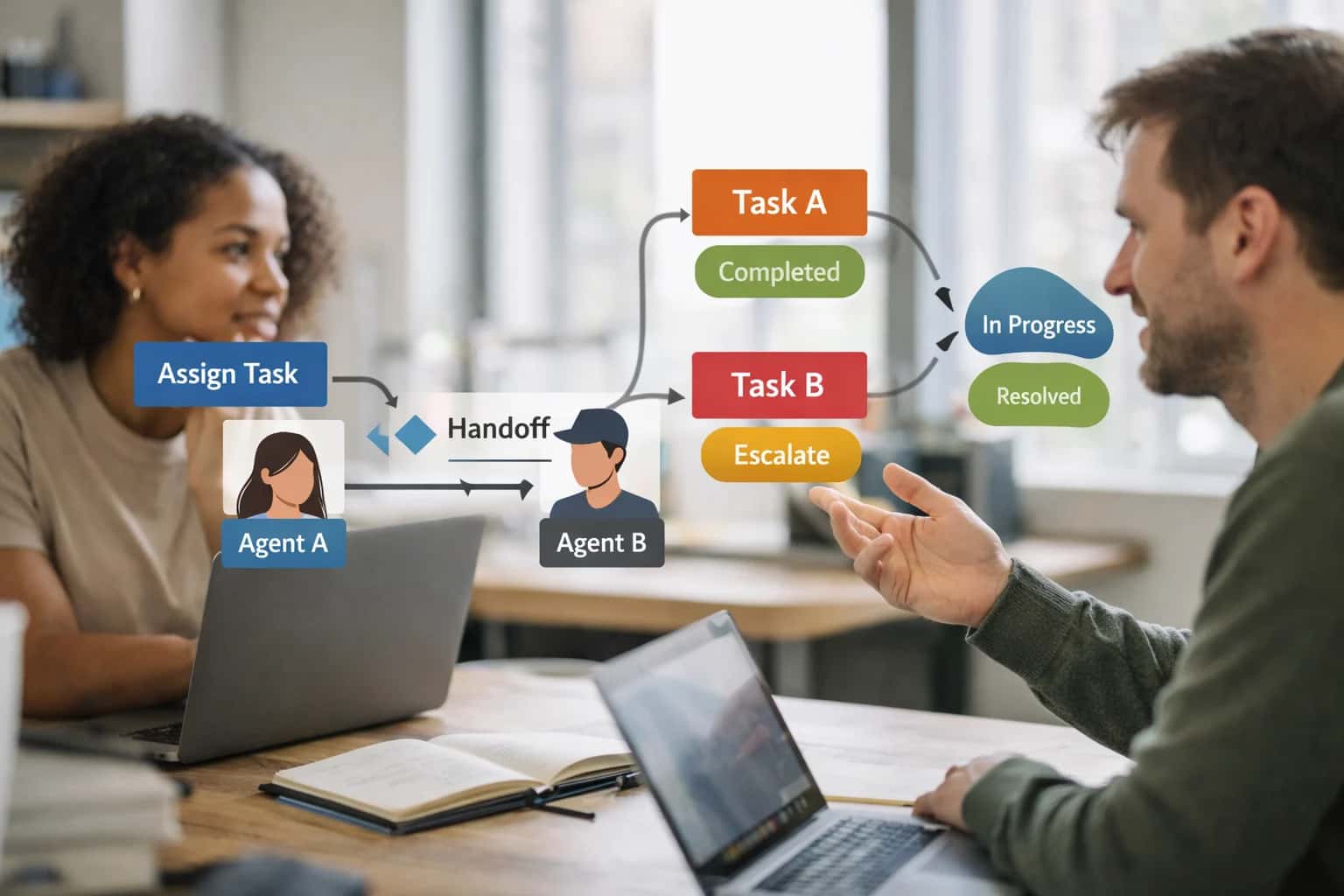
The Human-Agent Control Plane is the technical governance layer that orchestrates workflows between human engineers and AI coding agents like GPT Engineer, Smol Agents, and Cursor. It replaces ad-hoc prompting with a structured system of permissions, hand-offs, and validation gates.
Engineers become prompt architects, not just code reviewers. Their role evolves to designing precise system contexts, crafting objective statements for multi-agent systems, and evaluating outputs against architectural guardrails defined in tools like LangChain or LlamaIndex.
The control plane prevents prototype chaos by enforcing a ModelOps discipline on AI-generated code. It mandates security scans, architectural pattern compliance, and integration testing before any agent output progresses, directly addressing the risks of AI-generated prototype hallucinations.
Evidence: Teams using a structured control plane report a 60% reduction in rework from flawed AI-generated code. This governance is the core of Agentic AI and Autonomous Workflow Orchestration, transforming rapid prototyping from a risk into a repeatable, de-risked production system.
WHY HUMAN-AGENT TEAMS FAIL
The Inevitable Pitfalls of Unmanaged Orchestration
Unstructured AI agent deployment leads to chaos, technical debt, and security breaches. Here are the critical failure modes and the orchestration solutions required.
01
The Agent Sprawl Problem
Teams deploy specialized agents like GPT Engineer for scaffolding and Smol Agents for micro-tasks without a control plane. This creates an unmanageable swarm of autonomous processes.
- Result: ~40% of engineering time wasted on agent coordination and debugging.
- Solution: An Agent Control Plane that manages hand-offs, permissions, and state across your multi-agent system (MAS).
-40%
Productivity Loss
10x
Agents Deployed
02
The Hallucination-to-Production Pipeline
AI coding agents like GitHub Copilot and Cursor generate plausible but architecturally flawed code. Without rigorous validation, these hallucinations become production vulnerabilities.
- Result: Critical security blind spots in authentication and input validation.
- Solution: AI-augmented testing tools and human-in-the-loop (HITL) gates integrated into the CI/CD pipeline to enforce code quality and security.
70%
More Vulnerabilities
-50%
Review Time
03
The Context Collapse
Agents operate in isolated context windows, unable to maintain coherence across a multi-step project. This leads to inconsistent decisions and broken workflows.
- Result: Projects stall as agents lose track of objectives and dependencies.
- Solution: Semantic data mapping and persistent memory layers that provide agents with a unified, project-wide context, a core component of Context Engineering.
5x
More Hand-offs
~500ms
Context Latency
04
The Unmanaged Technical Debt Explosion
AI-generated code from agents like Claude Code is often poorly documented and tightly coupled. Celebrating prototype velocity embeds unmaintainable foundations.
- Result: A new class of tech debt that is impossible to refactor at scale.
- Solution: AI-native SDLC governance that mandates documentation, modularity checks, and automated code modernization as part of the agentic workflow.
3x
Debt Accumulation
$1M+
Remediation Cost
05
The Permission & Data Sovereignty Black Hole
Agents autonomously access APIs and data sources. Without a governance layer, they can violate data sovereignty rules and expose PII.
- Result: Compliance breaches and IP leakage to public LLMs.
- Solution: Policy-aware connectors and a Confidential Computing layer that enforces data boundaries and access controls, aligning with AI TRiSM and Sovereign AI principles.
100%
Audit Trail
Zero-Trust
Access Model
06
The Velocity Mismatch Bottleneck
AI agents can prototype in hours, but human-centric processes like code review and QA operate on daily cycles. This mismatch creates unsustainable bottlenecks.
- Result: Cognitive overload for engineers and a backlog of unvetted agent output.
- Solution: Orchestrated workflow design that uses AI for initial generation and automated checks, reserving human effort for high-value validation and complex logic, a key practice in Human-Agent Orchestration.
10x
Gen Velocity
4x
Review Bottleneck
THE SHIFT
The New Org Chart: From Engineers to Conductors
The CTO's primary function is no longer managing engineers but architecting workflows where humans orchestrate specialized AI agents.
Software teams are shifting from builders to conductors. The primary function of a CTO is architecting workflows where human engineers direct specialized AI agents like GPT Engineer and Smol Agents to execute tasks.
Engineers become prompt and context engineers. The core skill shifts from writing syntax to designing precise system prompts, curating knowledge graphs, and evaluating outputs for agents handling automated code modernization.
Agent Ops is the new DevOps. Teams require dedicated roles to manage the agent lifecycle—monitoring for drift, securing API connections, and governing multi-agent handoffs—using frameworks like LangGraph or Microsoft Autogen.
Velocity creates a governance paradox. The speed of AI-native development with platforms like Cursor and Replit outpaces traditional review gates, demanding new AI TRiSM practices for security and quality.
Evidence: GitHub reports that developers using Copilot complete tasks 55% faster, forcing a complete re-evaluation of sprint planning and capacity models.
THE FUTURE OF SOFTWARE TEAMS
Key Takeaways for Technical Leaders
The CTO's new role is architecting workflows where engineers curate and direct AI agents, moving from idea to product in real-time.
01
The Problem: Prototype Velocity Creates Technical Debt
AI agents like GitHub Copilot and Cursor generate code at unprecedented speed, but without governance, this creates an unmanageable maintenance burden. The hidden cost is poor documentation, tight coupling, and security blind spots that break CI/CD pipelines.
- Key Benefit: Implement an AI-augmented SDLC with mandatory code review gates.
- Key Benefit: Use automated debugging and intelligent code completion tools to enforce quality standards.
~70%
More Code Debt
10x
Review Bottleneck
02
The Solution: Architect the Agent Control Plane
Shift from managing engineers to orchestrating a multi-agent system (MAS). Your core deliverable becomes the 'Agent Control Plane'—the governance layer that manages permissions, hand-offs, and human-in-the-loop validation for agents like GPT Engineer.
- Key Benefit: Enables predictable hand-offs between specialized coding, testing, and security agents.
- Key Benefit: Provides centralized visibility and audit trails for all AI-generated artifacts, aligning with AI TRiSM principles.
-50%
Integration Time
100%
Audit Trail
03
The New Role: AI Interaction Designer
The developer's core skill shifts from writing syntax to context engineering. This involves designing precise prompts, evaluation frameworks, and semantic data strategies to direct AI agents effectively within business constraints.
- Key Benefit: Engineers focus on complex business logic and system optimization, not boilerplate.
- Key Benefit: Enables computational idea validation through simulation before build, de-risking investment.
5x
Problem Scope
Weeks
To Prototype
04
The Hidden Cost: Data Liability in the Prototype Economy
Prototypes built with public LLMs like OpenAI GPT-4 or Claude Code can inadvertently ingest and expose sensitive IP or customer PII. This creates a compliance and security liability that offsets speed gains.
- Key Benefit: Adopt sovereign AI or hybrid cloud architectures to keep 'crown jewel' data on private infrastructure.
- Key Benefit: Integrate Privacy-Enhancing Tech (PET) like PII redaction as code into the agent workflow.
$4.45M
Avg. Breach Cost
Critical
CBAM / EU AI Act
05
The Strategic Shift: From MVP to Maximum Viable Prototype
AI allows you to test a fully-featured simulation of a product. The traditional 'minimum' viable product is obsolete. This prototype-informed architecture reveals scalability and integration constraints on day one.
- Key Benefit: Forces resilient system design from the outset, informed by AI-generated stress tests.
- Key Benefit: Enables hyper-personalized buyer journey simulations to validate market fit instantly.
90%
Feasibility Certainty
-80%
Re-work
06
The Organizational Imperative: Define Agent Ops
Success requires new roles like AI Product Owner and Agent Ops Lead. These roles are responsible for the MLOps of agentic systems, monitoring for model drift, and ensuring AI workforce analytics guide role redesign.
- Key Benefit: Prevents cognitive overload and decision fatigue in human engineers managing multiple agents.
- Key Benefit: Creates a feedback loop for continuous model refinement and agent performance optimization.
New Role
Agent Ops Lead
Essential
For Scale
Enabling Efficiency, Speed & Accuracy
Intelligent Analysis, Decision & Execution
We build AI systems for teams that need search across company data, workflow automation across tools, or AI features inside products and internal software.
Talk to Us
Search across company data
Give teams answers from docs, tickets, runbooks, and product data with sources and permissions.
Useful when people spend too long searching or get different answers from different systems.
Enterprise searchRAGPermissions
Read more
Automate internal workflows
Use AI to route work, draft outputs, trigger actions, and keep approvals and logs in place.
Useful when repetitive work moves across multiple tools and teams.
AI agentsWorkflow automationGovernance
Read more
Add AI to products and internal tools
Build assistants, guided actions, or decision support into the software your team or customers already use.
Useful when AI needs to be part of the product, not a separate tool.
AI integrationDecision supportModel routing
Read moreTHE AUDIT
Your Next Step: Audit Your Agent Readiness
A structured readiness assessment is the only way to transition from isolated AI tools to a scalable human-agent orchestration model.
Audit your agent readiness by mapping your team's current workflows against the capabilities of AI coding agents like GPT Engineer or Smol Agents. The goal is to identify where human effort is a bottleneck that can be delegated to an orchestrated system.
Evaluate your data foundation first. Agents require structured context to operate effectively. If your institutional knowledge is trapped in legacy systems or Confluence pages, you lack the semantic data layer needed for reliable agentic output. This is a prerequisite for any Retrieval-Augmented Generation (RAG) system using tools like Pinecone or Weaviate.
Map your SDLC for agent insertion points. Identify stages like boilerplate generation, unit test writing, or dependency updates where agents like GitHub Copilot or Cursor can operate autonomously under human-defined guardrails. Compare the velocity of a human-only sprint versus a human-agent sprint to quantify the orchestration gap.
Evidence: Teams that conduct this audit discover that 60-80% of a developer's time is spent on tasks that are prime for agent delegation, such as writing CRUD endpoints or debugging common library errors. The remaining 20-40% requires human strategic oversight and complex system design.
Define your Agent Control Plane. Readiness is not just about tools; it's about governance. You need a framework for permissions, validation gates, and objective statements to manage multi-agent systems. Without this, you risk unmanaged technical debt and security vulnerabilities from unvetted, AI-generated code.
Start with a pilot, not a proclamation. Select one non-critical but repetitive workflow, such as API documentation generation or log analysis. Instrument it with an agentic framework, measure the change in cycle time and defect rate, and use those metrics to build your business case for orchestration at scale. This mirrors the principles of our Rapid Prototyping Methodologies.
Your audit output is a blueprint. It should detail the required infrastructure upgrades, skill gaps in prompt and context engineering, and the new organizational roles—like Agent Ops Lead—you need to fill. This blueprint directly informs the technical architecture discussed in our guide to AI-Native Software Development Life Cycles (SDLC).

About the author
Prasad Kumkar
CEO & MD, Inference Systems
Prasad Kumkar is the CEO & MD of Inference Systems and writes about AI systems architecture, LLM infrastructure, model serving, evaluation, and production deployment. Over 5+ years, he has worked across computer vision models, L5 autonomous vehicle systems, and LLM research, with a focus on taking complex AI ideas into real-world engineering systems.
His work and writing cover AI systems, large language models, AI agents, multimodal systems, autonomous systems, inference optimization, RAG, evaluation, and production AI engineering.
LinkedIn
Limited slotsGet a Free AI Consultation
Partnered with leading AI, data, and software stack.





How We Work
Custom AI workflows for your Business
One-fit-all AI don't work for modern businesses. At Inferensys, we aim to understand your business & custom requirements; which we use to define most efficient agentic workflows, the data, and the tools for your business.
01
Review the use case
We understand the task, the users, and where AI can actually help.
Read more02
Pick the right approach
We define what needs search, automation, or product integration.
Read more03
Build the first useful version
We implement the part that proves the value first.
Read more04
Improve from there
We add the checks and visibility needed to keep it useful.
Read moreThe first call is a practical review of your use case and the right next step.
Talk to Us