AI ROI calculators are misleading because they model a frictionless deployment, ignoring the data foundation problem where 80% of project effort is spent cleaning and structuring information trapped in legacy systems.

Blog
Why Current AI ROI Calculators Are Misleading SMB Decision-Makers
Vendor-provided AI ROI calculators systematically underestimate the hidden costs of data preparation, change management, and ongoing model tuning, setting SMBs up for budget overruns and failed projects. This analysis reveals the real cost drivers and advocates for outcome-based service models.
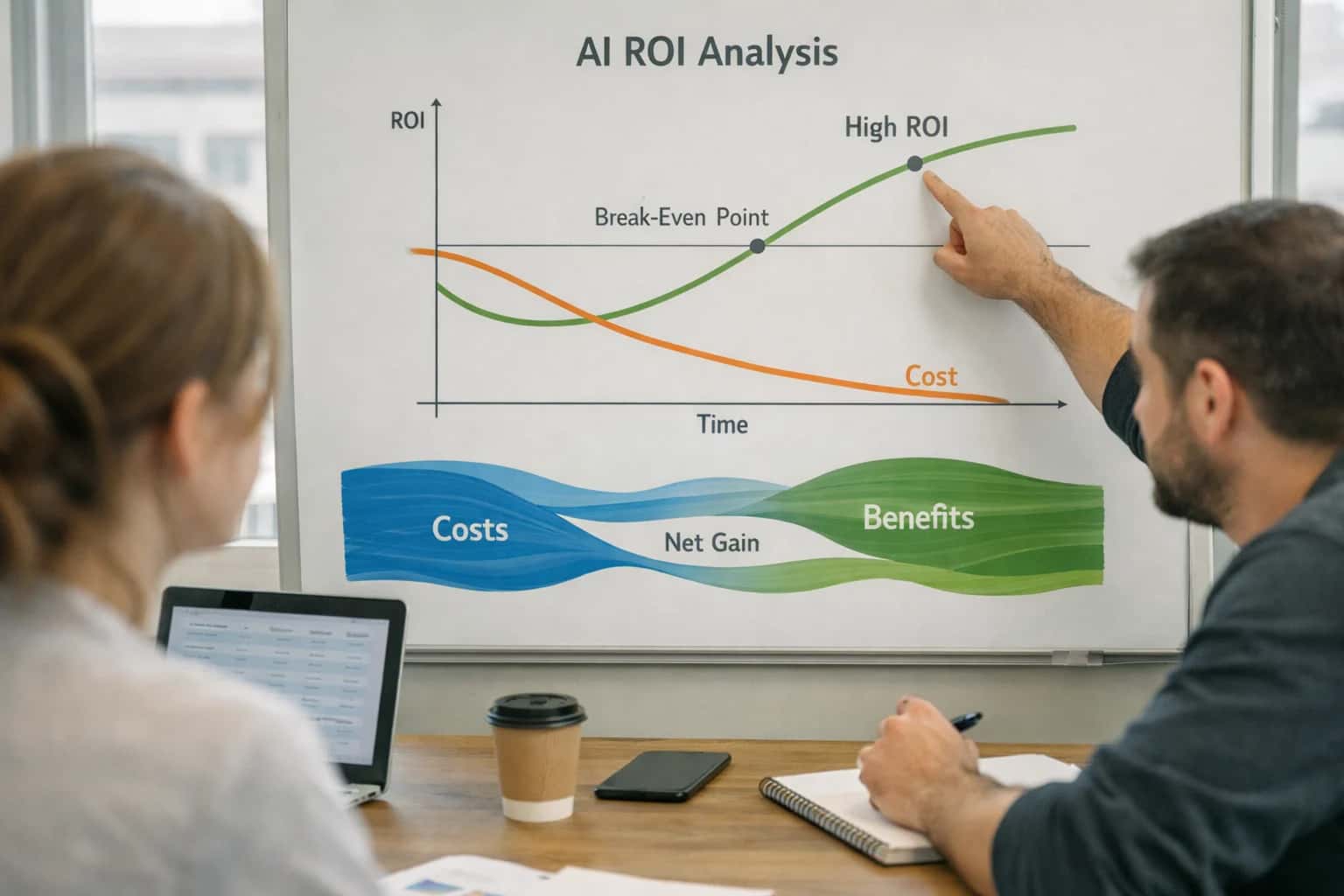
THE DATA
The ROI Mirage: How Calculators Set SMBs Up to Fail
Most AI ROI calculators ignore the hidden costs of data preparation, model tuning, and change management, creating a dangerously optimistic projection for SMBs.
These tools ignore inference economics, presenting a static API cost while real-world usage with models like GPT-4 or Claude 3 on cloud platforms leads to unpredictable, budget-busting expenses that erase projected savings.
Calculators assume perfect MLOps, omitting the continuous cost of monitoring for model drift and retuning, a critical service SMBs lack the in-house expertise to manage, leading to stale, ineffective automations.
Evidence: A study by MIT Sloan found that change management and integration account for over 60% of total AI project cost, a line item absent from every generic ROI tool. For a deeper analysis of SMB-specific barriers, see our pillar on SMB AI Accessibility and Adoption Gaps.
The real cost is operational fragility. DIY integration of LangChain, Pinecone or Weaviate, and model APIs without production-grade oversight creates systems that fail under load, turning promised efficiency into firefighting. Learn about the risks of DIY AI integration.
THE HIDDEN COST TRAP
The Three Trends Exposing Flawed AI ROI Calculators
Most ROI tools for SMBs ignore the operational realities of integration, change management, and model decay, painting a dangerously optimistic picture of value.
01
The Phantom of Perfect Data
ROI calculators assume clean, structured data is a given. For SMBs, 70-80% of the project cost is in dark data recovery, semantic enrichment, and building a functional data foundation. The promised automation fails without this unaccounted-for groundwork.
- Hidden Cost: $50k+ in data engineering before a single model runs
- Real Metric: Time-to-Value extends from months to 12-18 months
- Solution: Start with a data readiness audit and semantic mapping, not model selection.
+80%
Project Cost
12-18mo
Time-to-Value
02
Inference Economics & Unpredictable Burn
Calculators use static per-token API estimates. Real-world costs explode due to unoptimized prompts, recursive agent calls, and cloud egress fees. For dynamic pricing or customer support bots, latency directly impacts revenue, forcing expensive edge deployments.
- Hidden Cost: Cloud inference bills 2-5x higher than projected
- Real Metric: ~500ms added latency can crater conversion rates
- Solution: Architect for hybrid cloud AI and optimized model serving with tools like vLLM to control burn.
2-5x
Cost Overage
~500ms
Revenue Impact
03
The Model Drift Time Bomb
ROI is calculated on Day 1 model performance. Without continuous tuning, models drift within 3-6 months as business conditions change. SMBs lack the MLOps staff for tools like Weights & Biases, leading to silent failures in automated decisions.
- Hidden Cost: Quarterly retuning and monitoring adds 20-30% to TCO
- Real Metric: Accuracy decays 15-40% without active management
- Solution: Demand Automation-as-a-Service that bundles ongoing human expertise for model refinement, not a static software license.
-40%
Accuracy
+30%
Annual TCO
SMB AI ROI ANALYSIS
The Real Cost Breakdown: Calculator Promise vs. Operational Reality
A comparison of the costs typically projected by AI ROI calculators versus the actual, multi-year operational expenses required for a successful deployment, as detailed in our analysis of the SMB AI adoption gap.
| Cost Factor | ROI Calculator Promise | Operational Reality (Year 1) | Operational Reality (Years 2-3) |
|---|---|---|---|
Initial Model Integration | $5k - $15k | $25k - $75k (Includes data pipeline & API-wrapping legacy systems) | $5k - $15k/year (Maintenance & updates) |
Monthly Inference/API Costs | $200 - $500 | $800 - $3k (Scales with usage & premium model tiers) | $1k - $4k (Increases with business growth) |
Data Preparation & Enrichment | Included | $10k - $30k (For dark data recovery & semantic mapping) | $5k - $15k/year (Ongoing data hygiene) |
Change Management & Training | $2k | $15k - $40k (Stakeholder alignment & workflow redesign) | $10k/year (Continuous upskilling) |
Ongoing Model Tuning (MLOps) | Not Modeled | $20k - $50k/year (To combat model drift & maintain accuracy) | $20k - $50k/year (Essential for sustained ROI) |
Governance & Security (AI TRiSM) | Not Modeled | $10k - $25k (For explainability, monitoring, and compliance) | $10k - $25k/year (Ongoing risk management) |
Total 3-Year Cost of Ownership | < $50k | $80k - $223k (Year 1) | $150k - $450k (Cumulative) |
THE MISLEADING CALCULUS
Deconstructing the Hidden Cost Drivers That Kill SMB AI ROI
Standard ROI calculators ignore the true, compounding costs of data preparation, model tuning, and operational overhead, creating a false promise of value for SMBs.
Current AI ROI calculators are misleading because they treat AI deployment as a one-time software purchase, ignoring the continuous resource drain of production MLOps and data pipeline maintenance. They calculate savings from automation but omit the costs of achieving reliable, production-grade automation.
The largest hidden cost is data readiness. Calculators assume clean, structured data, but SMBs typically operate on legacy databases and unstructured dark data. Mobilizing this for AI requires expensive semantic enrichment and integration work, a foundational step our Legacy System Modernization and Dark Data Recovery services address.
Model inference is a variable, not fixed, cost. Calculators use static API pricing, but real-world usage with tools like vLLM or cloud endpoints fluctuates wildly. Unoptimized prompts and retrieval-augmented generation (RAG) systems on Pinecone or Weaviate can create unpredictable, budget-busting monthly bills.
Ongoing tuning creates a permanent tax. Foundation models like GPT-4 or Claude 3 drift and fail on proprietary data. Maintaining accuracy requires continuous fine-tuning and monitoring for model drift, an operational overhead most SMBs lack the expertise to manage internally.
The evidence is in failed pilots. Forrester notes that up to 60% of AI proofs-of-concept never reach production, with unforeseen integration complexity and change management costs being primary culprits. The promised ROI evaporates long before the system delivers value.
SMB AI ACCESSIBILITY
The Uncalculated Risks: Where Flawed ROI Models Create Liability
Most AI ROI calculators ignore the hidden costs of integration, data, and maintenance, leading SMBs into costly pilot purgatory.
01
The Problem: The Phantom Labor Savings
ROI models assume a direct 1:1 replacement of human hours, ignoring the ~30% productivity tax of managing the AI itself. They fail to account for the new roles required, like Agent Ops Leads and AI product owners, whose salaries are not offset by the automation.
- Hidden Cost: The 'AI management overhead' for prompt tuning, output validation, and workflow orchestration.
- Real Metric: Net labor cost reduction is often <50% of the projected figure after accounting for new hybrid roles.
<50%
Actual Labor Savings
+30%
Management Overhead
02
The Problem: The Data Readiness Black Hole
Calculators treat data as a free, clean input. For SMBs, ~80% of the project cost is in dark data recovery, semantic enrichment, and building the Retrieval-Augmented Generation (RAG) pipelines required for accuracy. This is a prerequisite most tools ignore.
- Hidden Cost: Data engineering and knowledge graph construction before a single model can be run.
- Real Metric: ROI timelines stretch by 6-12 months due to unplanned data mobilization work.
80%
Project Cost in Data
+12mo
Timeline Delay
03
The Solution: Inference Economics & Edge AI
Cloud API costs for models like GPT-4 are volatile and scale linearly with use. The real ROI comes from optimizing inference economics via open-source models (Llama, Mistral) deployed on edge devices or via efficient serving with vLLM. This reduces latency and locks in predictable costs.
- Key Benefit: ~70% reduction in ongoing inference costs versus premium cloud APIs.
- Key Benefit: Enables real-time decisioning for use cases like dynamic pricing or customer support.
-70%
Inference Cost
~200ms
Edge Latency
04
The Solution: Automation-as-a-Service with Continuous Tuning
Static models fail. True ROI requires a service model that bundles initial integration with ongoing model tuning and MLOps to combat model drift. This shifts the cost from CapEx to a predictable OpEx tied to business outcomes.
- Key Benefit: Eliminates the SMB MLOps skills gap with a fully managed service layer.
- Key Benefit: Guarantees model performance over time, protecting the initial automation investment.
0%
MLOps Overhead
SLA-Backed
Performance
05
The Liability: Unmanaged Model Drift
SMBs lack the monitoring tools of enterprises. A fine-tuned model for lead scoring or inventory forecasting can decay in 3-6 months due to changing market conditions, leading to silent revenue leakage. Flawed ROI models assume perpetual accuracy.
- Hidden Cost: Undetected bad decisions eroding margins before the problem is identified.
- Real Metric: Model performance can degrade by >40% without active monitoring and retraining loops.
3-6mo
Decay Timeline
-40%
Performance Drop
06
The Liability: The Integration Tax on Legacy Systems
ROI calculators assume seamless API connectivity. The reality for SMBs is legacy ERP and CRM systems that require 'strangler fig' pattern migrations or complex API-wrapping agents. This integration work often doubles the projected implementation timeline and cost.
- Hidden Cost: Custom connector development and ongoing maintenance for closed legacy systems.
- Real Metric: Total project cost is typically 2.5x the initial software/license estimate.
2.5x
True Project Cost
+100%
Timeline
THE DATA
The Vendor Rebuttal (And Why It's Wrong)
Vendor ROI calculators systematically ignore the hidden costs of data preparation, model tuning, and change management, creating a dangerously optimistic projection.
Vendor ROI calculators are misleading because they model a frictionless world where your data is clean, your team is AI-fluent, and the model works perfectly on day one. This ignores the data readiness gap and MLOps overhead that consume 70% of a real project's budget.
The 'plug-and-play' promise is false. Integrating a model like GPT-4 or Claude 3 into a legacy CRM requires API-wrapping legacy systems and building a Retrieval-Augmented Generation (RAG) pipeline with Pinecone or Weaviate. These are complex engineering tasks, not configuration.
ROI models exclude continuous tuning. A static model in production suffers model drift. Real ROI requires ongoing human-in-the-loop validation and retraining, a cost vendors omit by selling a product, not a lifecycle. This is why managed MLOps services are critical.
They underestimate change management. Calculators assume 100% user adoption. In reality, workflow resistance and the AI skills gap create productivity drag. Successful adoption requires redesigning roles, not just installing software, a concept explored in our pillar on AI Workforce Analytics.
Evidence: The pilot purgatory rate. For SMBs, over 60% of AI initiatives stall after the proof-of-concept because the projected ROI never materializes once data engineering and integration costs are fully accounted for, trapping capital in non-productive assets.
BEYOND THE CALCULATOR
Key Takeaways: How SMBs Should Evaluate AI ROI
Most AI ROI tools ignore hidden costs, creating a false picture of value. Here's what SMBs must measure instead.
01
The Problem of Hidden Integration Costs
ROI calculators assume a clean data feed. Reality involves dark data recovery, API-wrapping legacy systems, and semantic enrichment before the first AI query runs. This foundational work accounts for ~40-60% of total project cost and timeline.
- Key Benefit 1: Realistic budgeting that includes data readiness audits.
- Key Benefit 2: Focus on retrofit kits and Automation-as-a-Service models that bundle this work.
40-60%
Project Cost
~6 mos
Timeline Risk
02
The Myth of Static Model Value
Calculators present a one-time ROI. In production, models degrade due to data drift. SMBs lack the MLOps staff for continuous monitoring and retuning, leading to silent failure.
- Key Benefit 1: Demand continuous model tuning as part of service agreements.
- Key Benefit 2: Evaluate vendors on their ModelOps and drift detection capabilities, not just initial accuracy.
-20%
Accuracy/Yr
$0
Budgeted
03
Inference Economics: The Silent Budget Killer
Per-query API costs for models like GPT-4 are trivial in a demo but explode at scale. Unoptimized inference on cloud platforms creates unpredictable, variable expenses that erase projected savings.
- Key Benefit 1: Model cost-per-decision as a core KPI, not just time saved.
- Key Benefit 2: Architect for edge AI and smaller, fine-tuned models (e.g., via Ollama, vLLM) to control long-term inference costs.
10-100x
Cost Variance
Uncapped
Risk Profile
04
The Change Management Tax
No calculator accounts for productivity loss during workflow redesign, employee retraining, and trust-building with opaque AI outputs. This human-in-the-loop overhead determines ultimate adoption.
- Key Benefit 1: Allocate 20-30% of project budget for training and explainable AI features.
- Key Benefit 2: Prioritize solutions with clear audit trails and rationale for automated actions to build organizational trust.
20-30%
Budget Allocation
#1
Failure Cause
05
Vendor Lock-In is an ROI Sinkhole
Proprietary service wrappers create deeper, more expensive dependency than software licenses. Exiting requires redoing all integration and retraining work, negating cumulative ROI.
- Key Benefit 1: Insist on open architectures (e.g., open-source models, standard APIs) even within managed services.
- Key Benefit 2: Favor vendors who transfer full IP ownership of custom fine-tunes and connectors.
2-3x
Exit Cost
Permanent
Strategic Debt
06
Pilot Purgatory: The ROI Black Hole
Grants and internal proofs-of-concept fund exploration but not the production MLOps, security hardening, and scalability engineering. Projects stall, draining capital and eroding faith in AI.
- Key Benefit 1: Evaluate vendors on their path from POC to production, not demo capabilities.
- Key Benefit 2: Adopt pay-per-outcome or managed service models that align vendor success with your operational results, de-risking the scale-up phase.
90%
Stall Rate
$0 ROI
Outcome
Enabling Efficiency, Speed & Accuracy
Intelligent Analysis, Decision & Execution
We build AI systems for teams that need search across company data, workflow automation across tools, or AI features inside products and internal software.
Talk to Us
Search across company data
Give teams answers from docs, tickets, runbooks, and product data with sources and permissions.
Useful when people spend too long searching or get different answers from different systems.
Enterprise searchRAGPermissions
Read more
Automate internal workflows
Use AI to route work, draft outputs, trigger actions, and keep approvals and logs in place.
Useful when repetitive work moves across multiple tools and teams.
AI agentsWorkflow automationGovernance
Read more
Add AI to products and internal tools
Build assistants, guided actions, or decision support into the software your team or customers already use.
Useful when AI needs to be part of the product, not a separate tool.
AI integrationDecision supportModel routing
Read moreTHE MISLEADING METRIC
Demand Transparency, Not Just a Number
Generic AI ROI calculators ignore the hidden costs of data preparation, model tuning, and change management, creating a false picture of value for SMBs.
Current ROI calculators are fundamentally flawed because they treat AI as a plug-and-play software license, not a complex system integration. They calculate savings from hypothetical automation but omit the 60-80% of project effort spent on dark data recovery and building a production-ready data pipeline.
The real cost is in the data foundation. Calculators assume clean, structured data feeds into models like GPT-4 or Claude 3. The reality requires extracting data from legacy ERPs, normalizing it, and building a Retrieval-Augmented Generation (RAG) system with vector databases like Pinecone or Weaviate to ensure accuracy.
Ongoing tuning creates a recurring cost center. A static model is a failing model. Calculators ignore the MLOps overhead for monitoring model drift, fine-tuning on new data, and managing inference costs on cloud platforms, which can erase projected savings.
Change management is the silent budget killer. The promised 40% efficiency gain requires redesigning employee workflows and managing adoption resistance. This human factor, critical for agentic workflow success, is never quantified in upfront ROI tools.

About the author
Prasad Kumkar
CEO & MD, Inference Systems
Prasad Kumkar is the CEO & MD of Inference Systems and writes about AI systems architecture, LLM infrastructure, model serving, evaluation, and production deployment. Over 5+ years, he has worked across computer vision models, L5 autonomous vehicle systems, and LLM research, with a focus on taking complex AI ideas into real-world engineering systems.
His work and writing cover AI systems, large language models, AI agents, multimodal systems, autonomous systems, inference optimization, RAG, evaluation, and production AI engineering.
LinkedIn
Limited slotsGet a Free AI Consultation
Partnered with leading AI, data, and software stack.





How We Work
Custom AI workflows for your Business
One-fit-all AI don't work for modern businesses. At Inferensys, we aim to understand your business & custom requirements; which we use to define most efficient agentic workflows, the data, and the tools for your business.
01
Review the use case
We understand the task, the users, and where AI can actually help.
Read more02
Pick the right approach
We define what needs search, automation, or product integration.
Read more03
Build the first useful version
We implement the part that proves the value first.
Read more04
Improve from there
We add the checks and visibility needed to keep it useful.
Read moreThe first call is a practical review of your use case and the right next step.
Talk to Us