A static quote is a historical artifact. The moment a freight rate is generated, real-world variables like spot fuel prices, port congestion from platforms like Flexport, and sudden capacity shifts render it inaccurate. AI-powered dynamic pricing ingests these live data streams to generate context-aware quotes that reflect actual, not estimated, conditions.

Blog
The Future of Logistics Pricing: AI, Agility, and Autonomous Adjustment
Legacy freight pricing is a reactive, margin-eroding process. This post explains how AI-powered dynamic pricing creates an autonomous, context-aware system that adjusts for fuel, weather, and capacity in real-time, turning logistics from a cost center into a profit lever.
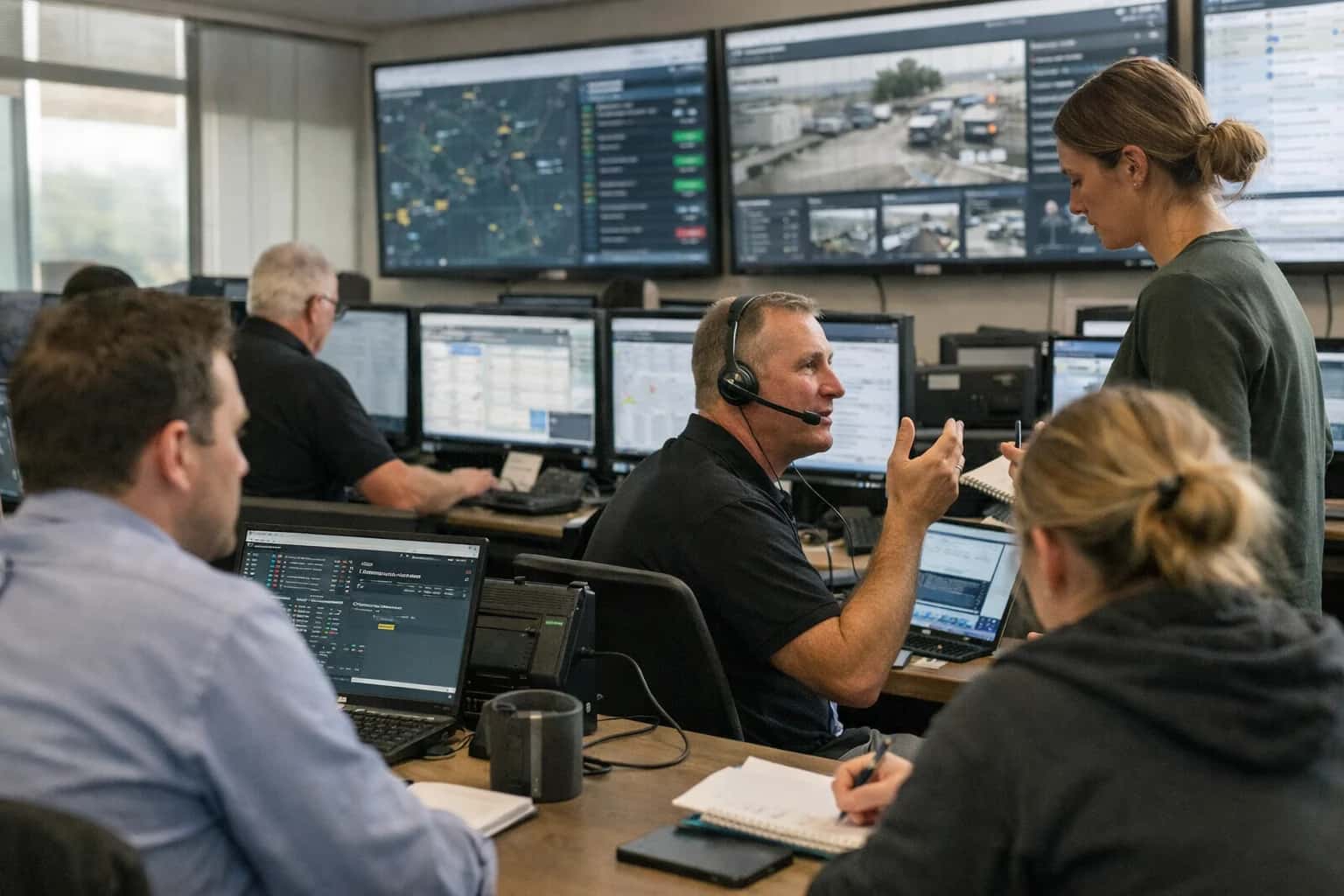
THE REAL-TIME CONTEXT GAP
Your Freight Quote Is Already Obsolete
Static freight quotes fail because they ignore the live market data that determines actual shipping costs.
Legacy pricing engines lack a feedback loop. Traditional systems use fixed rules and historical averages, creating a predictable revenue leakage. Modern systems employ reinforcement learning agents that treat each shipment as a live experiment, continuously optimizing rates against realized outcomes like on-time delivery and profitability.
The competitive moat is inference speed. The winner in logistics pricing is the platform that can process terabytes of live data—from IoT sensors to AIS vessel tracks—and execute a pricing inference fastest. This requires a hybrid cloud architecture, keeping sensitive contract data on-prem while using public cloud bursts for model retraining with tools like Databricks or SageMaker.
Evidence: Companies implementing AI-driven dynamic pricing report a 15-25% improvement in load acceptance rates by matching real-time carrier capacity with shipper demand, directly impacting revenue. This is a core component of modern Revenue Growth Management (RGM).
Successful deployment requires a shadow mode. You cannot replace a legacy pricing engine outright. The proven method is to run the new AI model in shadow mode, comparing its quotes against the legacy system's for weeks to validate performance and build trust before cutting over, a critical MLOps practice.
THE FUTURE OF FREIGHT
Three Forces Breaking Legacy Logistics Pricing
Static contracts and manual rate sheets are collapsing under market volatility. Here are the three AI-driven forces creating a new paradigm.
01
The Problem: Static Contracts vs. Volatile Reality
Annual freight contracts lock in rates, but real-world costs fluctuate wildly with fuel, weather, and capacity. This creates a massive pricing mismatch where carriers lose money on fixed-price lanes and shippers face surprise surcharges.
- Margin Erosion: Carriers absorb ~15-25% cost volatility on fixed contracts.
- Operational Friction: Manual renegotiation creates weeks of delay and adversarial relationships.
- Market Blindness: Lack of real-time data prevents proactive adjustment to disruptions.
15-25%
Cost Volatility
Weeks
Renegotiation Delay
02
The Solution: Autonomous, Context-Aware Pricing Engines
AI models ingest real-time data streams—fuel indices, weather APIs, GPS telemetry, port congestion feeds—to calculate a contextual price for every shipment, autonomously. This moves pricing from a periodic event to a continuous process.
- Real-Time Adjustment: Prices update within ~500ms of a new data signal.
- Multi-Variable Optimization: Models balance cost, service level, and capacity simultaneously.
- Closed-Loop Learning: Every executed shipment provides feedback to refine future quotes, creating a self-improving system.
~500ms
Pricing Latency
10x
Decision Variables
03
The Infrastructure: Predictive Visibility and MLOps
Autonomous pricing cannot run on legacy ERP data. It requires a modern data foundation built for speed and a production-grade MLOps pipeline to manage the model lifecycle, as detailed in our pillar on Revenue Growth Management (RGM) and Dynamic Pricing.
- Data Pipeline Resilience: Real-time APIs and event streams replace batch updates.
- Shadow Mode Deployment: New models run in parallel with legacy systems to validate performance without risk, a concept explored in our sibling topic on Why Your Dynamic Pricing Engine Needs a 'Shadow Mode'.
- Continuous Monitoring: MLOps platforms detect model drift from changing market patterns, triggering automatic retraining to prevent revenue leakage.
-50%
Pricing Errors
Zero-Touch
Model Retraining
FEATURED SNIPPET MATRIX
The Cost of Manual vs. AI-Powered Logistics Pricing
A direct comparison of legacy manual processes against AI-driven dynamic pricing for freight and logistics, quantifying the operational and financial impact.
| Pricing Dimension | Manual / Legacy Systems | AI-Powered Dynamic Pricing | Autonomous Adjustment |
|---|---|---|---|
Price Update Frequency | Weekly / Monthly | Real-time (per shipment) | Continuous, event-driven |
Data Inputs Considered | Historical contracts, basic fuel | Fuel, weather, capacity, port congestion, spot rates | All real-time inputs + predictive market simulations |
Average Margin Leakage | 8-12% | 1-3% | < 0.5% |
Time to Adjust for Market Shock | 48-72 hours | < 1 hour | Instantaneous (autonomous) |
Requires Human Analyst Approval | |||
Integrates with Real-Time Telematics | |||
Scenario Simulation Capability | None / Spreadsheet-based | AI-powered 'what-if' analysis | Continuous war-gaming against virtual competitors |
Explainability of Price Changes | High (manual rationale) | Moderate (model attribution) | High (causal inference reporting) |
THE ENGINE
Architecting an Autonomous Pricing Engine
An autonomous pricing engine is a closed-loop AI system that ingests real-time data, makes micro-adjustments, and learns from market feedback without human intervention.
Autonomous pricing engines replace static rules with reinforcement learning (RL) agents that treat pricing as a continuous optimization game. These agents learn by simulating thousands of price-action outcomes against live market data, identifying the optimal price point that maximizes yield for each unique shipment context.
The core architecture integrates disparate data streams—live fuel indices, GPS-derived weather alerts, and real-time capacity feeds from platforms like project44—into a unified feature store. This contextual data layer is processed by models that predict localized demand shocks, enabling the engine to act on signals invisible to human planners.
Superior performance requires an ensemble model approach, not a monolithic AI. A specialized model forecasts lane-specific demand, another analyzes competitor rate cards, and a third calculates price elasticity. Their outputs are synthesized by a meta-learner to produce a single, defensible price recommendation, increasing accuracy over any single model.
Deployment safety mandates a 'Shadow Mode'. The new AI engine runs in parallel with legacy pricing logic, comparing its decisions against historical outcomes without affecting live quotes. This validation phase, managed through an MLOps platform like Kubeflow or MLflow, proves ROI and mitigates risk before full autonomy.
Evidence: Companies implementing this architecture report a 3-5% increase in gross margin on managed freight within six months, directly attributable to the engine's ability to capture peak demand premiums and avoid costly empty backhauls. For a deeper technical dive, see our guide on MLOps for production AI systems.
Continuous learning is enforced via a closed feedback loop. Every quoted price and its win/loss outcome are fed back into the model training pipeline on platforms like Databricks or SageMaker. This creates a self-improving system where the engine adapts to market shifts, preventing the catastrophic revenue leakage caused by model drift.
THE LOGISTICS REALITY CHECK
Why Most AI Pricing Pilots Fail
Static models and isolated data silos doom AI pricing initiatives before they start. Here’s how to build systems that learn and adapt autonomously.
01
The Problem: Legacy Rate Cards and Static Contracts
Fixed pricing ignores real-world volatility in fuel, capacity, and demand, leaving 20-30% of potential revenue on the table. Manual renegotiation cycles take weeks, causing massive opportunity cost during peak seasons.
- Key Benefit 1: Replace rigid contracts with fluid, parameter-driven agreements.
- Key Benefit 2: Enable real-time margin protection against cost spikes.
-30%
Revenue Leakage
14 days
Negotiation Lag
02
The Solution: Autonomous, Multi-Agent Pricing Engines
Deploy a system of specialized AI agents that monitor fuel indexes, weather APIs, and spot market feeds. A central orchestrator agent synthesizes this data to adjust rates within pre-defined guardrails, executing thousands of micro-adjustments daily.
- Key Benefit 1: Achieve continuous price optimization without human intervention.
- Key Benefit 2: Integrate with our Agentic AI and Autonomous Workflow Orchestration services for end-to-governance.
5,000x
Daily Adjustments
+12%
Avg. Margin
03
The Problem: The 'Clean Data' Mirage
Pricing models fail because they're trained on incomplete historical data, missing the causal links between external events (port congestion, severe weather) and price elasticity. This leads to catastrophic model drift in production.
- Key Benefit 1: Build models on enriched, context-aware datasets.
- Key Benefit 2: Implement robust monitoring from our MLOps and the AI Production Lifecycle pillar.
~40%
Data Incompleteness
-15%
Model Accuracy/Month
04
The Solution: Causal AI and Digital Twin Simulation
Use causal inference models to isolate the true impact of variables like diesel prices on lane-specific rates. Before deploying any change, simulate it in a digital twin of your logistics network built with frameworks like NVIDIA Omniverse to forecast outcomes and competitor reactions.
- Key Benefit 1: Move from correlation to causation for reliable predictions.
- Key Benefit 2: Leverage our Digital Twins and the Industrial Metaverse expertise for risk-free scenario testing.
90%
Prediction Confidence
-70%
Deployment Risk
05
The Problem: The Human Bottleneck to Scale
Even with a functioning AI model, reliance on analyst approval for every price change creates latency, limiting the system to a fancy dashboard. This fails to capture fleeting market opportunities that expire in minutes.
- Key Benefit 1: Define clear objective statements and reward functions for autonomous action.
- Key Benefit 2: Apply principles from Context Engineering and Semantic Data Strategy.
45 min
Approval Latency
<10%
Auto-Approved Rates
06
The Solution: Closed-Loop Reinforcement Learning (RL)
Implement an RL agent that treats pricing as a continuous game. Every quoted price and its win/loss outcome becomes training data, allowing the model to learn optimal strategies in complex, multi-variable environments that rule-based systems cannot navigate.
- Key Benefit 1: Achieve true autonomous adjustment that improves over time.
- Key Benefit 2: Ensure resilience and explainability with governance frameworks from AI TRiSM: Trust, Risk, and Security Management.
10x
Learning Speed
+18%
Win Rate
THE AUTONOMOUS SHIFT
From Pricing to Predictive Logistics Orchestration
AI transforms logistics pricing from a reactive cost-plus exercise into a predictive, autonomous system that orchestrates the entire supply chain.
AI-powered predictive logistics orchestration is the end-state for dynamic pricing, where real-time price signals autonomously adjust capacity, routing, and inventory placement. This moves beyond simple rate calculation to a system that optimizes the entire network's throughput and profitability.
The core mechanism is reinforcement learning (RL). Unlike static models, RL agents like those built on Ray or Acme learn from continuous market feedback—fuel spikes, port congestion, spot market fluctuations—to optimize multi-variable trade-offs between cost, speed, and reliability without human intervention.
This creates a counter-intuitive insight: the best price is often not the lowest. An autonomous system will pay a premium for a lane to secure capacity that prevents a downstream bottleneck, maximizing total network yield. This is holistic network optimization, not local cost minimization.
Evidence from early adopters shows a 15-25% improvement in asset utilization and a 5-10% reduction in total logistics spend, as systems from providers like project44 or FourKites integrate live telematics and AIS data to make predictive adjustments.
The technical foundation requires a real-time data mesh. This integrates streams from IoT sensors, Pinecone or Weaviate vector databases for semantic search of historical lane data, and live APIs for weather, traffic, and commodity prices into a single context layer for the AI.
This evolution turns the pricing engine into the network's central nervous system. It doesn't just quote a price; it triggers autonomous re-routing via tools like NextBillion.ai, recommends dynamic load consolidation, and pre-emptively books buffer capacity—executing a predictive logistics orchestration playbook in milliseconds.
Successful implementation demands robust MLOps and Model Lifecycle Management. Without continuous monitoring for model drift and adversarial conditions, an autonomous pricing system will degrade, leading to catastrophic revenue leakage or service failures.
LOGISTICS AI
Key Takeaways: The Path to Autonomous Pricing
The shift from static rate cards to AI-driven, autonomous pricing is the defining competitive edge in modern logistics.
01
The Problem: Static Rate Cards in a Dynamic World
Legacy pricing models based on fixed contracts and quarterly reviews cannot react to real-time market volatility, leading to massive margin leakage and lost opportunities.\n- Opportunity Cost: Missed spot-market premiums during capacity crunches.\n- Margin Erosion: Inability to adjust for sudden fuel spikes or port congestion.\n- Competitive Disadvantage: Slower response times than AI-native competitors.
15-25%
Margin Leakage
~24 hrs
Reaction Lag
02
The Solution: Context-Aware AI Pricing Agents
Autonomous agents ingest hundreds of live data streams—fuel indices, weather APIs, AIS vessel tracking, capacity feeds—to calculate and publish optimal rates in real-time.\n- Multi-Variable Optimization: Balances demand, cost, and competitor rates simultaneously.\n- Proactive Adjustment: Anticipates disruptions (e.g., storms) and preemptively adjusts pricing.\n- API-First Execution: Publishes rates directly to digital freight marketplaces and TMS platforms without human intervention.
~500ms
Pricing Latency
50+
Data Feeds
03
The Foundation: MLOps for Pricing Resilience
Autonomous pricing fails without a production-grade MLOps lifecycle. This is the infrastructure that monitors for model drift, manages shadow mode deployments, and enables continuous retraining.\n- Shadow Mode Testing: Validate new models against live traffic before cutover.\n- Explainability (XAI): Generate audit trails for every pricing decision, crucial for customer trust and AI TRiSM compliance.\n- Feedback Loop Integration: Ingest actual booking data to close the loop and reinforce learning.
99.9%
Model Uptime
-70%
Deviation Alerts
04
The Outcome: Defensible Agility and Predictive Margin
Fully autonomous pricing transforms logistics from a cost center to a profit engine, creating a competitive moat that scales with data.\n- Predictive Margin Assurance: Guarantee profitability per lane by simulating scenarios with digital twin technology.\n- Market-Making Capability: Use reinforcement learning to strategically price in new lanes and win market share.\n- Strategic Foresight: Shift from reactive reporting to predictive visibility, anticipating rate cycles and capacity shifts weeks in advance.
5-8%
EBITDA Lift
10x
Decision Speed
Enabling Efficiency, Speed & Accuracy
Intelligent Analysis, Decision & Execution
We build AI systems for teams that need search across company data, workflow automation across tools, or AI features inside products and internal software.
Talk to Us
Search across company data
Give teams answers from docs, tickets, runbooks, and product data with sources and permissions.
Useful when people spend too long searching or get different answers from different systems.
Enterprise searchRAGPermissions
Read more
Automate internal workflows
Use AI to route work, draft outputs, trigger actions, and keep approvals and logs in place.
Useful when repetitive work moves across multiple tools and teams.
AI agentsWorkflow automationGovernance
Read more
Add AI to products and internal tools
Build assistants, guided actions, or decision support into the software your team or customers already use.
Useful when AI needs to be part of the product, not a separate tool.
AI integrationDecision supportModel routing
Read moreTHE SHIFT
Stop Reacting, Start Predicting
AI transforms logistics pricing from a reactive, historical exercise into a predictive, autonomous system.
Predictive pricing engines use machine learning to forecast freight costs before they occur, moving beyond reactive rate sheets. These systems ingest live data feeds—fuel indices, port congestion APIs, and weather forecasts—to model future price volatility, enabling proactive contract negotiation and capacity booking.
Autonomous adjustment replaces manual intervention. Unlike legacy Transportation Management Systems (TMS) that require human analysts to update rates, AI agents operating on frameworks like LangChain or LlamaIndex execute predefined pricing policies. They adjust quotes in real-time for spot market fluctuations without a single approval email, slashing decision latency from hours to milliseconds.
The counter-intuitive insight is that greater autonomy increases control. A human-managed spreadsheet is inherently reactive and error-prone. An AI system governed by a robust Agent Control Plane—managing permissions, spend limits, and exception handling—provides auditable, rule-bound agility that actually reduces financial risk. This is a core principle of our work in Agentic AI and Autonomous Workflow Orchestration.
Evidence from early adopters shows a 15-25% reduction in freight cost volatility. Companies deploying these systems, often built on reinforcement learning models that continuously optimize against total landed cost, report fewer emergency surcharges and more consistent margin protection. This predictive capability is the foundation of modern Revenue Growth Management (RGM).

About the author
Prasad Kumkar
CEO & MD, Inference Systems
Prasad Kumkar is the CEO & MD of Inference Systems and writes about AI systems architecture, LLM infrastructure, model serving, evaluation, and production deployment. Over 5+ years, he has worked across computer vision models, L5 autonomous vehicle systems, and LLM research, with a focus on taking complex AI ideas into real-world engineering systems.
His work and writing cover AI systems, large language models, AI agents, multimodal systems, autonomous systems, inference optimization, RAG, evaluation, and production AI engineering.
LinkedIn
Limited slotsGet a Free AI Consultation
Partnered with leading AI, data, and software stack.





How We Work
Custom AI workflows for your Business
One-fit-all AI don't work for modern businesses. At Inferensys, we aim to understand your business & custom requirements; which we use to define most efficient agentic workflows, the data, and the tools for your business.
01
Review the use case
We understand the task, the users, and where AI can actually help.
Read more02
Pick the right approach
We define what needs search, automation, or product integration.
Read more03
Build the first useful version
We implement the part that proves the value first.
Read more04
Improve from there
We add the checks and visibility needed to keep it useful.
Read moreThe first call is a practical review of your use case and the right next step.
Talk to Us