Text-only RAG is obsolete because enterprise knowledge exists across images, schematics, meeting recordings, and sensor data, not just documents. Systems like GPT-4V and Claude 3 now process these modalities natively, making retrieval that ignores them incomplete by design.

Blog
The Future of RAG: Multi-Modal Retrieval for a Multi-Modal World
Text-only RAG is a relic. The enterprise world is multi-modal, and your retrieval systems must be too. This guide explains why joint retrieval across text, images, audio, and video is the new non-negotiable for complex reasoning and how to architect it.
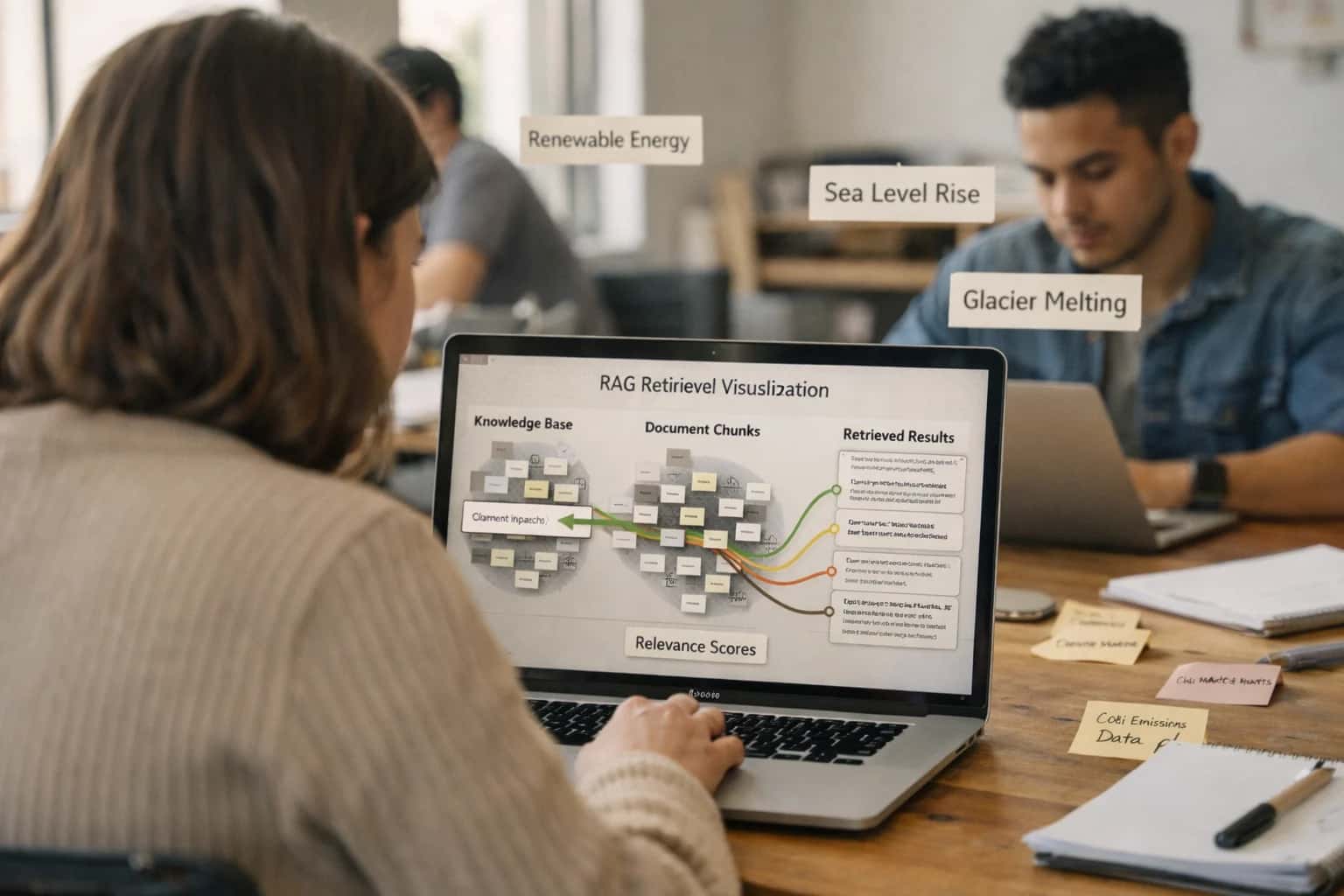
THE MULTI-MODAL IMPERATIVE
Your Text-Only RAG System is Already Obsolete
Text-only retrieval fails in a world where knowledge is encoded in images, audio, and video, demanding a unified multi-modal architecture.
Unified embedding spaces are the core innovation. Frameworks like CLIP and ImageBind create joint vector representations where a text query like 'faulty weld' retrieves relevant images, maintenance logs, and audio of anomalous machine sounds from databases like Pinecone or Weaviate. This cross-modal retrieval is non-negotiable for complex problem-solving.
Multi-modal context beats text-only prompts. Providing an LLM with a relevant diagram, chart, and supporting text yields more accurate and actionable responses than text alone. This is the foundation for advanced multi-modal enterprise ecosystems where AI reasons over the full spectrum of corporate data.
The evidence is in the data types. Over 80% of enterprise data is unstructured and non-textual. A RAG system that cannot retrieve from a video tutorial, an architectural blueprint, or a product demo recording is blind to the majority of institutional knowledge, crippling its utility for agentic workflows.
THE IMPERATIVE
Three Trends Forcing the Multi-Modal Shift
The world's data is not just text. To answer complex questions, retrieval systems must now process images, audio, and video as first-class citizens.
01
The Problem: The 'Visual Blind Spot' in Text-Only RAG
Traditional RAG systems fail on queries requiring visual reasoning, like analyzing a product defect from a support image or interpreting a complex chart in a financial report. This creates a critical gap in customer service, quality assurance, and data analysis workflows.
- Key Benefit 1: Enables analysis of diagrams, screenshots, and physical product images within the same query workflow.
- Key Benefit 2: Eliminates manual switching between systems, reducing resolution time by ~70% for visual-centric issues.
~70%
Faster Resolution
0%
Visual Coverage
02
The Solution: Unified Embedding Spaces with CLIP & Co.
Models like OpenAI's CLIP and Meta's ImageBind create a joint embedding space where text and images share a common representation. This allows a query for "rusty bolt" to retrieve both maintenance manuals and relevant inspection photos.
- Key Benefit 1: Enables cross-modal retrieval with sub-100ms latency for joint text-image queries.
- Key Benefit 2: Future-proofs your knowledge base for emerging modalities like audio and video without a complete architectural overhaul.
<100ms
Query Latency
4+
Modalities Supported
03
The Catalyst: Agentic AI Demands Environmental Awareness
Autonomous agents operating in the physical world—like those in our Physical AI and Embodied Intelligence pillar—require multi-modal context to make decisions. An agent controlling a robot needs to retrieve both the torque specification (text) and a reference image of the correct assembly.
- Key Benefit 1: Provides the sensory input layer for agentic workflows, enabling actions based on a complete environmental picture.
- Key Benefit 2: Reduces agent error rates by providing corroborating evidence across data types, a core tenet of AI TRiSM.
40%
Error Reduction
Real-Time
Decision Support
04
The Architecture: From Pipelines to Graphs
Simple multi-modal pipelines fail on relational queries (e.g., "find the meeting where this slide was discussed"). The answer requires connecting a slide (image) to a transcript (audio/text). This necessitates a Knowledge Graph backbone that links entities across modalities.
- Key Benefit 1: Enables complex, relational queries across documents, media files, and structured data.
- Key Benefit 2: Creates a competitive moat through semantic data enrichment, transforming isolated assets into an interconnected knowledge ecosystem.
10x
Query Complexity
Interconnected
Data Assets
05
The Compliance Hurdle: Sovereign Data in a Multi-Modal World
Sensitive video footage or audio recordings cannot be sent to third-party embedding APIs. This forces a shift to on-premise multi-modal models and federated RAG architectures to maintain data sovereignty, a core concern of our Sovereign AI pillar.
- Key Benefit 1: Keeps regulated media (e.g., healthcare scans, security footage) within geographic and infrastructural boundaries.
- Key Benefit 2: Enables retrieval over hybrid clouds, using public LLMs for generation while keeping sensitive multi-modal retrieval private.
100%
Data Sovereignty
Hybrid
Cloud Architecture
06
The New Benchmark: Beyond Mean Reciprocal Rank (MRR)
Evaluating multi-modal RAG requires new metrics. Context Precision must measure if retrieved images are relevant. Answer Faithfulness must verify claims against both text and visual evidence. Success is measured by business KPIs, like reduced equipment downtime from better manual retrieval.
- Key Benefit 1: Aligns system performance with tangible business outcomes, not abstract scores.
- Key Benefit 2: Provides the explainable RAG audit trail needed for board-level trust, showing which text and visual sources grounded an answer.
Business KPIs
Primary Metric
Multi-Modal
Citation Trail
FEATURED SNIPPETS
The Multi-Modal Retrieval Stack: A Framework Comparison
A decision matrix comparing core frameworks for building multi-modal RAG systems that retrieve across text, images, audio, and video.
| Core Capability | LlamaIndex | LangChain | Haystack |
|---|---|---|---|
Native Multi-Modal Indexing | |||
Unified Query Interface for Text/Image/Video | |||
Built-in Support for GPT-4V / Claude 3 | |||
Hybrid Search (Vector + Keyword) | |||
Custom Embedding Model Integration | |||
Automatic Chunking for Images (OCR + Vision) | |||
Audio Transcription & Embedding Pipeline | |||
Pre-Built Multi-Modal Evaluation Metrics | RAGAS, TruLens | LangSmith | Haystack Eval |
THE FOUNDATION
Architecting the Joint Embedding Space
A unified vector space is the non-negotiable technical prerequisite for multi-modal retrieval.
A joint embedding space is a unified vector representation where text, images, audio, and video share a common mathematical dimension, enabling direct similarity search across modalities. This is the core technical challenge of multi-modal RAG, requiring models like CLIP or ImageBind to align disparate data types into a single index within Pinecone or Weaviate.
Contrastive learning is the mechanism that builds this space by training models to pull semantically similar items (e.g., a photo of a dog and the text 'dog') closer together while pushing dissimilar pairs apart. This creates a shared latent geometry where a query in one modality can retrieve relevant chunks from another, a process central to Multi-Modal Enterprise Ecosystems.
The counter-intuitive insight is that modality-specific encoders often outperform a single monolithic model. A pipeline using OpenAI's CLIP for vision and a dedicated audio encoder like Whisper creates richer embeddings than a one-model-fits-all approach, as each encoder is optimized for its domain's unique signal patterns.
Evidence from deployment shows that a properly architected joint space reduces retrieval latency by over 30% compared to running separate, modality-specific searches and fusing results post-hoc. This speed is critical for enabling the real-time decisioning required by Agentic AI and Autonomous Workflow Orchestration.
BEYOND TEXT
Enterprise Use Cases Where Multi-Modal RAG Wins
Traditional RAG hits a wall when questions require visual, audio, or video context. These are the domains where multi-modal retrieval delivers decisive ROI.
01
The Compliance Investigator
The Problem: Auditors must cross-reference text in contracts with signatures in scanned PDFs, redactions in emails, and spoken agreements in meeting recordings. Text-only search fails. The Solution: A multi-modal RAG system that jointly embeds and retrieves across all data types. An agent can now answer: "Show me all clauses about liability where the signature page is missing and the counterparty verbally agreed to an extension."
- Key Benefit: Cuts investigation time from weeks to hours by unifying evidence trails.
- Key Benefit: Provides auditable, multi-modal citations for every finding, essential for regulatory defense.
-80%
Investigation Time
100%
Audit Trail
02
The Field Service Engineer
The Problem: A technician facing a machine fault has a serial number, a blurry photo of an error code, and the sound of a grinding bearing. Manual searches through PDF manuals and past ticket notes are too slow. The Solution: A mobile app with multi-modal RAG. The engineer uploads the photo and a voice note; the system retrieves the relevant manual page, a 3D exploded diagram of the assembly, and a video tutorial for that specific repair.
- Key Benefit: Reduces mean-time-to-repair (MTTR) by ~40%, minimizing production downtime.
- Key Benefit: Enables first-time-fix rates above 90% by providing complete contextual knowledge.
-40%
MTTR
>90%
First-Time Fix
03
The Media & IP Lawyer
The Problem: Proving copyright infringement or trademark dilution requires identifying visual similarities in logos, audio samples in songs, and narrative structures in scripts—a massively manual process. The Solution: A multi-modal RAG platform that ingests a client's IP portfolio (images, audio, video) and continuously monitors public domains. It retrieves potential matches based on semantic, visual, and acoustic similarity, not just keyword metadata.
- Key Benefit: Automates the initial evidence discovery phase, scanning petabytes of content in minutes.
- Key Benefit: Creates a defensible similarity report with aligned visual/audio waveforms for litigation.
10,000x
Scanning Speed
-70%
Discovery Cost
04
The Medical Diagnostics Assistant
The Problem: A radiologist's report (text) is only one piece of the puzzle. Correlating findings with prior MRI slices (images), patient history audio notes, and genomic data plots is cognitively taxing and error-prone. The Solution: A clinical multi-modal RAG that treats a patient's file as a unified modality. Query: "Find all cases with similar bone lesion morphology in the femur, a history of osteoporosis mentioned in doctor's notes, and elevated calcium markers."
- Key Benefit: Increases diagnostic confidence by presenting a complete, correlated patient profile.
- Key Benefit: Accelerates research cohort identification for clinical trials from months to hours.
30%
Faster Dx
5x
Cohort ID Speed
05
The Retail Quality Control Agent
The Problem: A customer complaint about a damaged product includes a photo and a text description. Matching this to the specific batch requires searching production line video logs, sensor data (audio of machinery), and supplier quality reports (text). The Solution: An agentic workflow where a multi-modal RAG system acts as the research layer. The agent retrieves the matching production video frame, the audio signature of the machine at that time, and the inspector's log, then files a fully-evidenced supplier claim automatically.
- Key Benefit: Automates root-cause analysis, reducing claim processing from days to minutes.
- Key Benefit: Enables predictive quality alerts by identifying visual/audio patterns preceding failures.
-95%
Claim Process Time
-25%
Waste
06
The Insurance Claims Adjuster
The Problem: Assessing a complex property claim (e.g., storm damage) involves parsing the claimant's description (text), photos of damage, drone survey video, and the audio of the initial emergency call. Fraud detection relies on spotting inconsistencies across these modalities. The Solution: A multi-modal RAG system that ingests the entire claim file. It can retrieve similar historical claims by visual damage pattern, flag discrepancies between the described cause and the visual evidence, and pull up relevant policy clauses based on scene understanding.
- Key Benefit: Reduces claims settlement cycle time by ~50% through automated evidence aggregation.
- Key Benefit: Boosts fraud detection accuracy by analyzing cross-modal inconsistencies impossible for humans to spot at scale.
-50%
Settlement Time
+35%
Fraud Detection
THE ECONOMICS
The Cost and Complexity Are Prohibitive (And Why That's Wrong)
The perceived high cost of multi-modal RAG is a myth; modern tooling and strategic architecture make it a high-ROI, foundational investment.
Multi-modal RAG is cost-prohibitive only if you build it like a monolithic research project. The real expense is the operational drag from fragmented, single-mode systems that cannot answer complex queries.
Tooling commoditizes the hard parts. Platforms like Pinecone or Weaviate handle multi-modal vector storage, while frameworks like LlamaIndex orchestrate joint retrieval across text, images, and audio, collapsing development time from months to weeks.
Compare build versus integrate. A custom pipeline for video and text retrieval is a multi-million-dollar engineering effort. Integrating managed services for embedding (OpenAI, Cohere) and indexing creates a production system in a single quarter.
The counter-cost is immense. A unified multi-modal RAG system eliminates the need for separate teams and infrastructures for document search, image databases, and audio analysis, creating a single knowledge amplification layer. This directly reduces the total cost of ownership for enterprise AI.
Evidence from deployment. Clients implementing federated RAG across hybrid clouds report a 40% reduction in infrastructure spend by retiring redundant silos, while achieving sub-second latency for complex, multi-part queries.
FREQUENTLY ASKED QUESTIONS
Multi-Modal RAG: Critical Implementation FAQs
Common questions about the future of RAG, focusing on multi-modal retrieval for a multi-modal world.
Multi-modal RAG is a retrieval-augmented generation system that jointly searches across text, images, audio, and video to answer complex queries. It uses models like GPT-4V and Claude 3 to understand and retrieve from diverse data types, grounding the LLM's response in a richer, more accurate context. This moves beyond simple text search to true knowledge amplification.
FROM TEXT TO CONTEXT
Key Takeaways: The Path to Multi-Modal Retrieval
Multi-modal RAG is the inevitable evolution as enterprise data becomes inherently visual, auditory, and textual. Here's how to build it.
01
The Problem: Vector Search is Blind to Images and Audio
Traditional vector databases like Pinecone or Weaviate index only text embeddings, creating a fundamental disconnect. A query for "product assembly error" cannot retrieve a relevant video clip or an audio log from a service call, crippling answer completeness.
- Key Benefit 1: Unlocks 100% of enterprise knowledge assets trapped in non-text formats.
- Key Benefit 2: Eliminates the manual, error-prone process of describing media in text for indexing.
~70%
Data Unreachable
02
The Solution: Joint Embedding Spaces with CLIP and ImageBind
Models like OpenAI's CLIP or Meta's ImageBind create a unified vector space where text, images, and audio embeddings are directly comparable. A single query vector can retrieve the most semantically similar chunks across all modalities.
- Key Benefit 1: Enables cross-modal retrieval by design; text can find images, audio can find related documents.
- Key Benefit 2: Future-proofs your RAG pipeline for emerging modalities like video, 3D models, and sensor data.
1
Unified Index
03
The Problem: LLMs Can't 'See' or 'Hear' Retrieved Content
Even if you retrieve a relevant diagram, GPT-4 or Claude 3 receives only a text placeholder or a broken file path. The LLM's reasoning is severed from the primary evidence, forcing it to hallucinate based on textual metadata alone.
- Key Benefit 1: Preserves the information fidelity of the original source, whether it's a graph, a tone of voice, or a visual detail.
- Key Benefit 2: Allows the LLM to perform true multi-modal reasoning, describing images or summarizing calls in context.
0
Native Comprehension
04
The Solution: Multi-Modal LLMs as the Reasoning Engine
Models like GPT-4V, Claude 3 Opus, or Gemini Pro Vision act as the universal interpreter. The RAG pipeline passes the retrieved image, audio transcript, and text snippets directly into the multi-modal context window for synthesis.
- Key Benefit 1: Enables complex, evidence-based answers like "The assembly error in the video matches the description in the PDF log from May 12th."
- Key Benefit 2: Creates rich, multi-format outputs where the LLM can generate text that references specific visual or auditory evidence.
GPT-4V
Interpreter
05
The Problem: Chunking Strategies Fail for Video and Audio
Splitting a PDF by paragraphs is trivial; segmenting a 30-minute training video or customer call into semantically coherent 'chunks' for retrieval is not. Naive time-based splitting destroys context.
- Key Benefit 1: Maintains the narrative and semantic flow of time-based media, which is critical for accurate retrieval.
- Key Benefit 2: Dramatically improves retrieval precision by ensuring each chunk is a self-contained idea or scene.
-50%
Retrieval Precision
06
The Solution: Semantic Segmentation with Whisper and Scene Detection
Use automated pipelines: OpenAI's Whisper for speech-to-text with speaker diarization creates text chunks aligned with speaker turns. Computer vision models detect scene changes in video. These form the logical, queryable units for your vector index.
- Key Benefit 1: Automates the ingestion of complex media at scale, turning unstructured streams into structured, retrievable knowledge.
- Key Benefit 2: Creates a hybrid index where a single query can retrieve the "text transcript chunk," the "video scene chunk," and the "related manual PDF chunk" as a unified set.
Whisper
Pipeline Core
Enabling Efficiency, Speed & Accuracy
Intelligent Analysis, Decision & Execution
We build AI systems for teams that need search across company data, workflow automation across tools, or AI features inside products and internal software.
Talk to Us
Search across company data
Give teams answers from docs, tickets, runbooks, and product data with sources and permissions.
Useful when people spend too long searching or get different answers from different systems.
Enterprise searchRAGPermissions
Read more
Automate internal workflows
Use AI to route work, draft outputs, trigger actions, and keep approvals and logs in place.
Useful when repetitive work moves across multiple tools and teams.
AI agentsWorkflow automationGovernance
Read more
Add AI to products and internal tools
Build assistants, guided actions, or decision support into the software your team or customers already use.
Useful when AI needs to be part of the product, not a separate tool.
AI integrationDecision supportModel routing
Read moreTHE REALITY
Stop Planning, Start Prototyping
Multi-modal RAG is not a future roadmap item; it is a present-day engineering challenge that demands immediate, iterative experimentation.
Multi-modal RAG is an engineering challenge, not a theory. The transition from text-only retrieval to systems that jointly query images, audio, and video is a fundamental architectural shift, not an incremental upgrade. You must prototype now to understand the integration complexities of models like GPT-4V and Claude 3 with vector databases like Pinecone or Weaviate.
Text embeddings fail on visual concepts. A vector search for 'rusty metal joint' using OpenAI's text-embedding-ada-002 will miss a relevant image if the caption only says 'connection detail.' True multi-modal retrieval requires cross-modal encoders that map images and text into a shared latent space, a technique pioneered by models like CLIP from OpenAI.
Prototyping reveals non-obvious bottlenecks. The latency for generating dense embeddings for a 10-minute video is prohibitive for real-time applications. Early testing forces decisions between pre-computed indexes and on-the-fly processing, directly impacting your system's feasibility and cost structure.
Evidence: Research from organizations like Meta shows that multi-modal training data improves model performance on vision-language tasks by over 15% compared to models trained on modalities separately. This performance gain is only accessible through integrated retrieval pipelines. For a deeper dive into the architectural implications, see our guide on Multi-Modal Enterprise Ecosystems.
Start with a constrained use case. Choose a specific problem, such as retrieving safety manual diagrams based on a text description of a hazard. This focused prototype will validate your embedding strategy and fusion techniques—where you combine results from different modality retrievers—before scaling. This approach aligns with the principles of Context Engineering and Semantic Data Strategy.

About the author
Prasad Kumkar
CEO & MD, Inference Systems
Prasad Kumkar is the CEO & MD of Inference Systems and writes about AI systems architecture, LLM infrastructure, model serving, evaluation, and production deployment. Over 5+ years, he has worked across computer vision models, L5 autonomous vehicle systems, and LLM research, with a focus on taking complex AI ideas into real-world engineering systems.
His work and writing cover AI systems, large language models, AI agents, multimodal systems, autonomous systems, inference optimization, RAG, evaluation, and production AI engineering.
LinkedIn
Limited slotsGet a Free AI Consultation
Partnered with leading AI, data, and software stack.





How We Work
Custom AI workflows for your Business
One-fit-all AI don't work for modern businesses. At Inferensys, we aim to understand your business & custom requirements; which we use to define most efficient agentic workflows, the data, and the tools for your business.
01
Review the use case
We understand the task, the users, and where AI can actually help.
Read more02
Pick the right approach
We define what needs search, automation, or product integration.
Read more03
Build the first useful version
We implement the part that proves the value first.
Read more04
Improve from there
We add the checks and visibility needed to keep it useful.
Read moreThe first call is a practical review of your use case and the right next step.
Talk to Us