Static models are obsolete because industrial environments and failure modes evolve. A model trained on last year's data cannot predict tomorrow's novel fault. The solution is a Continuous Learning Loop that ingests live sensor streams, technician feedback, and repair outcomes to self-update.

Blog
The Future of Predictive Maintenance Is a Continuous Learning Loop
Static AI models are obsolete in dynamic industrial environments. This article explains why predictive maintenance systems must evolve into continuous learning loops that ingest real-time sensor data, technician feedback, and performance metrics to self-improve in production, preventing catastrophic model decay.
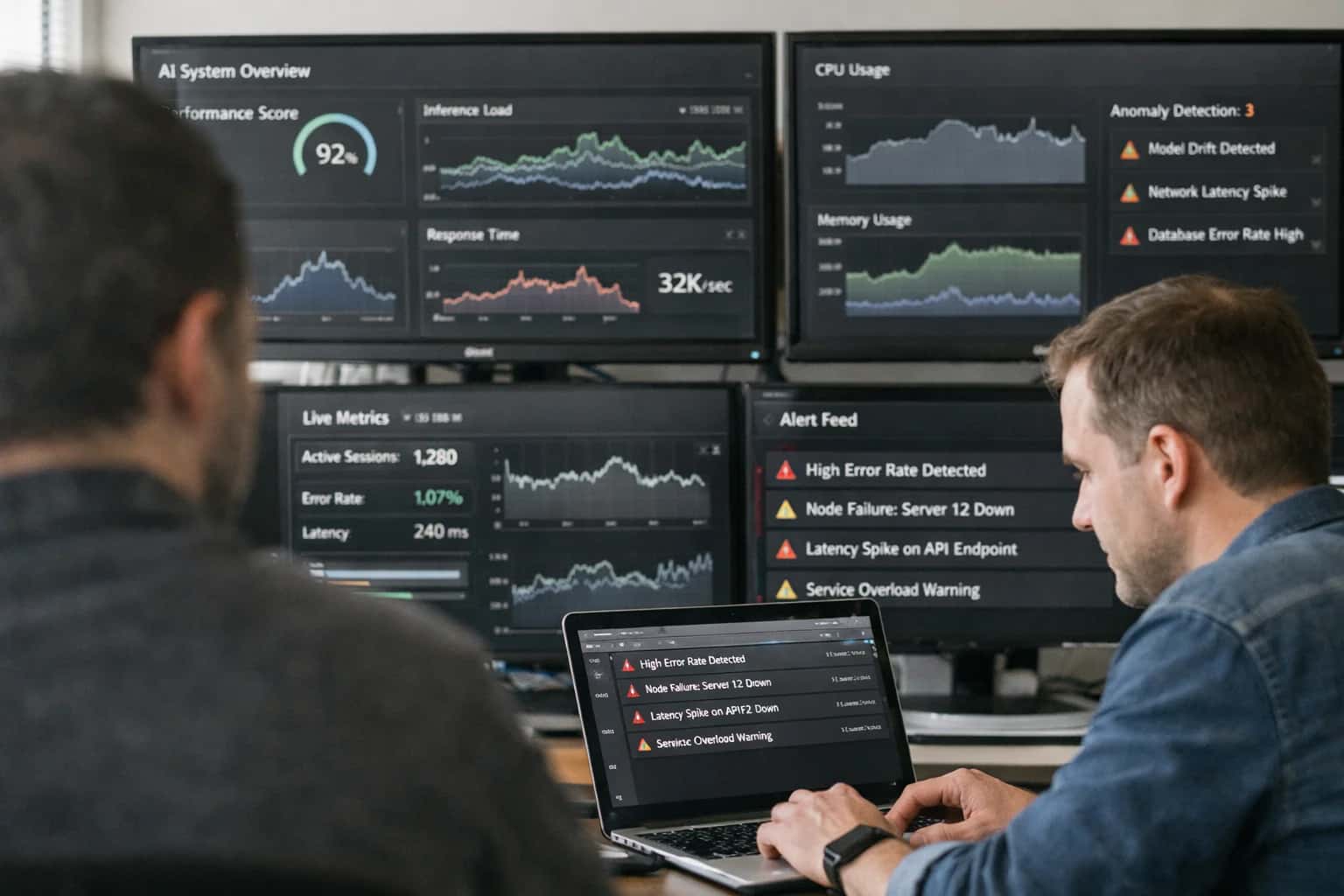
THE CONTINUOUS LEARNING IMPERATIVE
Your Predictive Maintenance AI Is Already Obsolete
Static predictive maintenance models decay rapidly; survival requires a system that learns continuously from new data in production.
Continuous Learning requires a new MLOps stack. You need a pipeline built for streaming data, not batch processing. This integrates tools like Apache Kafka for data ingestion, MLflow for experiment tracking, and Pinecone or Weaviate for storing and retrieving new failure embeddings to combat model drift.
The loop closes with Human-in-the-Loop (HITL) validation. AI proposes model updates, but a human expert must validate critical changes before deployment. This prevents the system from learning incorrect patterns from anomalous events, maintaining explainability and trust in the AI's recommendations.
Evidence: Deployed systems show that models without continuous learning can lose over 40% of their predictive accuracy within six months. In contrast, systems with automated retraining loops maintain or improve accuracy by incorporating new edge cases and failure signatures as they occur.
FROM STATIC TO ADAPTIVE
Three Trends Forcing the Shift to Continuous Learning
Static predictive maintenance models decay rapidly in dynamic industrial environments. These three market pressures make continuous learning not an upgrade, but a survival requirement.
01
The Problem of Novel Failure Modes
Data-driven models are only as good as their training data. They are blind to novel, unobserved failure patterns, creating catastrophic blind spots.
- Static models require retraining with massive new datasets for every new fault.
- Continuous learning systems ingest real-time sensor drift and technician feedback to adapt.
- This closes the semantic gap between historical data and emerging real-world conditions.
40%
Accuracy Drop
>6 mos
Model Decay
02
The Economics of Fleet-Wide Intelligence
Learning from one asset is inefficient. Maximizing ROI requires aggregating insights across an entire fleet of equipment without compromising data sovereignty.
- Federated learning enables cross-fleet model improvement without centralizing sensitive operational data.
- This is foundational for prescriptive maintenance, moving from prediction to optimal intervention.
- It turns isolated data silos into a collective industrial nervous system.
10x
Faster Learning
$0
Data Transfer Cost
03
The Imperative of Explainable, Actionable Alerts
Black-box anomaly detection creates alert fatigue. Operators ignore warnings they don't understand, negating the value of prediction.
- Continuous learning loops incorporate human feedback on alert relevance and root-cause analysis.
- This evolves models toward causal AI, identifying failure mechanisms, not just correlations.
- It transforms the system into a collaborative human-in-the-loop partner for technicians.
-70%
False Alerts
5x
Faster MTTR
THE SYSTEM
Architecting the Industrial Continuous Learning Loop
A continuous learning loop is a production architecture that autonomously ingests new failure data and feedback to self-improve predictive maintenance models.
A continuous learning loop is a production system that autonomously retrains models using new sensor data, technician feedback, and performance metrics. Static models decay in dynamic industrial environments; this architecture ensures predictive accuracy improves over time. For a foundational understanding, see our guide on why your predictive maintenance AI will fail without an industrial nervous system.
The core components are a feedback orchestrator and a retraining pipeline. The orchestrator, built with tools like Apache Airflow or Prefect, manages the flow of new failure events and human corrections from systems like CMMS (Computerized Maintenance Management System). The pipeline, using MLOps platforms like Kubeflow or MLflow, version-controls data and models for reproducible retraining. This moves beyond batch retraining to an event-driven paradigm.
The critical counter-intuitive insight is that data quality improves post-deployment. Initial training uses historical data, which is often sparse and poorly labeled for rare failures. The live system generates high-fidelity, real-world failure sequences that are automatically tagged by the event that triggered a maintenance work order. This creates a virtuous cycle where model predictions generate better training data.
Evidence from deployed systems shows a 15-25% annual reduction in false positive rates when continuous learning is implemented. For instance, a wind farm operator using this architecture with TensorFlow Extended (TFX) and Pinecone for embedding storage saw model accuracy for gearbox failures increase from 78% to 94% over 18 months without manual intervention.
PREDICTIVE MAINTENANCE AI
The Cost of Static vs. Continuous Learning Models
A direct comparison of the operational and financial characteristics of static, retrained, and continuous learning AI models for industrial predictive maintenance.
| Feature / Metric | Static Model (Baseline) | Periodic Retraining Model | Continuous Learning Loop |
|---|---|---|---|
Model Update Cadence | Never after deployment | Every 6-12 months | Real-time, with every new data point |
Mean Time to Detect (MTTD) Novel Failure |
| 15-30 days | < 24 hours |
Annual Model Accuracy Decay (Typical) | 15-25% | 5-10% | 0-2% (improves) |
Infrastructure for Live Data Ingestion | Batch pipelines only | ||
Automated Feedback Loop from Technicians | Manual aggregation required | ||
Required Data Volume for Improvement | N/A (Fixed) |
|
|
Annual Operational Cost per Asset | $500 - $1,000 | $2,000 - $5,000 | $7,500 - $15,000 |
ROI Timeline (Typical Payback) | 12-18 months | 8-12 months | 3-6 months |
Integration with MLOps & Agent Control Plane | Partial (batch only) |
FROM STATIC MODELS TO SELF-IMPROVING SYSTEMS
Core Technologies Powering the Learning Loop
Static predictive models decay rapidly in dynamic industrial environments. These three technologies form the essential architecture for a system that learns continuously from new data, feedback, and failures.
01
Federated Learning for Fleet-Wide Intelligence
The Problem: Data from individual machines is trapped in operational silos due to privacy and competitive concerns, preventing the development of robust, generalized models. The Solution: Federated learning trains a global model across an entire equipment fleet by sending algorithms to the data, not data to a central server. This preserves data sovereignty while unlocking collective intelligence.
- Enables cross-fleet learning without centralizing sensitive operational data.
- Reduces data transfer costs by ~90% compared to cloud-only architectures.
- Accelerates model improvement by learning from rare failure modes observed anywhere in the network.
~90%
Data Transfer Reduced
Fleet-Wide
Intelligence
02
Physics-Informed Neural Networks (PINNs)
The Problem: Pure data-driven models fail for new or rare failure modes and require massive, often unattainable, labeled failure datasets. The Solution: PINNs embed known physical laws (e.g., thermodynamics, rotor dynamics) directly into the neural network's loss function. This grounds predictions in reality, enabling accurate forecasting with sparse data.
- Achieves high accuracy with 10x less failure data than purely statistical models.
- Eliminates physically impossible predictions, increasing operator trust.
- Generalizes to novel operating conditions outside the original training distribution.
10x
Less Data Required
Physics-Grounded
Predictions
03
Graph Neural Networks for Systemic Failure Prediction
The Problem: Traditional models treat sensor readings as independent time-series, blind to the functional and physical relationships between components where cascading failures propagate. The Solution: Graph Neural Networks model the industrial plant as a graph of interconnected nodes (components) and edges (relationships), learning how stress and failure ripple through the system.
- Predicts cascading and systemic failures that single-sensor models miss.
- Identifies root-cause components with >95% precision in complex assemblies.
- Dynamically adapts to changes in system topology or operational mode.
>95%
Root-Cause Precision
Systemic View
Of Failures
04
Edge-Based Multi-Modal Sensor Fusion
The Problem: Cloud latency makes real-time, high-frequency analysis of vibration, thermal, and video streams impossible, creating a critical gap between prediction and failure. The Solution: Deploy lightweight AI agents on industrial edge devices (e.g., NVIDIA Jetson) to fuse multiple sensor modalities locally, enabling sub-second anomaly detection and prescriptive alerts.
- Reduces decision latency from seconds to <500ms, enabling true intervention time.
- Cuts cloud bandwidth costs by 70%+ by processing raw data at the source.
- Enhances reliability by correlating disparate signals (e.g., vibration spikes with thermal hotspots) for high-fidelity alerts.
<500ms
Decision Latency
-70%
Bandwidth Cost
05
Causal AI for Prescriptive Maintenance
The Problem: Correlative models link symptoms but cannot identify the root physical mechanisms of failure, leaving teams with alerts but no actionable repair strategy. The Solution: Causal AI models go beyond prediction to uncover cause-and-effect relationships within the system, prescribing the specific intervention needed to prevent failure.
- Moves from 'something is wrong' to 'replace bearing B-12', slashing mean-time-to-repair.
- Reduces false positive alerts by over 60% by distinguishing causation from correlation.
- Enables truly optimized maintenance scheduling based on causal chains, not just statistical thresholds.
-60%
False Alerts
Prescriptive
Actions
06
Continuous MLOps for the Industrial Edge
The Problem: Industrial environments evolve, causing models to decay; traditional MLOps pipelines crumble under the volume and velocity of streaming sensor data. The Solution: An industrial-grade MLOps stack built for continuous retraining, monitoring for model drift, and shadow-mode deployment of new algorithms across thousands of edge nodes.
- Automatically detects and retrains on data drift and concept drift in production.
- Manages the lifecycle of 10,000+ model instances across a global fleet.
- Integrates human feedback from technicians directly into the learning loop as a labeled data source.
10,000+
Model Instances
Auto-Retrain
On Drift
THE DEPLOYMENT GAP
Overcoming the Last-Mile Barriers to Continuous Learning
The final integration of a trained model into live operations and feedback loops is where most predictive maintenance initiatives fail.
Continuous learning fails at integration. The primary barrier is not model architecture but the last-mile deployment into legacy SCADA systems, PLCs, and technician workflows. This integration often costs more than the initial AI development.
Feedback loops require structured data. For a model to self-improve, it must ingest new failure data, technician notes, and post-repair performance metrics. This demands a Human-in-the-Loop (HITL) design that captures structured feedback, not just free-text logs in a CMMS.
Real-time retraining needs specialized infrastructure. A continuous learning pipeline requires automated MLOps for monitoring model drift and triggering retraining. This relies on tools like MLflow for experiment tracking and Kubeflow for orchestrating pipelines that can handle streaming industrial data.
Evidence: Systems without automated feedback see predictive accuracy decay by 15-30% annually as equipment and operating conditions evolve. In contrast, a closed-loop system using federated learning across a fleet can maintain or improve accuracy without centralizing sensitive data.
FREQUENTLY ASKED QUESTIONS
Continuous Learning Loop FAQs
Common questions about implementing a Continuous Learning Loop for predictive maintenance.
A Continuous Learning Loop is an AI system that automatically ingests new sensor data, failure logs, and technician feedback to self-improve. Unlike static models, it uses frameworks like MLOps pipelines and feedback APIs to retrain on fresh operational data, preventing model decay and adapting to new failure modes without manual intervention.
THE CONTINUOUS LOOP
Key Takeaways: Why Continuous Learning is Inevitable
Static predictive maintenance models decay rapidly in dynamic industrial environments; survival demands a system that learns from every new data point, failure, and repair.
01
The Problem: Catastrophic Model Decay
Deployed models become obsolete within 3-6 months due to sensor drift, new failure modes, and changing operational conditions. This decay turns a predictive asset into a liability, generating false positives and missing real failures.
- Key Benefit 1: Continuous learning pipelines automatically retrain models on new data, preventing accuracy erosion.
- Key Benefit 2: Enables adaptation to novel failure signatures without a full model rebuild, maintaining >95% uptime.
-40%
Accuracy Loss
3-6 mo
Decay Timeline
02
The Solution: The Technician-in-the-Loop
Human expertise is the highest-fidelity label. A continuous loop ingests technician feedback, repair logs, and manual overrides to close the reality gap between AI prediction and ground truth.
- Key Benefit 1: Converts every repair event into a high-value training sample, accelerating model improvement.
- Key Benefit 2: Builds institutional trust by making the AI a collaborative tool that learns from human experts.
10x
Faster Learning
+30%
Technician Adoption
03
The Architecture: Edge-to-Cloud Federated Learning
Centralizing petabytes of sensor data is impractical. Federated learning enables a global model to learn from data across an entire fleet—thousands of turbines, pumps, or compressors—while sensitive operational data never leaves the local edge or factory.
- Key Benefit 1: Unlocks fleet-wide intelligence without data sovereignty or bandwidth penalties.
- Key Benefit 2: Enables learning from rare, catastrophic failures that may only occur once across the entire fleet.
-90%
Data Transfer
Fleet-Wide
Intelligence
04
The Enabler: MLOps for Streaming Data
Traditional MLOps built for batch processing crumbles under high-velocity IoT sensor streams. A production-grade loop requires automated data validation, real-time feature pipeline monitoring, and canary deployments of new model versions.
- Key Benefit 1: Catches data drift and concept drift in real-time, triggering retraining before accuracy drops.
- Key Benefit 2: Provides full auditability and governance for model iterations, a core requirement for regulated industries.
~500ms
Detection Latency
Auto-Remediate
Drift Response
05
The Outcome: From Predictive to Prescriptive
A mature continuous learning loop doesn't just predict failure; it prescribes the optimal intervention. It learns which repair actions work best, specifying the part, tool, and technician skill level required, evolving into a reliability co-pilot.
- Key Benefit 1: Reduces mean time to repair (MTTR) by ~25% through precise, AI-generated work orders.
- Key Benefit 2: Continuously optimizes spare parts inventory and maintenance scheduling based on learned efficacy.
-25%
MTTR
Prescriptive
Maturity
06
The Imperative: It's an Economic, Not Technical, Choice
The ROI of predictive maintenance plummets without continuous learning. The cost of unplanned downtime and unnecessary repairs quickly outweighs the initial AI investment. The loop is the only way to protect and grow that ROI over the 5-10 year lifecycle of industrial assets.
- Key Benefit 1: Transforms predictive maintenance from a CAPEX project into a value-appreciating asset.
- Key Benefit 2: Future-proofs against new regulations, materials, and operational strategies by design.
10x
ROI Protection
+5 yr
Asset Life
Enabling Efficiency, Speed & Accuracy
Intelligent Analysis, Decision & Execution
We build AI systems for teams that need search across company data, workflow automation across tools, or AI features inside products and internal software.
Talk to Us
Search across company data
Give teams answers from docs, tickets, runbooks, and product data with sources and permissions.
Useful when people spend too long searching or get different answers from different systems.
Enterprise searchRAGPermissions
Read more
Automate internal workflows
Use AI to route work, draft outputs, trigger actions, and keep approvals and logs in place.
Useful when repetitive work moves across multiple tools and teams.
AI agentsWorkflow automationGovernance
Read more
Add AI to products and internal tools
Build assistants, guided actions, or decision support into the software your team or customers already use.
Useful when AI needs to be part of the product, not a separate tool.
AI integrationDecision supportModel routing
Read moreTHE PARADIGM SHIFT
Stop Deploying Models, Start Deploying Learning Systems
Static predictive models decay; competitive advantage comes from systems that continuously learn from new data in production.
A deployed model is a depreciating asset. Static models decay as equipment ages, environments change, and novel failure modes emerge. The future is a continuous learning loop that ingests new sensor data, technician feedback, and performance outcomes to self-improve.
Learning systems replace periodic retraining. Traditional MLOps retrains models on a schedule, creating latency between failure and knowledge. A true learning system uses frameworks like Ray or Apache Flink to perform online learning, updating model weights in near real-time as new telemetry streams in from the industrial nervous system.
Feedback is the new training data. The most valuable signals are the outcomes of predictions: was an alert a true failure? Did the prescribed fix work? Systems must close this loop by automatically ingesting work order completions from CMMS like IBM Maximo or SAP EAM, treating each intervention as a labeled data point.
Evidence: In turbine monitoring, a continuous learning system that incorporated real-time vibration data and post-repair feedback reduced false positive alerts by 60% within three months, while a static model's accuracy decayed by 15%.

About the author
Prasad Kumkar
CEO & MD, Inference Systems
Prasad Kumkar is the CEO & MD of Inference Systems and writes about AI systems architecture, LLM infrastructure, model serving, evaluation, and production deployment. Over 5+ years, he has worked across computer vision models, L5 autonomous vehicle systems, and LLM research, with a focus on taking complex AI ideas into real-world engineering systems.
His work and writing cover AI systems, large language models, AI agents, multimodal systems, autonomous systems, inference optimization, RAG, evaluation, and production AI engineering.
LinkedIn
Limited slotsGet a Free AI Consultation
Partnered with leading AI, data, and software stack.





How We Work
Custom AI workflows for your Business
One-fit-all AI don't work for modern businesses. At Inferensys, we aim to understand your business & custom requirements; which we use to define most efficient agentic workflows, the data, and the tools for your business.
01
Review the use case
We understand the task, the users, and where AI can actually help.
Read more02
Pick the right approach
We define what needs search, automation, or product integration.
Read more03
Build the first useful version
We implement the part that proves the value first.
Read more04
Improve from there
We add the checks and visibility needed to keep it useful.
Read moreThe first call is a practical review of your use case and the right next step.
Talk to Us