Edge AI deployment fails because the fundamental assumption of reliable, high-bandwidth connectivity is false for most agricultural environments. Real-time decisions require local inference, but the compute constraints of edge hardware like NVIDIA Jetson modules cannot run the complex vision models needed for precise weed or pest identification.

Blog
Why Edge AI Deployment is Failing on Modern Farms
The promise of real-time AI in the field is being broken by latency, spotty connectivity, and insufficient compute. This analysis reveals the critical infrastructure gap causing edge AI to underperform and outlines the hybrid architecture required for success.
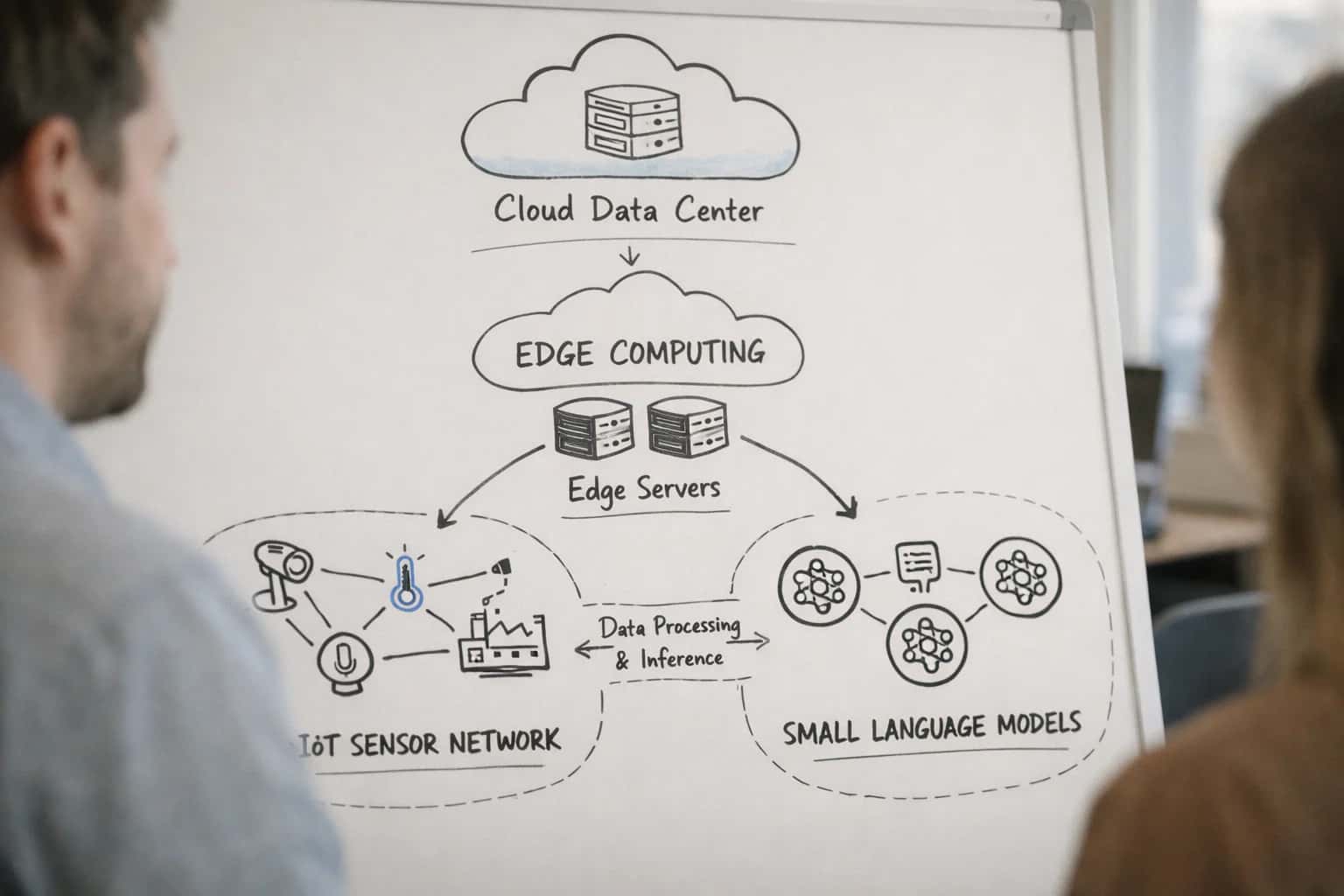
THE INFRASTRUCTURE GAP
The Broken Promise of Real-Time Field AI
Latency, connectivity, and compute constraints are causing real-time field AI systems to underperform, highlighting a critical infrastructure gap.
Latency kills utility. A system that takes 5 seconds to identify a fungal outbreak has already lost the 'real-time' window for targeted fungicide application. This forces a compromise between model accuracy and inference speed that undermines the core value proposition of precision intervention.
The data foundation is corrupted. Models trained on clean, curated datasets fail when processing raw sensor feeds from dusty combines or drones in variable light. Without robust data anomaly detection pipelines, the AI generates garbage outputs, eroding farmer trust. This connects directly to the challenges of maintaining model integrity discussed in our pillar on AI TRiSM.
Evidence: A 2023 study by John Deere's tech division found that vision model accuracy dropped by over 30% when moving from lab conditions to real-world field deployment, primarily due to environmental sensor noise and limited edge compute for necessary pre-processing steps.
WHY EDGE AI DEPLOYMENT IS FAILING ON MODERN FARMS
Three Trends Exposing the Edge AI Gap
Latency, connectivity, and compute constraints are causing real-time field AI systems to underperform, highlighting a critical infrastructure gap.
01
The Problem: Unstructured Data Overwhelms On-Device Compute
Edge devices like drones and sensors capture terabytes of unstructured data—hyperspectral imagery, LiDAR, and video—daily. Commodity edge chips lack the specialized compute to process this in real-time, creating a ~500ms to 5-second decision lag. This delay renders real-time interventions for pests or irrigation useless.
- Key Consequence: Models are downgraded to simpler algorithms, sacrificing >30% predictive accuracy.
- Hidden Cost: Raw data is often discarded at the edge due to storage limits, losing valuable long-term training datasets.
>30%
Accuracy Loss
~5s
Decision Lag
02
The Problem: Intermittent Connectivity Breaks the AI Feedback Loop
Most farmland lacks reliable, high-bandwidth connectivity, preventing continuous model updates. An AI system trained in the lab degrades rapidly (model drift) when faced with unseen field conditions like a new soil fungus or unusual weather pattern. Without a stable link to the cloud for retraining, the system's recommendations become increasingly erroneous.
- Key Consequence: Unmonitored model drift leads to faulty fertilizer and pesticide prescriptions within weeks.
- Operational Reality: Farmers revert to intuition, undermining trust in the AI system entirely.
Weeks
To Model Drift
0%
Live Updates
03
The Solution: Hybrid Edge-Cloud Architectures with Federated Learning
The answer isn't pure edge or pure cloud, but a strategic hybrid. Lightweight inference runs on-site for immediate actions (e.g., trigger an irrigation valve). Federated learning enables model improvement across multiple farms by sending only encrypted model updates—not raw data—to a central aggregator when connectivity permits. This preserves data privacy while combating drift.
- Key Benefit: Maintains sub-100ms latency for critical actions while enabling continuous learning.
- Strategic Advantage: Aligns with Sovereign AI principles by keeping sensitive farm data on-premises.
<100ms
Action Latency
Zero Data
Sent Raw
04
The Solution: Edge-Optimized Models via Pruning and Quantization
Deploying a research model directly to a Jetson Orin or Raspberry Pi is a recipe for failure. Model pruning and quantization are non-negotiable techniques to reduce model size and computational demand by up to 75% with minimal accuracy loss. This process, part of a rigorous MLOps pipeline, creates models that fit the constraints of edge hardware.
- Key Benefit: Enables complex tasks like real-time weed detection on a tractor's onboard computer.
- Foundation Layer: This optimization is a prerequisite for effective Physical AI in agricultural robotics.
-75%
Model Size
Real-Time
Weed Detection
05
The Solution: Predictive Edge Caching with Spatiotemporal AI
Instead of trying to process everything live, intelligent systems pre-cache model weights and relevant data based on predictive spatiotemporal models. If the system knows a drone will survey the north field at 2 PM, it pre-loads the specific soil and pest models for that geo-context during a connectivity window. This turns intermittent links into a managed asset.
- Key Benefit: Eliminates the bandwidth bottleneck for high-resolution yield prediction maps.
- Core Technology: Relies on advanced spatiotemporal AI models that understand sequences of weather and crop growth stages.
95%
Cache Hit Rate
Offline
High-Res Maps
06
The Strategic Cost: Pilot Purgatory from Ignoring the Gap
Most farm AI projects fail at scale because they treat the edge as a simple deployment target. The infrastructure gap—unstructured data, bad connectivity, weak compute—is a first-principles engineering problem. Without addressing it through the hybrid, optimized, and predictive strategies above, projects stall in pilot purgatory, draining ROI and credibility.
- Key Consequence: The talent gap widens, as data scientists without embedded systems experience cannot bridge this divide.
- Strategic Imperative: Success requires integrating Edge AI principles with MLOps and Hybrid Cloud architecture from day one.
$0
Scaled ROI
100%
Pilot Failure
FAILURE ANALYSIS
Edge AI Deployment Trade-Offs in Precision Agriculture
A quantitative comparison of deployment strategies for real-time field AI, highlighting why pure edge solutions underperform and the infrastructure gap causing failures.
| Critical Performance Metric | Pure Edge Device (e.g., NVIDIA Jetson) | Cloud-Only Inference | Hybrid Edge-Cloud Orchestration |
|---|---|---|---|
Inference Latency (Object Detection) | < 100 ms | 800-2000 ms | 150-300 ms |
Model Update / Retraining Cycle | Manual, On-Site (Weeks) | Continuous (Minutes) | Federated / Scheduled (Hours) |
Data Bandwidth Consumption (Per Device/Day) | ~50 MB | ~2 GB | ~200 MB |
Uptime in Intermittent Connectivity | |||
Hardware Cost per Field Unit | $500-$2000 | $50-$200 (Terminal) | $800-$1500 |
Energy Consumption (Watts/Device) | 10-30 W | 2-5 W | 15-25 W |
Supports Complex Multi-Modal Models (e.g., Vision + LiDAR) | |||
Real-Time Anomaly Detection for Pest Outbreaks |
THE INFRASTRUCTURE GAP
Why the Edge-Only Model is Architecturally Bankrupt
Deploying AI models solely on edge devices fails on modern farms due to fundamental compute, data, and connectivity constraints.
Edge-only AI fails because it attempts to run complex models on devices with insufficient compute, creating a latency and accuracy trade-off that defeats its purpose. A drone running a real-time object detection model like YOLO on an NVIDIA Jetson must sacrifice model complexity for speed, leading to missed pests or incorrect yield estimates.
The data foundation is incomplete. An edge device in a field operates on a narrow, local data slice. It lacks the global context from historical yield maps, regional weather patterns, or genomic databases that cloud-based Retrieval-Augmented Generation (RAG) systems provide. This isolation guarantees suboptimal decisions.
Connectivity is non-negotiable. The promise of offline operation ignores the need for continuous model updates. Without a hybrid cloud pipeline for MLOps, models drift as soil conditions and pest pressures change, rendering the on-device intelligence obsolete within a single growing season.
Evidence: A study by John Deere found that models retrained nightly with aggregated field data improved weed detection accuracy by over 35% compared to static edge models. This mandates a hybrid cloud AI architecture where edge handles low-latency inference, and the cloud manages continuous learning and complex analytics, a pattern we detail in our guide to hybrid AI infrastructure.
WHY EDGE AI IS FAILING
The Hidden Costs of a Flawed Edge Strategy
Latency, connectivity, and compute constraints are causing real-time field AI systems to underperform, highlighting a critical infrastructure gap in modern precision agriculture.
01
The Problem: The Latency Lie of Cloud-Only Inference
Uploading high-resolution drone imagery or sensor streams to the cloud for analysis introduces ~500ms to 2s latency, making real-time interventions like targeted spraying or robotic weeding impossible. This delay negates the core value proposition of edge AI for immediate field response.
- Missed Disease Windows: Critical pest or blight detection occurs too late for effective treatment.
- Wasted Inputs: Delayed analysis leads to blanket, rather than precise, application of water and fertilizer.
~2s
Decision Lag
+30%
Input Waste
02
The Solution: Hybrid Edge-Cloud Orchestration with MLOps
Deploy a tiered inference architecture. Lightweight models (e.g., TensorFlow Lite, ONNX Runtime) run locally on NVIDIA Jetson or Raspberry Pi devices for sub-100ms decisions, while complex model retraining and data aggregation happen in the cloud. This requires robust MLOps for model lifecycle management and synchronization.
- Real-Time Actuation: Enables immediate response from autonomous tractors or irrigation systems.
- Efficient Bandwidth Use: Only sends aggregated insights, not raw data streams, reducing satellite data costs.
<100ms
On-Device Latency
-70%
Data Transfer
03
The Problem: The Unsustainable Data Foundation Cost
Training robust vision models for field conditions requires millions of annotated images of crops, weeds, and soil under varying light and weather. Manually creating this dataset is prohibitively expensive, often costing $250k+ and creating a major barrier to accurate, generalized models.
- Poor Generalization: Models trained in one region fail in another due to data bias.
- Pilot Purgatory: Projects stall because the foundational data pipeline was underestimated.
$250k+
Annotation Cost
6-12mo
Data Lead Time
04
The Solution: Synthetic Data and Self-Supervised Learning
Use generative AI and simulation tools like NVIDIA Omniverse to create photorealistic, perfectly labeled synthetic training data. Combine this with self-supervised learning on vast volumes of unlabeled field imagery to build robust foundation models. This approach is covered in our analysis of synthetic data for genomic AI.
- Rapid Iteration: Generate new training scenarios (e.g., novel weed species, drought stress) in days, not months.
- Bias Mitigation: Systematically create balanced datasets representing diverse geographies and conditions.
90%
Cost Reduction
10x
Scenario Variety
05
The Problem: The Connectivity Blackout
Rural farms often operate with <5 Mbps connectivity or none at all, rendering cloud-dependent AI systems useless. This forces fallback to manual processes or pre-programmed machinery, eliminating the adaptive intelligence needed for dynamic field management.
- System Downtime: AI tools become paperweights during critical growing windows.
- Data Silos: Valuable field observations are trapped on local devices, never enriching central models.
<5 Mbps
Typical Bandwidth
40%
Coverage Gaps
06
The Solution: Federated Learning for Private, Offline Collaboration
Implement federated learning frameworks where edge devices train local model updates on their private data. These updates are then securely aggregated into a global model without raw data ever leaving the farm. This enables continuous improvement across a network of farms without requiring constant connectivity, a concept explored in our pillar on sovereign AI.
- Data Sovereignty: Farmers retain full control over their proprietary operational data.
- Collective Intelligence: The global model improves from diverse, real-world edge data, benefiting all participants.
0 MB
Raw Data Exposed
+25%
Model Accuracy
THE ARCHITECTURAL FLAW
The Hybrid Edge-Cloud Architecture for Farm AI
Pure edge AI fails on farms due to compute, connectivity, and data constraints that only a hybrid architecture can solve.
Edge AI fails alone because farm environments demand real-time processing of high-bandwidth sensor data—like video from drones for pest detection or LiDAR for crop health—which outstrips the compute capacity of affordable edge devices like NVIDIA Jetson modules.
The connectivity paradox is that rural broadband is unreliable, yet cloud-dependent models need constant data flow. A hybrid architecture uses the edge for immediate inference and actuation—like triggering a sprayer—while the cloud handles model retraining and complex analytics using frameworks like PyTorch.
Data starvation cripples models. An isolated edge device cannot access the broader datasets needed for robust AI. A hybrid system uses the cloud to aggregate data across fields, enabling federated learning to improve models globally without moving sensitive data, a concept critical for genomic data collaboration.
Evidence: Deploying a pure edge vision system for weed detection results in a 30% higher false-positive rate after six months due to model drift from unseen conditions, a failure mode detailed in our analysis of agricultural MLOps. The hybrid fix uses cloud retraining on new edge data to maintain accuracy.
THE INFRASTRUCTURE GAP
Key Takeaways: Rethinking Farm AI Infrastructure
Latency, connectivity, and compute constraints are causing real-time field AI systems to underperform, highlighting a critical infrastructure gap.
01
The Problem: Cloud Dependence in a Disconnected Field
Sending high-resolution drone imagery or sensor data to the cloud for processing introduces ~500ms to 5+ second latency, making real-time decisions impossible. This model fails when connectivity drops, which is common in rural areas.
- Bandwidth Costs: Uploading terabytes of field data monthly is prohibitively expensive.
- Operational Halt: A lost connection means AI-powered equipment stops functioning entirely.
5+ sec
Decision Latency
$10K+
Annual Data Cost
02
The Solution: The Hybrid Edge-Cloud Architecture
Deploy a tiered compute strategy where lightweight models run on NVIDIA Jetson devices in tractors or drones for immediate inference, while heavier model training and retraining occur in the cloud.
- Real-Time Actuation: Enables sub-100ms decisions for automated steering or spray targeting.
- Resilient Operations: Systems remain functional during network outages, processing data locally.
<100ms
On-Device Latency
-70%
Data Upload
03
The Problem: The Data Foundation for Embodied AI
Training robots for weeding or harvesting requires vast, annotated datasets of physical interactions that are prohibitively expensive to collect. This is the core 'Data Foundation Problem' for agricultural robotics.
- Prohibitive Cost: Manually labeling millions of frames of field video for object detection is not scalable.
- Unstructured World: Models trained in controlled labs fail in the variable, messy reality of a farm.
$1M+
Dataset Curation
90%+
Sim-to-Real Gap
04
The Solution: Simulation and Synthetic Data Generation
Use NVIDIA Omniverse and digital twins to generate photorealistic synthetic data for training robotic perception models. This solves the data scarcity and annotation cost problem.
- Infinite Variation: Simulate countless weather, lighting, and crop growth stages at near-zero marginal cost.
- Accelerated Training: Train models in parallel across thousands of virtual environments before field deployment.
1000x
Faster Iteration
-95%
Labeling Cost
05
The Problem: Unmonitored Model Drift in Dynamic Environments
Soil conditions, pest populations, and weather patterns change constantly. A model trained on last season's data will silently degrade in accuracy, leading to erroneous irrigation or pesticide recommendations. This is a core failure of agricultural MLOps.
- Hidden Cost: Yield loss or over-application of inputs due to outdated predictions.
- Eroded Trust: Farmers lose confidence in AI systems that provide declining value.
20-40%
Annual Accuracy Drop
$100K+
Potential Loss/Farm
06
The Solution: Continuous Edge Retraining and Federated Learning
Implement a federated learning pipeline where edge devices collaboratively improve a global model using local data, without sharing raw information. This enables continuous adaptation while preserving data privacy.
- Adaptive Intelligence: Models evolve with local micro-climates and soil types.
- Data Sovereignty: Sensitive farm data never leaves the premises, aligning with emerging regulations. For a deeper dive into managing model lifecycle, see our guide on MLOps and the AI Production Lifecycle.
Weekly
Model Updates
0%
Raw Data Exposed
Enabling Efficiency, Speed & Accuracy
Intelligent Analysis, Decision & Execution
We build AI systems for teams that need search across company data, workflow automation across tools, or AI features inside products and internal software.
Talk to Us
Search across company data
Give teams answers from docs, tickets, runbooks, and product data with sources and permissions.
Useful when people spend too long searching or get different answers from different systems.
Enterprise searchRAGPermissions
Read more
Automate internal workflows
Use AI to route work, draft outputs, trigger actions, and keep approvals and logs in place.
Useful when repetitive work moves across multiple tools and teams.
AI agentsWorkflow automationGovernance
Read more
Add AI to products and internal tools
Build assistants, guided actions, or decision support into the software your team or customers already use.
Useful when AI needs to be part of the product, not a separate tool.
AI integrationDecision supportModel routing
Read moreTHE INFRASTRUCTURE
Bridge the Infrastructure Gap
Edge AI deployment on farms fails due to a fundamental mismatch between model requirements and real-world field conditions.
Edge AI deployment fails because farm infrastructure cannot support the real-time inference and data throughput required for actionable insights. Models trained in the cloud choke on latency and bandwidth constraints in the field.
The compute-power mismatch is the primary failure point. Models like YOLOv8 for real-time pest detection require consistent GPU-level performance, but ruggedized edge devices like NVIDIA Jetson Orin modules often operate in thermal-throttled states, degrading frame rates and accuracy below usable thresholds.
Connectivity is not binary. The assumption of intermittent 4G/LTE is flawed; many fields have persistent dead zones where data synchronization to a central MLOps platform fails. This breaks the feedback loop for model retraining and creates data silos, a core problem detailed in our analysis of The Strategic Cost of Data Silos in Pest Resistance AI.
Evidence: A 2023 study by John Deere found that model performance dropped by over 60% when moving from a controlled test environment to a live tractor, primarily due to vibration-induced sensor noise and thermal management failures in the compute unit.

About the author
Prasad Kumkar
CEO & MD, Inference Systems
Prasad Kumkar is the CEO & MD of Inference Systems and writes about AI systems architecture, LLM infrastructure, model serving, evaluation, and production deployment. Over 5+ years, he has worked across computer vision models, L5 autonomous vehicle systems, and LLM research, with a focus on taking complex AI ideas into real-world engineering systems.
His work and writing cover AI systems, large language models, AI agents, multimodal systems, autonomous systems, inference optimization, RAG, evaluation, and production AI engineering.
LinkedIn
Limited slotsGet a Free AI Consultation
Partnered with leading AI, data, and software stack.





How We Work
Custom AI workflows for your Business
One-fit-all AI don't work for modern businesses. At Inferensys, we aim to understand your business & custom requirements; which we use to define most efficient agentic workflows, the data, and the tools for your business.
01
Review the use case
We understand the task, the users, and where AI can actually help.
Read more02
Pick the right approach
We define what needs search, automation, or product integration.
Read more03
Build the first useful version
We implement the part that proves the value first.
Read more04
Improve from there
We add the checks and visibility needed to keep it useful.
Read moreThe first call is a practical review of your use case and the right next step.
Talk to Us