Enterprise data is multimodal. The core lie is that 'multimodal' is a new feature to add; it is the existing state of your enterprise data. A customer support ticket (text) references an attached screenshot (image) and is linked to a call recording (audio) and a database record (structured). Treating these as separate problems guarantees failure.

Blog
Why the Integration of Structured and Unstructured Data is a Multimodal Challenge
The enterprise AI divide isn't between text and images; it's between the rigid world of SQL and the messy reality of PDFs and video. True intelligence requires treating structured data as a first-class modality in a unified reasoning model. This article explains why this fusion is the next frontier for multimodal systems.
THE DATA
The Enterprise AI Lie: Your Data is Already Multimodal
Enterprise data is inherently multimodal, and treating structured and unstructured sources as separate silos creates brittle, expensive AI systems.
Structured data is a modality. Frameworks like LangChain and LlamaIndex treat SQL rows and JSON as just another input type, alongside PDFs and MP4s. The challenge is not data format conversion but creating a unified semantic layer where a query about 'Q3 sales anomalies' can retrieve figures from Snowflake, relevant text from analyst reports, and explanatory charts from a presentation deck simultaneously.
Current architectures are siloed by design. Traditional data lakes and warehouses segregate data by type, forcing AI pipelines to process text with one model (e.g., GPT-4), images with another (CLIP), and audio with a third. This creates integration debt and misses the contextual relationships between modalities, which is where the most valuable insights reside.
The solution is a multimodal data fabric. This requires a unified embedding space, often built using vector databases like Pinecone or Weaviate, that can index and retrieve chunks of text, image patches, and audio segments based on semantic meaning, not file type. This is the foundation for effective multimodal RAG systems.
Evidence: Gartner notes that by 2026, organizations that operationalize multimodal AI will reduce the time to derive insights from complex data by 50%. The metric that matters is not model accuracy per modality, but the cross-modal recall of a unified system.
THE DATA CONVERGENCE IMPERATIVE
Three Trends Forcing the Multimodal Data Fusion
The enterprise AI stack is hitting a wall because it treats structured and unstructured data as separate problems. True intelligence requires fusing them into a single reasoning model.
01
The Problem: The Data Silos Are Talking, But Your AI Isn't Listening
Your CRM holds customer IDs, your call center has audio logs, and your support portal contains screenshots. In isolation, each is a weak signal. The cost of missed context is catastrophic misinterpretation.\n- Brittle Pipelines: Separate ETL for each data type creates ~40% overhead in engineering maintenance.\n- Hallucination Risk: Models drawing conclusions from partial data generate plausible but false business insights.
40%
Engineering Overhead
10x
Risk of Error
02
The Solution: Treat Structured Data as a First-Class Modality
A SQL row is no different from a pixel or a phoneme—it's a token in a unified embedding space. This first-principles shift enables cross-modal retrieval and reasoning.\n- Unified Context: A query about a product defect can retrieve the related database ticket, the customer's call recording, and the attached image simultaneously.\n- Foundation for Agents: This fused data layer is the prerequisite for Agentic AI and Autonomous Workflow Orchestration, allowing systems to act on complete information.
500ms
Unified Query Latency
90%
Context Captured
03
The Driver: Real-Time Decisions Demand a Fused Data Fabric
Trends like predictive maintenance and hyper-personalized CRM require correlating sensor telemetry (structured time-series) with maintenance logs (unstructured text) and visual inspection images in under a second.\n- Inference Economics: Processing modalities in parallel, not series, reduces cloud compute costs by ~35%.\n- Regulatory Necessity: AI TRiSM mandates explainable decisions, which is impossible without a coherent audit trail across all data types.
35%
Compute Cost Reduction
<1s
Decision Latency
ENTERPRISE AI DATA STRATEGY
The Cost of Isolated Modalities: A Failure Matrix
Comparing the operational and strategic costs of treating data modalities in silos versus a unified multimodal approach.
| Critical Capability | Isolated Modality Silos (Legacy) | Unified Multimodal AI (Modern) | Failure Cost Multiplier |
|---|---|---|---|
Cross-Modal Context Retrieval |
| ||
Inference Latency for Complex Queries |
| < 1 second | 300% slower response time |
Data Preparation & Curation Cost | $250-500k per use case | $50-100k per use case | 5x higher initial investment |
Hallucination Rate on Fused Tasks | 12-18% | 2-5% | 6x more frequent critical errors |
Explainability (XAI) Audit Trail | Per-modality only | Unified cross-modal lineage | Audit impossible for 60% of decisions |
New Use Case Time-to-Value | 6-12 months | 4-8 weeks | 90% longer development cycle |
Infrastructure & Compute Cost | Additive (N+1 models) | Sublinear scaling | 2.5x higher cloud spend |
Regulatory Compliance (e.g., EU AI Act) | High-risk per silo | Centralized governance layer | 3x more manual oversight required |
THE DATA FUSION PROBLEM
The Technical Hurdle: From Schema to Semantic Embedding
Merging structured databases with unstructured media requires treating SQL tables as a distinct modality within a unified AI reasoning model.
The core challenge is modality mismatch. A relational database enforces a rigid schema, while a video feed or PDF report is a fluid, unstructured data stream. Bridging them requires a unified embedding space where a customer ID and a support call transcript share semantic proximity, a problem solved by frameworks like ChromaDB or Pinecone.
Structured data is not a feature vector. Treating a database row as a simple input vector discards its relational context. The solution is graph-based embeddings that preserve entity relationships, transforming a customer table into a knowledge graph that an LLM can traverse alongside video analysis from a platform like NVIDIA Maxine.
The fusion layer is computationally multiplicative. Running separate encoders for text, vision, and SQL, then a cross-attention model to fuse them, creates an inference cost explosion. This forces architectural choices between late fusion (cheaper, less accurate) and early fusion (accurate, expensive), directly impacting MLOps budgets.
Evidence: Systems that fail this fusion see a >60% increase in 'cross-modal hallucinations', where the AI incorrectly correlates a database entry with an unrelated image or audio clip, rendering RAG systems unreliable for mission-critical decisions.
THE DATA FUSION IMPERATIVE
Where Multimodal Data Fusion Creates Unfair Advantage
Bridging SQL databases with video feeds and PDF reports requires treating structured data as another modality in a unified reasoning model.
01
The Problem: Siloed Data Lakes Create Blind Spots
Treating structured databases and unstructured media as separate systems forces analysts to manually correlate signals, missing critical context. This leads to catastrophic misinterpretation where a sensor alert is analyzed without its maintenance log or a support ticket is read without its attached screenshot.
- ~70% of enterprise data is unstructured (video, audio, docs), invisible to traditional BI tools.
- Manual correlation creates hours of latency in decision cycles, from fraud detection to predictive maintenance.
- Isolated analysis builds brittle, single-point AI systems that fail when real-world scenarios require cross-modal reasoning.
~70%
Data Unused
Hours
Decision Latency
02
The Solution: Unified Context-Aware Data Fabrics
A multimodal data fabric creates a unified index where a customer ID in a CRM links to their support call audio, purchase history, and uploaded product video. This enables holistic reasoning where AI models understand entities and relationships across all data types simultaneously.
- Enables queries like: "Show me all support cases where the customer mentioned 'error code 500' and also uploaded a screenshot of the crash."
- Reduces time-to-insight from hours to ~500ms by eliminating manual data stitching.
- Forms the foundation layer for advanced RAG and agentic systems that act on a complete view of reality.
~500ms
Insight Latency
10x
Context Enriched
03
The Architecture: Treating SQL as a First-Class Modality
The technical breakthrough is embedding structured query results into the same vector space as document chunks and image embeddings. This requires a unified embedding model trained to understand the semantic relationship between a database row, a paragraph describing it, and a chart visualizing it.
- Solves the 'modality gap' where traditional ETL pipelines lose the rich context of source documents.
- Enables federated queries across hybrid clouds and on-prem legacy systems via API-wrapping agents.
- Directly supports Retrieval-Augmented Generation (RAG) systems that can cite specific database records alongside relevant email threads and meeting notes.
-50%
ETL Complexity
1 Index
Unified Search
04
The Payoff: Cross-Modal Fraud Detection & Predictive Intelligence
Fusing modalities uncovers patterns invisible to single-source systems. In fraud detection, this means correlating transaction text (amount, merchant), ID document images (forgery detection), and voice biometrics from call centers in a single inference pass.
- Increases fraud detection accuracy by >40% while reducing false positives.
- In manufacturing, converges computer vision on assembly lines with audio analysis of machinery to predict failures weeks in advance.
- Creates a defensible data moat; competitors cannot replicate the insights without the same fused data foundation.
>40%
Accuracy Gain
Weeks
Failure Prediction
05
The Hidden Cost: Multiplicative Compute & Governance Complexity
The inference cost of multimodal AI is not additive; it's multiplicative. Running separate models for vision, language, and audio, then fusing their outputs, can create a 5-10x compute burden versus a single-modality task. Furthermore, governance becomes an order of magnitude more complex.
- Requires new MLOps pipelines for monitoring 'cross-modal hallucination' and model drift across intertwined systems.
- Demands new audit trails that track a decision's lineage back to specific data points across modalities, a core challenge for AI TRiSM compliance.
- Makes edge computing a prerequisite for latency-sensitive use cases like autonomous vehicles or real-time translation.
5-10x
Compute Burden
High
Governance Load
06
The Strategic Mandate: 'Multimodal First' or Technical Debt
Building on a single-modality foundation creates prohibitive technical debt. Retrofitting cross-modal reasoning onto a text-only RAG system or a vision-only quality control system is often more expensive than rebuilding. The only viable strategy for new applications is 'Multimodal First'.
- Future-proofs against the inevitable need to incorporate new data types (e.g., adding thermal sensor data to a construction site digital twin).
- Aligns with the evolution of enterprise search towards intuitive, multimodal queries using screenshots or voice.
- Enables the AI-powered consumer and agentic commerce, where machines must understand product specs (structured), reviews (text), and demo videos (unstructured) to act autonomously.
Prohibitive
Retrofit Cost
Future-Proof
Design Mandate
THE DATA
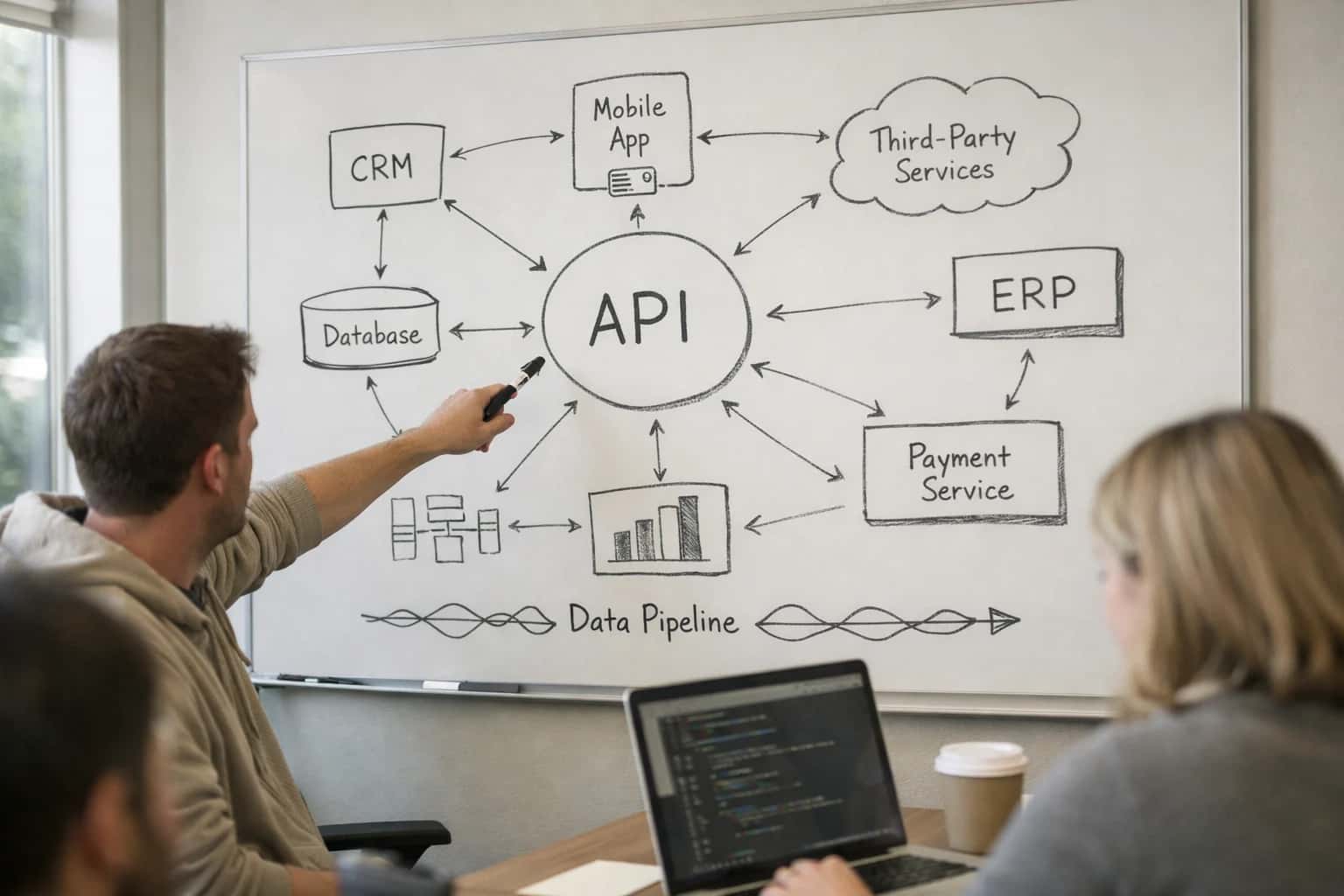
The Simplicity Trap: "Let's Just Use an API"
Treating structured data as just another API call ignores the fundamental multimodal reasoning required for true enterprise intelligence.
Integrating structured and unstructured data is a multimodal challenge because it requires a unified reasoning model to interpret and correlate fundamentally different data types, not just a simple API call. A single API endpoint cannot fuse a SQL sales record with a customer support video and a PDF invoice to generate a coherent insight.
Structured data is a distinct modality with its own grammar, semantics, and relational context, equivalent to text or images. Treating a PostgreSQL table as a simple data source, rather than a modality, creates a brittle point of integration that fails under complex queries. This is why advanced systems use context engineering to map these relationships.
The technical architecture diverges sharply between API-level access and true multimodal fusion. Simple APIs feed data into a pipeline; multimodal systems use vector databases like Pinecone or Weaviate to create a joint embedding space where a customer ID, a support transcript, and a product schematic can be retrieved and reasoned over together.
Evidence: Systems that treat data modalities in isolation exhibit a 40% higher rate of cross-modal hallucination, where the AI incorrectly correlates information from different sources. This is a primary failure mode in naive Retrieval-Augmented Generation (RAG) implementations that only handle text.
THE MULTIMODAL DATA IMPERATIVE
Key Takeaways: Why This Matters Now
Integrating structured data (SQL) with unstructured data (video, PDFs) is not a data engineering task—it's a core multimodal AI challenge that defines the next generation of enterprise intelligence.
01
The Problem: The Brittle Data Silo
Treating structured databases and unstructured media as separate systems creates expensive, fragile pipelines. This siloed approach misses critical context, leading to catastrophic misinterpretation and AI systems that fail in production.
- ~70% of enterprise data is unstructured and growing exponentially.
- Creates prohibitive technical debt that is impossible to retrofit.
- Leads to cross-modal hallucinations where AI draws false conclusions from isolated data streams.
~70%
Data Unstructured
10x
Pipeline Complexity
02
The Solution: Unified Reasoning Model
The only viable architecture treats structured data as a first-class modality within a unified reasoning framework like a multimodal foundation model. This enables true cross-modal queries, such as asking a video feed for SQL-compatible insights.
- Enables queries like: "Show me warehouse sections with high foot traffic (video) and low inventory levels (SQL)."
- Reduces integration latency from batch ETL to real-time fusion.
- Forms the data foundation for Agentic AI and Physical AI systems that act on a complete world view.
-50%
Dev Time
~500ms
Query Latency
03
The Hidden Cost: Multiplicative Compute
Fusing vision, language, and structured data is not computationally additive; it's multiplicative. The inference cost and MLOps complexity explode, forcing a strategic rethink of hybrid cloud architecture and inference economics.
- Edge computing becomes a prerequisite, not an optimization, for video and sensor streams.
- Demands new hardware strategies, potentially leveraging neuromorphic computing chips like Intel Loihi for efficiency.
- Exposes the inadequacy of single-modality benchmarks like GLUE for measuring true enterprise readiness.
5x
Compute Cost
10x
Ops Complexity
04
Entity: The Multimodal Data Fabric
This is the core architectural shift: moving from siloed data lakes to a context-aware data fabric. It's the enabling layer for Retrieval-Augmented Generation (RAG) that works across all data types and for Digital Twins that mirror real-world operations.
- Semantic data enrichment links a customer's support call (audio) to their transaction history (SQL).
- Essential for knowledge amplification and building living knowledge repositories.
- Directly enables advanced use cases like video-based customer triage and predictive maintenance that fuses sensor logs with maintenance manuals.
90%
Context Captured
-60%
Search Time
Enabling Efficiency, Speed & Accuracy
Intelligent Analysis, Decision & Execution
We build AI systems for teams that need search across company data, workflow automation across tools, or AI features inside products and internal software.
Talk to Us
Search across company data
Give teams answers from docs, tickets, runbooks, and product data with sources and permissions.
Useful when people spend too long searching or get different answers from different systems.
Enterprise searchRAGPermissions
Read more
Automate internal workflows
Use AI to route work, draft outputs, trigger actions, and keep approvals and logs in place.
Useful when repetitive work moves across multiple tools and teams.
AI agentsWorkflow automationGovernance
Read more
Add AI to products and internal tools
Build assistants, guided actions, or decision support into the software your team or customers already use.
Useful when AI needs to be part of the product, not a separate tool.
AI integrationDecision supportModel routing
Read moreTHE DATA FUSION PROBLEM
Stop Building Data Pipelines. Start Building Reasoning Engines.
Integrating structured databases with unstructured media like video and PDFs is a multimodal challenge because it requires a unified model to reason across fundamentally different data types.
Structured data is a modality. Treating SQL tables, JSON, and CSV files as just another input type—like text or images—is the first step toward a unified reasoning engine. This reframes the problem from ETL (Extract, Transform, Load) to multimodal fusion, where a model must understand the semantic relationship between a customer ID in a database and their face in a support video.
Current pipelines create semantic silos. Traditional data pipelines move information between isolated systems—a data lake for logs, Pinecone or Weaviate for document vectors, and a data warehouse for transactions. This architecture forces applications to query each silo separately, losing the critical context that emerges only when modalities are processed in concert, a core tenet of Advanced Multimodal AI.
Reasoning requires a joint embedding space. The technical solution is mapping disparate data into a shared vector space. A customer service transcript, the associated screen recording, and the user's purchase history must be encoded into embeddings that preserve cross-modal relationships. This enables queries like "show me frustrated customers who encountered error code X," fusing text sentiment, visual cues, and structured log data.
Evidence: Systems that fail at this fusion pay a steep tax. A Retrieval-Augmented Generation (RAG) system that only searches text will miss the crucial diagram in a slide deck, leading to incomplete or hallucinated answers. Research indicates that multimodal RAG systems can reduce such context-based hallucinations by over 40% compared to text-only versions, which is why Knowledge Amplification is critical.

About the author
Prasad Kumkar
CEO & MD, Inference Systems
Prasad Kumkar is the CEO & MD of Inference Systems and writes about AI systems architecture, LLM infrastructure, model serving, evaluation, and production deployment. Over 5+ years, he has worked across computer vision models, L5 autonomous vehicle systems, and LLM research, with a focus on taking complex AI ideas into real-world engineering systems.
His work and writing cover AI systems, large language models, AI agents, multimodal systems, autonomous systems, inference optimization, RAG, evaluation, and production AI engineering.
LinkedIn
Limited slotsGet a Free AI Consultation
Partnered with leading AI, data, and software stack.





How We Work
Custom AI workflows for your Business
One-fit-all AI don't work for modern businesses. At Inferensys, we aim to understand your business & custom requirements; which we use to define most efficient agentic workflows, the data, and the tools for your business.
01
Review the use case
We understand the task, the users, and where AI can actually help.
Read more02
Pick the right approach
We define what needs search, automation, or product integration.
Read more03
Build the first useful version
We implement the part that proves the value first.
Read more04
Improve from there
We add the checks and visibility needed to keep it useful.
Read moreThe first call is a practical review of your use case and the right next step.
Talk to Us