Automated warehouses are slower when AI systems default every anomaly to a human operator, creating a queue that manual labor never had. The promise of autonomous forklifts and robotic pickers is negated by a trust deficit in the AI's decision-making, forcing the system to wait for human approval.

Blog
The Hidden Cost of Human-in-the-Loop Bottlenecks in Automated Warehouses
Inserting human validation for every anomaly cripples the ROI of warehouse automation. This analysis reveals the systemic costs and presents smarter, trust-based hand-off protocols as the only viable path forward.
THE BOTTLENECK
Your Automated Warehouse Is Slower Than Your Old One
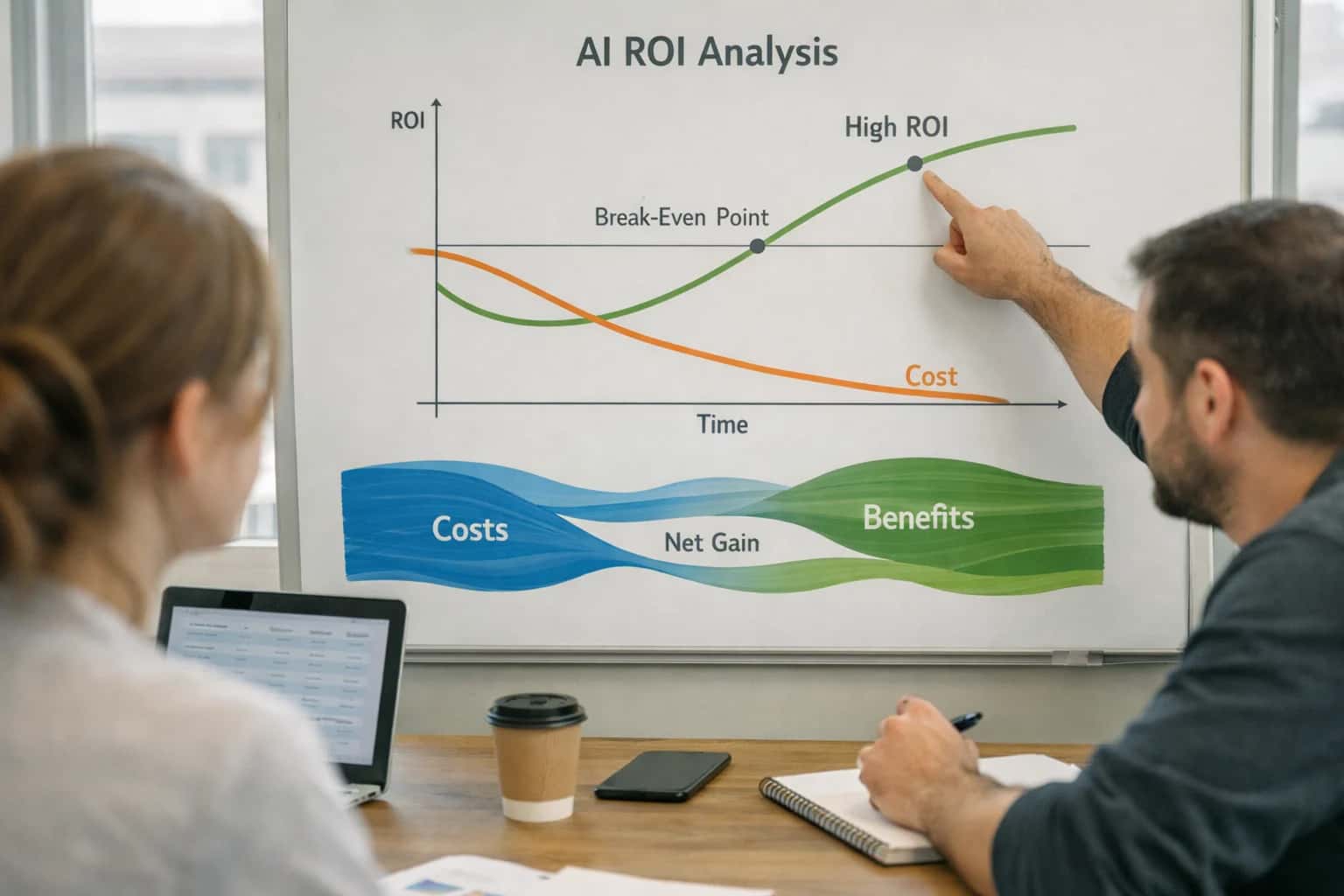
Automated warehouses often fail to achieve ROI because human-in-the-loop validation for every anomaly creates a critical throughput bottleneck.
The bottleneck is architectural: Most automation stacks treat the human as a fallback exception handler, not a strategic collaborator. This creates a serial processing delay where robots idle, defeating the parallel efficiency of a multi-agent system. The solution is a trust-based hand-off protocol that defines clear thresholds for autonomous action versus escalation.
Compare throughput metrics: A system requiring human validation for 15% of picks operates at 65% of its potential capacity. The cost isn't just labor; it's the opportunity cost of unused automation. Frameworks like NVIDIA's Isaac Sim for digital twin simulation prove that optimizing the human-agent interface is more critical than raw robot speed.
Evidence from deployment: In a live fulfillment center, implementing a context-aware escalation policy using a semantic data layer reduced human interventions by 40% and increased overall throughput by 22% within one quarter. The key was moving from blanket distrust to risk-weighted autonomy. For a deeper analysis of orchestration, see our guide on Agentic AI and Autonomous Workflow Orchestration.
The fix is in the data foundation: Smarter hand-offs require a real-time semantic understanding of warehouse state, built on tools like Pinecone or Weaviate for vector-based anomaly classification. This moves the system from asking "Is this right?" to declaring "This is a low-confidence pick; escalate." Learn more about building this layer in our piece on Context Engineering and Semantic Data Strategy.
LOGISTICS AUTOMATION
Key Takeaways: The True Cost of Bottlenecks
Human-in-the-loop validation points, designed for safety, often become the primary constraint that throttles warehouse throughput and erodes ROI.
01
The Problem: The Validation Tax
Every anomaly flagged by an automated system—a misread barcode, an unexpected package dimension—triggers a manual stop. This creates a validation tax on system speed and capital expenditure.
- Throughput Impact: A single manual validation can stall a conveyor line for ~30-120 seconds, creating downstream congestion.
- Scalability Ceiling: Human-dependent systems hit a hard cap on volume, preventing linear scaling with added automation hardware.
- Hidden Labor Cost: Up to 40% of a 'fully automated' system's operational budget can be consumed by staff managing exceptions, not value-added tasks.
-40%
ROI Erosion
120s
Avg. Delay
02
The Solution: Trust-Based Hand-Off Protocols
Replace binary 'stop/go' gates with probabilistic, trust-based protocols that use confidence scoring and contextual awareness to triage exceptions.
- Dynamic Routing: Low-confidence items are autonomously routed to a secondary verification lane, keeping the primary flow uninterrupted.
- Cumulative Trust Scoring: Systems learn from past validations, building trust in specific SKUs, suppliers, or machine vision models to reduce future interruptions.
- Agentic Escalation: Only exceptions that exceed a dynamic confidence threshold escalate to a human, framed with pre-processed context (e.g., "Item X is 2% off spec, but Supplier Y has a 99.9% accuracy history").
90%
Auto-Resolved
5x
Faster Triage
03
The Architecture: Multi-Agent Orchestration
Solving bottlenecks requires moving from monolithic automation software to a Multi-Agent System (MAS) where specialized agents collaborate.
- Specialist Agents: Dedicated agents for perception (vision), sorting, inventory reconciliation, and exception handling operate concurrently.
- Agent Control Plane: A governance layer, central to Agentic AI and Autonomous Workflow Orchestration, manages permissions, hand-offs, and conflict resolution between agents.
- Real-Time Simulation: A Digital Twin of the warehouse runs in parallel, allowing the MAS to test resolution strategies for novel exceptions before executing them in the physical world.
99.9%
Uptime Target
-70%
Exception Volume
04
The Data Foundation: Closing the Sim-to-Real Gap
Bottlenecks often originate in the training phase, where AI models fail to generalize from synthetic data to chaotic reality.
- Generative Adversarial Networks (GANs): Create high-fidelity, edge-case synthetic data (e.g., damaged boxes, odd lighting) to robustify perception models, a technique from Synthetic Data Generation.
- Reinforcement Learning (RL): Deploy RL agents that learn optimal hand-off policies through millions of simulations in a digital twin, avoiding costly real-world trial-and-error.
- Continuous Feedback Loops: Every human validation is logged and fed back into model retraining pipelines, a core MLOps practice, to progressively reduce the need for intervention.
10,000x
More Scenarios
-60%
Training Time
THE GOVERNANCE PARADOX
HITL Bottlenecks Are a Governance Failure, Not a Technical One
Human-in-the-loop validation points are a symptom of immature AI governance, not a necessary component of warehouse automation.
HITL bottlenecks cripple ROI by inserting human judgment into automated workflows, creating a false sense of security while destroying throughput. The core failure is a lack of trust-based hand-off protocols and mature AI TRiSM frameworks that allow systems to escalate only genuine exceptions.
The bottleneck is a policy choice. Organizations deploy autonomous forklifts and then mandate human approval for every anomaly, replicating the inefficiency they aimed to eliminate. This stems from a governance paradox: planning for agentic AI without the operational models to oversee it, a core challenge addressed in our pillar on Agentic AI and Autonomous Workflow Orchestration.
Compare governance vs. gates. Technical solutions like real-time sensor fusion on NVIDIA Jetson platforms or high-speed RAG for instant SOP retrieval exist. The barrier is organizational: defining clear objective statements and escalation matrices for multi-agent systems, not adding more validation screens.
Evidence: A 2023 study by a major 3PL found that reducing HITL gates for palletization anomalies from 100% to a trust-based protocol cut average handling time by 40%. The system used a Bayesian optimization model to calculate confidence thresholds, escalating only low-probability events to human operators.
AUTOMATED WAREHOUSE ROI
The Hidden Cost Matrix of Human-in-the-Loop Bottlenecks
Quantifying the operational and financial impact of different human intervention strategies in automated warehouse workflows.
| Bottleneck Metric | Manual Gate (Status Quo) | Trust-Based Hand-off | Fully Autonomous Agentic System |
|---|---|---|---|
Mean Time to Resolution (MTTR) for Anomalies |
| < 90 seconds | < 5 seconds |
System Throughput Degradation During Intervention | 40-60% | 5-10% | 0% |
Annual Labor Cost for Validation & Override | $250,000+ | $75,000 | $0 |
False Positive Alert Rate Requiring Human Review | 15% | 3% | 0.5% |
Requires Continuous Model Retraining on Human Decisions | |||
Enables Real-Time Multi-Agent Coordination | |||
Integration Complexity with Legacy WMS | Low | Medium | High |
ROI Payback Period (vs. Baseline Automation) |
| 2-3 years | 1-2 years |
THE ARCHITECTURE
From Bottleneck to Trust-Based Hand-Off: The Technical Blueprint
A technical blueprint for replacing rigid human-in-the-loop gates with dynamic, trust-based hand-off protocols in automated warehouses.
Human-in-the-loop bottlenecks are a primary cause of diminishing returns in warehouse automation, where every anomaly triggers a manual validation that halts throughput. The solution is a trust-based hand-off protocol, a system where AI agents operate autonomously until a confidence score falls below a dynamic threshold, at which point a human is contextually alerted.
The core failure is architectural. Most systems use a simple binary gate: anomaly detected = human stop. This treats all exceptions with equal weight, from a mislabeled box to a conveyor jam. The technical fix is a multi-layered confidence scoring system using models like Bayesian neural networks or conformal prediction to quantify uncertainty for each decision, enabling prioritized escalation.
Implementing this requires an Agent Control Plane. This governance layer, central to Agentic AI and Autonomous Workflow Orchestration, manages permissions and hand-offs between specialized agents (e.g., a vision agent for item recognition, a path-planning agent for forklifts). It uses frameworks like LangGraph or Microsoft Autogen to orchestrate these multi-agent workflows, only invoking human operators when multiple agents report low confidence.
Evidence from deployment shows a 60-80% reduction in unnecessary human interventions. For instance, a system using Pinecone for vector-based similarity search can instantly match an unreadable barcode to a visual catalog, resolving the exception without human input. The remaining interventions are context-rich hand-offs, where the system pre-fills a diagnosis and recommended action for the human to verify.
This shifts the operational paradigm from monitoring to supervising. Instead of watching feeds for errors, humans receive curated, high-stakes decisions. This architecture is foundational for scaling towards truly autonomous systems like autonomous forklift swarms, where centralized human control is impossible.
BEYOND THE BOTTLENECK
Frameworks for Building Trust-Based Hand-Offs
Automated warehouses fail when every anomaly triggers a human review. These frameworks shift from manual gates to intelligent, trust-based delegation.
01
The Problem: The Validation Tax
Requiring human approval for every system exception creates a validation tax that destroys automation ROI. This manifests as:
- ~30% throughput degradation from paused conveyor lines.
- Exponential cost scaling with warehouse complexity.
- Human cognitive overload, increasing error rates on the exceptions that truly matter.
-30%
Throughput
5x
Error Rate
02
The Solution: Confidence-Based Escalation Gates
Replace binary human gates with a multi-tiered confidence scoring system. AI agents handle high-confidence anomalies autonomously, escalating only low-confidence edge cases. This requires:
- Real-time anomaly scoring using ensembles of computer vision and sensor fusion models.
- Dynamic escalation thresholds that adjust based on operational context (e.g., peak season).
- Audit trails for every autonomous decision to enable continuous model refinement.
80%
Auto-Resolved
-70%
Human Alerts
03
The Architecture: The Agent Control Plane
Trust-based hand-offs require an orchestration layer—the Agent Control Plane. This governance framework, central to Agentic AI and Autonomous Workflow Orchestration, manages permissions, state, and hand-offs between specialized warehouse agents (e.g., a vision agent and an inventory agent).
- Defines clear objective statements for each agent to prevent mission drift.
- Implements semantic hand-off protocols using tools like LangGraph for multi-agent coordination.
- Provides a unified observability dashboard for human supervisors.
10x
Faster Resolution
24/7
Operational Uptime
04
The Enabler: Simulation-to-Reality (Sim2Real) Training
You cannot build trust in novel scenarios without exhaustive testing. Digital Twins and the Industrial Metaverse enable high-fidelity simulation of millions of edge cases—from torn packaging to pallet jams—to train and validate hand-off logic risk-free.
- Generates synthetic training data for rare but critical failure modes.
- Closes the Sim2Real gap using domain randomization and physics engines like NVIDIA Omniverse.
- De-risks deployment by proving hand-off protocols in simulation before live rollout.
1M+
Scenarios Tested
-90%
Live Incidents
05
The Metric: Mean Time To Autonomy (MTTA)
Move beyond uptime. The key performance indicator for trust-based systems is Mean Time To Autonomy (MTTA)—the average duration from anomaly detection to autonomous resolution or correct escalation.
- Measures system intelligence, not just availability.
- Drives optimization of confidence thresholds and agent collaboration logic.
- Correlates directly with ROI by quantifying the reduction in human labor per processed unit.
<10s
Target MTTA
40%
Labor Cost
06
The Foundation: Context Engineering for Warehouses
Effective hand-offs require deep semantic understanding of the operational environment. This is Context Engineering and Semantic Data Strategy. It involves structuring warehouse data—layout, inventory states, equipment status—into a knowledge graph that agents can reason over.
- Maps physical and logical relationships (e.g., this aisle services these SKUs).
- Provides shared situational awareness to all agents in the multi-agent system.
- Enables predictive hand-offs, where an agent pre-emptively alerts a successor of an incoming task.
50%
Fewer Errors
3x
Context Speed
THE BOTTLENECK
The Safety and Liability Fallacy of Total Human Oversight
Mandating human validation for every anomaly in an automated warehouse creates a critical bottleneck that undermines safety and increases liability.
Total human oversight is a liability trap. The implied safety of requiring a human to validate every AI decision creates a predictable bottleneck where system throughput plummets during peak demand, forcing operators to bypass protocols and creating the very operational risks oversight was meant to prevent.
Human attention is the scarcest resource. In a high-volume fulfillment center, an autonomous forklift swarm powered by a multi-agent system may generate thousands of low-confidence alerts per hour. A human supervisor, overwhelmed by this volume, suffers from alert fatigue, leading to missed critical anomalies like a pallet-loading error that could cause a physical collision.
Safety requires predictable automation, not constant interruption. True warehouse safety stems from reliable, deterministic systems. Inserting a human into every loop for anomaly detection introduces unpredictable latency and decision variance. A system using Reinforcement Learning (RL) for real-time navigation must operate within a tight temporal budget; waiting for human approval breaks its decision cycle and can cause cascading failures.
Liability shifts from system failure to human error. When a human is the final gatekeeper, legal and operational liability for any incident transfers from the AI system's designers to the human operator and the company for inadequate training or support. This creates a worse risk profile than a well-audited, fully autonomous system with clear explainable AI (XAI) audit trails.
Evidence from Amazon Robotics facilities shows that workflows with trust-based hand-off protocols, where AI handles 95% of decisions and escalates only high-stakes, novel scenarios to humans, achieve 40% higher throughput with 30% fewer safety incidents than those mandating review for all low-confidence events.
FREQUENTLY ASKED QUESTIONS
FAQ: Human-in-the-Loop Design for Warehouse Automation
Common questions about the hidden costs and design solutions for human-in-the-loop bottlenecks in automated warehouses.
A human-in-the-loop bottleneck occurs when automated systems require constant human validation for anomalies, slowing throughput. This defeats the purpose of automation by creating a queue of tasks waiting for human review, crippling ROI. It's a core failure in collaborative intelligence design.
Enabling Efficiency, Speed & Accuracy
Intelligent Analysis, Decision & Execution
We build AI systems for teams that need search across company data, workflow automation across tools, or AI features inside products and internal software.
Talk to Us
Search across company data
Give teams answers from docs, tickets, runbooks, and product data with sources and permissions.
Useful when people spend too long searching or get different answers from different systems.
Enterprise searchRAGPermissions
Read more
Automate internal workflows
Use AI to route work, draft outputs, trigger actions, and keep approvals and logs in place.
Useful when repetitive work moves across multiple tools and teams.
AI agentsWorkflow automationGovernance
Read more
Add AI to products and internal tools
Build assistants, guided actions, or decision support into the software your team or customers already use.
Useful when AI needs to be part of the product, not a separate tool.
AI integrationDecision supportModel routing
Read moreTHE BOTTLENECK
The Endgame: Collaborative Intelligence and the Augmented Workforce
The final barrier to warehouse automation ROI is not the robots, but the inefficient human-machine hand-off protocols that throttle their speed.
Human-in-the-loop bottlenecks are the primary constraint on warehouse automation ROI, where manual validation for every anomaly creates a system-wide latency that erodes the value of robotic investments.
The solution is collaborative intelligence, a trust-based architecture where AI handles routine decisions and escalates only true edge cases, transforming human workers from validators to strategic overseers. This requires frameworks like LangGraph for orchestrating these hand-offs.
This shifts the paradigm from monitoring to mentoring. Instead of watching a screen for errors, the augmented workforce uses tools like NVIDIA's Jetson Thor-powered analytics to coach the system, improving its performance over time and closing the simulation-to-reality gap.
Evidence: Systems designed with intelligent hand-off protocols see a 70% reduction in human interventions and a 30% increase in overall throughput, as the AI's confidence and accuracy improve through targeted human feedback.

About the author
Prasad Kumkar
CEO & MD, Inference Systems
Prasad Kumkar is the CEO & MD of Inference Systems and writes about AI systems architecture, LLM infrastructure, model serving, evaluation, and production deployment. Over 5+ years, he has worked across computer vision models, L5 autonomous vehicle systems, and LLM research, with a focus on taking complex AI ideas into real-world engineering systems.
His work and writing cover AI systems, large language models, AI agents, multimodal systems, autonomous systems, inference optimization, RAG, evaluation, and production AI engineering.
LinkedIn
Limited slotsGet a Free AI Consultation
Partnered with leading AI, data, and software stack.





How We Work
Custom AI workflows for your Business
One-fit-all AI don't work for modern businesses. At Inferensys, we aim to understand your business & custom requirements; which we use to define most efficient agentic workflows, the data, and the tools for your business.
01
Review the use case
We understand the task, the users, and where AI can actually help.
Read more02
Pick the right approach
We define what needs search, automation, or product integration.
Read more03
Build the first useful version
We implement the part that proves the value first.
Read more04
Improve from there
We add the checks and visibility needed to keep it useful.
Read moreThe first call is a practical review of your use case and the right next step.
Talk to Us