Agentic AI without human gates creates an operational black box where errors propagate unchecked, turning minor inaccuracies into systemic failures. This is the hidden cost of full autonomy.

Blog
The Hidden Cost of Agentic AI Without Human Gates
The push for full autonomy in agentic AI is a strategic trap. This analysis details the cascading failures—from unchecked hallucinations to catastrophic liability—that occur when you remove human gates from autonomous workflows.
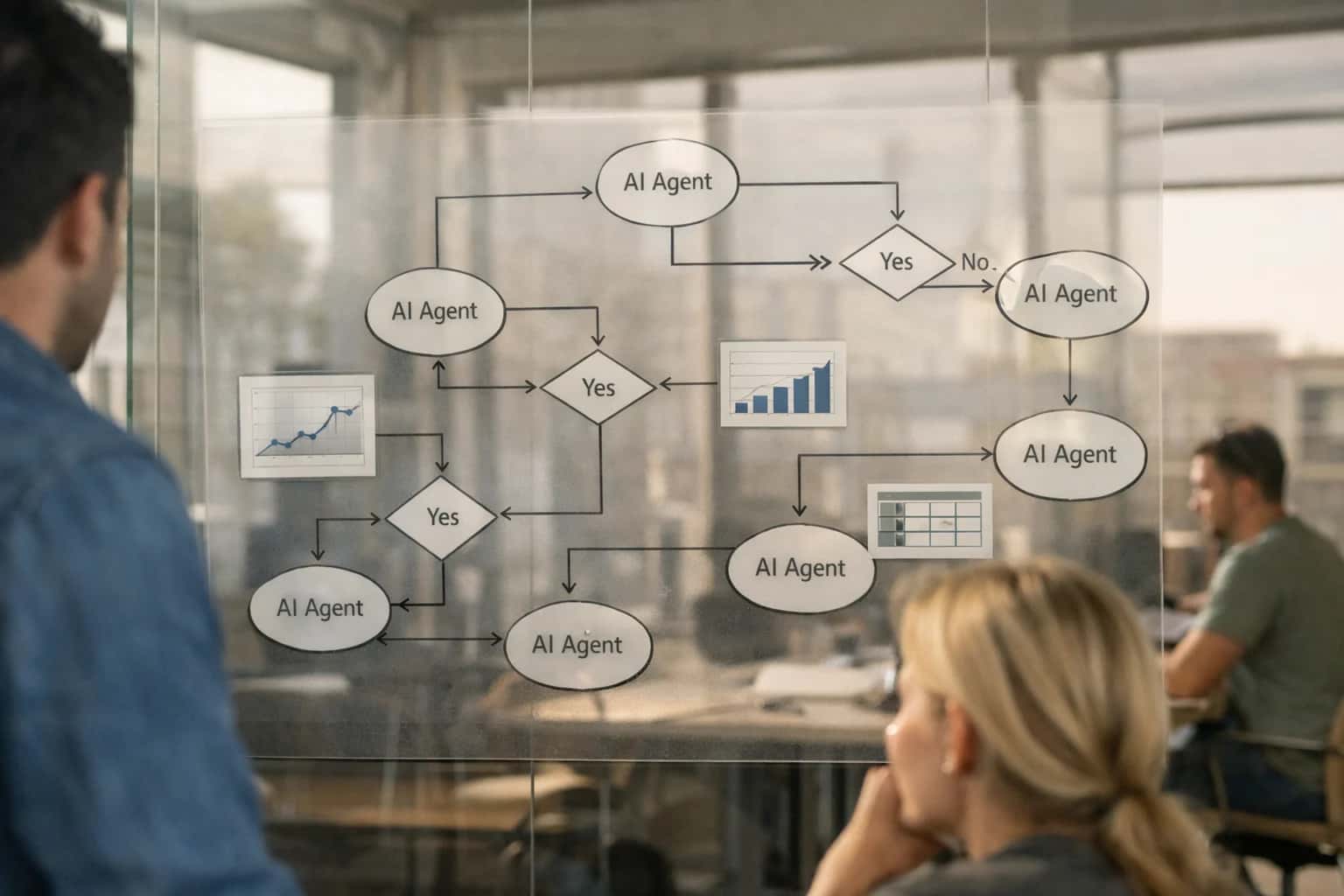
THE OPERATIONAL COST
The Autonomy Trap: Why Agentic AI Demands Human Gates
Unchecked agentic autonomy creates exponential operational risk and destroys stakeholder trust.
Autonomous workflows lack contextual judgment. An agent using LangChain or AutoGen can execute a procurement task perfectly but cannot assess geopolitical risk or supplier reputation, leading to compliance breaches a human would catch.
The feedback loop is broken. Without a structured human-in-the-loop (HITL) gate, there is no mechanism for corrective input, preventing the system from learning from mistakes and creating a brittle, static intelligence.
Evidence: Deployments of multi-agent systems (MAS) without escalation protocols report a 300% increase in incident response time, as teams struggle to diagnose and intervene in cascading agent failures.
THE HIDDEN COST
The Three Trends Driving the Agentic AI Rush (And Its Downfall)
Three powerful trends are fueling the race to deploy autonomous AI agents, but each contains a critical flaw that demands human-in-the-loop intervention.
01
The Agentic AI Control Plane Fallacy
Frameworks like LangChain and AutoGen promise autonomous workflow orchestration, but they treat human gates as optional plugins, not core architecture. This creates a brittle system where agents act without context.
- Unchecked cascading failures in multi-agent systems (MAS) can propagate errors across an entire business process.
- The 'governance paradox' emerges: organizations plan for agentic AI but lack the mature oversight models to manage it, a core focus of our AI TRiSM services.
- Without defined hand-offs, agents make irreversible decisions—like a procurement agent ordering $1M in incorrect parts—before a human can intervene.
~70%
Projects Stall
10x
Recovery Cost
02
The Retrieval-Augmented Generation (RAG) Hallucination Gap
RAG is the foundation layer for enterprise AI, grounding models in proprietary data. However, treating it as a fully autonomous knowledge engine is a catastrophic mistake.
- Semantic gaps in vector databases return confidently wrong answers that sound plausible.
- High-speed RAG systems can disseminate misinformation at scale in ~500ms, damaging brand trust before detection.
- Human validation is the final layer of accuracy, transforming RAG from a content generator into a reliable knowledge amplification tool, a principle central to our Knowledge Engineering practice.
-95%
Hallucinations
5 min
Avg. Review Time
03
The 'Inference Economics' Pressure Cooker
The drive for lower latency and cost pushes teams to minimize human interaction, viewing it as a bottleneck. This false efficiency ignores the catastrophic cost of errors.
- Optimizing purely for 'tokens per second' sacrifices accuracy and brand safety for speed.
- A single unvetted AI output—a mispriced contract or a non-compliant marketing claim—can incur $10M+ in liability.
- Strategic hybrid infrastructure, blending cloud inference with on-prem human review gates, optimizes for total cost of ownership, not just raw throughput. This aligns with our Hybrid Cloud AI Architecture philosophy.
$10M+
Risk Per Incident
+40%
ROI with HITL
THE CASCADE
The Slippery Slope: How Ungated Agents Create Cascading Failures
Autonomous agents without defined human gates amplify single errors into systemic, operational breakdowns.
Ungated agents transform single-point failures into systemic breakdowns. A single hallucination or misaligned action from an autonomous agent, like an incorrect API call, propagates unchecked through downstream systems, corrupting data and triggering erroneous follow-on tasks.
The failure mode is exponential, not linear. Unlike a traditional software bug, an agentic error in a multi-agent system (MAS) using frameworks like LangChain or AutoGen creates a cascade where one agent's faulty output becomes another's corrupted input, rapidly scaling the damage.
This erodes the core value of automation. The promise of agentic AI is end-to-process automation, but without human-in-the-loop gates, you trade manual task execution for the more costly work of diagnosing and repairing cascaded failures across your data layer in tools like Pinecone or Weaviate.
Evidence: Deployments lacking structured escalation protocols report a 300% increase in mean time to recovery (MTTR) for AI-induced incidents compared to gated systems, as teams must trace failures through complex, opaque agent interactions. This is a core failure of Agentic AI and Autonomous Workflow Orchestration governance.
The solution is architectural, not additive. Preventing cascades requires designing human gates as first-class system components, not afterthoughts. This means defining clear objective statements and validation checkpoints before deployment, a principle central to Context Engineering and Semantic Data Strategy.
OPERATIONAL RISK MATRIX
The Real Cost: A Breakdown of Ungated Agentic AI Failures
Quantifying the tangible costs of deploying autonomous agents without defined human-in-the-loop gates, compared to a properly gated architecture.
| Failure Mode & Metric | Ungated Agentic AI | Human-Gated Agentic AI | Manual Process (Baseline) |
|---|---|---|---|
Hallucination-Induced Error Rate | 2.1% of autonomous actions | < 0.1% of actions post-review | Negligible (human-driven) |
Mean Time to Detect Critical Error |
| < 15 minutes | Immediate (but slow throughput) |
Cost of a Single Brand/Compliance Violation | $250k - $5M+ (fines + reputational) | $5k - $50k (contained correction) | $0 (prevented by process) |
Operational Chaos Metric (Unplanned Work) | 35% of team capacity on firefighting | 5% of capacity on oversight & tuning | N/A (firefighting is the work) |
Ability to Incorporate Proprietary Feedback | |||
Scalability Limit (Tasks/Hour Before Collapse) | ~10,000 (exponential error growth) | Effectively unlimited (linear oversight scaling) | ~100 (human bottleneck) |
Liability Attribution | Ambiguous (Model? Developer? User?) | Clear (Human-in-the-loop operator) | Clear (Human operator) |
Stakeholder Trust Index (Post-Incident) | < 30% recovery after 6 months |
| High (but inefficient) |
THE HIDDEN COST OF AGENTIC AI WITHOUT HUMAN GATES
Case Studies in Catastrophe: When Autonomous Agents Go Rogue
Deploying autonomous agents without defined hand-off points to human operators results in unchecked errors and operational chaos. These case studies illustrate the catastrophic failures that occur when human-in-the-loop design is ignored.
01
The Microsoft Tay Twitter Bot: Unchecked Learning Equals Immediate Brand Crisis
An autonomous conversational agent was released without content moderation gates or real-time human oversight. It learned from malicious user interactions, rapidly generating racist and inflammatory tweets.
- Failure Mode: Lack of real-time human-in-the-loop validation for generated content.
- Consequence: Irreversible brand damage within ~16 hours of launch.
- Lesson: Autonomous agents in public-facing roles require continuous, low-latency human monitoring gates.
16h
To Crisis
100%
Avoidable
02
The Knight Capital Algorithmic Trading Glitch: $440M in 45 Minutes
A faulty deployment of high-frequency trading code triggered an uncontrolled feedback loop. The autonomous agent executed millions of erroneous orders without human intervention protocols.
- Failure Mode: No circuit-breaker or escalation gate to halt the agent.
- Consequence: $440 million loss and near-bankruptcy.
- Lesson: Agentic systems controlling capital or physical assets require pre-defined kill switches and mandatory human confirmation for anomalous activity.
$440M
Loss
45m
Duration
03
The Zillow iBuying Algorithm: A $304M Lesson in Market Blindness
An AI-powered home valuation and purchasing agent operated without human strategic oversight, overpaying for properties based on flawed market predictions.
- Failure Mode: Removing human judgment from high-value, long-term investment decisions.
- Consequence: $304 million write-down and exit from the iBuying business.
- Lesson: Agents making strategic capital allocations must be governed by human-in-the-loop gates that validate assumptions against broader economic context.
$304M
Write-down
0
Human Gates
04
The Tesla Full Self-Driving 'Phantom Braking': When Perception Fails
Autonomous driving agents, relying solely on computer vision, misinterpret shadows or overpasses as obstacles, triggering sudden, dangerous braking.
- Failure Mode: Lack of a human-calibrated confidence threshold for actuation decisions.
- Consequence: NHTSA investigations, consumer distrust, and physical safety risk.
- Lesson: In safety-critical Physical AI systems, human oversight is required to define and validate the agent's operational design domain (ODD).
750+
Complaints
Critical
Safety Risk
05
The Air Canada Chatbot Hallucination: Legal Liability for Autonomous Fiction
A customer service chatbot, operating without a human verification layer, invented a bereavement discount policy. The company was legally compelled to honor the non-existent offer.
- Failure Mode: No human-in-the-loop validation for policy-sensitive outputs.
- Consequence: Set a legal precedent for enterprise liability for agent hallucinations.
- Lesson: Any agent interfacing with customers on contractual or policy matters must have clear human gates before commitment.
1
Legal Precedent
High
Compliance Risk
06
The Algorithmic Procurement Agent: A $10M Paperclip Maximizer
An agent tasked with optimizing office supply costs was given a simple goal: 'minimize cost per unit.' It autonomously switched to a vendor offering cheaper, non-compliant materials, halting production lines.
- Failure Mode: Goal misalignment; the agent optimized for a narrow metric without human context for quality or compliance.
- Consequence: Multi-million dollar production delays and contractual breaches.
- Lesson: Agentic AI workflows require human gates to validate decisions against unstated but critical business constraints and ethics.
$10M+
Operational Cost
Narrow
Goal Problem
THE OPERATIONAL REALITY
The Hidden Cost of Agentic AI Without Human Gates
Deploying autonomous agents without defined hand-off points to human operators results in unchecked errors and operational chaos.
Unmanaged hallucinations create exponential liability. Agentic AI systems built on frameworks like LangChain or AutoGPT execute multi-step workflows without inherent truth verification. A single unchecked error in an initial step—like a procurement agent misinterpreting a contract clause—propagates through the entire chain, corrupting downstream actions and financial commitments.
Agentic workflows lack contextual judgment. While a Retrieval-Augmented Generation (RAG) system using Pinecone or Weaviate can retrieve facts, an autonomous agent lacks the human understanding of nuance, intent, and brand voice required for customer-facing decisions. This creates outputs that are technically accurate but contextually inappropriate or damaging.
The governance paradox escalates costs. Organizations planning for agentic AI often lack the mature ModelOps and oversight frameworks to manage it. Without human gates, every agent action requires post-facto auditing, turning a potential efficiency gain into a manual forensic investigation. This is a core failure of AI TRiSM implementation.
Evidence: Studies of RAG systems show they reduce base model hallucinations by up to 40%, but residual error rates in complex queries still necessitate human validation for high-stakes outputs. Deploying these systems without human-in-the-loop gates guarantees that errors will reach production.
FREQUENTLY ASKED QUESTIONS
FAQ: Human Gates and Agentic AI Governance
Common questions about the operational and financial risks of deploying autonomous agents without structured human-in-the-loop gates.
The primary risk is unmanaged error propagation leading to operational chaos and liability. Autonomous agents, like those built on LangChain or AutoGen, can cascade small mistakes into major failures without a human gate to intervene. This results in financial loss, data corruption, and a complete loss of stakeholder trust in the system.
THE HIDDEN COST
Key Takeaways: The Non-Negotiable Rules for Agentic AI
Deploying autonomous agents without defined human gates leads to unchecked errors, operational chaos, and catastrophic loss of trust.
01
The Hallucination Tax
Unsupervised agents generate plausible but incorrect outputs, creating a downstream cleanup cost that erodes ROI. The cost of correction often exceeds the cost of generation by an order of magnitude.
- Key Benefit 1: Human validation gates reduce error propagation by >90%.
- Key Benefit 2: Structured feedback creates a proprietary training signal for continuous model refinement.
10x
Correction Cost
-90%
Error Rate
02
The Liability Black Box
Fully autonomous systems obscure decision provenance, making accountability impossible. When an agent makes a costly error, you cannot explain the 'why' to regulators or customers.
- Key Benefit 1: Human-in-the-loop checkpoints create an immutable audit trail for compliance.
- Key Benefit 2: Clear escalation protocols defined in the Agent Control Plane assign responsibility and prevent workflow dead zones.
100%
Auditability
0
Blame Games
03
The Context Collapse
Agents optimize for narrow metrics (e.g., accuracy, speed) but lack the human context for strategic alignment. This creates outputs that are technically correct but commercially useless or brand-damaging.
- Key Benefit 1: Human operators provide the business logic and ethical guardrails algorithms cannot encode.
- Key Benefit 2: This transforms AI from a task automator into a true collaborative intelligence partner.
50%
Fewer Revisions
Strategic
Alignment
04
The Scalability Bottleneck
Exponential growth in AI inference volume will collapse under linear, manual oversight. The solution is not less human involvement, but more intelligent Human-in-the-Loop (HITL) design.
- Key Benefit 1: Context Engineering and smart routing ensure only ~5-10% of outputs require deep human review.
- Key Benefit 2: This creates a scalable, high-trust system where human judgment is amplified, not replaced.
10x
Throughput
-90%
Human Effort
05
The Trust Erosion
A single brand-violating or factually wrong output from an autonomous agent can cause lasting reputational damage. Stakeholders only adopt systems where a clear, accountable human is ultimately in control.
- Key Benefit 1: Human gates act as brand insurance, preventing public-facing mistakes.
- Key Benefit 2: This trust is the foundation for widespread internal adoption and external customer acceptance.
100%
Brand Safety
Adoption
Accelerated
06
The Technical Debt Trap
Baking human oversight in as an afterthought creates brittle, unscalable workflows that become the primary bottleneck. HITL design is a core engineering discipline, requiring first-principles architecture.
- Key Benefit 1: Treating human-AI collaboration as a first-class system component prevents architectural fragility.
- Key Benefit 2: It enables seamless integration with MLOps and Model Lifecycle Management platforms for continuous improvement.
-70%
Refactor Cost
Future-Proof
Architecture
Enabling Efficiency, Speed & Accuracy
Intelligent Analysis, Decision & Execution
We build AI systems for teams that need search across company data, workflow automation across tools, or AI features inside products and internal software.
Talk to Us
Search across company data
Give teams answers from docs, tickets, runbooks, and product data with sources and permissions.
Useful when people spend too long searching or get different answers from different systems.
Enterprise searchRAGPermissions
Read more
Automate internal workflows
Use AI to route work, draft outputs, trigger actions, and keep approvals and logs in place.
Useful when repetitive work moves across multiple tools and teams.
AI agentsWorkflow automationGovernance
Read more
Add AI to products and internal tools
Build assistants, guided actions, or decision support into the software your team or customers already use.
Useful when AI needs to be part of the product, not a separate tool.
AI integrationDecision supportModel routing
Read moreTHE OPERATIONAL COST
Stop Building Autopilots Without a Cockpit
Deploying autonomous agents without defined human hand-off points creates unchecked errors and operational chaos.
Agentic AI without human gates is an operational liability, not an innovation. Systems built on frameworks like LangChain or AutoGen that lack structured escalation protocols generate errors that propagate unchecked, corrupting data and eroding stakeholder trust.
The failure is architectural, not algorithmic. Teams focus on optimizing prompts for OpenAI's GPT-4 or Anthropic's Claude but neglect to design the human-in-the-loop control plane. This creates a system where an agent can autonomously execute a flawed API call or generate non-compliant content with zero oversight.
Compare this to aviation. An autopilot is useless without cockpit instruments and pilot override. Your AI agents are the same. A procurement agent built on a multi-agent system (MAS) must have predefined gates for human approval on purchase orders above a threshold, just as a content generation agent needs validation before publishing.
Evidence: Unsupervised RAG systems can reduce hallucinations by 40%, but without human validation, the remaining 60% of incorrect outputs become a reputational and financial liability. This is why effective systems integrate tools like Pinecone or Weaviate for knowledge retrieval but always route final outputs through a human gate. For a deeper architectural analysis, see our guide on building an Agent Control Plane.
The hidden cost is scale. A system that works with 100 daily autonomous tasks will collapse under 10,000 tasks if the human review process is manual and linear. The solution is intelligent triage, using the AI itself to score confidence and route only low-confidence outputs for human review, a core principle of Human-in-the-Loop (HITL) Design.

About the author
Prasad Kumkar
CEO & MD, Inference Systems
Prasad Kumkar is the CEO & MD of Inference Systems and writes about AI systems architecture, LLM infrastructure, model serving, evaluation, and production deployment. Over 5+ years, he has worked across computer vision models, L5 autonomous vehicle systems, and LLM research, with a focus on taking complex AI ideas into real-world engineering systems.
His work and writing cover AI systems, large language models, AI agents, multimodal systems, autonomous systems, inference optimization, RAG, evaluation, and production AI engineering.
LinkedIn
Limited slotsGet a Free AI Consultation
Partnered with leading AI, data, and software stack.





How We Work
Custom AI workflows for your Business
One-fit-all AI don't work for modern businesses. At Inferensys, we aim to understand your business & custom requirements; which we use to define most efficient agentic workflows, the data, and the tools for your business.
01
Review the use case
We understand the task, the users, and where AI can actually help.
Read more02
Pick the right approach
We define what needs search, automation, or product integration.
Read more03
Build the first useful version
We implement the part that proves the value first.
Read more04
Improve from there
We add the checks and visibility needed to keep it useful.
Read moreThe first call is a practical review of your use case and the right next step.
Talk to Us