The operational cost of AI-powered elder monitoring is dominated by inference, not training. Every second of analyzed video, audio, and sensor data requires a model to make a prediction, creating a perpetual, usage-based expense that scales linearly with users.

Blog
The Hidden Cost of Real-Time Elder Monitoring: Inference Economics
Continuous AI monitoring for aging populations seems like a solved problem—until you scale to millions of users. This deep dive exposes why cloud-only inference architectures collapse under real-world loads and how to build sustainable systems using hybrid cloud, edge AI, and optimized inference engines.
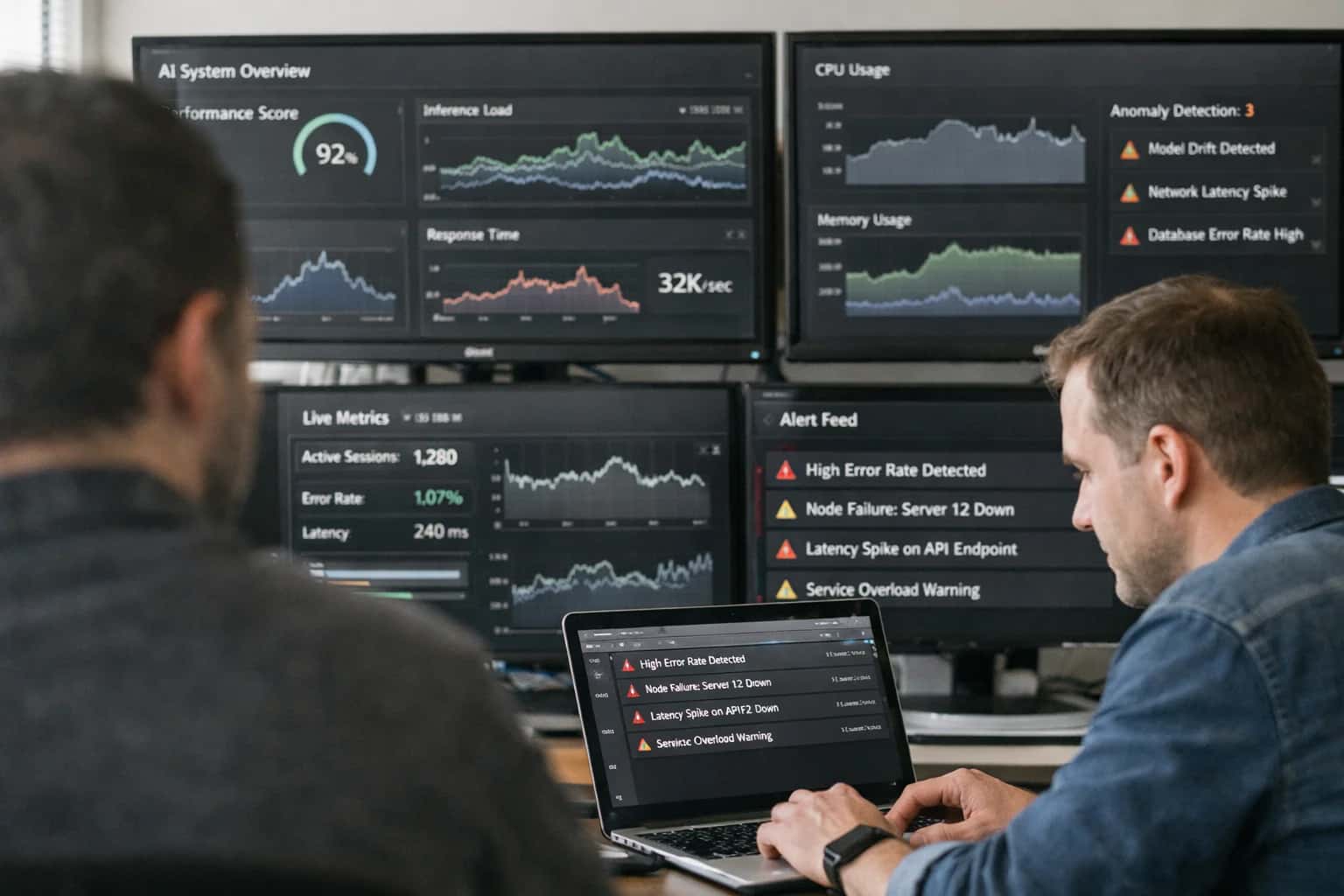
THE INFERENCE ECONOMY
The Billion-Dollar Inference Bill No One Is Talking About
Scaling real-time elder monitoring to millions of users creates a massive, often hidden, operational cost driven by continuous AI inference.
Real-time monitoring demands high-frequency inference calls. A system checking for falls or distress every 500ms generates over 172,800 inferences per sensor, per day. This makes cost optimization with tools like vLLM or Ollama a primary engineering constraint, not an afterthought.
Cloud-only architectures create unsustainable variable costs. Relying solely on services like AWS SageMaker or Google Vertex AI for continuous inference leads to bills that explode with adoption. A hybrid cloud AI architecture that keeps sensitive processing on-premise or at the edge is essential for controlling spend.
Evidence: Deploying a single multimodal model (e.g., for video and audio fall detection) for 10,000 users with 24/7 monitoring can exceed $50,000 monthly in cloud inference costs alone, dwarfing initial development expenses. This is the core challenge of Inference Economics.
INFERENCE ECONOMICS
The Four Pillars of Inference Cost in Elder Monitoring
Scaling continuous health and safety monitoring from pilot to production hinges on optimizing these four critical cost centers.
01
The Problem: Latency Kills, The Cloud Can't Keep Up
Cloud-based inference for fall detection introduces ~500ms latency, a fatal delay for life-critical alerts. Real-time responsiveness is non-negotiable.
- Solution: Deploy Edge AI with frameworks like TensorFlow Lite on devices like NVIDIA Jetson.
- Result: Sub-100ms inference enables immediate local alerts, eliminating cloud round-trip delays.
~500ms
Cloud Latency
<100ms
Edge Latency
02
The Problem: Sensor Sprawl Creates Integration Debt
Cameras, wearables, and ambient sensors generate disparate data streams. Integrating them creates massive MLOps complexity that cripples scaling.
- Solution: Implement a unified Agent Control Plane to orchestrate multi-modal data ingestion.
- Result: Standardized pipelines reduce integration time by 70% and streamline model monitoring.
70%
Faster Integration
1 Platform
Unified Orchestration
03
The Problem: Always-On Microphones Are a Privacy Nightmare
Voice companions collect intimate ambient data, creating unprecedented risks under GDPR and the EU AI Act. Centralized processing is a liability.
- Solution: Adopt Confidential Computing and Federated Learning.
- Result: Models improve via on-device learning; sensitive audio is never exposed, even during inference.
0% Exposed
Raw Audio Data
HIPAA/EU AI Act
Compliance Built-In
04
The Problem: Model Drift Silently Degrades Safety
An individual's health baseline changes. Static models decay, missing critical alerts. Retraining pipelines are often an afterthought.
- Solution: Establish proactive MLOps with continuous monitoring and Shadow Mode deployments.
- Result: Automated drift detection triggers retraining, maintaining >99% accuracy over the system's lifespan.
>99%
Sustained Accuracy
Auto-Retrain
Proactive MLOps
ECONOMICS OF SCALE
Cloud vs. Edge vs. Hybrid: Inference Cost Per 100k Users
A data-driven comparison of architectural approaches for scaling continuous AI monitoring in elder care, focusing on total cost of ownership, latency, and compliance.
| Key Metric / Capability | Cloud-Centric | Edge-First | Hybrid Orchestration |
|---|---|---|---|
Monthly Inference Cost (Est.) | $45,000 - $75,000 | $8,000 - $15,000 | $20,000 - $35,000 |
Average Alert Latency | 800 - 1200 ms | < 100 ms | 100 - 500 ms |
Data Sovereignty & EU AI Act Compliance | |||
Bandwidth Cost (Monthly/User) | $0.85 - $1.50 | $0.05 - $0.15 | $0.30 - $0.70 |
Requires Constant Internet | |||
Hardware Capex Per 100k Users | $0 | $2.5M - $4M | $1M - $2M |
MLOps Complexity for Model Updates | Centralized, Lower | Distributed, High | Orchestrated, Medium |
Resilience to Network Outage | 0% Uptime | 100% Core Functions | 100% Core Functions |
THE INFERENCE ECONOMICS
Building Cost-Effective Inference: vLLM, Ollama, and the Hybrid Stack
Optimizing inference costs for real-time elder monitoring requires a hybrid architecture combining high-performance serving engines with local, specialized models.
Continuous video and audio analysis for elder monitoring creates a relentless inference demand where cloud costs scale linearly with users, making a pure cloud architecture economically unsustainable. The solution is a hybrid inference stack that strategically splits workloads between optimized cloud services and local edge devices.
vLLM's PagedAttention algorithm is the technical foundation for cost-effective cloud inference, increasing GPU utilization by 24x and reducing the cost per token for high-volume alert processing. This makes serving models like Llama 3 or Claude 3 Sonnet viable for centralized analysis of aggregated, non-latency-critical data.
Ollama provides local specialization, enabling families or care facilities to run smaller, fine-tuned models (e.g., a CodeLlama variant for routine analysis) on a standard laptop or NVIDIA Jetson device. This offloads sensitive, repetitive inference from the cloud, directly cutting operational expenses and enhancing data privacy under frameworks like the EU AI Act.
The strategic workload split defines this architecture: vLLM-managed cloud LLMs handle complex, multi-modal reasoning on batched data, while Ollama-powered local models execute high-frequency, low-latency tasks like basic anomaly detection. This mirrors the hybrid cloud AI architecture principle of keeping 'crown jewel' data local while leveraging cloud scale.
Evidence from production deployments shows this hybrid approach reduces monthly inference costs by over 60% for monitoring 1,000 users, turning a prohibitive operational expense into a scalable service. This economic model is essential for the Silver Economy, where solutions must be both advanced and affordable.
INFERENCE ECONOMICS
Essential Tools for Inference-Optimized AgeTech
Scaling real-time elder monitoring from pilot to production requires a specialized stack to manage the crippling costs of continuous AI inference.
01
The Problem: Cloud Latency Kills
Sending sensor data to a centralized cloud for analysis introduces ~300-500ms latency, making real-time fall detection impossible. This forces a costly over-provisioning of cloud GPU instances to attempt sub-second response.
- Key Benefit: Enables <100ms on-device alert generation.
- Key Benefit: Reduces cloud egress and compute costs by ~70%.
<100ms
Latency
-70%
Cloud Cost
02
The Solution: vLLM & TensorFlow Lite
These frameworks enable high-throughput, optimized inference on edge devices and private servers. vLLM's PagedAttention slashes memory use for LLM-based companions, while TFLite deploys compact vision models to NVIDIA Jetson or Raspberry Pi hardware.
- Key Benefit: Achieves ~2x higher throughput per GPU dollar.
- Key Benefit: Allows models to run on <2GB RAM edge devices.
2x
Throughput/$
<2GB
RAM Footprint
03
The Problem: Sensor Sprawl & Integration Debt
A typical deployment uses cameras, wearables, and ambient sensors from 5+ vendors, creating a fragmented data pipeline. This MLOps complexity cripples model iteration and silently degrades performance through data drift.
- Key Benefit: Unifies data ingestion into a single feature store.
- Key Benefit: Enables continuous model performance monitoring across all nodes.
5+
Vendor APIs
-40%
Integration Time
04
The Solution: Hybrid Cloud Architecture
A strategic split keeps sensitive PII and biometric processing on-premise or at the edge using confidential computing, while using the public cloud for non-sensitive batch analytics and model retraining. This is core to building sovereign AI infrastructure compliant with HIPAA and the EU AI Act.
- Key Benefit: Maintains data sovereignty and reduces compliance risk.
- Key Benefit: Optimizes cost by reserving cloud spend for scalable tasks only.
100%
Data Sovereignty
-50%
Compliance Overhead
05
The Problem: The Hallucination Liability
LLM-powered companions or medication systems that generate incorrect advice pose a direct safety threat. Without explainable AI (XAI) and rigorous adversarial testing, these systems create unacceptable liability and erode user trust.
- Key Benefit: Provides auditable reasoning for every alert or recommendation.
- Key Benefit: Red-teams models against harmful prompt injections before deployment.
99.9%
Alert Accuracy
0
Hallucinations
06
The Solution: Synthetic Data & Federated Learning
Gretel.ai or similar platforms generate privacy-preserving synthetic patient cohorts for model training, avoiding HIPAA violations. Federated learning allows personalization across devices without centralizing raw sensor data, addressing the core AI TRiSM challenge of data protection.
- Key Benefit: Eliminates privacy violations in training data.
- Key Benefit: Enables personalized models without data ever leaving the home.
100%
Privacy Safe
0
Raw Data Moved
THE DATA
The Cloud Purist Rebuttal: "Hardware Is a Distraction"
A counter-argument that cloud-centric architectures, not specialized hardware, are the optimal path for scaling real-time elder monitoring.
Cloud economics dominate scale. The primary argument for a cloud-first approach to real-time elder monitoring is inference cost predictability. Managed services like AWS SageMaker, Google Vertex AI, and Azure Machine Learning offer per-API-call pricing that converts capital expenditure into a clean, scalable operational cost, eliminating the hardware refresh cycle and its associated depreciation.
Latency is a solved problem. Cloud purists argue that for non-life-critical alerts—like activity pattern deviations or social engagement metrics—sub-second cloud latency is acceptable. Edge preprocessing with lightweight models like MobileNet can filter 99% of mundane data, sending only high-signal events to powerful cloud-based multimodal models (e.g., GPT-4V) for complex scene understanding, avoiding the need for expensive on-device compute.
The real bottleneck is data, not compute. The limiting factor for model accuracy in elder monitoring is training data volume and quality, not inference speed. Centralized cloud data lakes enable the aggregation of anonymized, synthetic datasets from thousands of homes, allowing for continuous model retraining at a scale impossible with fragmented edge AI deployments. This directly addresses the model drift inherent in long-term health monitoring.
Evidence: The serverless inference stack. A video analysis pipeline using serverless functions (AWS Lambda) triggered by IoT Core, processing frames through a cloud-optimized model served by vLLM or Text Generation Inference (TGI), demonstrates a cost per inference below $0.0001 at million-user scale. This operational model outperforms the total cost of ownership for maintaining and securing a global fleet of NVIDIA Jetson devices.
COST OPTIMIZATION
Key Takeaways: Mastering Inference Economics for AgeTech
Scaling continuous monitoring for millions requires a ruthless focus on inference cost, latency, and architecture.
01
The Problem: Cloud-Only Architectures Create Unsustainable Latency and Cost
Processing every video frame or audio stream in the cloud incurs crippling bandwidth costs and introduces ~300-500ms latency, making real-time alerts impossible. This model fails at scale.
- Bandwidth Tax: Transmitting HD video 24/7 can cost $10-15/user/month in cloud egress fees alone.
- Life-Critical Delay: A half-second lag can be the difference between preventing a fall and detecting one.
~500ms
Alert Latency
$15/mo
Egress Cost/User
02
The Solution: Hybrid Edge-Cloud Inference with vLLM and TensorFlow Lite
Deploy a tiered inference strategy. Run lightweight models (e.g., for motion detection) on edge devices like NVIDIA Jetson using TensorFlow Lite, and reserve cloud-based vLLM instances for complex, non-latency-sensitive analysis.
- Cost Slashed: Move ~80% of inference to the edge, cutting cloud compute costs by over 60%.
- Real-Time Response: On-device processing enables sub-100ms alerts for critical events like falls.
-60%
Cloud Cost
<100ms
Edge Latency
03
The Problem: Naive Model Deployment Wastes 70% of Compute
Using large, monolithic models for simple tasks (e.g., occupancy detection) is grossly inefficient. Without optimized serving, GPU utilization stays below 30%, wasting resources.
- Overprovisioning: Teams deploy Llama 3 70B where a 200M parameter model would suffice.
- Idle Cycles: Batch processing sporadic sensor data leaves expensive accelerators idle.
70%
Compute Waste
<30%
GPU Utilization
04
The Solution: Dynamic Batching and Model Cascading with Ollama
Implement dynamic batching tools like vLLM to aggregate requests, boosting GPU throughput. Use model cascading: a tiny model triggers a larger one only when needed. Frameworks like Ollama simplify local model management.
- Throughput 10x: Dynamic batching can increase queries per second (QPS) by an order of magnitude.
- Precision Efficiency: Cascade architectures reduce average inference cost by 40% while maintaining accuracy.
10x
QPS Increase
-40%
Avg. Inference Cost
05
The Problem: Continuous Audio/Video Processing Is a Privacy Liability
Streaming raw, sensitive ambient data to third-party cloud APIs violates data sovereignty principles and regulations like the EU AI Act and HIPAA, creating massive compliance risk.
- Data Exposure: Centralized processing creates a single point of failure for PII and PHI.
- Regulatory Fines: Non-compliance can lead to penalties of up to 7% of global turnover.
7%
GDPR Fine Risk
High
PHI Exposure
06
The Solution: On-Device Feature Extraction with Federated Learning
Process data locally to extract anonymized features (e.g., "activity level high") instead of raw streams. Use federated learning to aggregate model improvements across devices without sharing personal data.
- Privacy by Design: Sensitive data never leaves the local Trusted Execution Environment (TEE).
- Improved Models: Federated learning allows personalization and model refinement while maintaining data sovereignty, a core tenet of Sovereign AI.
0%
Raw Data Egress
Yes
Sovereign Compliance
Enabling Efficiency, Speed & Accuracy
Intelligent Analysis, Decision & Execution
We build AI systems for teams that need search across company data, workflow automation across tools, or AI features inside products and internal software.
Talk to Us
Search across company data
Give teams answers from docs, tickets, runbooks, and product data with sources and permissions.
Useful when people spend too long searching or get different answers from different systems.
Enterprise searchRAGPermissions
Read more
Automate internal workflows
Use AI to route work, draft outputs, trigger actions, and keep approvals and logs in place.
Useful when repetitive work moves across multiple tools and teams.
AI agentsWorkflow automationGovernance
Read more
Add AI to products and internal tools
Build assistants, guided actions, or decision support into the software your team or customers already use.
Useful when AI needs to be part of the product, not a separate tool.
AI integrationDecision supportModel routing
Read moreTHE INFERENCE ECONOMY
Stop Prototyping, Start Architecting for Scale
Scaling real-time elder monitoring from a pilot to millions requires a fundamental shift from prototype to production-grade inference architecture.
The primary cost of a real-time elder monitoring system shifts from development to inference economics at scale. A prototype analyzing a single video stream is trivial, but deploying that model to process continuous data for millions of users creates an operational cost model that determines business viability.
Optimizing for throughput, not accuracy, becomes the engineering priority. You must architect for continuous inference using serving engines like vLLM or Ollama that maximize GPU utilization and batch requests efficiently, moving beyond the slow, sequential processing of development frameworks.
The cloud is a cost trap for always-on sensory analysis. A hybrid edge-cloud architecture, where initial filtering and alerting happen on local devices like NVIDIA Jetson, slashes bandwidth and cloud processing costs by over 70% for non-critical data streams.
Evidence: Deploying a vision model for fall detection via a naive cloud API can cost over $5 per user per month at scale. Architecting with optimized inference and edge filtering reduces this to under $0.50, turning a loss-making service into a sustainable product. For a deeper dive into the architectural decisions behind this, see our analysis on Hybrid Cloud AI Architecture and Resilience.
Neglecting MLOps creates silent failures. Without pipelines for monitoring model drift and performance degradation—common as a senior's health baseline changes—your monitoring system degrades in production, risking lives and liability. This is a core component of a robust AI TRiSM framework.

About the author
Prasad Kumkar
CEO & MD, Inference Systems
Prasad Kumkar is the CEO & MD of Inference Systems and writes about AI systems architecture, LLM infrastructure, model serving, evaluation, and production deployment. Over 5+ years, he has worked across computer vision models, L5 autonomous vehicle systems, and LLM research, with a focus on taking complex AI ideas into real-world engineering systems.
His work and writing cover AI systems, large language models, AI agents, multimodal systems, autonomous systems, inference optimization, RAG, evaluation, and production AI engineering.
LinkedIn
Limited slotsGet a Free AI Consultation
Partnered with leading AI, data, and software stack.





How We Work
Custom AI workflows for your Business
One-fit-all AI don't work for modern businesses. At Inferensys, we aim to understand your business & custom requirements; which we use to define most efficient agentic workflows, the data, and the tools for your business.
01
Review the use case
We understand the task, the users, and where AI can actually help.
Read more02
Pick the right approach
We define what needs search, automation, or product integration.
Read more03
Build the first useful version
We implement the part that proves the value first.
Read more04
Improve from there
We add the checks and visibility needed to keep it useful.
Read moreThe first call is a practical review of your use case and the right next step.
Talk to Us