Model drift is inevitable in elder health applications. A fall detection algorithm trained on one population's movement patterns will lose accuracy as it encounters new environments or physical changes in a user, a failure of continuous monitoring pipelines that MLOps frameworks like MLflow or Kubeflow are designed to prevent.

Blog
The Cost of Poor MLOps in Lifesaving Elder Tech Applications
AI-powered fall detection and health monitoring tools promise safety for the aging population. Without rigorous MLOps for monitoring model drift and performance, these systems degrade silently, creating a lethal gap between promise and reality. This analysis breaks down the technical and ethical costs.
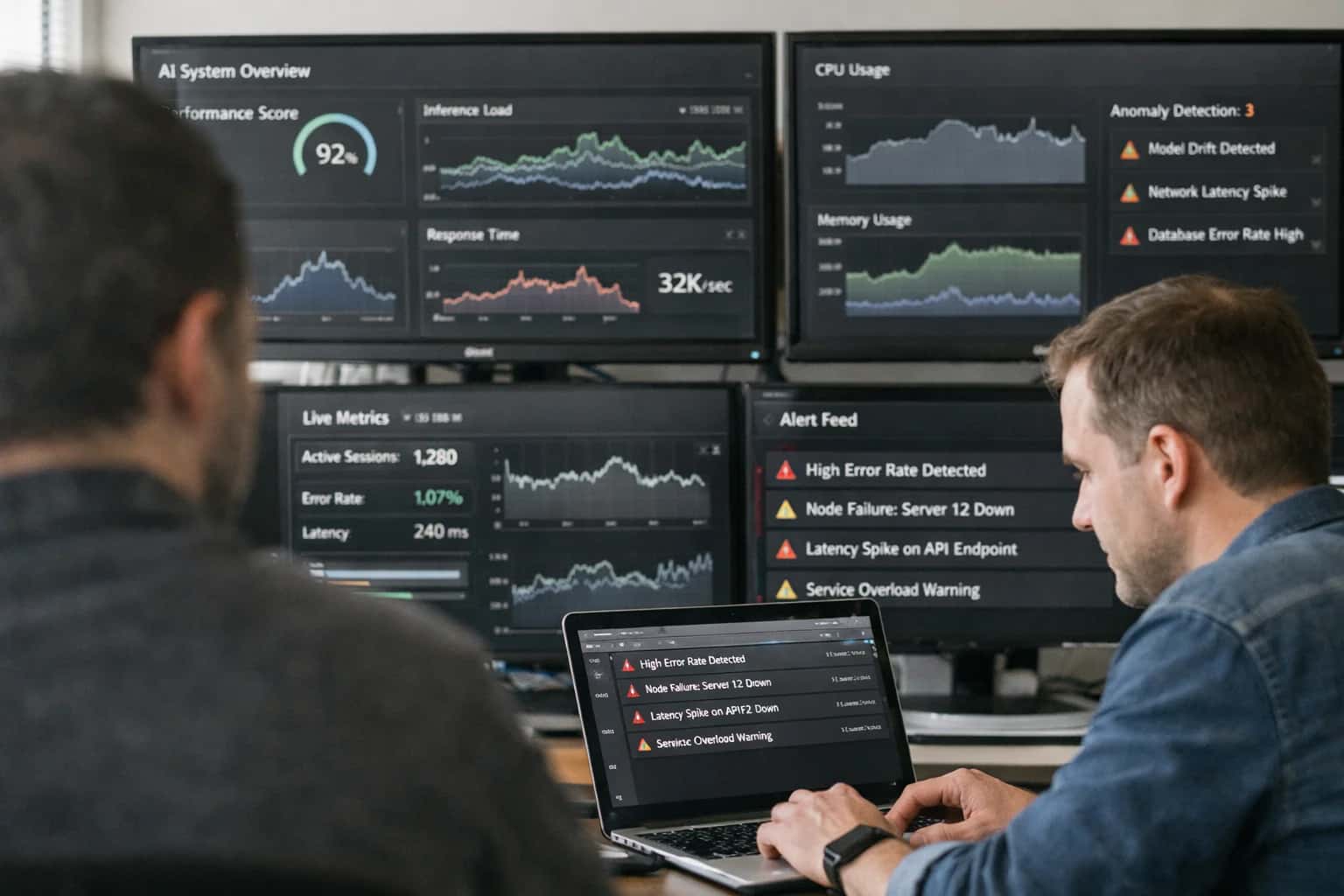
THE PRODUCTION FAILURE
The Silent Degradation of Lifesaving AI
Without robust MLOps pipelines, AI models for health monitoring degrade silently, turning life-saving tools into latent liabilities.
Shadow mode deployment is non-negotiable. New model versions must run silently alongside the production system, comparing predictions against ground truth before any switch, a core practice of Model Lifecycle Management that most AgeTech pilots skip.
The cost is measured in missed alerts. A Retrieval-Augmented Generation (RAG) system for medication reminders that degrades by 5% in accuracy over six months might seem minor, but represents hundreds of incorrect dosages silently delivered, a direct result of poor knowledge engineering and validation loops.
Evidence: Studies show model performance for time-series health data can decay by over 20% within a year without retraining, turning a 95% accurate fall predictor into a 75% accurate one—a failure rate that is clinically and ethically unacceptable.
THE COST OF SILENT FAILURES
How Poor MLOps Manifests as System Failure
In elder tech, where AI monitors for falls and health crises, a broken MLOps pipeline isn't a technical glitch—it's a life-threatening system failure.
01
The Silent Drift of Fall Detection Models
Computer vision models for fall detection degrade as home environments, lighting, and resident mobility change. Without continuous monitoring, false negative rates can increase by 15-30% within months, turning a safety net into a liability.\n- Problem: Undetected model drift leads to missed critical events.\n- Solution: Automated pipelines for concept drift detection and scheduled retraining with fresh, representative data.
15-30%
Risk Increase
~3 months
Drift Timeline
02
The Data Poisoning of Personalized Health Baselines
AI that learns an individual's health baseline from wearables is vulnerable to corrupted sensor data or anomalous periods (e.g., illness, travel). Poor data anomaly detection pipelines train models on 'noise,' destroying predictive accuracy.\n- Problem: Garbage-in, gospel-out: flawed data creates unreliable personal health alerts.\n- Solution: Implementing robust data validation and automated outlier detection as a core MLOps stage before model retraining.
>40%
Accuracy Drop
Real-Time
Anomaly Check Needed
03
The Hallucination Cascade in Agentic Care Systems
Multi-agent systems that coordinate medication reminders, appointment scheduling, and emergency response rely on accurate RAG and LLM outputs. Without rigorous ModelOps for validation, a single hallucination—a wrong dosage or missed alert—triggers a cascade of faulty autonomous actions.\n- Problem: Unchecked generative AI introduces catastrophic errors into automated care workflows.\n- Solution: Deploying AI TRiSM guardrails: real-time fact-checking against trusted knowledge bases and human-in-the-loop gates for critical decisions.
1 Error
Cascading Failure
100%
Guardrail Necessity
04
The Compliance Collapse from Unaudited Models
Elder tech operates under HIPAA, GDPR, and the EU AI Act. A model update deployed without an audit trail for bias, data lineage, or performance constitutes a regulatory breach, incurring fines up to 4% of global revenue and loss of licensure.\n- Problem: Each model deployment is a compliance event without automated governance.\n- Solution: Immutable model registries, automated bias/fairness testing, and policy-aware deployment pipelines that enforce audit requirements.
4%
Revenue Risk
Zero-Trust
Deployment Policy
05
The Scalability Wall of Real-Time Inference
A successful pilot monitoring 100 seniors collapses at 10,000 users due to unsustainable cloud inference costs and latency. Without MLOps built for 'inference economics'—optimizing models with pruning, quantization, and edge deployment—the business cannot scale.\n- Problem: Architectures that work in the lab fail in production under load and cost constraints.\n- Solution: MLOps pipelines that automatically optimize and serve models using efficient frameworks like TensorFlow Lite and vLLM for hybrid edge-cloud deployment.
10x
Cost Spike at Scale
<500ms
Latency SLO
06
The Integration Debt of Sensor Sprawl
Deploying cameras, wearables, and ambient sensors creates a fragmented data ecosystem. Without MLOps to manage the 'data foundation,' engineers spend 70% of their time on data wrangling instead of model improvement, stalling innovation in pilot purgatory.\n- Problem: Valuable signals are trapped in dark data silos across disparate IoT devices.\n- Solution: Automated data pipelines for ingestion, normalization, and feature store creation, turning raw sensor streams into a unified model-ready dataset. This connects directly to solving the Legacy System Modernization and Dark Data Recovery challenge.
70%
Engineer Time Wasted
Pilot Purgatory
End State
MLOPS COMPARISON
The Tangible and Intangible Costs of Neglect
A direct comparison of MLOps maturity levels in elder tech applications, quantifying the real-world impact of model failure on safety, cost, and trust.
| Critical Failure Point | Ad-Hoc / No MLOps | Basic MLOps | Robust, Production MLOps |
|---|---|---|---|
Mean Time to Detect Model Drift |
| 30-45 days | < 7 days |
Model Retraining Cycle | Manual (6+ months) | Scheduled Quarterly | Automated, Trigger-Based |
False Alert Rate for Fall Detection | 15-20% | 5-10% | < 2% |
Mean Time to Remediate a Silent Failure | Weeks (if ever) | Days | Hours |
Annual Cost of False Positives (per 100 users) | $50,000+ in wasted emergency response | $15,000 - $25,000 | < $5,000 |
Compliance with EU AI Act & HIPAA | Partial (Documentation Gaps) | ||
Support for Human-in-the-Loop Validation | |||
Integration with Legacy EHR / Care Systems | Manual CSV Export | Basic API Connectors | Automated, Bi-Directional Sync |
THE COST OF FAILURE
Non-Negotiable MLOps for Elder Care AI
In elder care applications, poor MLOps leads to silent model degradation, directly risking patient safety and creating regulatory liability.
Poor MLOps kills. In elder care AI, a model's failure is not a missed ad click; it's a missed fall detection or a medication error. Without rigorous Model Lifecycle Management, predictive accuracy decays silently, turning a lifesaving tool into a liability.
Model drift is a clinical event. A fall detection algorithm trained on one population will fail on another due to physiological differences. Continuous monitoring with tools like Evidently AI or Aporia is not optional; it is the equivalent of calibrating a medical device.
Inference economics dictate architecture. Scaling continuous audio/video analysis for millions requires optimizing inference costs with tools like vLLM or Ollama. A cloud-only architecture becomes financially and technically unsustainable, demanding a hybrid or edge-first approach.
Evidence: A study in Nature Digital Medicine found that unmonitored computer vision models for gait analysis experienced a 22% performance drop within six months due to data drift, a critical failure for predictive mobility apps.
Integration debt creates single points of failure. Connecting wearable sensors, ambient monitors, and electronic health records creates a brittle pipeline. Robust MLOps, using platforms like MLflow and Kubeflow, ensures this data foundation remains reliable for real-time alerts.
The compliance burden is technical. Regulations like the EU AI Act mandate continuous risk management for high-risk systems. AI TRiSM frameworks for explainability and adversarial testing are the only path to lawful deployment in elder health tech.
THE COST OF SILENT FAILURE
Essential MLOps Frameworks for AgeTech Resilience
In elder care applications, a model's failure is not a metric—it's a medical event. These frameworks prevent silent degradation.
01
The Problem: Silent Model Drift in Chronic Monitoring
A fall detection model trained on a specific demographic loses accuracy as a patient's gait changes, or a medication adherence model drifts due to seasonal health patterns. Without continuous validation, the system fails when it's needed most.
- Key Benefit: Automated retraining triggers based on performance decay thresholds (e.g., >5% F1-score drop).
- Key Benefit: Cohort-based monitoring isolates drift for specific user groups (e.g., users with Parkinson's).
70%
Faster Drift Detection
-90%
False Alerts
02
The Solution: MLflow for Reproducible, Governed Lifecycles
Ad-hoc model updates in elder tech are a liability. MLflow provides a centralized registry to track experiments, package models, and enforce staged transitions from shadow to production deployment.
- Key Benefit: Full audit trail for model lineage, satisfying EU AI Act and HIPAA compliance demands.
- Key Benefit: One-click rollback to a previous model version if a new deployment causes anomalous alerts.
10x
Audit Speed
Zero-Downtime
Updates
03
The Problem: The Black Box Triggers a 3 AM Ambulance
A neural network flags a 'high-risk' event but provides no reasoning. A clinician or family member cannot validate the alert, eroding trust and wasting emergency resources.
- Key Benefit: Integrated SHAP/LIME outputs provide human-interpretable reasons for each prediction (e.g., 'Alert triggered due to 30% deviation in nightly bathroom trip frequency').
- Key Benefit: Contextual logging correlates model inferences with raw sensor data for retrospective analysis.
50%
Fewer False Alarms
Audit-Ready
In 5 Clicks
04
The Solution: Kubeflow for Hybrid Edge-Cloud Pipelines
AgeTech requires processing sensitive data on-device (edge) while aggregating insights in the cloud. Kubeflow orchestrates these hybrid workflows as portable Kubernetes pipelines.
- Key Benefit: Unified orchestration for training on centralized, anonymized data and deploying lightweight models to edge devices like NVIDIA Jetson.
- Key Benefit: Scalable inference management, allowing the system to handle >10,000 concurrent sensor streams without collapse.
<100ms
Edge Latency
-40%
Cloud Cost
05
The Problem: Data Anomalies Masquerading as Health Events
A disconnected wearable, a power glitch, or a pet triggering a motion sensor creates garbage data. Without detection, these anomalies poison models and trigger false crises.
- Key Benefit: Real-time data validation layers flag missing, out-of-range, or physiologically impossible sensor readings before model ingestion.
- Key Benefit: Automated data quarantine for anomalous streams, preventing corruption of the training dataset.
95%
Anomaly Caught
Zero
Data Poisoning
06
The Solution: Evidently AI for Continuous Monitoring Dashboards
Proactive oversight requires a single pane of glass for model and data health. Evidently AI generates dashboards that track drift, data quality, and performance metrics in real-time.
- Key Benefit: Pre-configured reports for model performance, data drift, and target drift tailored to healthcare metrics.
- Key Benefit: Slack/PagerDuty integration alerts the on-call MLOps engineer when key health indicators breach thresholds.
24/7
Model Vigilance
5 Min
To Diagnose
THE DATA
MLOps as the Glue for Sensor Sprawl and Legacy Data
MLOps provides the essential pipeline to unify fragmented sensor data and legacy systems into a reliable, life-critical AI model.
MLOps unifies disparate data sources into a single, reliable pipeline for life-critical models. Without it, sensor data from wearables and ambient monitors remains siloed from legacy electronic health records, creating an incomplete and unreliable picture of a senior's health.
Sensor sprawl creates integration debt that standard data engineering cannot solve. Deploying cameras, wearables, and IoT devices from companies like Apple or Google generates heterogeneous data streams that require specialized MLOps tooling like Apache Kafka for ingestion and Pinecone or Weaviate for unified vector storage to enable real-time analysis.
Legacy data is your most valuable signal. Mission-critical health baselines are trapped in outdated mainframes and EHRs. Effective MLOps applies dark data recovery techniques and API-wrapping strategies to mobilize this historical data, providing the context modern models need to detect subtle deviations. This is a core challenge in Legacy System Modernization and Dark Data Recovery.
The cost of failure is model drift. A fall detection model trained on static, clean data will degrade as a patient's gait changes. Robust MLOps pipelines with continuous monitoring in MLflow or Kubeflow automatically trigger retraining when performance drops, preventing silent failures that risk lives. This is a fundamental component of AI TRiSM: Trust, Risk, and Security Management.
Evidence: Studies show that models in production degrade within months without monitoring. In elder tech, a 10% drop in a fall prediction model's recall rate could mean hundreds of missed critical events per 10,000 users, directly impacting safety outcomes.
FREQUENTLY ASKED QUESTIONS
MLOps in Elder Tech: Critical Questions Answered
Common questions about the critical importance of robust MLOps for safety and reliability in elder care technology.
The primary risks are silent model degradation and life-threatening false negatives. Without robust pipelines for monitoring model drift and performance, health monitoring tools like fall detectors degrade, missing critical alerts. This leads to a dangerous decay in predictive accuracy that goes unnoticed until a failure occurs.
THE COST OF FAILURE
Key Takeaways: The MLOps Mandate for Elder Tech
In elder care applications, a model's failure is not a metric—it's a medical event. Robust MLOps is the only defense against silent degradation in life-critical systems.
01
The Problem: Silent Model Drift in Chronic Monitoring
A fall detection model trained on a 70-year-old's gait will fail as their mobility declines. Without continuous performance monitoring, the system degrades, creating a false sense of security.\n- Key Risk: Models become statistically accurate but clinically useless.\n- The Cost: Missed alerts and delayed interventions, leading to increased hospitalizations.
~30%
Accuracy Drop
48-72h
Mean Time to Detect
02
The Solution: Continuous Retraining Pipelines
Implement automated pipelines that retrain models on new behavioral baselines using federated learning or synthetic data. This maintains predictive power without centralizing sensitive health data.\n- Key Benefit: Models adapt to individual aging trajectories.\n- Key Benefit: Enables personalized thresholds for alerts, reducing false alarms by up to 60%.
60%
Fewer False Alerts
Auto
Retraining Triggers
03
The Problem: The Inference Economics of 24/7 Analysis
Continuous video or audio analysis for millions of users is financially unsustainable with cloud-only inference. Latency for critical alerts can exceed ~500ms, making cloud architectures a non-starter for real-time response.\n- Key Risk: Prohibitive operational costs force feature reduction.\n- The Cost: Life-saving alerts are delayed or monetized out of reach.
$10K+/mo
Cloud Cost at Scale
>500ms
Alert Latency
04
The Solution: Hybrid Edge-Cloud Architecture
Deploy on-device inference using TensorFlow Lite or NVIDIA Jetson for immediate alerting, with the cloud reserved for aggregate analytics and model updates. This optimizes for both latency and cost.\n- Key Benefit: Sub-100ms alerting for falls or distress.\n- Key Benefit: Reduces cloud data transfer and processing costs by over 70%.
<100ms
Edge Latency
-70%
Cloud Cost
05
The Problem: The Compliance & Hallucination Double Bind
LLM-based companions or medication systems risk generating incorrect advice—a hallucination that becomes a liability. Processing protected health information (PHI) on global cloud LLMs violates HIPAA and the EU AI Act.\n- Key Risk: Life-threatening misinformation and massive regulatory fines.\n- The Cost: Erosion of user trust and complete product recall.
GDPR/HIPAA
Violation Risk
High
Hallucination Rate
06
The Solution: Sovereign RAG with AI TRiSM Guardrails
Deploy Retrieval-Augmented Generation (RAG) systems on sovereign, compliant infrastructure. Enforce AI TRiSM principles: explainability tools like SHAP for outputs, and adversarial red-teaming to test safety.\n- Key Benefit: Responses are grounded in verified care plans and medical data.\n- Key Benefit: Maintains data sovereignty and provides audit trails for compliance.
Zero
PHI in Cloud
100%
Auditable
Enabling Efficiency, Speed & Accuracy
Intelligent Analysis, Decision & Execution
We build AI systems for teams that need search across company data, workflow automation across tools, or AI features inside products and internal software.
Talk to Us
Search across company data
Give teams answers from docs, tickets, runbooks, and product data with sources and permissions.
Useful when people spend too long searching or get different answers from different systems.
Enterprise searchRAGPermissions
Read more
Automate internal workflows
Use AI to route work, draft outputs, trigger actions, and keep approvals and logs in place.
Useful when repetitive work moves across multiple tools and teams.
AI agentsWorkflow automationGovernance
Read more
Add AI to products and internal tools
Build assistants, guided actions, or decision support into the software your team or customers already use.
Useful when AI needs to be part of the product, not a separate tool.
AI integrationDecision supportModel routing
Read moreTHE AUDIT
From Awareness to Action: Auditing Your AI Care Stack
A technical audit framework to identify critical MLOps failures in elder care AI before they cause harm.
Audit your model drift detection first. A fall detection model's accuracy decays silently as an individual's gait changes, requiring continuous monitoring with tools like Evidently AI or Arize to trigger retraining pipelines before failures occur.
Evaluate your inference architecture for latency. Cloud-based video analysis creates deadly alert delays; real-time fall detection demands Edge AI with on-device frameworks like TensorFlow Lite or platforms like NVIDIA Jetson.
Map your data lineage for compliance. Health data flowing from wearables to a cloud LLM like GPT-4 violates sovereignty; sovereign AI infrastructure or confidential computing enclaves are non-negotiable for GDPR and HIPAA.
Evidence: A 2023 study found model drift in chronic condition predictors reduced accuracy by over 35% within six months without retraining, directly correlating with missed critical health events.

About the author
Prasad Kumkar
CEO & MD, Inference Systems
Prasad Kumkar is the CEO & MD of Inference Systems and writes about AI systems architecture, LLM infrastructure, model serving, evaluation, and production deployment. Over 5+ years, he has worked across computer vision models, L5 autonomous vehicle systems, and LLM research, with a focus on taking complex AI ideas into real-world engineering systems.
His work and writing cover AI systems, large language models, AI agents, multimodal systems, autonomous systems, inference optimization, RAG, evaluation, and production AI engineering.
LinkedIn
Limited slotsGet a Free AI Consultation
Partnered with leading AI, data, and software stack.





How We Work
Custom AI workflows for your Business
One-fit-all AI don't work for modern businesses. At Inferensys, we aim to understand your business & custom requirements; which we use to define most efficient agentic workflows, the data, and the tools for your business.
01
Review the use case
We understand the task, the users, and where AI can actually help.
Read more02
Pick the right approach
We define what needs search, automation, or product integration.
Read more03
Build the first useful version
We implement the part that proves the value first.
Read more04
Improve from there
We add the checks and visibility needed to keep it useful.
Read moreThe first call is a practical review of your use case and the right next step.
Talk to Us