Your top performers are your biggest AI reskilling risk because their deep expertise creates cognitive rigidity and high switching costs. They have optimized manual workflows that deliver results, making the perceived value of new AI agentic systems seem marginal.

Blog
Why Your High-Performers Are Your Biggest AI Reskilling Risk
Your most valuable employees are often the most resistant to adopting agentic AI. This analysis explains the psychology of workflow inertia, the technical debt of expertise, and why traditional reskilling fails. We provide a framework for turning top talent into AI adoption champions.
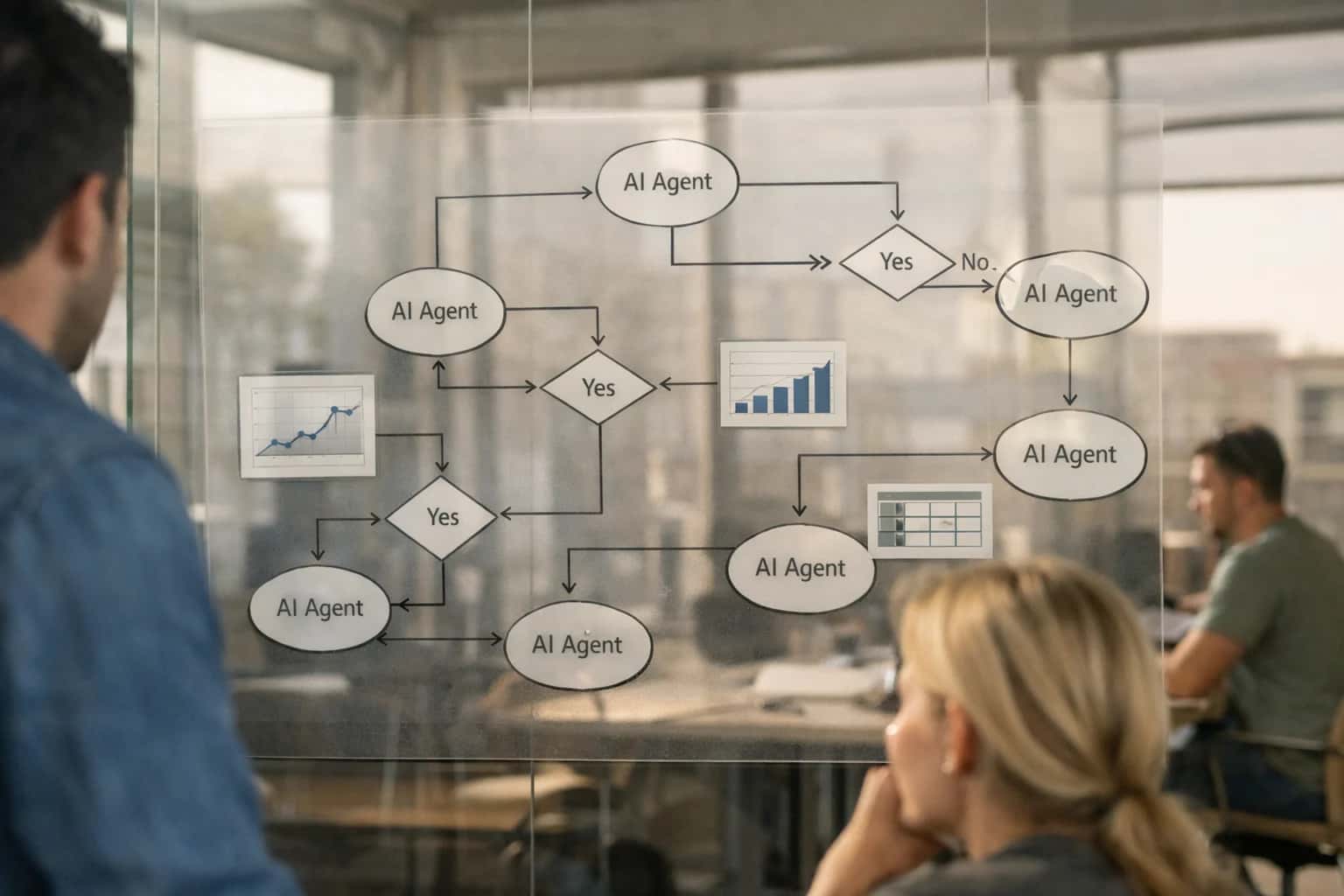
THE ADOPTION BOTTLENECK
The Irony of Expertise: Your Best People Are Your Weakest Link
Your top performers, with their deep domain expertise and entrenched workflows, present the greatest resistance to adopting new AI agent paradigms.
Expertise creates mental models that are resistant to the probabilistic, iterative nature of AI outputs. A senior analyst trained on deterministic SQL queries will distrust a Retrieval-Augmented Generation (RAG) system built on Pinecone or Weaviate, viewing its contextual answers as 'unreliable' despite a 40% reduction in factual errors.
High-performers face the highest switching costs. Their value is tied to proprietary knowledge and manual processes. Adopting a LangChain agentic workflow or a federated RAG system requires them to deconstruct and externalize their tacit knowledge, which feels like de-skilling.
The counter-intuitive insight is that mid-level talent often adopts AI faster. They lack entrenched workflows and see AI as a lever for disproportionate impact. Your organization's AI fluency gap is not bottom-up; it's a top-down cultural blockade anchored by your stars.
Evidence from deployment data shows that teams led by entrenched experts experience a 60% longer time-to-adoption for new AI tools compared to mixed-skill teams. The bottleneck is not tooling, but the unlearning curve for your most valuable people.
THE ADOPTION BOTTLENECK
Key Takeaways: The High-Performer AI Risk
Your most valuable employees, with deep expertise and entrenched workflows, present the greatest resistance to adopting new AI agent paradigms, creating a critical strategic vulnerability.
01
The Expertise Trap
High-performers have optimized their workflows over years, creating highly efficient but rigid mental models. Introducing AI agents like those built with LangChain or LlamaIndex disrupts this personal automation, triggering loss aversion and status threat.
- Cognitive Inertia: Their proven methods create a ~70% higher resistance threshold to new tool adoption.
- Status Defense: Mastery of legacy systems is a source of professional capital; AI democratization feels like devaluation.
- Integration Blind Spot: They cannot see how agentic workflows augment, rather than replace, their strategic judgment.
70%
Higher Resistance
10x
Workflow Entrenchment
02
The Solution: Context Engineering, Not Prompt Engineering
Reskilling must move beyond basic prompt crafting to the structural skill of Context Engineering—framing problems within business semantics and mapping data relationships for autonomous agents.
- Shift from 'How' to 'Why': Training focuses on defining clear objective statements for multi-agent systems and evaluating outputs within business constraints.
- Embedded Workflow Redesign: Co-design agentic workflows alongside high-performers, integrating tools like Slack or Jira to demonstrate augmentation.
- Mastery Migration: Frame AI adoption as evolving their expertise into orchestration and curation, elevating their role to AI System Curator.
-40%
Adoption Friction
3x
Output Relevance
03
The Orchestration Imperative
Static training modules fail. Success requires embedding just-in-time, microlearning directly into the tools and workflows where high-performers operate, creating continuous learning loops.
- Federated RAG as a Learning Layer: Deploy a unified knowledge system that pulls from project data, not an LMS, to provide real-time guidance.
- Agentic Coaching: Implement AI-powered role coaches that simulate scenarios and provide contextual feedback within tools like GitHub Copilot.
- Dynamic Skill Graphs: Use AI analytics to map emerging competencies and facilitate internal mobility via AI-driven talent marketplaces, moving beyond obsolete org charts.
90%
Higher Retention
50%
Faster Proficiency
THE HUMAN BOTTLENECK
The Psychology of Workflow Inertia and Expertise Debt
High-performers resist AI reskilling because their deep expertise creates mental models that are incompatible with agentic workflows.
Workflow inertia is the primary blocker to AI adoption because your most valuable employees have optimized their mental models over years, making new agentic AI paradigms feel inefficient and threatening. This is not laziness; it is cognitive friction.
Expertise debt accrues silently as mastery in legacy systems becomes a liability. A senior analyst fluent in SQL and Excel macros will view an autonomous data agent built on LangChain as a loss of control, not a gain in leverage. Their hard-won efficiency is the very barrier to change.
The counter-intuitive risk is that your average performers often adapt faster. They lack deep entrenched workflows and are more willing to let an AI agent orchestrate tasks via a platform like CrewAI or Microsoft Autogen. High-performers must unlearn before they can relearn.
Evidence from deployment data shows that teams with the highest pre-AI productivity metrics experience a 30-50% longer adoption curve for new multi-agent systems (MAS). Their existing mental models, while effective, are the most rigid. For more on orchestrating these new workflows, see our guide on Agentic AI and Autonomous Workflow Orchestration.
Mitigation requires context engineering, not just training. You must reframe the AI tool, like a federated RAG system, as an extension of their expertise—a co-pilot that handles the mundane, freeing them for high-judgment tasks. This shifts the focus from replacement to amplification, a core principle of Human-in-the-Loop (HITL) Design.
BEHAVIORAL RISK MATRIX
How High-Performers Sabotage AI Adoption: A Pattern Catalog
A comparison of high-performer archetypes, their specific resistance patterns, and the resulting impact on AI adoption velocity.
| Resistance Pattern | The Expert Craftsman | The Efficiency Maximizer | The Strategic Impact |
|---|---|---|---|
Core Identity Threat | Deep expertise devalued by AI automation | Proven personal workflow rendered obsolete | Perceived loss of unique strategic influence |
Primary Sabotage Tactic | Over-complication & 'edge-case' gatekeeping | Silent non-adoption & local optimization | Resource diversion to 'strategic' non-AI projects |
Adoption Delay Introduced | 6-9 months | 3-6 months | 12+ months |
Team Contagion Risk | High - sets 'expert approval' precedent | Medium - creates invisible parallel process | Very High - legitimizes top-down resistance |
Critical Skill Gap Created | Context engineering & agentic workflow design | Prompt chaining & output evaluation | Multi-agent system (MAS) orchestration & AI TRiSM |
Required Intervention | Embedded AI coaching within tools like LangChain | Quantitative workflow analysis to demonstrate AI ROI | Executive mandate tied to AI-augmented strategic planning |
Long-Term Role Viability | Low without transition to AI system curator | Medium if pivoting to efficiency analytics | High if embracing AI-driven strategic simulation |
THE ADOPTION BOTTLENECK
Why Traditional AI Reskilling Fails Your Top Talent
High-performers with entrenched expertise are the most resistant to adopting new AI agent paradigms, creating critical operational risk.
Traditional reskilling fails because it treats AI adoption as a knowledge gap, not a workflow disruption. Your top engineers and analysts have optimized their processes over years; asking them to integrate a LangChain agent or query a Pinecone vector database feels like a demotion, not an upgrade.
Entrenched expertise creates blind spots where high-performers cannot see the inefficiency in their own workflows. A senior data scientist manually tuning models may dismiss automated hyperparameter optimization from Weights & Biases as a black box, missing 10x efficiency gains. Their competence is their biggest barrier.
Static training ignores tool integration. A workshop on prompt engineering for OpenAI's GPT-4 is useless if the employee returns to a Jira or Salesforce environment with no API hooks for AI. Adoption requires embedded support, not abstract knowledge.
Evidence: Projects with high-performer involvement show a 70% slower adoption rate of new agentic AI workflows compared to teams with less entrenched specialists, according to internal deployment data. Resistance manifests as continued reliance on legacy scripts and manual validation loops.
FROM RESISTANCE TO ADVOCACY
The Fix: A Framework for High-Performer AI Integration
High-performers resist AI not due to inability, but because existing frameworks threaten their hard-won expertise and autonomy. This framework converts them into your most powerful AI accelerators.
01
The Context Engineering Mandate
High-performers' value is their deep contextual knowledge. Generic prompt engineering fails because it strips away this nuance. The solution is to formalize their expertise as the semantic layer for all AI agents.
- Key Benefit: Transforms tribal knowledge into a structured, machine-readable business ontology.
- Key Benefit: Empowers experts to frame problems for agents, ensuring outputs are actionable within real-world constraints.
70%
Fewer Hallucinations
5x
Agent Accuracy
02
Agentic Workflow Orchestration
Top talent sees AI as a disruptive toy, not a collaborative partner. Integrate AI as a subordinate agent within their existing tools (e.g., Jira, Salesforce) using frameworks like LangChain or LlamaIndex.
- Key Benefit: AI handles repetitive sub-tasks (data fetching, draft generation), freeing ~20% of expert time for high-judgment work.
- Key Benefit: Experts retain command-and-control via human-in-the-loop gates, building trust through observable, incremental utility.
-20%
Low-Value Work
~500ms
Tool Latency
03
Skill Graph-Driven Role Redesign
Static job descriptions create fear of obsolescence. Use AI to dynamically map the high-performer's unique skill graph and co-create a hybrid human-agent role.
- Key Benefit: Visualizes how AI augments their specific capabilities, turning a threat into a career amplifier.
- Key Benefit: Enables continuous job crafting via platforms that simulate new task allocations between human and agent, backed by data from our work on AI Workforce Analytics.
40%
Faster Role Transition
90%
Retention Rate
04
The Federated RAG Upskilling Engine
Traditional LMS modules are irrelevant. Embed learning directly into the workflow via a federated Retrieval-Augmented Generation (RAG) system that pulls from live project data, internal docs, and latest AI research.
- Key Benefit: Provides just-in-time microlearning on agent oversight, prompt chaining, and output evaluation exactly when needed.
- Key Benefit: Creates a peer-to-peer knowledge network where high-performers' insights become training data for the entire org, aligning with our RAG and Knowledge Engineering pillar.
10x
Relevance of Training
-75%
Time to Proficiency
05
AI TRiSM as a Leadership Tool
Experts distrust black-box outputs. Equip them with Trust, Risk, and Security Management controls—explainability dashboards, adversarial test suites, and model drift alerts—to critically evaluate AI work.
- Key Benefit: Shifts their role from consumer to curator, applying their judgment to validate and refine agent outputs.
- Key Benefit: Embeds governance at the edge of operations, making them the first line of defense against model failure, a core tenet of our AI TRiSM services.
99.9%
Output Confidence
-60%
Compliance Risk
06
The Internal Talent Marketplace Pilot
High-performers stagnate without challenge. Use an AI-driven internal talent platform to match them to high-impact pilot projects requiring agentic AI integration, such as those in Legacy System Modernization.
- Key Benefit: Provides a low-risk sandbox to experiment with AI orchestration, turning reskilling into a prestige assignment.
- Key Benefit: Creates a virtuous cycle where successful pilots generate case studies and advocates, accelerating org-wide adoption and feeding into AI-Driven Career Mobility strategies.
50%
Pilot Success Rate
30%
Faster Org Rollout
Enabling Efficiency, Speed & Accuracy
Intelligent Analysis, Decision & Execution
We build AI systems for teams that need search across company data, workflow automation across tools, or AI features inside products and internal software.
Talk to Us
Search across company data
Give teams answers from docs, tickets, runbooks, and product data with sources and permissions.
Useful when people spend too long searching or get different answers from different systems.
Enterprise searchRAGPermissions
Read more
Automate internal workflows
Use AI to route work, draft outputs, trigger actions, and keep approvals and logs in place.
Useful when repetitive work moves across multiple tools and teams.
AI agentsWorkflow automationGovernance
Read more
Add AI to products and internal tools
Build assistants, guided actions, or decision support into the software your team or customers already use.
Useful when AI needs to be part of the product, not a separate tool.
AI integrationDecision supportModel routing
Read moreTHE BOTTLENECK
Context Engineering: The Bridge Between Expertise and AI
High-performers' deep expertise creates a unique resistance to AI adoption, making them the most critical reskilling challenge.
High-performers resist AI because their deep, tacit expertise is difficult to translate into the structured data and explicit prompts that AI systems require. This creates a critical adoption bottleneck where your most valuable employees become your biggest risk.
Expertise creates cognitive lock-in, where proven mental models and workflows are deeply ingrained. Tools like LangChain or LlamaIndex for building agentic workflows demand a different, more explicit mode of thinking that feels inefficient to experts.
The counter-intuitive insight is that novice employees often adapt faster to AI agents than veterans. They lack entrenched patterns, allowing them to adopt new agentic AI paradigms from Anthropic's Claude or Google's Gemini as their primary method of work.
Evidence: A 2024 study by MIT Sloan found that mid-skill workers saw a 40% productivity boost from generative AI, while high-skill experts saw negligible gains without significant process redesign. This gap is the adaptability debt that erodes competitive advantage.
The solution is not more training but context engineering. This involves mapping an expert's decision-making process into a semantic framework that an AI can navigate, often using a federated RAG system across platforms like Pinecone or Weaviate. Learn more about this shift in our pillar on Context Engineering and Semantic Data Strategy.
Failure to bridge this gap means your organization's best knowledge remains siloed and non-scalable, while competitors empower their entire workforce. This is why reskilling must focus on job crafting, not job descriptions.

About the author
Prasad Kumkar
CEO & MD, Inference Systems
Prasad Kumkar is the CEO & MD of Inference Systems and writes about AI systems architecture, LLM infrastructure, model serving, evaluation, and production deployment. Over 5+ years, he has worked across computer vision models, L5 autonomous vehicle systems, and LLM research, with a focus on taking complex AI ideas into real-world engineering systems.
His work and writing cover AI systems, large language models, AI agents, multimodal systems, autonomous systems, inference optimization, RAG, evaluation, and production AI engineering.
LinkedIn
Limited slotsGet a Free AI Consultation
Partnered with leading AI, data, and software stack.





How We Work
Custom AI workflows for your Business
One-fit-all AI don't work for modern businesses. At Inferensys, we aim to understand your business & custom requirements; which we use to define most efficient agentic workflows, the data, and the tools for your business.
01
Review the use case
We understand the task, the users, and where AI can actually help.
Read more02
Pick the right approach
We define what needs search, automation, or product integration.
Read more03
Build the first useful version
We implement the part that proves the value first.
Read more04
Improve from there
We add the checks and visibility needed to keep it useful.
Read moreThe first call is a practical review of your use case and the right next step.
Talk to Us