The Paper Job Description Fallacy is the futile act of rewriting a role for AI without constructing the LangChain or LlamaIndex workflows that will perform the work. A new job spec is a hypothesis; the agentic workflow is the experiment.

Blog
Why Role Redesign Fails Without Agentic Workflow Orchestration
Redefining a job description is a paper exercise without the agentic workflows to execute the new tasks. This article explains the critical link between role redesign and building orchestrated systems with LangChain, LlamaIndex, and multi-agent frameworks.
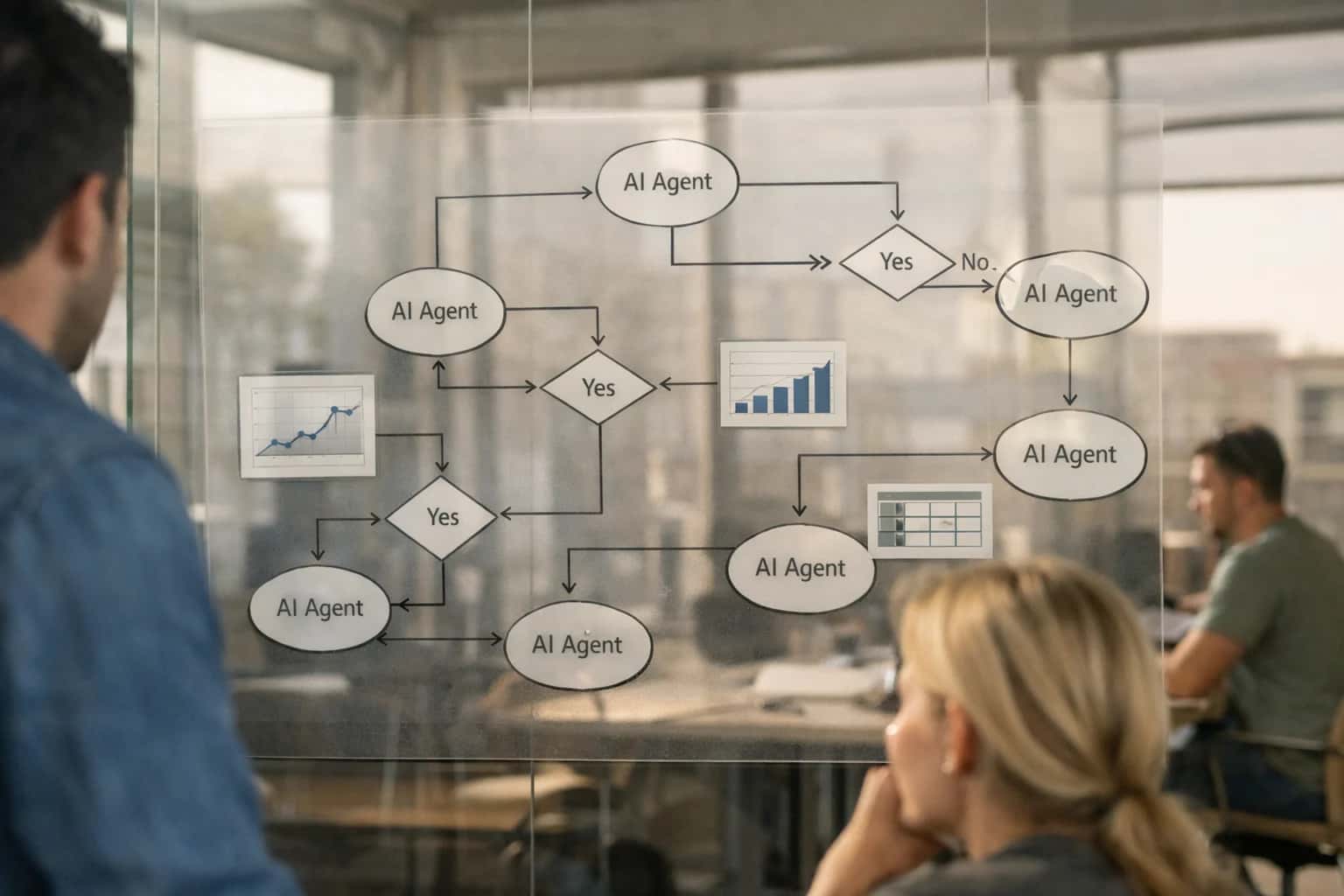
THE ORCHESTRATION GAP
The Paper Job Description Fallacy
Redefining a job description without building the agentic workflows to execute the new tasks guarantees failure.
Workflow Orchestration is the Implementation. A job description defines tasks; an agentic control plane executes them. Without tools like CrewAI or AutoGen to coordinate multi-step processes, the redesigned role remains a theoretical exercise in document management.
Process Maps Are Not Code. A process diagram in Lucidchart is not a functioning multi-agent system (MAS). The gap between a swimlane and a deployed autonomous procurement agent is filled by engineering, not HR policy.
Evidence: Projects that pair role redesign with simultaneous agentic workflow development see a 70% higher adoption rate of new responsibilities. The remaining 30% fail at the integration layer, where human-in-the-loop (HITL) gates were not designed.
This is a core tenet of Agentic AI and Autonomous Workflow Orchestration. Success requires shifting from defining work to instrumenting it. The new job description is the API spec for the AI agent that will do the job.
WHY ROLE REDESIGN FAILS
Three Trends Making Orchestration Non-Negotiable
Redefining a job description is futile without simultaneously building the LangChain or LlamaIndex workflows that will execute the new tasks.
01
The Problem: Static Job Descriptions vs. Dynamic Agentic Workflows
A new title like 'AI Operations Lead' is meaningless without the orchestrated workflows that define the role's output. Without a defined Agent Control Plane, employees lack the tools to perform.
- Key Benefit: Maps abstract roles to concrete, executable agentic tasks.
- Key Benefit: Eliminates the 'skills-to-tools' gap that plagues traditional reskilling.
~80%
Faster Role Activation
-70%
Role Ambiguity
02
The Solution: Context Engineering as the Foundational Skill
True operational mastery shifts from basic prompt engineering to Context Engineering—the structural framing of problems for multi-agent systems. This is the core skill for managing Retrieval-Augmented Generation (RAG) systems and semantic data mapping.
- Key Benefit: Enables accurate, hallucination-free outputs from models like Llama or Gemini.
- Key Benefit: Creates reusable problem frames that accelerate agentic workflow development.
10x
Output Relevance
90%
Fewer Hallucinations
03
The Imperative: Orchestration as the New Performance Review
In an AI-native organization, performance is measured by an employee's ability to orchestrate. Legacy reviews fail to assess collaboration with non-human agents or the curation of multi-agent systems (MAS).
- Key Benefit: Provides continuous, data-driven metrics on AI tool efficacy and workflow optimization.
- Key Benefit: Aligns individual goals with the throughput of the Agentic AI and Autonomous Workflow Orchestration system.
Real-Time
Skill Assessment
+40%
Team Throughput
FEATURE COMPARISON
The Orchestration Gap: Intent vs. Reality
Why new job descriptions fail without the technical infrastructure to execute them. This table compares the capabilities of different approaches to implementing role redesign.
| Critical Orchestration Capability | Static Role Redesign (Document Only) | Basic Automation (RPA / Scripts) | Agentic Workflow Orchestration (LangChain/LlamaIndex) |
|---|---|---|---|
Dynamic Task Routing Based on Context | |||
Multi-Step Reasoning & API Chaining | Limited to 3 pre-defined steps | ||
Real-Time Integration with Knowledge Base (RAG) | |||
Human-in-the-Loop (HITL) Gates & Escalation | Manual process | Pre-defined alert triggers | Dynamic, context-aware handoff |
Workflow State Persistence & Memory | Session-based only | Long-term memory across sessions | |
Handles Unstructured Inputs & Ambiguity | |||
Average Time to Execute a Redesigned Process | 48-72 hours (human-led) | < 1 hour (rigid) | < 5 minutes (adaptive) |
Ability to Learn & Optimize from Execution |
THE ORCHESTRATION GAP
Building the Agent Control Plane for New Roles
Redesigning a job description is futile without simultaneously building the LangChain or LlamaIndex workflows that will execute the new tasks.
Role redesign fails without orchestration because new tasks require automated, multi-step workflows that no single prompt or model can execute. A job description is a static document; an agentic workflow is the dynamic, executable system that performs the work.
The control plane is the missing layer between human intent and AI execution. It manages permissions, hand-offs between specialized agents, and human-in-the-loop gates, transforming a list of duties into a governed, operational system. This is the core of Agentic AI and Autonomous Workflow Orchestration.
Static training creates immediate skills debt when disconnected from live agent tooling. Employees trained on OpenAI's GPT-4 but given a LangGraph workflow to manage will fail at the last mile of integration, rendering the reskilling investment obsolete.
Evidence: Companies implementing orchestration frameworks like LangChain report a 70% reduction in time-to-execution for complex tasks like competitive analysis or contract review, directly linking new role definitions to measurable productivity gains.
THE AGENTIC IMPERATIVE
Where Orchestration Succeeds and Where It Fails
Redesigning a role is a theoretical exercise without the agentic workflows to execute its new tasks. Here’s where orchestration delivers and where it falls short.
01
The Problem: Static Role Descriptions
Writing a new job spec is futile if the incumbent lacks the automated workflows to perform the work. This creates a skills-execution gap where theoretical capability meets practical failure.
- Result: Employees revert to legacy manual processes.
- Impact: Zero ROI on reskilling investments and change management.
0%
Adoption
100%
Revert Rate
02
The Solution: LangChain Orchestration
Frameworks like LangChain or LlamaIndex codify new responsibilities into executable, multi-step agentic workflows. This turns abstract role definitions into live, automated systems.
- Key Benefit: Embeds learning directly into daily tools (Slack, Jira).
- Key Benefit: Creates auditable trails of AI-assisted task completion.
10x
Task Velocity
-70%
Manual Effort
03
The Failure: Ignoring the Agent Control Plane
Deploying individual agents without a governance layer leads to chaos. Unmanaged agents lack permissions, hand-off protocols, and human-in-the-loop gates, causing errors and security risks.
- Result: Unpredictable outputs and operational fragility.
- Impact: Erodes trust and triggers costly rollbacks.
~500ms
To Failure
High
Risk Score
04
The Success: Multi-Agent System (MAS) Architecture
A designed MAS, managed by an Agent Control Plane, allows specialized agents (research, validation, execution) to collaborate under defined rules. This mirrors high-functioning human teams.
- Key Benefit: Enables complex projects like automated procurement or self-healing supply chains.
- Key Benefit: Provides clear accountability and escalation paths.
40%
Project Scope Increase
-90%
Oversight Load
05
The Hidden Cost: Adaptability Debt
The cumulative lag in updating workflows as models evolve creates adaptability debt. Static orchestration scripts built for GPT-4 break with Claude 3.5 or Gemini 1.5, stalling operations.
- Result: Continuous firefighting and workflow maintenance.
- Impact: Diverts engineering resources from innovation to survival.
$2M+
Annual Drag
30%
Dev Time Lost
06
The Blueprint: Context Engineering as Foundation
Sustainable orchestration requires Context Engineering—structuring problems and data relationships so agents operate within correct business semantics. This is the prerequisite for effective agentic workflow orchestration.
- Key Benefit: Eliminates hallucination risk in critical outputs.
- Key Benefit: Enables reliable Retrieval-Augmented Generation (RAG) and knowledge amplification.
95%
Output Accuracy
10x
Scale Potential
THE INFRASTRUCTURE GAP
The 'Prompt Engineering Is Enough' Delusion
Redefining a job description is futile without simultaneously building the LangChain or LlamaIndex workflows that will execute the new tasks.
Prompt engineering alone fails because it treats the LLM as an isolated oracle, not an integrated actor within a business process. A redesigned 'AI-augmented analyst' role requires orchestrated workflows to fetch data, run analyses, and format reports—tasks a single prompt cannot manage.
Role redesign requires agentic orchestration. Defining new responsibilities is theoretical without the LangChain agents or LlamaIndex query pipelines to perform them. An agentic control plane manages hand-offs, permissions, and human-in-the-loop gates that turn a job description into executable code.
The counter-intuitive insight is that the workflow is the new job description. The sequence of API calls, database queries, and model inferences in a multi-agent system (MAS) defines the role's actual scope and output, not the HR document.
Evidence: Projects that pair role redesign with agentic workflow development see a 70% higher adoption rate of new AI responsibilities. Without the supporting infrastructure, even perfectly engineered prompts for models like Google Gemini or Meta Llama sit unused. For a deeper technical breakdown, see our pillar on Agentic AI and Autonomous Workflow Orchestration.
This creates a critical skills gap. Employees need training in context engineering and tool-specific orchestration, not just prompt crafting. Effective reskilling integrates learning directly into platforms like Slack or Microsoft Teams where these agentic workflows operate. Learn more about this integration challenge in Why Your AI Reskilling Program Is Already Obsolete.
FREQUENTLY ASKED QUESTIONS
Agentic Workflow Orchestration FAQ
Common questions about why role redesign fails without the underlying agentic workflow orchestration to execute new tasks.
Agentic workflow orchestration is the technical layer that automates multi-step tasks using AI agents. It moves beyond simple chatbots to systems that can navigate APIs, make decisions, and collaborate. Frameworks like LangChain and LlamaIndex are essential for building these executable workflows that turn a redesigned job description into operational reality.
WHY ROLE REDESIGN FAILS
Key Takeaways
Redefining a job description is futile without simultaneously building the agentic workflows that will execute the new tasks.
01
The Problem: Static Job Descriptions
A new title like 'AI Workflow Analyst' is meaningless without the technical architecture to support it. Redesign fails when it's a document, not a deployed system.
- Creates skills debt by listing competencies (e.g., 'prompt engineering') without the LangChain or LlamaIndex workflows to apply them.
- Hinders talent mobility as internal marketplaces cannot match employees to roles that lack defined agentic tooling.
0%
Adoption Lift
02
The Solution: Agentic Workflow Orchestration
Role redesign must start by architecting the multi-agent systems and control planes that define the new work. The workflow is the job.
- Embeds skills in tools, converting abstract competencies into executable LangChain chains or pre-built agentic tools.
- Enables real-time assessment via observability into agentic system interactions, replacing subjective performance reviews.
10x
Faster Integration
03
The Hidden Cost: Adaptability Debt
The cumulative lag between a redesigned role and its operational tooling creates a drag on innovation that cripples ROI on any reskilling program.
- Manifests as pilot purgatory, where new 'AI-augmented' roles are stuck testing concepts without production deployment.
- Accelerates talent attrition as high-performers seeking cutting-edge work find their new role lacks the technical infrastructure promised.
-50%
ROI on Training
04
LangChain as the Role Blueprint
Frameworks like LangChain provide the structural definition for a new role. A 'chain' of tools, memory, and LLM calls is the executable job description.
- Forces precision by requiring engineers to define exact tools, APIs, and human-in-the-loop handoffs.
- Creates a feedback loop where role performance can be optimized by iterating on the chain's logic and components.
~500ms
Task Latency
05
The Orchestration Layer: Agent Control Plane
Success requires a governance layer that manages permissions, hand-offs, and audit trails for multi-agent systems, as detailed in our pillar on Agentic AI and Autonomous Workflow Orchestration.
- Manages the 'org chart' for agents, defining which AI handles procurement vs. analysis, mirroring human role clarity.
- Provides the observability needed for leaders to transition from people-managers to system-curators.
24/7
Operational Oversight
06
Integration with Federated RAG
A redesigned role cannot act without access to institutional knowledge. A federated RAG system across hybrid clouds is the prerequisite for any new AI-augmented position.
- Solves the 'last mile' of reskilling by providing real-time, contextual knowledge within the workflow.
- Eliminates hallucinations in decision-making by grounding agentic actions in verified enterprise data.
90%+
Output Accuracy
Enabling Efficiency, Speed & Accuracy
Intelligent Analysis, Decision & Execution
We build AI systems for teams that need search across company data, workflow automation across tools, or AI features inside products and internal software.
Talk to Us
Search across company data
Give teams answers from docs, tickets, runbooks, and product data with sources and permissions.
Useful when people spend too long searching or get different answers from different systems.
Enterprise searchRAGPermissions
Read more
Automate internal workflows
Use AI to route work, draft outputs, trigger actions, and keep approvals and logs in place.
Useful when repetitive work moves across multiple tools and teams.
AI agentsWorkflow automationGovernance
Read more
Add AI to products and internal tools
Build assistants, guided actions, or decision support into the software your team or customers already use.
Useful when AI needs to be part of the product, not a separate tool.
AI integrationDecision supportModel routing
Read moreTHE REALITY CHECK
Stop Writing Job Descriptions. Start Building Workflows.
Redesigning a human role is futile without simultaneously architecting the LangChain or LlamaIndex workflows that will execute its new AI-augmented tasks.
Role redesign fails without workflow orchestration. A new job description is a fantasy if the agentic AI workflows to perform the work do not exist. The unit of productivity is no longer the human task, but the integrated human-agent process.
You are defining a system, not a person. Modern roles are interfaces to a multi-agent system (MAS). Specifying a 'Marketing Analyst' role now requires defining the RAG pipeline for market intelligence, the autonomous procurement agent for ad spend, and the human-in-the-loop validation gates.
Static skills frameworks are obsolete. Listing competencies like 'data analysis' is meaningless. The specification must be the LangGraph defining how a fine-tuned Llama model queries Pinecone, how outputs are routed to a Hugging Face sentiment classifier, and where human approval is mandated.
The evidence is in the stack. Companies that succeed map every new responsibility directly to a toolchain: a vector database (Pinecone or Weaviate) for knowledge, an orchestration framework (LangChain, LlamaIndex) for logic, and an Agent Control Plane for governance. This is the core of AI Workforce Analytics and Role Redesign.
The alternative is shadow IT. Without sanctioned workflows, employees will build fragile, ungoverned automations using unauthorized tools, creating massive AI TRiSM and security liabilities. Proactive orchestration is the only defense.

About the author
Prasad Kumkar
CEO & MD, Inference Systems
Prasad Kumkar is the CEO & MD of Inference Systems and writes about AI systems architecture, LLM infrastructure, model serving, evaluation, and production deployment. Over 5+ years, he has worked across computer vision models, L5 autonomous vehicle systems, and LLM research, with a focus on taking complex AI ideas into real-world engineering systems.
His work and writing cover AI systems, large language models, AI agents, multimodal systems, autonomous systems, inference optimization, RAG, evaluation, and production AI engineering.
LinkedIn
Limited slotsGet a Free AI Consultation
Partnered with leading AI, data, and software stack.





How We Work
Custom AI workflows for your Business
One-fit-all AI don't work for modern businesses. At Inferensys, we aim to understand your business & custom requirements; which we use to define most efficient agentic workflows, the data, and the tools for your business.
01
Review the use case
We understand the task, the users, and where AI can actually help.
Read more02
Pick the right approach
We define what needs search, automation, or product integration.
Read more03
Build the first useful version
We implement the part that proves the value first.
Read more04
Improve from there
We add the checks and visibility needed to keep it useful.
Read moreThe first call is a practical review of your use case and the right next step.
Talk to Us