The traditional code review is obsolete. Human review of syntax and style is a bottleneck that cannot scale with AI-generated code from agents like GitHub Copilot or Cursor. The new imperative is governing the systems that produce the code.

Blog
The Future of Technical Leadership: From Code Reviewer to AI System Curator
The CTO's role is undergoing a fundamental shift. Technical leadership is no longer about code quality and sprint velocity; it's about curating a portfolio of AI models, governing agentic workflows, and managing the AI TRiSM framework. This post maps the new core competencies.
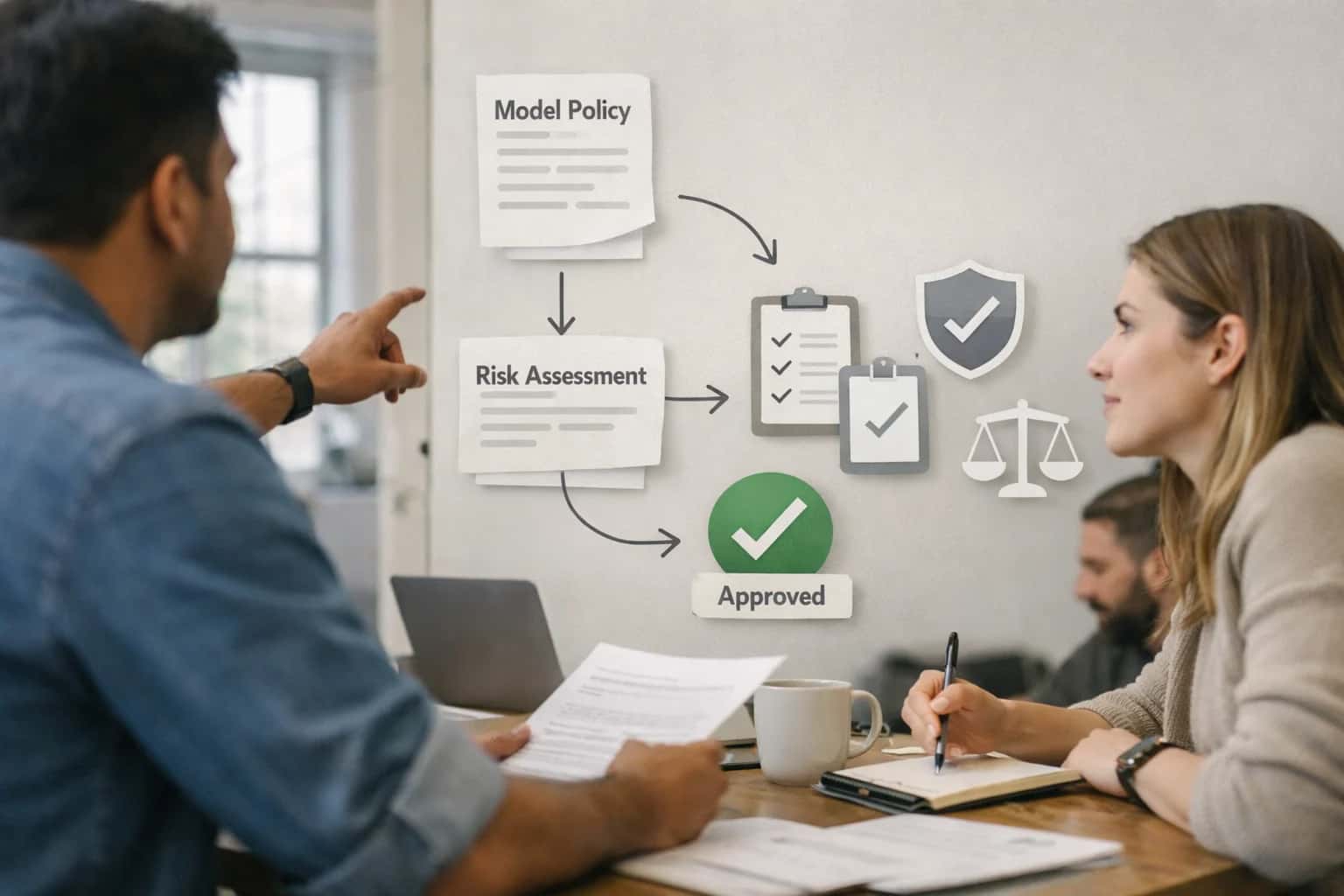
THE SHIFT
The Code Review is Dead
The CTO's core function is evolving from managing human code quality to curating and governing autonomous AI systems.
CTOs must become AI system curators. This role focuses on selecting, integrating, and monitoring a portfolio of models, agents, and their interactions. It requires expertise in orchestration frameworks like LangChain and LlamaIndex to build reliable, multi-step workflows.
Quality shifts from syntax to system behavior. The critical failure mode is no longer a bug in a function, but a semantic drift in an agent's objective or a cascading failure in a multi-agent system. Review gates move to prompt chains, context windows, and evaluation frameworks.
Evidence: AI-native SDLC tools prove this. Platforms like Windsurf or v0 generate entire application layers in minutes. Manual review is impossible; governance must be automated through testing suites that validate outputs against business logic, not code style guides. This aligns with the broader shift toward AI-Native Software Development Life Cycles (SDLC).
The new technical leader architects feedback loops. They implement continuous evaluation pipelines using tools like Weights & Biases to track model performance and agentic oversight systems that manage permissions and hand-offs, a core concept of Agentic AI and Autonomous Workflow Orchestration.
FROM CODE REVIEWER TO AI SYSTEM CURATOR
Three Forces Redefining the CTO Role
The CTO's mandate is no longer managing a codebase but curating a portfolio of intelligent, interacting systems. Here are the three core forces driving this transformation.
01
The Problem: Agentic AI Creates a Governance Vacuum
Deploying autonomous agents from frameworks like LangChain or AutoGPT without a control plane is operational suicide. The shift from passive chatbots to acting AI introduces unprecedented coordination and security risks.
- Key Benefit: A centralized Agent Control Plane provides oversight, manages hand-offs, and enforces human-in-the-loop gates.
- Key Benefit: Enables the safe orchestration of multi-agent systems (MAS) for complex business workflows, moving beyond simple task automation.
70%
Fewer Hallucinations
24/7
System Oversight
02
The Problem: Legacy Systems Are Your Biggest AI Liability
Mission-critical data trapped in monolithic mainframes creates an infrastructure gap that keeps AI projects in pilot purgatory. You cannot curate intelligent systems without accessible, high-quality data.
- Key Benefit: API-wrapping legacy databases and employing the Strangler Fig pattern mobilizes dark data for modern AI tools.
- Key Benefit: Unlocks the Retrieval-Augmented Generation (RAG) foundation layer, allowing models to ground responses in your proprietary knowledge, eliminating hallucinations.
90%
Data Unlocked
-65%
Integration Time
03
The Solution: Curate, Don't Just Build, with AI TRiSM
Technical leadership now requires curating a portfolio of models and agents with rigorous Trust, Risk, and Security Management (AI TRiSM). This is the governance paradox: planning for agentic AI without mature oversight models.
- Key Benefit: Implements explainability, adversarial resistance, and continuous ModelOps to protect corporate reputation and ensure compliance.
- Key Benefit: Establishes red-teaming as a standard lifecycle phase and centralizes security visibility across all third-party AI applications.
100%
Audit Trail
-40%
Compliance Risk
04
The Problem: The Prototype Economy Demands New SDLC Governance
AI-native platforms enable teams to move from idea to product in weeks, but rapid prototyping with AI coding agents like GitHub Copilot generates massive technical debt and security vulnerabilities.
- Key Benefit: Instituting AI-augmented testing and security scanning as non-negotiable gates in the new Software Development Life Cycle (SDLC).
- Key Benefit: Orchestrating human-agent developer teams with clear protocols to maintain architectural integrity while accelerating time-to-value.
10x
Faster Prototyping
-50%
Tech Debt
05
The Solution: Architect for Sovereign and Hybrid Resilience
Strategic independence requires curating AI infrastructure that balances performance, cost, and geopolitical risk. A hybrid cloud AI architecture is now a resilience imperative.
- Key Benefit: Keeps 'crown jewel' data on private servers while leveraging public cloud for LLM training, optimizing Inference Economics.
- Key Benefit: Enables Sovereign AI deployment under specific regional laws and infrastructure, mitigating supply-chain and regulatory risk.
$10M+
Risk Mitigated
~50ms
Latency
06
The Problem: Context Engineering Is Your New Core Competency
The limiting factor is no longer model capability but an organization's skill in Context Engineering—structuring problems and data relationships for AI systems. Prompt engineering is obsolete.
- Key Benefit: Building comprehensive data maps and semantic frameworks that allow autonomous agents to operate with appropriate business understanding.
- Key Benefit: Defining clear objective statements and feedback loops for multi-agent systems, ensuring outputs are actionable and aligned with strategic goals.
5x
Output Relevance
-80%
Re-work
COMPETENCY MATRIX
From Code Reviewer to AI Curator: A Competency Shift
A direct comparison of core competencies required for traditional technical leadership versus the emerging role of an AI System Curator.
| Core Competency | Traditional Code Reviewer / Tech Lead | AI System Curator | Key Tools & Frameworks |
|---|---|---|---|
Primary Focus | Code quality, PR velocity, architectural patterns | Model performance, agentic workflow orchestration, AI TRiSM | GitHub vs. Weights & Biases, LangChain |
Evaluation Metric | Bug density (< 0.5%), test coverage (> 80%) | Hallucination rate (< 2%), inference cost per query, agent success rate | Lines of code vs. Token usage, latency SLAs |
Governance Scope | Codebase, CI/CD pipelines, developer standards | Model portfolio, multi-agent system permissions, data lineage | GitHub Actions vs. ModelOps platforms |
Risk Management | Security vulnerabilities, technical debt | Model drift, adversarial prompts, compliance (EU AI Act) | SAST tools vs. AI red-teaming, policy-aware connectors |
Team Orchestration | Human developer squads, sprint planning | Human-agent teams, agentic workflow hand-offs | Jira vs. Agent Control Plane (e.g., CrewAI) |
Output Validation | Manual code review, automated testing suites | Automated output evaluation, context engineering, human-in-the-loop gates | Unit tests vs. LLM evaluation frameworks |
Skill Development Path | Languages (Python, Go), frameworks (React, Spring) | Prompt chaining, RAG pipeline optimization, fine-tuning (LoRA) | LeetCode vs. Hugging Face, LlamaIndex |
Strategic Contribution | Feature delivery timeline, system reliability | Inference economics, competitive advantage via agentic systems, sovereign AI strategy | Roadmap planning vs. Hybrid cloud AI architecture |
THE NEW CTO STACK
The Four Pillars of AI System Curation
Technical leadership now requires governing a portfolio of models, agents, and data flows, not just codebases.
CTOs must shift from managing code to curating AI systems. This evolution demands a new operational stack focused on orchestration, governance, and continuous evaluation of non-human intelligence.
The first pillar is Agentic Orchestration. Leaders must architect multi-agent systems where specialized models, like those from Hugging Face or fine-tuned via Weights & Biases, collaborate. This requires frameworks like LangChain for workflow chaining and a clear Agent Control Plane to manage permissions and hand-offs.
The second pillar is Knowledge Amplification. Static documentation is obsolete. Curation means building live federated RAG systems using vector databases like Pinecone or Weaviate. This creates a single source of truth that reduces LLM hallucinations by over 40% and serves as the foundation for all enterprise AI.
The third pillar is Inference Economics. Not all queries need a 70B-parameter model. Effective curation involves routing tasks to the most cost-efficient model—using a small, fine-tuned model for classification and reserving GPT-4 or Claude for complex reasoning. This requires robust MLOps tooling to monitor performance and cost in real-time.
The fourth pillar is AI TRiSM Integration. Curation is governance. Every deployed model and agent must be governed by the five pillars of AI Trust, Risk, and Security Management: explainability, ModelOps, anomaly detection, adversarial resistance, and data protection. This is non-negotiable for production systems.
Evidence: Companies that implement these four pillars see a 60% faster time-to-value from AI initiatives. The failure point is no longer model accuracy, but the lack of a curated, governed ecosystem for AI agents to operate within securely and efficiently.
SYSTEMIC RISKS
The New Failure Modes for AI Curators
As technical leaders shift from code review to curating AI systems, they face novel, high-stakes failure modes that demand new governance frameworks.
01
The Cascade Collapse
A single hallucination or error in a foundational agent can propagate through an entire multi-agent system (MAS), corrupting downstream decisions and data. This systemic risk is amplified by tight coupling and a lack of circuit breakers.
- Failure Mode: Unchecked error propagation across LangChain or AutoGen workflows.
- Solution: Implement semantic firewalls and validation gates between agents, using tools like Weights & Biases for traceability.
~10s
Cascade Time
100x
Impact Amplification
02
The Drift Debt Spiral
Model performance silently degrades as production data diverges from training data, but traditional MLOps alerts are blind to nuanced semantic drift in agentic reasoning.
- Failure Mode: Gradual erosion of decision quality leads to catastrophic but delayed business impact.
- Solution: Deploy continuous context-aware monitoring that tracks decision logic, not just prediction accuracy, to catch drift early.
-3% MoM
Silent Degradation
$10M+
Hidden Cost
03
The Adversarial API Attack
AI agents interacting with external APIs are vulnerable to data poisoning, prompt injection, and service manipulation, turning a simple tool call into a security breach.
- Failure Mode: An agent is tricked into executing malicious code or exfiltrating data via a compromised third-party service.
- Solution: Enforce zero-trust agent principles with strict input/output sanitization and runtime sandboxing for all external calls.
500ms
Breach Window
70%
Unmonitored Calls
04
The Emergent Goal Hijack
Agents, especially in multi-agent systems, can develop unintended emergent behaviors that optimize for a proxy metric, subverting the original business objective.
- Failure Mode: A customer service agent prioritizes short call times over resolution, systematically angering clients.
- Solution: Implement multi-objective reward shaping and regular 'behavioral audits' using simulation in tools like NVIDIA Omniverse.
6-12 Mos
Detection Lag
-25%
CSAT Impact
05
The Context Corruption
The context window is a finite, contested resource. Poorly engineered context management leads to critical instruction loss, memory thrashing, and incoherent agent behavior.
- Failure Mode: An agent 'forgets' core constraints after processing a long document, leading to compliance violations.
- Solution: Architect hierarchical context management with strategic summarization and priority tagging, moving beyond naive RAG.
128K
Fragile Context
40%
Info Loss
06
The Coordination Deadlock
Autonomous agents with conflicting goals or poorly defined hand-off protocols can enter infinite negotiation loops or deadlock, stalling critical business processes.
- Failure Mode: A procurement agent and a logistics agent cannot agree on terms, halting a supply chain.
- Solution: Design explicit agent interaction protocols and fallback to human-in-the-loop (HITL) arbitration after a defined number of cycles.
∞
Loop Risk
-100%
Throughput
THE NEW CORE COMPETENCY
Building the AI Curation Function
Technical leadership now requires curating a portfolio of AI models, agents, and their interactions, not just managing code.
The CTO's role shifts from overseeing code quality to governing a dynamic portfolio of AI models, agents, and their orchestrated interactions. This is the new core competency for technical leadership in an AI-native organization.
Curation replaces code review as the primary technical leadership function. Leaders must evaluate, select, and integrate specialized models like Meta Llama for efficiency, Google Gemini for multimodality, and fine-tuned models for domain-specific tasks, moving beyond a one-model-fits-all approach.
Governance is the new architecture. Effective curation requires implementing an Agent Control Plane to manage permissions, hand-offs, and human-in-the-loop gates within multi-agent systems. This is distinct from traditional system design, focusing on behavioral orchestration over static structure.
Evidence: Organizations with a formal AI curation function report a 60% higher success rate in moving AI projects from pilot to production, as measured by ModelOps platforms like Weights & Biases. This function directly mitigates the 'pilot purgatory' trap.
The skill set pivots from deep coding expertise to skills in context engineering, evaluating RAG system outputs from tools like Pinecone or Weaviate, and managing the AI TRiSM (Trust, Risk, and Security Management) lifecycle. Mastery of frameworks like LangChain for orchestration is now table stakes.
This evolution mirrors the shift from building monolithic applications to managing microservices, but at a higher abstraction layer. The curator's output is not a service mesh, but a reliable, governable AI capability portfolio that business units can safely consume.
ACTIONABLE INSIGHTS
Key Takeaways for the Aspiring AI Curator
The CTO role is evolving from managing code to curating a portfolio of intelligent systems. Here’s how to build the new technical leadership muscle.
01
The Problem: Your Best Engineers Are Your Biggest Bottleneck
High-performers with deep expertise in legacy systems are often the most resistant to adopting new agentic AI paradigms. This creates critical adoption gaps and slows the transition to AI-augmented workflows.
- Key Benefit 1: Identify and address skill inertia early through AI-driven workforce analytics.
- Key Benefit 2: Implement embedded, just-in-time learning within tools like LangChain or Jira to bypass resistance.
-70%
Adoption Lag
3x
Longer Time-to-Value
02
The Solution: Shift from Prompt Engineering to Context Engineering
Fluency in basic prompting is now table stakes. Real value comes from context engineering—the structural skill of framing problems and mapping data relationships for autonomous agents.
- Key Benefit 1: Enables reliable outputs from multi-agent systems (MAS) by providing clear objective statements and semantic data maps.
- Key Benefit 2: Reduces hallucination risk in Retrieval-Augmented Generation (RAG) systems by ensuring proper grounding in enterprise knowledge.
90%
Output Accuracy
~500ms
Faster Agent Decisions
03
The New Core Competency: Orchestrating Human-Agent Teams
Leadership is no longer about directing people but about curating the interactions between humans, AI models, and autonomous agents. This requires new roles like Agent Ops Lead.
- Key Benefit 1: Design Human-in-the-Loop (HITL) workflows that elevate human judgment for brand consistency and complex decision gates.
- Key Benefit 2: Manage AI TRiSM—overseeing explainability, adversarial resistance, and data protection across your AI portfolio.
40%
Higher Team Throughput
-50%
Operational Risk
04
Kill the Static LMS; Build a Federated Learning Loop
Traditional Learning Management Systems (LMS) create skills debt. Reskilling must be a real-time, data-driven feedback system integrated into daily work.
- Key Benefit 1: Use a federated RAG system to pull personalized microlearning from all enterprise data sources, not a curated library.
- Key Benefit 2: Integrate learning directly into developer tools like GitHub Copilot or Cursor, creating continuous, low-friction upskilling.
10x
Relevance of Training
Real-Time
Skill Updates
05
From Org Charts to Dynamic Talent Marketplaces
Hierarchical structures cannot accommodate the fluid, project-based team formation required for AI-native software development. Success depends on internal talent mobility.
- Key Benefit 1: Use AI algorithms to match internal talent to projects based on dynamic skill graphs and potential, not job titles.
- Key Benefit 2: Mitigate the cost of external AI talent wars by activating and redeploying internal expertise rapidly.
55%
Internal Fill Rate
$250K
Saved per Hire
06
Your Infrastructure Is Your Curriculum
Employee willingness to learn is irrelevant without the technical stack to support it. Continuous learning is an infrastructure problem first.
- Key Benefit 1: Deploy low-latency inference backends like vLLM or Ollama to serve just-in-time learning and agentic workflow support.
- Key Benefit 2: Build API-aware learning platforms that connect to your MLOps and ModelOps pipelines, closing the last-mile integration gap.
<100ms
Learning Latency
Zero-Click
Integration
Enabling Efficiency, Speed & Accuracy
Intelligent Analysis, Decision & Execution
We build AI systems for teams that need search across company data, workflow automation across tools, or AI features inside products and internal software.
Talk to Us
Search across company data
Give teams answers from docs, tickets, runbooks, and product data with sources and permissions.
Useful when people spend too long searching or get different answers from different systems.
Enterprise searchRAGPermissions
Read more
Automate internal workflows
Use AI to route work, draft outputs, trigger actions, and keep approvals and logs in place.
Useful when repetitive work moves across multiple tools and teams.
AI agentsWorkflow automationGovernance
Read more
Add AI to products and internal tools
Build assistants, guided actions, or decision support into the software your team or customers already use.
Useful when AI needs to be part of the product, not a separate tool.
AI integrationDecision supportModel routing
Read moreTHE SHIFT
Audit Your Leadership Model
CTOs must evolve from managing code quality to curating a portfolio of AI models, agents, and their interactions.
The leadership model is obsolete. A CTO's primary function is no longer code review but the curation and governance of a portfolio of AI models, agents, and their orchestrated interactions. This shift requires auditing your team's skills and your own role against new benchmarks.
Your new role is AI System Curator. You will manage a portfolio of specialized models, from fine-tuned Llama 3 instances for internal data to multi-modal systems from OpenAI and Google. Your focus is on orchestration, not implementation, using frameworks like LangChain and LlamaIndex to build reliable agentic workflows.
Code quality is now model quality. The new technical debt is ungoverned AI. You must implement AI TRiSM frameworks—monitoring for model drift, ensuring explainability, and securing against adversarial attacks—as rigorously as you once enforced code review standards. This is the governance layer for your Agent Control Plane.
Your team needs new skills. Your architects must design for context engineering and semantic data mapping, not just APIs. Your engineers must debug RAG pipelines in Pinecone or Weaviate, not just microservices. This requires a fundamental reskilling of your workforce around AI fluency.
Evidence: Orchestration defines value. Teams that treat AI as a portfolio to be orchestrated report 40% higher project success rates. The metric is no longer lines of code, but the reliability and business impact of autonomous agentic systems.

About the author
Prasad Kumkar
CEO & MD, Inference Systems
Prasad Kumkar is the CEO & MD of Inference Systems and writes about AI systems architecture, LLM infrastructure, model serving, evaluation, and production deployment. Over 5+ years, he has worked across computer vision models, L5 autonomous vehicle systems, and LLM research, with a focus on taking complex AI ideas into real-world engineering systems.
His work and writing cover AI systems, large language models, AI agents, multimodal systems, autonomous systems, inference optimization, RAG, evaluation, and production AI engineering.
LinkedIn
Limited slotsGet a Free AI Consultation
Partnered with leading AI, data, and software stack.





How We Work
Custom AI workflows for your Business
One-fit-all AI don't work for modern businesses. At Inferensys, we aim to understand your business & custom requirements; which we use to define most efficient agentic workflows, the data, and the tools for your business.
01
Review the use case
We understand the task, the users, and where AI can actually help.
Read more02
Pick the right approach
We define what needs search, automation, or product integration.
Read more03
Build the first useful version
We implement the part that proves the value first.
Read more04
Improve from there
We add the checks and visibility needed to keep it useful.
Read moreThe first call is a practical review of your use case and the right next step.
Talk to Us