Supply chain twins fail due to data fidelity gaps. The AI's simulation and predictions are only as accurate as the underlying data, and minor errors in inventory counts, location timestamps, or condition reports create a cascading divergence from reality.

Blog
The Hidden Cost of Data Fidelity Gaps in AI-Driven Supply Chain Twins
A 2% inventory error in your digital twin doesn't cause a 2% forecast error. It triggers a cascade of failed autonomous decisions, wasted capital, and broken trust in AI. This is the nonlinear cost of data fidelity gaps.
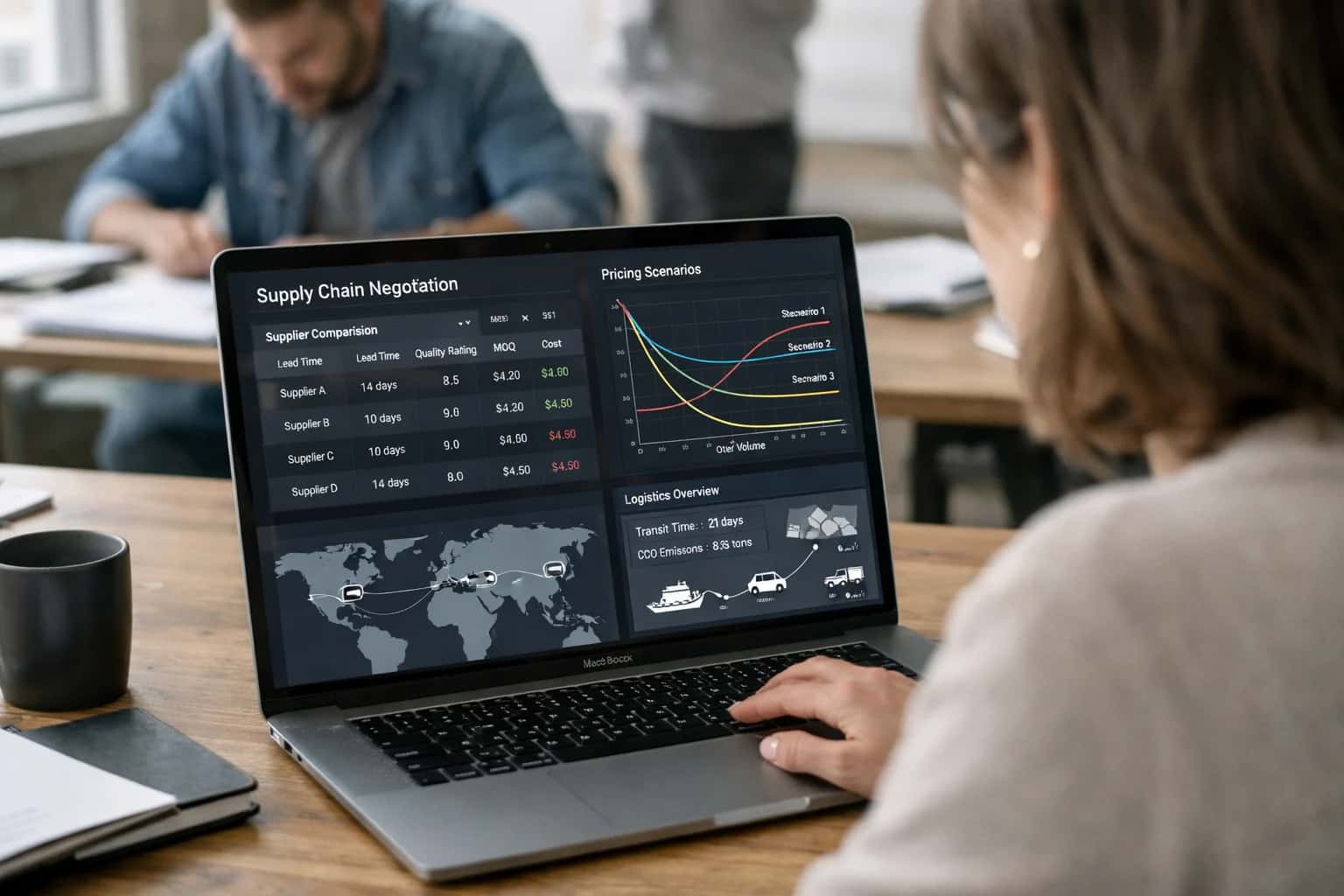
THE DATA FIDELITY GAP
Your Supply Chain Twin Is Lying to You (And You're Betting Millions on It)
Minor inaccuracies in your supply chain twin's data compound into massive forecasting errors and failed autonomous decisions.
Your twin hallucinates optimal routes. The system uses flawed GPS or IoT sensor data, leading an AI agent to dispatch a truck on a 'perfect' route that ignores a real-world bridge closure, costing millions in delays and spoilage. This is a core failure of Agentic AI and Autonomous Workflow Orchestration.
Static data models cause catastrophic drift. A twin built on weekly batch updates from an ERP like SAP cannot react to a port strike. Real-time synchronization via platforms like NVIDIA Omniverse and a robust MLOps pipeline is non-negotiable for operational validity.
Evidence: A 2% error in warehouse inventory data within a twin can lead to a 15% error in demand forecasting models, directly impacting revenue and causing stockouts or overstock write-offs worth millions.
DATA FIDELITY GAPS
The Five Primary Vectors of Supply Chain Twin Corruption
Minor inaccuracies in a supply chain digital twin compound into catastrophic forecasting errors and failed autonomous decisions.
01
The Legacy Data Lag
ERP and WMS systems update on batch cycles, not in real-time, creating a permanent latency gap between physical inventory and its digital representation. This lag forces AI to make decisions on stale data.
- Impact: Forecasts are based on inventory snapshots that are hours or days old.
- Result: AI-driven replenishment agents trigger unnecessary orders or miss critical shortages.
>24h
Data Latency
-15%
Forecast Accuracy
02
The Sensor Drift Anomaly
IoT sensors for temperature, humidity, and geolocation degrade or miscalibrate over time, injecting silent errors into condition and location data streams. AI models interpret this drift as real-world signal.
- Impact: Perishable goods are routed incorrectly based on faulty condition data.
- Result: Increased spoilage and compliance violations for sensitive cargo.
~5%
Annual Sensor Drift
$2M+
Waste per Facility
03
The Human-Input Integrity Gap
Manual data entry at warehouses and ports is prone to errors, omissions, and intentional falsification. This corrupts the foundational truth of the digital twin, as explored in our pillar on Legacy System Modernization and Dark Data Recovery.
- Impact: SKU mismatches and quantity errors propagate undetected through the AI's view of the network.
- Result: The twin optimizes a fictional supply chain, leading to physical gridlock and stockouts.
1-3%
Error Rate
10x
Amplification in AI Models
04
The Multi-Vendor Semantic Silos
Each supplier, carrier, and logistics partner uses different data schemas and identifiers for the same entities (e.g., 'PALLET' vs. 'UNIT LOAD'). The twin's AI cannot reconcile these without a unified ontology.
- Impact: The system sees multiple fragmented objects instead of a single coherent asset journey.
- Result: End-to-end traceability breaks down, crippling Agentic Commerce and M2M transactions.
40%
Data Reconciliation Effort
0%
Autonomous Handoff
05
The Simulation-Reality Feedback Loop
An AI uses the twin to prescribe actions (e.g., reroute a shipment). If the physical execution deviates and that deviation is not fed back into the twin, the simulation becomes a hallucination. This is a core challenge of AI TRiSM.
- Impact: The twin's state diverges permanently from physical reality.
- Result: Every subsequent AI decision increases operational risk, as covered in our analysis of The Operational Cost of Digital Twin Hallucinations.
Minutes
To Critical Divergence
100%
Decision Corruption
06
The Adversarial Data Poisoning Vector
Malicious actors can inject spoofed sensor data or corrupt API feeds into the twin's ingestion layer. Without robust anomaly detection and adversarial resistance, the AI will optimize toward sabotage.
- Impact: The twin directs assets to non-existent locations or approves fraudulent shipments.
- Result: Complete loss of control and significant financial theft, a direct failure of AI TRiSM: Trust, Risk, and Security Management.
$10M+
Potential Loss Event
Hours
To System Compromise
DATA FIDELITY GAP ANALYSIS
The Compounding Cost of Minor Inaccuracies
Comparison of data fidelity levels in a supply chain digital twin and their downstream impact on AI-driven forecasting and autonomous decision-making.
| Data Fidelity Metric | Low Fidelity (Legacy ERP) | Medium Fidelity (IoT-Enabled) | High Fidelity (AI-Optimized Twin) |
|---|---|---|---|
Inventory Accuracy | 92-95% | 98-99% |
|
Location Data Latency | 24-48 hours | 15-60 minutes | < 1 second |
Condition Monitoring (Temp/Humidity) | Threshold-based alerts | Continuous predictive modeling | |
Forecast Error at 30 Days | 12-18% | 5-8% | < 2% |
Autonomous Replenishment Success Rate | 65% | 88% | 99.5% |
Root Cause Analysis Capability | Manual, weeks | Semi-automated, days | AI-driven, real-time |
Annual Waste from Stockouts/Obsolescence | $2.5M - $5M | $0.8M - $1.5M | < $200K |
Integration with Physics-Based Simulation | Basic visualization | Full NVIDIA Omniverse / OpenUSD integration |
THE DATA FOUNDATION
Architectural Antidotes: Building a High-Fidelity Twin Foundation
High-fidelity supply chain twins require a unified data architecture that eliminates semantic gaps between disparate systems.
A high-fidelity digital twin foundation is a unified data architecture that synchronizes real-time operational data with deterministic simulation models. This architecture prevents the compounding errors that render AI predictions useless and autonomous decisions catastrophic.
The core failure is a semantic gap between systems. Inventory counts from SAP ERP, geolocation from a TMS, and condition data from IoT sensors use different schemas and update frequencies. A twin built on this fractured data fabric hallucinates, forcing AI to reason with flawed context. You must implement a semantic data layer using tools like Apache Atlas or a knowledge graph to enforce a single source of truth.
Real-time synchronization is non-negotiable, not aspirational. Batch ETL processes create a 'simulation gap' where the twin lags behind reality. You need a streaming data pipeline built on Apache Kafka or AWS Kinesis, feeding a vector database like Pinecone or Weaviate for low-latency context retrieval by AI agents. This is the backbone for closing the real-time data synchronization loop.
Fidelity requires a physics engine, not just visualization. A supply chain twin must simulate material stress, container dynamics, and thermal drift. NVIDIA Omniverse with its PhysX engine provides this deterministic backbone, turning disparate data into a physically accurate simulation environment where AI can train and test safely. This is the benchmark for physically accurate simulation.
Evidence: RAG systems reduce operational hallucinations by over 40%. By grounding AI agents in a vectorized, high-fidelity knowledge base, Retrieval-Augmented Generation ensures decisions are based on verified twin state, not model parametric memory. This directly mitigates the cost of twin hallucinations.
SUPPLY CHAIN TWINS
Key Takeaways: The High Cost of Low-Fidelity Data
Minor inaccuracies in inventory, location, or condition data within a supply chain twin compound into massive forecasting errors and failed autonomous decisions.
01
The Problem: The 5% Inventory Error That Costs Millions
A ~5% error rate in SKU-level inventory data, common in legacy WMS, seems trivial. In a digital twin, this error propagates through AI forecasting models, leading to catastrophic misallocations.
- Result: 15-25% overstock in wrong locations, 10-20% stockouts in high-demand nodes.
- Cost: Direct impact on working capital and missed revenue from lost sales.
- Root Cause: Lack of real-time synchronization between physical counts and the twin's data layer.
15-25%
Overstock
10-20%
Stockouts
02
The Solution: AI-Powered Anomaly Detection & Causal Inference
Deploying Graph Neural Networks (GNNs) and time-series forecasting AI directly within the twin creates a self-correcting data layer.
- Function: Models identify data drift and statistical outliers in sensor and transactional feeds.
- Action: Triggers automated reconciliation workflows or human-in-the-loop alerts.
- Outcome: Maintains >99% data fidelity, which is the minimum threshold for reliable autonomous procurement agent decisions.
>99%
Data Fidelity
-70%
Reconciliation Time
03
The Architecture Mandate: Unified Physics & Data Engine
Low-fidelity data often stems from siloed systems. The fix is a converged architecture integrating IoT, ERP, and the twin on a Unified Physics Engine like NVIDIA Omniverse.
- Core: OpenUSD provides the single source of truth for geometric, semantic, and live data states.
- Benefit: Eliminates the 'simulation gap' where the twin's state diverges from physical reality.
- Requirement: This convergence is the foundation for multi-agent systems that optimize the supply chain.
0 Gap
Simulation Drift
10x
Agent Coordination
04
The Compliance & Risk Multiplier
In regulated industries (pharma, aerospace), low-fidelity data in a twin isn't just costly—it's a compliance failure. Unexplained AI decisions based on bad data create audit trail breaches.
- Risk: Violations of EU AI Act requirements for transparency and human oversight.
- Solution: Embedding Explainable AI (XAI) frameworks and digital provenance tracking from day one.
- Outcome: Transparent decision logs that satisfy regulators and protect against adversarial data poisoning attacks.
100%
Audit Trail
High
Risk Mitigated
Enabling Efficiency, Speed & Accuracy
Intelligent Analysis, Decision & Execution
We build AI systems for teams that need search across company data, workflow automation across tools, or AI features inside products and internal software.
Talk to Us
Search across company data
Give teams answers from docs, tickets, runbooks, and product data with sources and permissions.
Useful when people spend too long searching or get different answers from different systems.
Enterprise searchRAGPermissions
Read more
Automate internal workflows
Use AI to route work, draft outputs, trigger actions, and keep approvals and logs in place.
Useful when repetitive work moves across multiple tools and teams.
AI agentsWorkflow automationGovernance
Read more
Add AI to products and internal tools
Build assistants, guided actions, or decision support into the software your team or customers already use.
Useful when AI needs to be part of the product, not a separate tool.
AI integrationDecision supportModel routing
Read moreTHE DATA
Stop Simulating, Start Validating
A supply chain twin built on low-fidelity data is a liability, not an asset, because its AI will make confidently wrong decisions.
Data fidelity gaps in AI-driven supply chain twins cause autonomous agents to optimize for a fictional world, leading to costly physical errors like misrouted shipments and production halts. The core failure is treating the twin as a visualization tool instead of a validated decision engine.
Simulation is not validation. A digital twin running on NVIDIA Omniverse can render a beautiful, real-time scene, but if its underlying inventory or location data is stale, every AI-driven 'what-if' scenario is scientifically invalid. Validation requires continuous, automated reconciliation between the physical asset's state and its virtual counterpart.
High-fidelity data ingestion is non-negotiable. This demands integrating real-time IoT streams, warehouse management systems, and graph databases like Neo4j to model complex supplier relationships. Without this, your twin's predictive models, built on frameworks like PyTorch Geometric for graph neural networks, will hallucinate.
Evidence: A 2023 McKinsey study found that companies with high-fidelity supply chain data achieved 15% lower inventory costs and 10% higher perfect-order rates. The gap between simulated and actual lead times is the primary predictor of forecasting error.
The solution is a closed-loop validation layer. Implement MLOps pipelines that use the digital twin not just for simulation, but as a testbed for AI agents. Deploy new routing or inventory algorithms in shadow mode within the twin, comparing their predictions against actual outcomes before granting them operational control. This transforms your twin from a cost center into a risk mitigation platform.

About the author
Prasad Kumkar
CEO & MD, Inference Systems
Prasad Kumkar is the CEO & MD of Inference Systems and writes about AI systems architecture, LLM infrastructure, model serving, evaluation, and production deployment. Over 5+ years, he has worked across computer vision models, L5 autonomous vehicle systems, and LLM research, with a focus on taking complex AI ideas into real-world engineering systems.
His work and writing cover AI systems, large language models, AI agents, multimodal systems, autonomous systems, inference optimization, RAG, evaluation, and production AI engineering.
LinkedIn
Limited slotsGet a Free AI Consultation
Partnered with leading AI, data, and software stack.





How We Work
Custom AI workflows for your Business
One-fit-all AI don't work for modern businesses. At Inferensys, we aim to understand your business & custom requirements; which we use to define most efficient agentic workflows, the data, and the tools for your business.
01
Review the use case
We understand the task, the users, and where AI can actually help.
Read more02
Pick the right approach
We define what needs search, automation, or product integration.
Read more03
Build the first useful version
We implement the part that proves the value first.
Read more04
Improve from there
We add the checks and visibility needed to keep it useful.
Read moreThe first call is a practical review of your use case and the right next step.
Talk to Us