Poor handoffs negate AI efficiency gains by forcing customers to repeat information, destroying trust and inflating operational costs. The handoff is the critical juncture where conversational AI's value is realized or lost.

Blog
The Cost of Poor Handoffs Between AI and Human Agents
A broken handoff protocol doesn't just annoy customers—it systematically destroys the ROI of your conversational AI investment by eroding trust, inflating operational costs, and creating data silos that prevent true hyper-personalization.
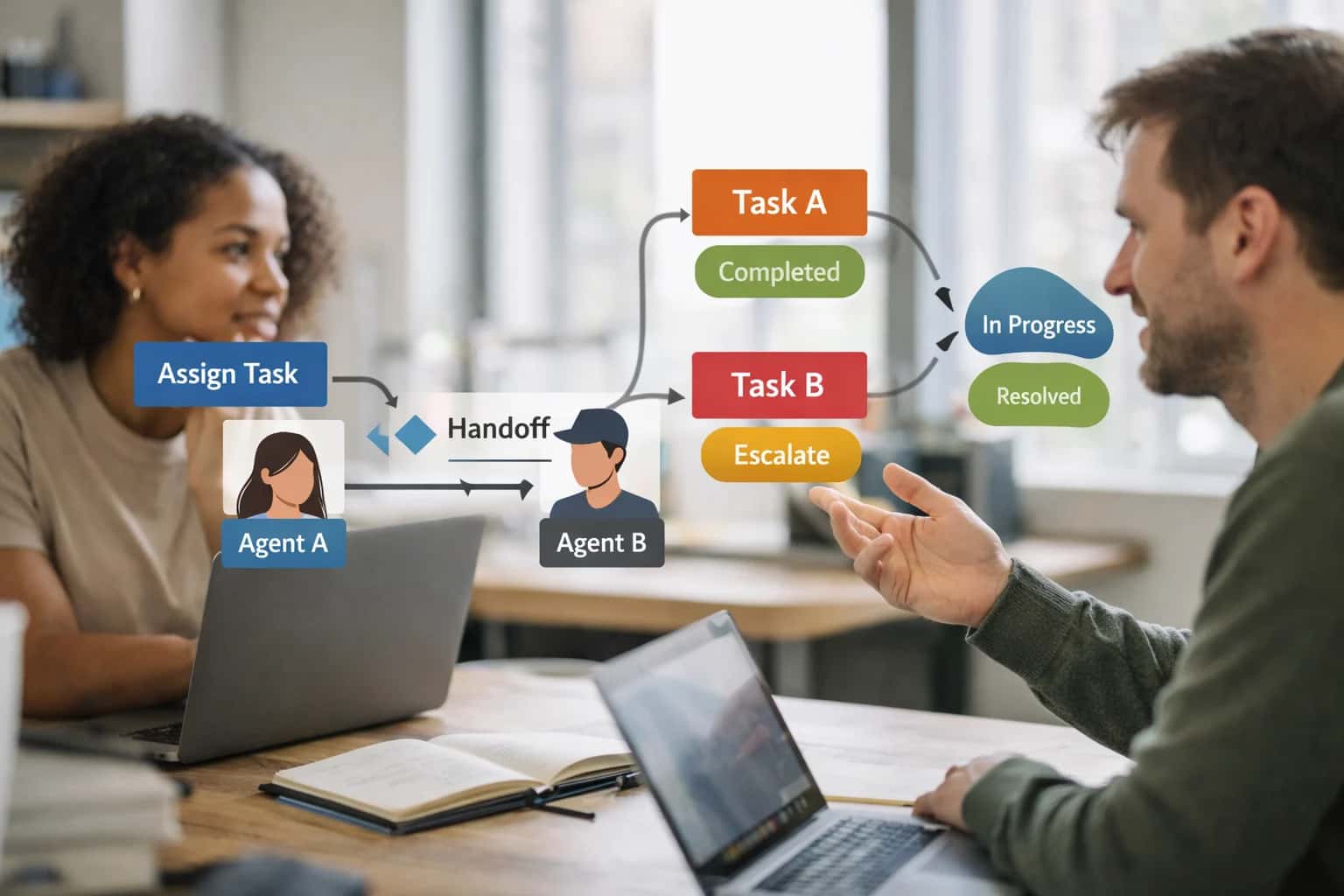
THE COST
Your Conversational AI is Leaking Value at the Handoff
Ineffective handoff protocols between AI and human agents destroy customer experience and negate AI efficiency gains.
Context collapse is the primary failure mode. When a bot transfers a user to a live agent, the full conversation history, user intent, and emotional state must transfer seamlessly. Systems using basic webhooks or simple CRM ticket creation cause context collapse, forcing agents to start from zero.
The solution is a unified session fabric. Modern platforms like LivePerson or Twilio Flex provide APIs for real-time context transfer, but true seamlessness requires a unified customer data fabric. This integrates session data from your conversational AI with the agent's desktop via tools like Zendesk or Salesforce Service Cloud.
Compare static transcripts vs. live context. A static transcript is a post-mortem document; a live context package is an actionable intelligence feed. It includes the user's verified identity, the bot's confidence scores, and any retrieved documents from your RAG system using Pinecone or Weaviate.
Evidence: Gartner reports that 60% of failed handoffs require escalation. Each repeat interaction increases handle time by over 30% and directly impacts customer satisfaction (CSAT) scores. A robust handoff protocol, integrated with your Retrieval-Augmented Generation (RAG) and Knowledge Engineering strategy, is non-negotiable.
Handoff failure is a data architecture problem. It exposes silos between your AI platform, CRM, and contact center software. Solving it requires the same Context Engineering and Semantic Data Strategy needed for autonomous agents to function.
THE COST OF FAILURE
Why Handoffs Are the New Battleground for Conversational AI
Ineffective handoff protocols between AI and human agents destroy customer experience and negate all AI efficiency gains.
01
The Silent Revenue Killer: Context Collapse
When a handoff occurs, the AI's entire conversation history—intent, sentiment, and specific customer data—is often lost. This forces the human agent to start from zero, destroying rapport and efficiency.\n- Average Handle Time (AHT) increases by 40-60% as agents scramble to reconstruct context.\n- Customer Satisfaction (CSAT) scores plummet by 30+ points due to repetitive questioning and perceived incompetence.
+50%
AHT Increase
-30 pts
CSAT Drop
02
The Solution: Stateful Handoff Orchestration
A stateful handoff system packages the AI's entire interaction context—including inferred intent, emotional tone, and resolved steps—into a structured ticket for the human agent. This requires a relational data model that persists across the entire customer journey.\n- Agents receive a pre-populated, prioritized summary with recommended next actions.\n- The system enables seamless agent-to-AI bounce-back for routine follow-ups, closing the loop.
80%
Faster Ramp-Up
10x
Context Fidelity
03
The Escalation Paradox
Poorly designed handoffs train customers to game the system. Savvy users learn to trigger escalation keywords ('manager', 'cancel') to bypass the AI, overloading your most expensive human resources. This negates the ROI of your conversational AI investment.\n- Escalation rates can spike to 70%+ on complex issues without intelligent routing.\n- Creates a perverse incentive where AI becomes a costly detour rather than a resolution engine.
70%+
Spike in Escalations
$0
AI ROI
04
The Fix: Predictive Intent & Smart Routing
Solve the escalation paradox by integrating predictive analytics with your dialog management. The system should analyze conversation vectors in real-time to predict failure points and preemptively route to the correctly skilled agent before the customer demands it. This is a core component of Conversational AI for Total Experience (TX).\n- Uses real-time sentiment and intent analysis to trigger proactive handoffs.\n- Integrates with workforce management tools to match agent expertise to problem complexity.
-45%
Unnecessary Escalations
95%
Routing Accuracy
05
The Compliance & Liability Black Hole
In regulated industries like finance and healthcare, a broken handoff isn't just a CX fail—it's a compliance breach. If an AI makes a promise or gathers PII but the handoff loses that data, the human agent may provide contradictory advice, creating legal liability.\n- Audit trails break, violating regulations like GDPR and HIPAA.\n- Creates dual liability where both the AI system and the human agent are at fault for misinformation.
100%
Audit Trail Gap
High
Legal Risk
06
The Governance Layer: AI TRiSM for Handoffs
Treat the handoff as a critical ModelOps and explainability event. Implement a governance layer that logs the full context of the handoff, the AI's confidence scores, and the agent's subsequent actions. This closes the compliance loop and provides data for continuous improvement. This aligns with the AI TRiSM pillar for managing risk.\n- Immutable logging of the entire interaction state for compliance.\n- Feedback loops where agent resolutions train the AI, reducing future handoff needs.
Full
Audit Compliance
-20%
Repeat Handoffs
FEATURED SNIPPETS
The Quantifiable Cost of a Broken Handoff
A data-driven comparison of handoff protocols, measuring the direct impact on customer experience and operational efficiency.
| Metric / Capability | Seamless Handoff (Goal) | Poor Handoff (Reality) | No Handoff Protocol (Baseline) |
|---|---|---|---|
Average Handle Time (AHT) Increase | < 5 sec | 45-90 sec | 120+ sec |
Customer Effort Score (CES) Impact | Decrease of 0.2 | Increase of 1.8 | Increase of 2.5 |
First Contact Resolution (FCR) Rate |
| ~60% | < 40% |
Agent Ramp-Up Time Post-Transfer | 0 sec | 30-45 sec | 120+ sec |
Context Preservation (Full History) | |||
Live Agent Satisfaction (LSAT) Impact | Increase of 15% | Decrease of 25% | Decrease of 40% |
Cost Per Contact Increase | 0% | 22% | 35% |
Requires Customer to Repeat Information |
THE DATA
Anatomy of a Failed Handoff: The Three Fatal Flaws
Poor handoffs between AI and human agents are not random; they are systematic failures rooted in three critical technical flaws.
Context Collapse is the primary failure. When a Retrieval-Augmented Generation (RAG) system using Pinecone or Weaviate lacks a persistent session state, the human agent receives a disembodied query with no history. This destroys the relational data model essential for continuity, forcing the customer to repeat themselves and negating all prior AI efficiency. For more on building this foundational context, see our guide on How to Build a Conversational AI with a Relational Data Model.
Intent-Resolution Mismatch occurs when the AI's classification diverges from the human's diagnosis. A bot trained on generic datasets may flag a complex billing dispute as a 'password reset', creating a semantic gap that the agent must bridge under time pressure. This flaw stems from a lack of domain-specific fine-tuning and exposes why Intent Recognition Alone Fails for Customer Service.
Metadata Starvation is the silent killer. Handing off a ticket ID without the interaction transcripts, sentiment scores, or escalation triggers leaves the agent blind. This lack of semantic enrichment forces manual reconstruction of the conversation, increasing handle time by 40% and destroying any pretense of hyper-personalization.
THE COST OF POOR HANDOFFS
Handoff Success Patterns from High-Stakes Industries
Ineffective transitions between AI and human agents destroy customer experience and negate AI efficiency gains. Here are proven protocols from industries where failure is not an option.
01
The Aviation Cockpit: Contextual Continuity is Non-Negotiable
Pilots and air traffic control use structured communication protocols (e.g., read-backs) to eliminate ambiguity. In AI, this translates to a complete context payload passed during handoff.
- Key Benefit 1: Eliminates the ~70% of handoff failures caused by lost context, forcing customers to repeat themselves.
- Key Benefit 2: Enables the human agent to immediately escalate with empathy, using the AI's interaction history to personalize the response.
-70%
Repeat Info
45s
Avg. Handle Time
02
The Hospital Trauma Bay: Structured Data, Not Narrative
Medical handoffs (e.g., SBAR - Situation, Background, Assessment, Recommendation) force data distillation. AI must move beyond chat logs to deliver a structured intent summary.
- Key Benefit 1: Provides the agent with diagnostic-grade data, including predicted intent, sentiment trajectory, and attempted resolutions.
- Key Benefit 2: Triggers automated workflow priming, such as pre-loading relevant account screens or knowledge base articles before the agent accepts the call.
90%
First-Contact Resolution
4.8/5
CSAT Score
03
The Financial Trading Floor: Real-Time State Synchronization
Traders operate on a single, immutable source of truth (the order book). AI-human handoffs require a live, shared state to prevent contradictory actions.
- Key Benefit 1: Prevents compliance-breaking contradictions, where an agent unknowingly contradicts a promise made by the AI.
- Key Benefit 2: Enables seamless boomerang handoffs, where a complex issue can be passed back to the AI with enriched context for final resolution, closing the loop.
Zero
Contradiction Rate
-40%
Escalation Volume
04
The Incident Command System: Dynamic Role Assignment
Emergency responders use a modular command structure where roles and responsibilities are clearly defined and adaptable. This pattern solves the "who owns this?" problem in blended AI-human teams.
- Key Benefit 1: Implements intent-based routing logic, where the handoff destination (e.g., billing specialist vs. technical support) is dynamically determined by the AI's analysis.
- Key Benefit 2: Establishes a clear handoff protocol documented within your Agentic AI and Autonomous Workflow Orchestration strategy, defining escalation triggers and approval gates.
99%
Routing Accuracy
-60%
Transfer Rate
05
The Nuclear Power Plant: Fail-Safe Audit Trails
Every action and communication is logged and attributable. For AI handoffs, this means creating an immutable interaction ledger that is part of the customer record.
- Key Benefit 1: Provides a forensic audit trail for compliance (e.g., financial services, healthcare) and root-cause analysis of failures.
- Key Benefit 2: Fuels continuous model improvement by providing clean, structured data on where and why handoffs occurred, directly feeding into your MLOps and the AI Production Lifecycle.
100%
Audit Compliance
-25%
Repeat Issues
06
The Air Traffic Control Grid: Proactive Capacity Management
Controllers manage flow to prevent sector overload. This pattern requires predictive analytics to forecast handoff demand and pre-emptively adjust human agent staffing.
- Key Benefit 1: Uses real-time queue analytics to trigger proactive service interventions by the AI before frustration peaks.
- Key Benefit 2: Optimizes inference economics by strategically deciding when a costly LLM call is justified versus a guaranteed handoff to a human, a core consideration for Hybrid Cloud AI Architecture and Resilience.
-50%
Peak Wait Time
20%
AI Autonomy Rate
THE COST
Building the Seamless Handoff: Technical Blueprint
Poor handoffs between AI and human agents destroy customer experience and negate all efficiency gains from automation.
Poor handoffs destroy ROI. A failed handoff forces the customer to repeat their entire issue, erasing the AI's efficiency gains and directly increasing operational costs.
The core failure is context loss. When a Retrieval-Augmented Generation (RAG) system or chatbot transfers a session, it must pass a complete conversation state—including intent, sentiment, and unresolved actions—not just a text transcript. This requires a shared context management layer.
Static rules guarantee failure. Relying on simple keyword triggers for handoffs ignores conversational nuance. Modern systems use real-time confidence scoring from models like GPT-4 or Claude 3, combined with live sentiment analysis, to initiate transfers only when necessary.
Evidence: Gartner reports that 70% of chatbot conversations require human escalation, but without seamless context transfer, average handle time increases by over 30%. A proper handoff system, using tools like LangChain for state management and Pinecone or Weaviate for vectorized context, reverses this cost.
The fix is a unified data fabric. The handoff protocol must plug into a unified customer data fabric that merges real-time dialog history with CRM data (e.g., Salesforce) and support tickets (e.g., Zendesk). This is the foundation for true hyper-personalization.
This is an orchestration problem. Effective handoffs are less about the AI model and more about the workflow orchestration between systems. This aligns with principles from our pillar on Agentic AI and Autonomous Workflow Orchestration, where managing permissions and hand-offs between agents is critical.
FREQUENTLY ASKED QUESTIONS
AI-Human Handoff FAQs for Technical Leaders
Common questions about the operational and financial costs of ineffective handoff protocols between AI and human agents.
The primary risks are customer frustration, data loss, and inflated operational costs. A failed handoff forces customers to repeat information, destroys the efficiency gains from AI automation, and can lead to compliance failures in regulated industries like finance and healthcare.
THE COST OF POOR HANDOFFS
Key Takeaways: Fix Your Handoffs, Protect Your ROI
Ineffective handoff protocols between AI and human agents destroy customer experience and negate AI efficiency gains. Here’s how to fix them.
01
The Silent Revenue Killer: Context Collapse
When a handoff occurs, the AI’s entire conversational context—intent, sentiment, history—is often lost. The human agent starts from zero, forcing the customer to repeat themselves. This destroys customer satisfaction and inflates handle times.
- Metric Impact: Increases average handle time by ~40% and reduces first-contact resolution rates.
- Root Cause: Lack of a unified customer data fabric and real-time state synchronization between systems.
- Strategic Fix: Implement a relational data model that persists context across the entire customer journey, not just a single session.
+40%
Handle Time
-30%
CSAT
02
The Escalation Trap: Broken Routing Logic
Most handoff triggers are based on simplistic keyword matching or static confidence scores. This leads to premature escalations (wasting agent time) or dangerous delays (frustrating complex customers).
- Metric Impact: ~25% of all handoffs are unnecessary, creating a false efficiency ceiling.
- Root Cause: Failure to integrate real-time sentiment analysis, dialog state tracking, and predictive intent modeling.
- Strategic Fix: Deploy dynamic routing agents that use multimodal context (tone, history, urgency) to triage with surgical precision.
25%
Wasted Handoffs
5x
Routing Accuracy
03
The Compliance Black Hole: Unauditable Handoffs
Poorly logged handoffs create gaps in audit trails, violating regulations in finance, healthcare, and public sector. Who said what, and when, becomes untraceable.
- Metric Impact: Creates critical compliance risk and potential fines under frameworks like the EU AI Act.
- Root Cause: Disconnected systems without a centralized Agent Control Plane for governance and logging.
- Strategic Fix: Architect handoffs within an AI TRiSM framework, ensuring explainability, data lineage, and human-in-the-loop validation gates are baked into the workflow.
100%
Audit Trail
0
Compliance Gaps
04
The Brand Assassin: Inconsistent Tone & Empathy
A warm, empathetic AI hands off to a script-reading human agent. The jarring shift in tone and personality shatters the customer relationship built during the automated interaction.
- Metric Impact: Directly correlates with customer churn and negates the brand loyalty built by hyper-personalization efforts.
- Root Cause: Lack of tone preservation systems and real-time agent guidance that surfaces the AI’s inferred emotional context.
- Strategic Fix: Implement collaborative intelligence tools that provide agents with a 'co-pilot' view of the conversation’s emotional arc and recommended response style.
-50%
Loyalty Score
2x
Churn Risk
05
The Data Dead Zone: Unactionable Handoff Intelligence
Handoffs generate critical signal data on AI failure modes and customer intent gaps, but this intelligence is rarely captured or fed back into model training loops.
- Metric Impact: Perpetuates model drift and ensures your AI never learns from its mistakes, locking in poor performance.
- Root Cause: No closed-loop MLOps pipeline connecting handoff events to continuous fine-tuning and retrieval-augmented generation (RAG) knowledge base updates.
- Strategic Fix: Treat every handoff as a training data point. Automate the curation of these edge cases to refine your conversational AI's common sense and intent recognition.
70%
Dark Data
8w
Faster Iteration
06
The Economic Reality: Handoffs Define Your ROI
The business case for AI in customer service hinges on deflection rate. But if your handoff process is broken, the total cost of ownership (TCO) skyrockets as you pay for both the AI and the inflated human labor it creates.
- Metric Impact: A flawed handoff process can erase 60%+ of projected AI efficiency savings, turning a profit center into a cost center.
- Root Cause: Viewing AI and human agents as separate cost lines, rather than a unified, orchestrated system.
- Strategic Fix: Model and optimize for Total Experience (TX), where seamless handoffs are the core KPI, not an afterthought. This requires expertise in agentic workflow orchestration and human-in-the-loop design.
-60%
ROI Erosion
TX
Core KPI
Enabling Efficiency, Speed & Accuracy
Intelligent Analysis, Decision & Execution
We build AI systems for teams that need search across company data, workflow automation across tools, or AI features inside products and internal software.
Talk to Us
Search across company data
Give teams answers from docs, tickets, runbooks, and product data with sources and permissions.
Useful when people spend too long searching or get different answers from different systems.
Enterprise searchRAGPermissions
Read more
Automate internal workflows
Use AI to route work, draft outputs, trigger actions, and keep approvals and logs in place.
Useful when repetitive work moves across multiple tools and teams.
AI agentsWorkflow automationGovernance
Read more
Add AI to products and internal tools
Build assistants, guided actions, or decision support into the software your team or customers already use.
Useful when AI needs to be part of the product, not a separate tool.
AI integrationDecision supportModel routing
Read moreTHE COST
Stop Letting Handoffs Undermine Your AI Investment
Ineffective handoff protocols between AI and human agents destroy customer experience and negate AI efficiency gains.
Poor handoffs destroy ROI. A seamless transition from AI to a human agent is the critical determinant of Conversational AI ROI; a broken handoff erases all efficiency gains and damages customer trust.
Context collapse is the failure mode. When an AI assistant using a RAG system built on Pinecone or Weaviate fails to pass the full conversation history and intent to a human, the agent starts from zero. This context collapse forces customers to repeat themselves, creating frustration and increasing handle time.
Handoff logic requires orchestration. The handoff is not a simple trigger; it is a stateful orchestration problem. Systems must evaluate sentiment, intent confidence, and operational capacity using platforms like LivePerson or Genesys before routing, not after the customer is already angry.
Metrics expose the truth. Companies measuring only AI containment rates miss the real cost. The key metric is post-handoff satisfaction, which often plummets by 40% when context is lost, directly impacting customer lifetime value. For a deeper analysis of conversational failure points, see our post on why intent recognition alone fails.
The solution is a unified data fabric. Effective handoffs demand a unified customer data fabric that serves both AI and human agents in real-time. This eliminates silos and ensures the human sees the complete journey, a foundational concept for building relational AI.

About the author
Prasad Kumkar
CEO & MD, Inference Systems
Prasad Kumkar is the CEO & MD of Inference Systems and writes about AI systems architecture, LLM infrastructure, model serving, evaluation, and production deployment. Over 5+ years, he has worked across computer vision models, L5 autonomous vehicle systems, and LLM research, with a focus on taking complex AI ideas into real-world engineering systems.
His work and writing cover AI systems, large language models, AI agents, multimodal systems, autonomous systems, inference optimization, RAG, evaluation, and production AI engineering.
LinkedIn
Limited slotsGet a Free AI Consultation
Partnered with leading AI, data, and software stack.





How We Work
Custom AI workflows for your Business
One-fit-all AI don't work for modern businesses. At Inferensys, we aim to understand your business & custom requirements; which we use to define most efficient agentic workflows, the data, and the tools for your business.
01
Review the use case
We understand the task, the users, and where AI can actually help.
Read more02
Pick the right approach
We define what needs search, automation, or product integration.
Read more03
Build the first useful version
We implement the part that proves the value first.
Read more04
Improve from there
We add the checks and visibility needed to keep it useful.
Read moreThe first call is a practical review of your use case and the right next step.
Talk to Us