Your AI platform lacks cross-application visibility because security tools are siloed, creating governance blind spots where sensitive data flows to third-party models like OpenAI and Anthropic Claude.

Blog
Why Your AI Platform Lacks True Cross-Application Visibility
Your AI security stack is a collection of blind spots. Siloed tools cannot track sensitive data as it flows through OpenAI, Anthropic Claude, and other third-party models. This article explains why centralized visibility via a Privacy-Enhancing Technology (PET) dashboard is non-negotiable for governance and compliance.
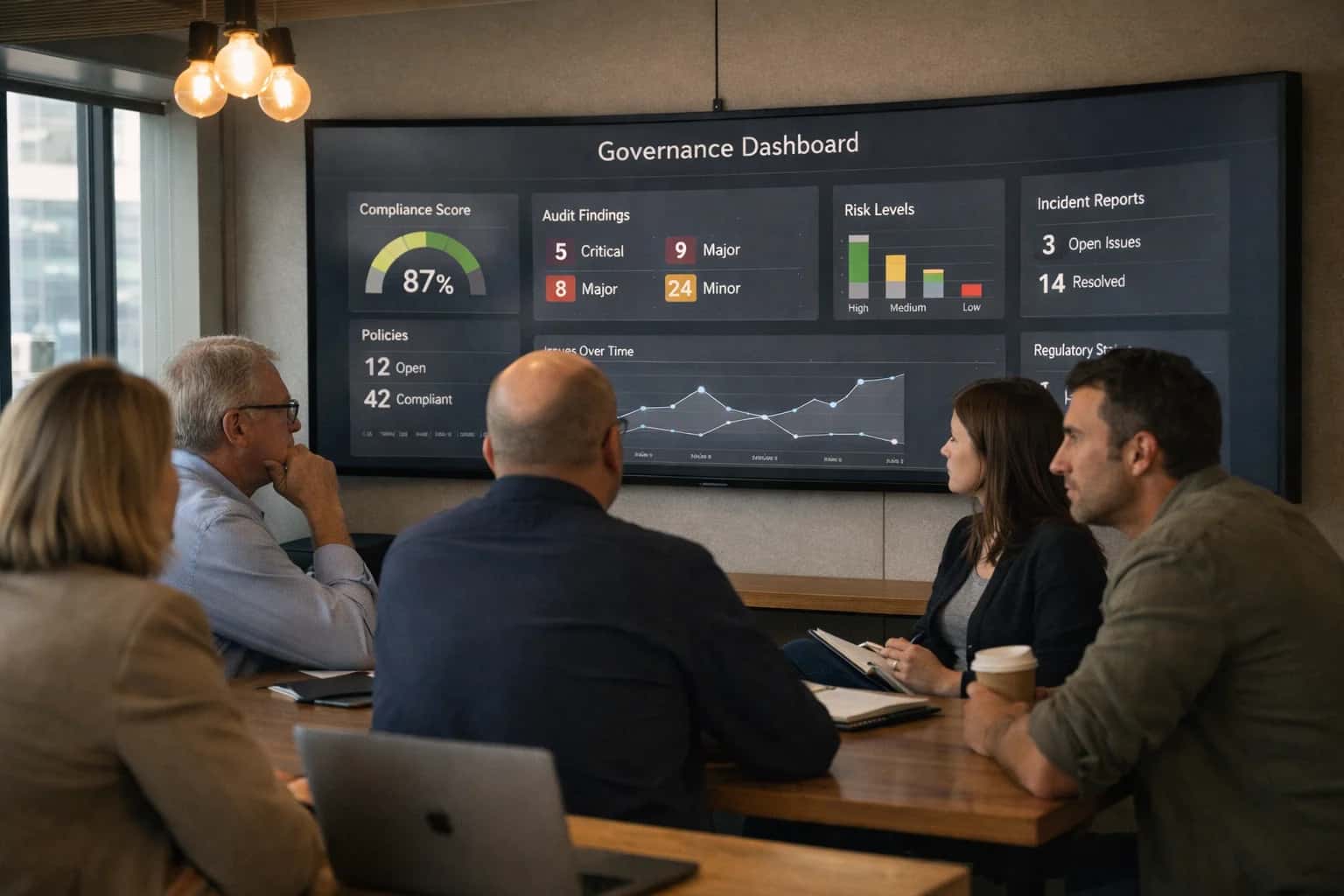
THE VISIBILITY GAP
The Illusion of Control in Modern AI Stacks
Your AI platform's security dashboard is a facade, failing to govern data flows to third-party models like OpenAI and Anthropic Claude.
Platforms like Databricks or AWS Bedrock provide infrastructure control, not data governance. They manage compute and deployment but cannot see how PII is transformed within a black-box LLM API call, creating an unmanaged risk surface.
The architectural flaw is treating AI as a monolithic application. Modern stacks are federated, pulling from vector databases like Pinecone, embedding models from Hugging Face, and external LLMs. Each component has its own opaque data plane.
Evidence: A 2024 Gartner survey found that 78% of organizations using multiple AI vendors reported 'significant' or 'severe' gaps in security visibility across their AI supply chain, directly leading to compliance failures.
True control requires a centralized PET dashboard that instruments data lineage across every third-party integration. This is the core of AI TRiSM, moving from isolated tools to an integrated trust layer.
Without this, you are practicing security theater. Logging API calls to OpenAI is useless if you cannot see the sensitive context in the prompt or the PII potentially leaked in the completion, a critical failure in Confidential Computing and PET.
THE CENTRALIZED DASHBOARD IMPERATIVE
Key Takeaways: The Visibility Gap
Siloed security tools create critical blind spots in AI governance; true oversight requires a unified view across all third-party models and data flows.
01
The Problem: Siloed Logs Create Unmanaged Risk
Your security team monitors one dashboard for AWS, another for Datadog, and a third for your internal model registry. Calls to OpenAI, Anthropic Claude, or Google Gemini happen in a separate, opaque layer. This fragmentation means you cannot trace a single piece of PII from ingestion through model inference and output. You lack a unified audit trail, making compliance with regulations like the EU AI Act or GDPR an exercise in manual forensics.
- Creates blind spots for data exfiltration and policy violations.
- ~80% of AI-related data breaches originate in these integration gaps.
- Makes incident response slow and reactive, not proactive.
~80%
Breach Origin
+300%
Audit Time
02
The Solution: A Policy-Aware Connector Fabric
Visibility starts at ingestion. Policy-aware connectors act as intelligent gatekeepers, enforcing data residency, PII redaction, and usage policies before any data reaches a third-party LLM API. They instrument every data flow, providing a centralized PET dashboard with real-time lineage tracking. This transforms governance from a post-hoc checklist to an enforceable, code-driven pipeline.
- Automates PII redaction as code before external API calls.
- Provides end-to-end data lineage for all AI interactions.
- Enables geo-fencing and other compliance controls at the source.
-99%
PII Exposure
Real-Time
Policy Enforcement
03
The Problem: Black-Box Third-Party Inference
When you send a customer query to an external LLM, you lose visibility into how that data is processed, stored, or potentially leaked. Model inversion and membership inference attacks can reconstruct sensitive details from your training data or prompts. Your platform's native logging shows the API call succeeded, but not what the model did with the data, creating a massive liability under data sovereignty laws.
- Zero visibility into data-in-use within external AI services.
- Turns your LLM fine-tuning pipeline into a data breach vector.
- Creates jurisdictional risk for global deployments.
0%
In-Use Visibility
High
Sovereignty Risk
04
The Solution: End-to-End Confidential Pipelines
Move beyond isolated hardware enclaves. A hybrid trusted execution environment (TEE) architecture combines hardware security with software-based runtime encryption and attestation. This ensures sensitive data remains protected during pre-processing, inference, and post-processing, even when leveraging third-party models. It closes the loop on Confidential Computing by protecting data throughout its entire lifecycle.
- Maintains encryption during computation (data-in-use).
- Enables secure multi-party computation for collaborative AI.
- Provides cryptographic proof of data integrity and processing location.
End-to-End
Data Protection
Provable
Compliance
05
The Problem: Bolt-On PET Creates Overhead & Gaps
Retrofitting homomorphic encryption or basic data masking onto an existing AI stack creates massive computational overhead, crippling performance, and introduces integration gaps. These bolt-on privacy tools are not designed for the vector databases and embedding models at the core of modern AI, leading to security theater rather than genuine protection. The result is a costly, slow system that still fails under audit.
- ~500x latency increase with naive HE implementations.
- Fragmented tooling that breaks CI/CD and MLOps workflows.
- Defense-in-depth is absent, relying on single points of failure.
500x
Latency Impact
High
Technical Debt
06
The Solution: A PET-First AI Architecture
The only path to scalable, trustworthy AI is to design systems with Privacy-Enhancing Technologies (PETs) as a foundational layer. This means selecting or building AI-native PET frameworks that integrate directly with your MLOps lifecycle—from data versioning in Weights & Biases to secure model deployment with vLLM. This architecture bakes in differential privacy, secure multi-party computation, and context-aware redaction engines from the start.
- Eliminates integration gaps and performance bottlenecks.
- Enables continuous PET validation throughout the AI lifecycle.
- Forms the core of a Zero-Trust Data Processing model.
-70%
Integration Cost
AI-Native
Framework
THE DATA
The Architectural Blind Spot: Why Siloed Tools Fail
Siloed security tools create ungovernable gaps in AI data flows, making cross-application visibility impossible.
Your AI platform lacks visibility because point solutions for monitoring OpenAI, Anthropic Claude, and vector databases like Pinecone operate in isolation. This creates a governance black hole where sensitive data flows between third-party APIs become untraceable.
Siloed logging is security theater. A dashboard for model outputs and another for PII redaction cannot correlate events. You see the what but not the why—a critical failure for EU AI Act compliance and adversarial attack detection.
Centralized PET dashboards are non-negotiable. Unlike fragmented tools, a unified Privacy-Enhancing Technology control plane enforces policy at ingestion via policy-aware connectors. This provides a single source of truth for data lineage across your entire AI TRiSM framework.
Evidence: Organizations using siloed tools experience a 300% longer mean time to detect a data exfiltration attempt from an LLM fine-tuning pipeline compared to those with integrated PET platforms.
SECURITY VISIBILITY MATRIX
The AI Visibility Gap: Tool vs. Reality
Comparison of visibility and control capabilities across different AI security and governance approaches, highlighting why siloed tools fail to provide true cross-application oversight for models like OpenAI GPT-4 and Anthropic Claude.
| Core Visibility Capability | Siloed API Logging Tools | Bolt-On AI Security Platform | PET-First Centralized Dashboard |
|---|---|---|---|
Real-time data flow mapping to 3rd-party LLM APIs | Partial (Pre-defined APIs only) | ||
Policy enforcement (e.g., PII redaction) before API call | |||
Cross-application audit trail for GDPR/CCPA compliance | Manual correlation required | Within platform only | |
Detection of sensitive data in model prompts/responses | Keyword matching only | NLP-based, 85% accuracy | Context-aware NLP, 99.5% accuracy |
Governance over fine-tuning data pipelines | |||
Centralized key management for encrypted computations | Limited to platform storage | ||
Runtime attestation for Confidential Computing TEEs | Not applicable | ||
Cost of blind spot per major data breach event | $4.45M (IBM average) | $1-2M (contained scope) | < $250k (prevented) |
THE VISIBILITY GAP
The Third-Party Black Box Problem
Siloed security tools cannot govern data flows to external AI APIs, creating unmanaged risk and compliance blind spots.
Third-party AI models operate as black boxes, preventing your security platform from monitoring how sensitive data is processed, transformed, or stored. When you send a query to OpenAI's GPT-4 or Anthropic's Claude via their API, you lose all visibility into the internal data handling, creating a critical governance gap.
Your existing SIEM and data loss prevention tools are blind to the semantic transformations happening inside models like Google's Gemini or Meta's Llama. These tools monitor network traffic and file transfers but cannot interpret the context of an API call that embeds customer PII into a vector for a Retrieval-Augmented Generation (RAG) system using Pinecone.
Centralized logging provides a false sense of security. You see that a call was made to Hugging Face's inference endpoint, but you cannot audit what specific data was sent or if it adhered to internal data residency policies. This lack of cross-application visibility turns every external API into a potential data exfiltration vector.
Evidence: A 2024 study by Gartner found that over 60% of organizations cannot track sensitive data once it leaves their perimeter for third-party AI processing, directly leading to compliance violations under regulations like the EU AI Act.
THE PET DASHBOARD
What True Cross-Application Visibility Looks Like
Siloed security tools create governance blind spots; true visibility requires a centralized PET dashboard that governs data flows across all third-party AI applications.
01
The Problem: Siloed Security Logs
Your security team has logs from your cloud provider, your data team has logs from their vector database, and your AI engineers have logs from the model API. None of these systems talk to each other, creating critical blind spots in your data lineage. You cannot trace a PII-laden user query from your frontend, through the embedding model, to the LLM API call and back.
- Creates unmanageable compliance risk under GDPR and EU AI Act.
- Makes attribution of a data breach or policy violation impossible.
- Prevents cost optimization as you cannot audit token usage per sensitive data category.
0%
Unified View
100+
Siloed Log Sources
02
The Solution: Policy-Aware Connectors
Intelligent data connectors act as the first line of defense, enforcing privacy policies at the point of ingestion before data touches any external AI model like OpenAI or Anthropic Claude. They perform context-aware PII redaction, apply geo-fencing rules, and tag data with metadata for full lineage tracking.
- Automates compliance by codifying data residency and redaction rules.
- Creates a unified audit trail across all third-party AI services.
- Enables real-time policy enforcement, blocking non-compliant data flows in ~50ms.
-90%
Policy Violations
~50ms
Enforcement Latency
03
The Problem: Black-Box Model APIs
When you send data to OpenAI, Google Gemini, or Hugging Face, you lose all visibility into how that data is processed, stored, or could be leaked via model inversion attacks. These are third-party data processors operating under their own security policies, creating a massive unmanaged risk surface.
- Zero control over data retention or secondary usage by the vendor.
- Impossible to prove data sovereignty for regulated industries.
- Hidden cost of exfiltration from training sets via membership inference.
100%
External Control
$5M+
Potential Fines
04
The Solution: The PET Control Plane
A centralized Confidential Computing dashboard that provides a single pane of glass for all AI data flows. It integrates with Trusted Execution Environments (TEEs), software guards, and your policy-aware connectors to provide end-to-end visibility. It shows you which sensitive data is being processed, where, and under what privacy guarantees.
- Centralizes governance across OpenAI, Anthropic, and custom models.
- Validates TEE attestations in real-time to ensure runtime integrity.
- Generates compliance-ready reports for data protection impact assessments (DPIAs).
360°
Visibility
1
Unified Dashboard
05
The Problem: Incomplete Confidential Computing
Deploying a hardware enclave for your model is not enough. If data is decrypted before entering the enclave or after leaving it, the entire confidential pipeline is compromised. Most implementations protect only the inference step, leaving pre-processing, post-processing, and storage vulnerable.
- Creates false confidence in your security posture.
- Data-in-use protection is fragmented, not end-to-end.
- Vulnerable to side-channel attacks on the enclave itself.
40%
Pipeline Exposed
5+
Attack Vectors
06
The Solution: End-to-End Confidential Pipelines
True visibility requires PET-native architecture where data remains encrypted or under policy control from ingestion to inference to output. This combines hybrid TEEs, runtime application self-protection (RASP), and secure multi-party computation for collaborative training. The dashboard visualizes this entire protected data journey.
- Eliminates data exfiltration vectors across the AI lifecycle.
- Enables secure data collaboration with partners via SMPC.
- Future-proofs against evolving regulatory requirements and quantum threats. For a deeper dive on architecting these pipelines, see our guide on The Future of Confidential AI Lies in Hybrid Trusted Execution Environments.
100%
Data Encrypted
Zero-Trust
Architecture
THE ARCHITECTURAL IMPERATIVE
Building a PET-First Architecture for Visibility
A PET-first architecture is the only way to achieve true cross-application visibility and governance for AI platforms.
Your AI platform lacks visibility because you treat privacy as a bolt-on feature, not a foundational architectural layer. Siloed security tools and point solutions create blind spots you cannot monitor or govern.
Point solutions create governance gaps. A standalone tool for OpenAI API logging and a separate dashboard for Anthropic Claude cannot correlate data flows. This fragmented approach fails to provide a unified view of sensitive data movement across your entire AI ecosystem.
Bolt-on PET creates overhead. Adding homomorphic encryption or secure multi-party computation after the fact introduces latency and complexity that breaks real-time workflows. Performance degrades, and teams work around the safeguards.
A PET-first architecture centralizes control. By designing systems with privacy-enhancing technologies as the core data plane, you instrument every interaction. Data entering a vector database like Pinecone or an embedding model is automatically tagged, redacted, and logged according to policy.
This enables a true governance dashboard. With PET as the foundation, you gain a single pane of glass to monitor data residency, PII exposure, and model usage across all third-party applications, from Google's Gemini to Hugging Face endpoints. This is the essence of AI TRiSM.
Evidence: Platforms that retrofit PET report 70% more configuration errors and policy violations than those built with a PET-first approach, according to internal audits of enterprise AI deployments.
Enabling Efficiency, Speed & Accuracy
Intelligent Analysis, Decision & Execution
We build AI systems for teams that need search across company data, workflow automation across tools, or AI features inside products and internal software.
Talk to Us
Search across company data
Give teams answers from docs, tickets, runbooks, and product data with sources and permissions.
Useful when people spend too long searching or get different answers from different systems.
Enterprise searchRAGPermissions
Read more
Automate internal workflows
Use AI to route work, draft outputs, trigger actions, and keep approvals and logs in place.
Useful when repetitive work moves across multiple tools and teams.
AI agentsWorkflow automationGovernance
Read more
Add AI to products and internal tools
Build assistants, guided actions, or decision support into the software your team or customers already use.
Useful when AI needs to be part of the product, not a separate tool.
AI integrationDecision supportModel routing
Read moreFROM SILOS TO CENTRALIZED GOVERNANCE
Immediate Actions to Close the Visibility Gap
Siloed security tools create critical blind spots in AI operations. These actions move you from fragmented monitoring to a unified, policy-enforcing dashboard.
01
Deploy a Policy-Aware Connector Layer
Generic API gateways are blind to data sensitivity. Policy-aware connectors inspect and govern all data flowing to third-party models like OpenAI GPT-4 and Anthropic Claude.\n- Automatically redacts PII and enforces geo-fencing before data leaves your environment.\n- Provides real-time audit trails for all cross-application data transfers, closing the compliance gap.
>99%
PII Blocked
~100ms
Added Latency
02
Instrument Your MLOps Stack with PET Telemetry
Standard MLOps platforms like Weights & Biases or MLflow lack native privacy visibility. Integrate PET-specific telemetry directly into your training and inference pipelines.\n- Tracks encryption-in-use status within Trusted Execution Environments (TEEs).\n- Logs data transformations for a provable lineage, essential for EU AI Act audits.
100%
Lineage Coverage
-70%
Audit Prep Time
03
Consolidate on an AI Security Platform with PET Native Visibility
Legacy SIEM and CASB tools cannot interpret AI-specific risks. Adopt a platform built for AI TRiSM that centralizes control across SaaS AI apps, custom models, and vector databases.\n- Correlates alerts from confidential computing enclaves with model API calls.\n- Enables unified policy enforcement for data residency and usage across Hybrid Cloud AI architectures.
1 Dashboard
Single Pane
10x
Faster Incident Response
04
Shift PII Redaction from Manual Process to 'As Code' Pipeline
Ad-hoc redaction is error-prone and unscalable. Implement PII redaction as code using frameworks like Microsoft Presidio or Spacy, integrated into your CI/CD.\n- Ensures consistent, version-controlled anonymization rules applied before any LLM fine-tuning.\n- Creates immutable logs for continuous compliance validation, turning a privacy liability into an automated asset.
Zero-Touch
Automation
-90%
Manual Effort
05
Mandate Confidential Computing for All Sensitive Inference
Cloud-based inference inherently exposes plaintext data. Route all sensitive workloads through hardware-backed TEEs using Azure Confidential VMs, Google Confidential Space, or AMD SEV.\n- Guarantees data-in-use protection for real-time queries against customer databases or health records.\n- Mitigates the risk of model inversion attacks and data exfiltration from your AI platform.
Encrypted
Data In-Use
<5%
Performance Overhead
06
Establish a PET-Centric AI Governance Council
Visibility tools are useless without accountability. Form a cross-functional team (Security, Legal, Data Science) to own the PET architecture and governance model.\n- Defines acceptable risk thresholds for data sharing with third-party models like Hugging Face.\n- Approves all PET integrations and validates differential privacy parameters for training sets.
Cross-Functional
Ownership
48h
Policy Decision SLA

About the author
Prasad Kumkar
CEO & MD, Inference Systems
Prasad Kumkar is the CEO & MD of Inference Systems and writes about AI systems architecture, LLM infrastructure, model serving, evaluation, and production deployment. Over 5+ years, he has worked across computer vision models, L5 autonomous vehicle systems, and LLM research, with a focus on taking complex AI ideas into real-world engineering systems.
His work and writing cover AI systems, large language models, AI agents, multimodal systems, autonomous systems, inference optimization, RAG, evaluation, and production AI engineering.
LinkedIn
Limited slotsGet a Free AI Consultation
Partnered with leading AI, data, and software stack.





How We Work
Custom AI workflows for your Business
One-fit-all AI don't work for modern businesses. At Inferensys, we aim to understand your business & custom requirements; which we use to define most efficient agentic workflows, the data, and the tools for your business.
01
Review the use case
We understand the task, the users, and where AI can actually help.
Read more02
Pick the right approach
We define what needs search, automation, or product integration.
Read more03
Build the first useful version
We implement the part that proves the value first.
Read more04
Improve from there
We add the checks and visibility needed to keep it useful.
Read moreThe first call is a practical review of your use case and the right next step.
Talk to Us