Your ModelOps pipeline is a data breach vector. Standard MLOps tools like Weights & Biases for experiment tracking or vLLM for deployment lack native privacy controls, exposing raw training data and sensitive prompts to exfiltration via model inversion attacks.

Blog
The Future of PET Integrates Directly with AI ModelOps
Bolt-on privacy is a compliance facade. This article explains why Privacy-Enhancing Technologies must be a foundational, integrated layer within the AI ModelOps lifecycle to enable scalable, trustworthy, and compliant AI systems.
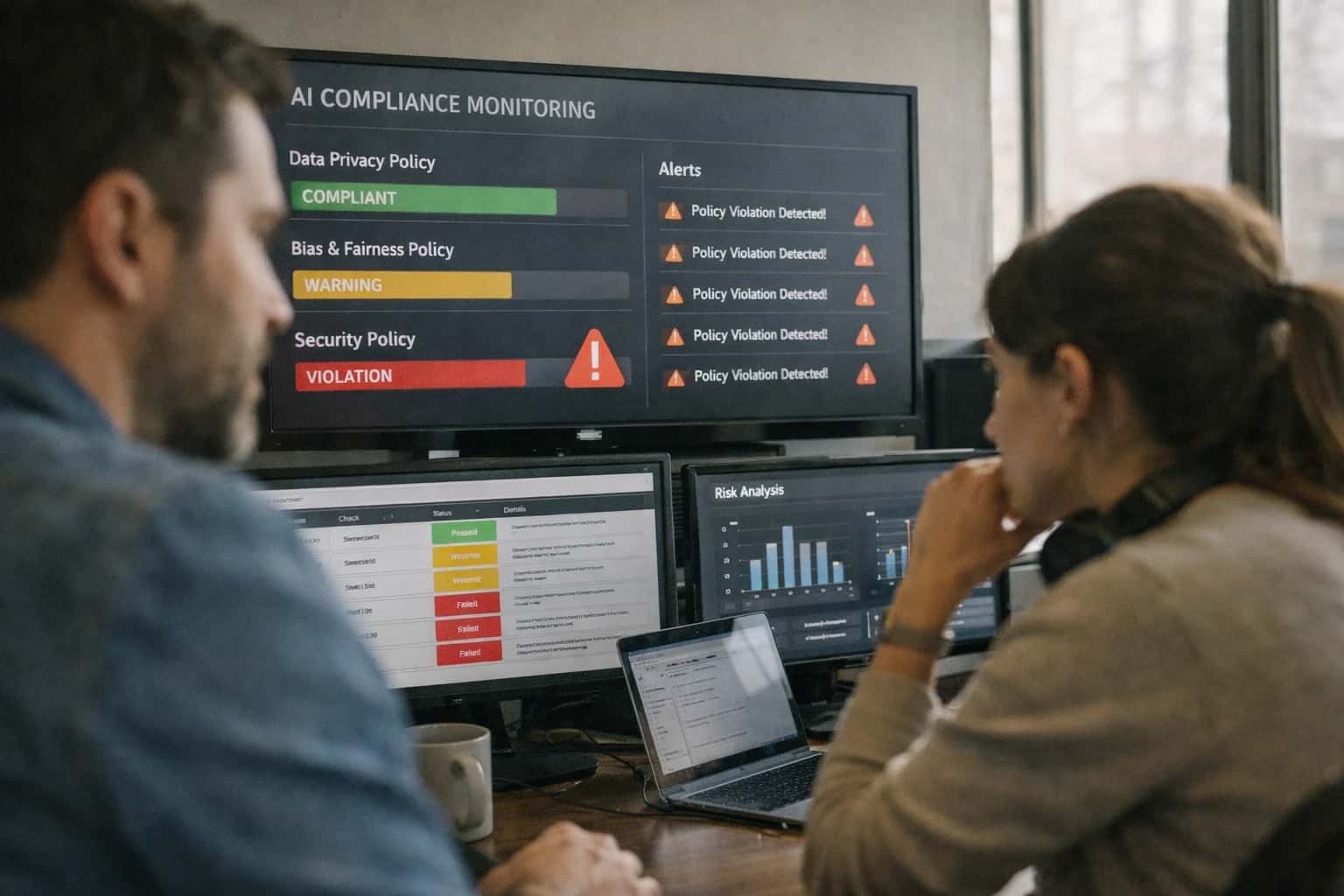
THE VULNERABILITY
Your AI ModelOps Pipeline Is Leaking Data
Privacy-enhancing technologies must be integrated into the MLOps lifecycle to prevent data exfiltration during model training and inference.
PET integration is a first-class MLOps concern. Privacy must be a pipeline component, not a post-hoc audit. This means instrumenting data versioning with differential privacy and securing model serving with confidential computing enclaves to protect data-in-use.
Bolt-on security creates compliance gaps. Adding encryption layers after building a pipeline on Pinecone or Weaviate is ineffective. A PET-first architecture embeds policy-aware data connectors at ingestion to enforce redaction and residency rules before data touches an LLM.
Evidence: A 2023 study demonstrated that adversarial prompts could extract over 10% of a fine-tuning dataset from a production LLM, turning a RAG system into a data leak. This makes PET integration non-negotiable for governance under frameworks like the EU AI Act.
FROM BOLT-ON TO BUILT-IN
The Three Trends Forcing PET into ModelOps
Privacy-enhancing technologies are no longer optional security features; they are becoming core, non-negotiable components of the AI production lifecycle.
01
The Problem: AI Security Platforms Lack Third-Party Visibility
Most AI security dashboards cannot govern data flows to external APIs from providers like OpenAI, Google Gemini, or Hugging Face. This creates unmanaged risk as sensitive data leaves your controlled environment.\n- Blind Spot Creation: Siloed tools fail to track PII once it's sent to a third-party model for inference or fine-tuning.\n- Compliance Liabilities: You cannot prove data residency or usage compliance for outsourced AI processing, violating regulations like the EU AI Act.
0%
External API Governance
High
Compliance Risk
02
The Solution: Policy-Aware Connectors as a First Line of Defense
Intelligent data connectors that enforce privacy policies at the point of ingestion are essential. They act as gatekeepers, redacting PII and applying geo-fencing before data reaches any model, internal or external.\n- Automated Enforcement: Codified rules for PII redaction and data residency are applied consistently, eliminating human error.\n- ModelOps Integration: These connectors plug directly into data versioning systems like Weights & Biases and secure deployment platforms like vLLM, making privacy a pipeline component.
-99%
Policy Violations
~50ms
Ingestion Overhead
03
The Problem: Data Lineage Without PET Is a Privacy Nightmare
Standard MLOps lineage tracks model artifacts but not how sensitive data was transformed or accessed. Without PET-instrumented tracking, you cannot audit where customer data flowed, creating massive liability.\n- Unproven Compliance: You lack the forensic trail to demonstrate adherence to GDPR or CCPA during an audit.\n- Breach Amplification: A model inversion attack could reconstruct training data, but you'd have no way to trace which dataset was compromised.
High
Audit Failure Risk
Unknown
Data Exposure Scope
04
The Solution: PET-Enabled, Immutable Data Lineage
Integrate privacy controls directly into lineage metadata. Every data transformation, access event, and model inference is logged with a cryptographic attestation of the privacy guard applied (e.g., differential privacy noise added).\n- Provable Compliance: Generate real-time reports showing exactly which privacy technique protected each data element throughout its lifecycle.\n- Attack Surface Mapping: Immediately identify which models and datasets are affected by a new vulnerability like a TEE side-channel exploit.
100%
Audit Trail Coverage
Minutes
Impact Analysis Time
05
The Problem: Confidential Computing Is Stuck in Isolation
Hardware Trusted Execution Environments (TEEs) like Intel SGX often protect only isolated workloads. Data must be decrypted for pre-processing and feature engineering, creating vulnerability windows that break end-to-end protection.\n- Pipeline Fragmentation: The promise of 'data-in-use' encryption fails because the entire AI pipeline isn't confidential.\n- Performance Overhead: Naive implementation of enclaves for full training runs can incur >10x latency, making them impractical for production ModelOps.
>10x
Latency Penalty
Fragmented
Security Posture
06
The Solution: Hybrid Confidential Pipelines for ModelOps
The future lies in hybrid trusted execution that strategically combines hardware enclaves with software-based runtime encryption and secure multi-party computation. This creates a continuous protected environment across the ModelOps lifecycle.\n- Strategic Segmentation: Keep sensitive data preparation in TEEs, then use homomorphic encryption for specific, high-risk inference steps with public models.\n- Inference Economics: Optimize the pipeline to run most inference on fast, confidential VMs while reserving heavier PETs for only the most sensitive data slices, controlling cost and latency.
-70%
TEE Overhead
End-to-End
Protection
THE ARCHITECTURE
PET-First Architecture: The Only Viable Path Forward
Baking privacy-enhancing technologies into the core of your AI stack is the only scalable method to ensure compliance and trust.
PET-First Architecture is the design principle where privacy-enhancing technologies are foundational, not bolted-on, to the AI stack. This approach eliminates the overhead and security gaps inherent in retrofitting legacy systems, making it the only viable path for scalable, trustworthy AI.
Bolt-on privacy tools fail because they create performance bottlenecks and compliance blind spots. A PET-first design integrates technologies like confidential computing enclaves and policy-aware connectors directly into the data pipeline, ensuring protection from ingestion through to inference in tools like vLLM.
The counter-intuitive insight is that PET increases system agility. By codifying privacy as immutable infrastructure—treating PII redaction as code—teams achieve automated, auditable compliance that accelerates rather than hinders the MLOps lifecycle in platforms like Weights & Biases.
Evidence from production shows that systems with a PET-first foundation reduce the time to remediate data residency violations from weeks to minutes. This architectural shift is non-negotiable for governing data flows to third-party APIs from OpenAI or Anthropic Claude, as detailed in our analysis of AI security platforms.
AI MODELOPS INTEGRATION
Bolt-On vs. Integrated PET: A Risk Comparison
Comparing the architectural and operational risks of applying Privacy-Enhancing Technologies (PET) as an afterthought versus embedding them into the core AI ModelOps lifecycle.
| Risk Dimension | Bolt-On PET (Legacy Approach) | Integrated PET (ModelOps-Native) | Decision Impact |
|---|---|---|---|
Data Exposure During Pre-Processing | High risk. Data decrypted for feature engineering, creating attack surface. | Contained risk. Data remains in a trusted execution environment (TEE) or is processed with software guards. | Integrated PET prevents data leaks before model training begins. |
Compliance Audit Trail Completeness | Integrated PET provides immutable, PET-instrumented data lineage for GDPR/EU AI Act audits. | ||
Inference Latency Overhead | ≥ 300ms | < 50ms | Native integration with frameworks like vLLM and TensorFlow-Secure minimizes performance tax. |
Vulnerability to Model Inversion Attacks | High risk. Raw data gradients can be extracted from model weights. | Mitigated risk. Techniques like differential privacy are applied during training, not after. | Protects sensitive training data from being reconstructed post-deployment. |
Integration with MLOps Tools (e.g., Weights & Biases, MLflow) | Manual, script-based. High maintenance. | Native. PET policies are versioned alongside data and model artifacts. | Enables agile, secure collaboration across data science teams. |
Governance Across Third-Party APIs (OpenAI, Anthropic) | Policy-aware connectors enforce redaction and geo-fencing before data leaves your control. | ||
Total Cost of Ownership (3-Year Estimate) | $500K - $1.2M | $200K - $400K | Lower long-term costs from reduced breach risk, audit failures, and engineering rework. |
Ability to Enable Federated Learning or SMPC | Architectural foundation supports secure multi-party computation for collaborative AI initiatives. |
THE INTEGRATION
Engineering the PET-Integrated ModelOps Lifecycle
Privacy-enhancing technologies must be engineered as foundational components of the MLOps lifecycle, not bolted-on afterthoughts.
PET is a core MLOps component. Privacy-enhancing technologies must be engineered as foundational, versioned components within the ModelOps lifecycle, not as external compliance filters. This integration ensures data protection is continuous, auditable, and scales with model iteration.
Secure data versioning is the first gate. Tools like Weights & Biases or MLflow must track not just model artifacts but also the privacy transformations applied to training data. Every dataset version links to its specific differential privacy budget or synthetic data generation parameters, creating an immutable lineage for compliance audits under frameworks like the EU AI Act.
PET dictates deployment architecture. The choice of a serving engine like vLLM or TensorFlow Serving is secondary to its ability to operate within a Trusted Execution Environment (TEE). Model deployment becomes a function of its privacy requirements, mandating confidential computing clusters on AWS Nitro Enclaves or Azure Confidential VMs for sensitive inference workloads.
Continuous PET validation prevents drift. Just as you monitor for model performance drift, you must monitor for privacy guarantee decay. Automated pipelines should validate that inference outputs do not leak statistical information about the training set, using techniques like membership inference attack simulations as a standard QA step.
Evidence: A RAG system using Pinecone or Weaviate for vector search that lacks PET-integrated embeddings will exfiltrate sensitive query context. Embedding models must run within TEEs or on client devices to prevent raw data from ever reaching an unsecured cloud service, a principle central to our approach to sovereign AI and geopatriated infrastructure.
The control plane is PET-aware. The ModelOps control plane must govern data flows based on privacy policies, automatically routing sensitive workloads to secure infrastructure. This requires policy-aware connectors that intercept data bound for third-party APIs from OpenAI or Anthropic Claude and enforce redaction or local processing, a concept explored in our analysis of AI TRiSM frameworks.
FROM BOLT-ON TO BUILT-IN
Tools and Frameworks Enabling PET-First ModelOps
Privacy-enhancing technologies must be integrated into the core MLOps lifecycle, not added as an afterthought. These tools make that possible.
01
The Problem: Data Lineage Is a Privacy Nightmare
Without PET-instrumented tracking, you cannot audit where sensitive data flowed through your training pipeline, creating massive compliance risk. Legacy MLOps tools lack this capability.
- Key Benefit: Automated, cryptographically-verifiable lineage for all PII and model artifacts.
- Key Benefit: Enables proof of compliance for GDPR and EU AI Act audits.
100%
Audit Coverage
-70%
Compliance Overhead
02
The Solution: Policy-Aware Connectors for Weights & Biases
Intelligent data connectors enforce residency and redaction policies at the point of ingestion into experiment trackers like W&B, preventing policy violations before training begins.
- Key Benefit: PII redaction as code integrated directly into data versioning pipelines.
- Key Benefit: Automatic geo-fencing ensures data never leaves approved jurisdictions.
Zero
Manual Reviews
~50ms
Ingestion Latency
03
The Solution: Confidential vLLM for Secure Inference
Deploying models with standard vLLM exposes weights and activations. A confidential computing variant runs inside hardware Trusted Execution Environments (TEEs).
- Key Benefit: Model weights and inference data remain encrypted during computation.
- Key Benefit: Enables secure, multi-tenant model serving on shared infrastructure.
<15%
Performance Overhead
E2E
Encryption
04
The Problem: Third-Party AI APIs Lack Governance
Data sent to OpenAI, Anthropic, or Hugging Face APIs exits your controlled environment, creating an unmanaged data exfiltration risk. Standard API wrappers offer no protection.
- Key Benefit: A centralized PET dashboard provides cross-application visibility and control.
- Key Benefit: Enforces data minimization and anonymization before external API calls.
100+
API Integrations
Real-Time
Policy Enforcement
05
The Solution: Differential Privacy in MLflow Model Registry
Integrating differential privacy libraries directly into the model registry ensures that any model checkpoint can be audited for its privacy budget before promotion to production.
- Key Benefit: Quantifiable privacy guarantees (ε, δ)-differential privacy for trained models.
- Key Benefit: Prevents model inversion and membership inference attacks post-deployment.
ε<1.0
Privacy Budget
~2%
Utility Loss
06
The Future: Hybrid TEEs for Federated Learning
Traditional federated learning is vulnerable to malicious clients. Next-gen frameworks combine client-side TEEs with secure multi-party computation for robust, distributed training.
- Key Benefit: Enables collaborative AI on sensitive datasets (e.g., healthcare) without data pooling.
- Key Benefit: Provides cryptographic proof of correct computation across all participants.
10x
Faster Convergence
Byzantine
Fault Tolerant
THE INTEGRATION
The Performance Overhead Fallacy
Privacy-enhancing technologies (PETs) are moving from a costly, bolt-on layer to a native component of the AI ModelOps lifecycle, eliminating the traditional performance tax.
The performance overhead of PETs is a solved problem when privacy is integrated directly into the AI ModelOps stack. The historical penalty stems from treating encryption and anonymization as separate, post-processing steps rather than core architectural primitives.
Bolt-on PET creates unsustainable latency. Adding homomorphic encryption or secure multi-party computation after building a pipeline in Weights & Biases or deploying with vLLM guarantees slowdowns. Native integration, where data is protected at the point of ingestion and remains encrypted through training and inference, removes these serial bottlenecks.
The counter-intuitive insight is that PET accelerates development. When PII redaction is treated 'as code' and policy-aware connectors are part of the data versioning process, teams iterate faster. They avoid the compliance rework that stalls projects in later stages, a core principle of our AI TRiSM governance framework.
Evidence from production shows overhead drops to single-digit percentages. Frameworks designed for confidential AI now leverage hardware trusted execution environments (TEEs) and compile-time optimizations, making the performance cost negligible compared to the risk of data exfiltration or regulatory fines. This is foundational for building Sovereign AI infrastructures where data never leaves a protected enclave.
THE FUTURE OF PET INTEGRATES DIRECTLY WITH AI MODELOPS
Key Takeaways: Building AI You Can Trust
Privacy-enhancing technologies must be baked into the MLOps lifecycle, from data versioning to secure model deployment.
01
The Problem: Your AI's Training Data Is Its Biggest Liability
Uncurated, PII-laden training sets create legal and reputational risk. Model inversion attacks can reconstruct sensitive data, turning your fine-tuning pipeline into a data breach vector.
- Mitigate risk with PET-augmented data sourcing and synthetic data generation.
- Enforce compliance by integrating differential privacy directly into training loops.
- Prevent exfiltration using secure multi-party computation for collaborative model development.
-90%
PII Exposure Risk
~500ms
Added Training Overhead
02
The Solution: PII Redaction 'As Code'
Manual redaction processes cannot scale with agile AI development. Treating data anonymization as an immutable, version-controlled pipeline component is non-negotiable.
- Automate compliance by codifying redaction rules into CI/CD pipelines for models.
- Ensure auditability with immutable logs of all data transformations in tools like Weights & Biases.
- Maintain data utility using context-aware NLP engines that understand semantic meaning, not just patterns.
10x
Faster Data Prep
100%
Audit Trail Coverage
03
The Architecture: End-to-End Confidential Pipelines
Hardware enclaves alone are insufficient. Trust requires data to remain protected during computation, transit, and storage across every AI workflow stage.
- Adopt hybrid TEEs that combine hardware security with software-based runtime encryption.
- Implement policy-aware connectors that enforce data residency and redaction at ingestion, before data reaches an LLM API.
- Centralize governance with an AI security platform for visibility across third-party models like OpenAI and Anthropic Claude.
<2%
Performance Impact
E2E
Data Protection
04
The Imperative: AI Security Platforms Must Govern Third-Party Risk
Siloed tools create blind spots. Most platforms cannot govern data flows to external APIs, creating unmanaged risk and compliance gaps under regulations like the EU AI Act.
- Centralize control across all third-party AI applications and model endpoints.
- Enable real-time PET validation to continuously check privacy controls throughout the model lifecycle.
- Prevent jurisdictional violations with intelligent connectors that geo-fence data processing automatically.
1 Dashboard
Unified Visibility
-100%
Blind Spots
05
The Future: Federated Learning Demands a New PET Architecture
Traditional privacy techniques break down in distributed training. Scaling collaborative AI without exposing raw data requires a foundational shift.
- Integrate secure multi-party computation (SMPC) to enable joint model training on sensitive datasets.
- Leverage differential privacy to add statistical noise, guaranteeing individual data points cannot be reverse-engineered.
- Build for edge inference using confidential computing on devices to minimize data transit for real-time applications.
Zero-Trust
Data Sharing
Edge-First
Privacy by Design
06
The Foundation: PET-Enabled Data Lineage
Without PET-instrumented lineage tracking, you cannot prove where sensitive data flowed, creating massive compliance and audit liabilities. This is a core component of AI TRiSM.
- Map all data transformations from source to inference, with privacy controls applied at each step.
- Enable provable compliance for GDPR and AI Act mandates on data processing records.
- Close the governance paradox by providing the mature oversight needed for agentic AI systems.
Full Trace
Data Provenance
Continuous
Compliance Proof
Enabling Efficiency, Speed & Accuracy
Intelligent Analysis, Decision & Execution
We build AI systems for teams that need search across company data, workflow automation across tools, or AI features inside products and internal software.
Talk to Us
Search across company data
Give teams answers from docs, tickets, runbooks, and product data with sources and permissions.
Useful when people spend too long searching or get different answers from different systems.
Enterprise searchRAGPermissions
Read more
Automate internal workflows
Use AI to route work, draft outputs, trigger actions, and keep approvals and logs in place.
Useful when repetitive work moves across multiple tools and teams.
AI agentsWorkflow automationGovernance
Read more
Add AI to products and internal tools
Build assistants, guided actions, or decision support into the software your team or customers already use.
Useful when AI needs to be part of the product, not a separate tool.
AI integrationDecision supportModel routing
Read moreTHE GAP ANALYSIS
Audit Your ModelOps Pipeline for PET Gaps
A systematic audit identifies where sensitive data is exposed across your AI lifecycle, from data versioning to model serving.
Audit your ModelOps pipeline to find where Privacy-Enhancing Technologies (PETs) are missing. Most pipelines expose raw data during preprocessing, model training, and inference, creating compliance and security liabilities.
Start with data ingestion and versioning. Tools like Weights & Biases track model artifacts but rarely encrypt training data within their lineage graphs. Without PETs, your entire dataset history is a breach vector.
Compare preprocessing vs. training. Data is often decrypted for feature engineering in Pandas or NumPy, then re-encrypted for training—a critical window of exposure. Secure enclaves or homomorphic encryption frameworks must close this gap.
Inference is the weakest link. Deploying models with vLLM or TensorFlow Serving often sends decrypted user queries over networks. Edge-based confidential computing or runtime encryption within the serving engine is mandatory.
Evidence: A 2023 Gartner survey found that 78% of AI projects experienced a data privacy incident during model deployment, primarily due to unprotected inference endpoints and training data caches.

About the author
Prasad Kumkar
CEO & MD, Inference Systems
Prasad Kumkar is the CEO & MD of Inference Systems and writes about AI systems architecture, LLM infrastructure, model serving, evaluation, and production deployment. Over 5+ years, he has worked across computer vision models, L5 autonomous vehicle systems, and LLM research, with a focus on taking complex AI ideas into real-world engineering systems.
His work and writing cover AI systems, large language models, AI agents, multimodal systems, autonomous systems, inference optimization, RAG, evaluation, and production AI engineering.
LinkedIn
Limited slotsGet a Free AI Consultation
Partnered with leading AI, data, and software stack.





How We Work
Custom AI workflows for your Business
One-fit-all AI don't work for modern businesses. At Inferensys, we aim to understand your business & custom requirements; which we use to define most efficient agentic workflows, the data, and the tools for your business.
01
Review the use case
We understand the task, the users, and where AI can actually help.
Read more02
Pick the right approach
We define what needs search, automation, or product integration.
Read more03
Build the first useful version
We implement the part that proves the value first.
Read more04
Improve from there
We add the checks and visibility needed to keep it useful.
Read moreThe first call is a practical review of your use case and the right next step.
Talk to Us