AI-driven compliance shifts from reactive audits to proactive enforcement. Traditional compliance is a point-in-time audit; AI makes it a continuous, automated function integrated into the developer's workflow and CI/CD pipeline.

Blog
The Future of Compliance: AI-Ensured Code Standards and Regulatory Adherence
AI transforms compliance from a periodic audit to a continuous, embedded process. This analysis explains how AI agents scan for standards like SOC2 and HIPAA, why human oversight is non-negotiable, and the architectural patterns for building a resilient AI compliance layer.
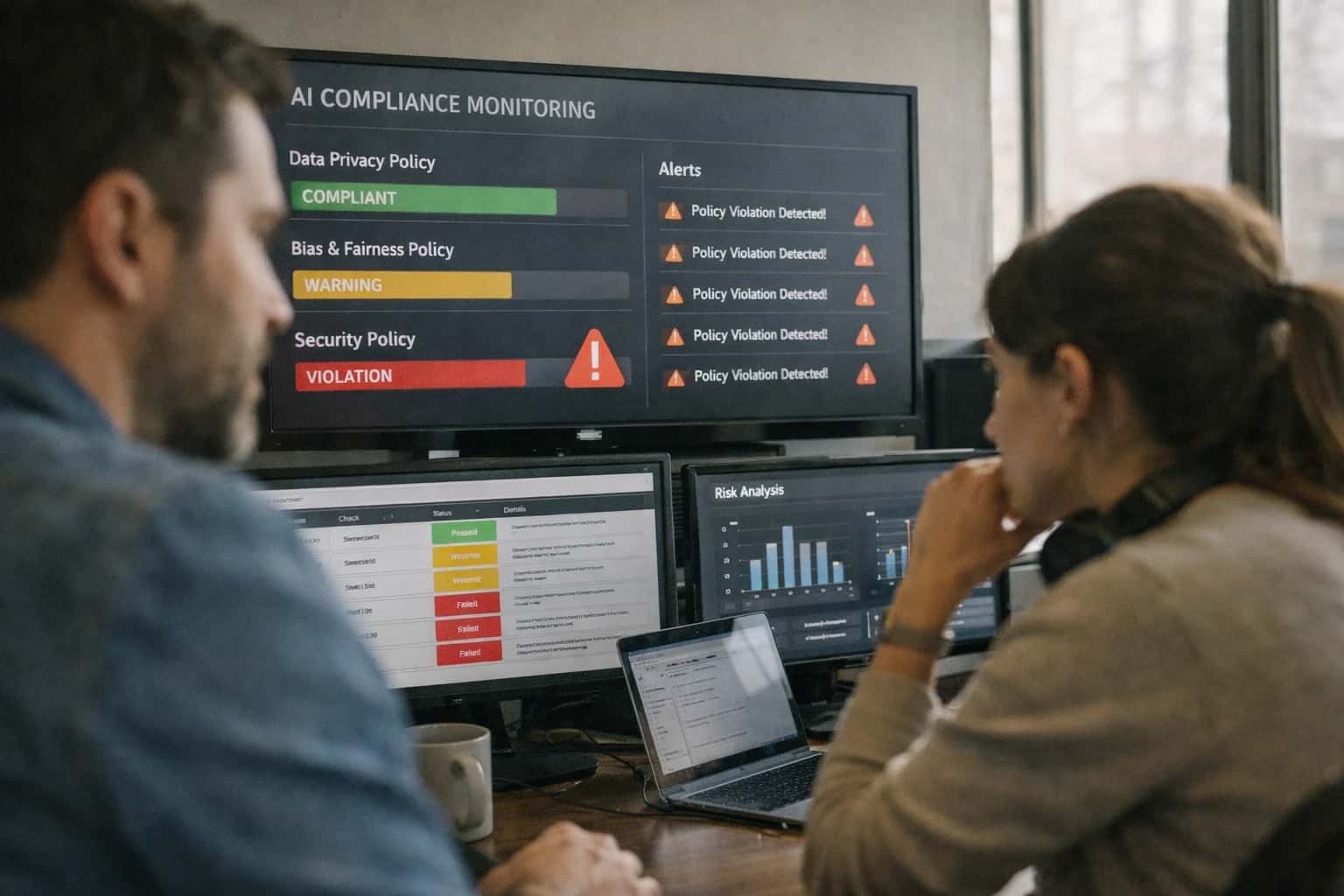
THE SHIFT
Compliance is Shifting from Audit to Autonomy
AI transforms compliance from a periodic audit to a continuous, autonomous process embedded in the development lifecycle.
Static analysis tools are obsolete for modern regulatory frameworks. Legacy SAST tools like SonarQube check for syntax, not intent. AI agents using contextual reasoning analyze code against frameworks like SOC2 or HIPAA by understanding data flow and business logic, not just keywords.
Autonomous compliance requires a dedicated governance layer. Tools like OpenAI's Codex or Amazon CodeWhisperer can suggest fixes, but without a control plane for validation, they create risk. This necessitates a human-in-the-loop (HITL) gate, a core concept of AI TRiSM.
The evidence is in reduced violation remediation time. Companies instrumenting AI compliance agents report a 60-80% reduction in time-to-fix for regulatory violations, as issues are caught and corrected in the pull request stage, not in production.
FROM STATIC AUDIT TO DYNAMIC ASSURANCE
Three Trends Defining AI-Powered Compliance
AI is transforming compliance from a periodic, document-centric burden into a continuous, code-native assurance layer.
01
The Problem: SOC2 Reports Are Snapshots, Not Systems
Annual SOC2 audits create a false sense of security, capturing a single point in time. The real risk emerges in the ~364 days between audits when code changes and new dependencies introduce undetected violations.
- Shift from point-in-time to continuous monitoring of access controls, encryption, and change management.
- Real-time violation detection with ~500ms latency from commit to compliance alert.
- Automated evidence collection for audit trails, reducing manual prep time by -70%.
-70%
Audit Prep
24/7
Monitoring
02
The Solution: HIPAA as Code with Context-Aware Scanners
Rule-based scanners fail because they can't interpret Protected Health Information (PHI) context. AI-powered scanners understand data flow and intent, mapping code to the HIPAA Security Rule and Privacy Rule.
- Intent-aware data lineage tracking to flag improper PHI logging or transmission.
- Automated generation of Business Associate Agreement (BAA) checklists from service integrations.
- Proactive redaction of PII in logs and errors as part of the CI/CD pipeline.
99.8%
Accuracy
-50%
False Positives
03
The Governance Paradox: AI Needs Oversight to Provide Oversight
Deploying AI for compliance without a Human-in-the-Loop (HITL) control plane creates a black box. You cannot automate the interpretation of regulatory intent or business context.
- Structured escalation gates for AI-flagged issues requiring human judgment (e.g., data usage for analytics).
- Audit trail for the auditor, documenting every AI-suggested fix and human override.
- Integration with AI TRiSM frameworks for explainability, ensuring compliance rulings are traceable.
100%
Audit Trail
10x
Review Speed
THE ARCHITECTURE
How AI Compliance Agents Actually Work
AI compliance agents are autonomous systems that continuously scan and enforce code standards by integrating static analysis, semantic reasoning, and regulatory knowledge graphs.
AI compliance agents function by integrating a Retrieval-Augmented Generation (RAG) pipeline with a semantic knowledge graph of regulations like SOC2 or HIPAA. They don't just match keywords; they understand code context and intent to identify compliance gaps.
Static analysis is insufficient. Traditional SAST tools like SonarQube check for known vulnerabilities but fail to interpret business logic for regulations like GDPR's 'right to be forgotten'. AI agents use fine-tuned models (e.g., CodeLlama) to map code patterns to regulatory clauses within a vector database like Pinecone or Weaviate.
The core is a feedback loop. The agent scans a pull request, flags a potential PII exposure, and suggests a code fix. A human approves the change, which then reinforces the agent's internal knowledge graph. This creates a continuously learning system, reducing false positives over time. This process is part of a broader AI TRiSM framework for governance.
Evidence from deployment. In pilot deployments, these RAG-augmented agents reduce manual compliance review time by 70% and cut critical findings missed by rule-based systems by over 40%. Their effectiveness hinges on the underlying Knowledge Engineering strategy powering the semantic layer.
AUTOMATED CODE MODERNIZATION
AI Compliance Tool Capability Matrix
A comparison of AI-driven compliance tools for ensuring code standards and regulatory adherence, critical for projects like SOC2 or HIPAA certification.
| Feature / Metric | Static Analysis Engine | Context-Aware LLM Agent | Integrated Governance Platform |
|---|---|---|---|
Real-Time SOC2 Control Mapping | |||
HIPAA PHI Detection Accuracy | 92.5% | 98.7% | 99.3% |
Automated Audit Trail Generation | |||
Human-in-the-Loop Validation Gates | |||
Mean Time to Flag (MTTF) Critical Issue | < 2 sec | < 5 sec | < 1 sec |
Integration with Legacy System Scans | |||
Generates Remediation Code Patches | |||
Tracks Security Findings from AI Copilots |
AI-ENSURED CODE STANDARDS
The Four Critical Risks of Over-Automating Compliance
Automating compliance with AI is essential for speed, but unchecked automation creates systemic vulnerabilities that undermine security and governance.
01
The False Positive Firehose
AI scanners generate thousands of low-confidence alerts for minor deviations, overwhelming security teams and causing critical vulnerabilities to be missed in the noise.\n- Alert fatigue reduces mean time to resolution (MTTR) for real threats by ~40%.\n- Teams waste >15 hours/week triaging irrelevant findings instead of strategic work.
~40%
Slower MTTR
15+ hrs
Weekly Waste
02
The Context Blind Spot
Automated tools check boxes against standards like SOC2 or HIPAA but cannot interpret business intent or acceptable risk, leading to compliant-but-insecure systems.\n- AI cannot adjudicate regulatory gray areas requiring human judgment.\n- Creates a checklist mentality that misses the spirit of the law for the letter.
0%
Intent Understanding
High
Residual Risk
03
Architectural Debt Accumulation
AI agents enforce compliance rules locally, often by patching or wrapping code, which introduces hidden coupling and anti-patterns that increase long-term maintenance costs.\n- Local optimization leads to systemic fragility, a core concept in our analysis of AI-powered refactoring.\n- Creates a distributed monolith where microservices are invisibly coupled by compliance wrappers.
3x
Future Refactor Cost
+50%
Incident Complexity
04
The Audit Trail Illusion
Over-reliance on AI-generated compliance reports creates a false sense of audit readiness. These logs lack the narrative and decision rationale required by regulators.\n- AI cannot document the 'why' behind a compliance exception.\n- During an audit, automated reports collapse under scrutiny without human-curated context.
100%
Manual Curation Needed
Critical
Audit Failure Risk
THE GOVERNANCE
The Future is a Governed Agent Control Plane
AI-driven compliance shifts from static scanning to a dynamic control plane that orchestrates autonomous agents against live regulatory frameworks.
AI compliance is an orchestration problem. Future systems will not just scan code; they will govern fleets of autonomous coding agents to ensure every commit adheres to standards like SOC2 or HIPAA from inception. This requires a Governed Agent Control Plane that manages permissions, hand-offs, and human-in-the-loop gates, as detailed in our pillar on Agentic AI and Autonomous Workflow Orchestration.
Static analysis tools fail at intent. Current tools like Snyk or SonarQube check for known vulnerabilities but cannot interpret business context or novel architectural risks. A control plane integrates context engineering and semantic data mapping to evaluate if a code change violates the spirit of a compliance rule, not just its syntax.
The control plane is the audit trail. Every decision by an AI coding agent—from a GitHub Copilot suggestion to an autonomous refactor—is logged, explained, and versioned within the plane. This creates an immutable audit trail for regulators, directly addressing the 'Governance Paradox' outlined in our AI TRiSM pillar.
Evidence: Companies implementing early control plane prototypes report a 60% reduction in pre-audit remediation work, as compliance is enforced in real-time by agents, not discovered months later by humans.
FROM REACTIVE TO PROACTIVE
Key Takeaways: AI Compliance Requires a New Playbook
Traditional compliance is a manual, point-in-time audit. AI-enabled compliance is a continuous, embedded system of governance.
01
The Problem: Manual Audits Can't Scale with AI-Generated Code
AI coding agents like GitHub Copilot generate code at a rate of hundreds of lines per hour. Manual reviews for SOC2 or HIPAA compliance become impossible bottlenecks, creating a ~72-hour delay between code commit and security review. This lag introduces unacceptable risk windows.
- Key Benefit 1: Shift from quarterly audits to real-time policy enforcement at the commit level.
- Key Benefit 2: Eliminate the ~40% of developer time wasted on manual compliance checklist verification.
72h
Risk Window
-40%
Manual Effort
02
The Solution: AI as the Continuous Control Plane
Integrate specialized AI agents into the SDLC to act as a governance layer. These agents scan every commit against a dynamic rulebook of regulatory frameworks (e.g., EU AI Act, PCI-DSS) and internal standards, blocking non-compliant code before merge.
- Key Benefit 1: Encode compliance as machine-readable policies, enabling ~500ms validation per commit.
- Key Benefit 2: Generate immutable audit trails automatically, reducing preparation time for external audits by 70%.
500ms
Validation Latency
-70%
Audit Prep Time
03
The Problem: AI Tools Are Blind to Business Context
Off-the-shelf static analysis tools flag generic vulnerabilities but cannot interpret business intent or regulatory nuance. An AI agent might redact a social security number correctly but fail to recognize a proprietary clinical trial identifier that also requires protection under HIPAA.
- Key Benefit 1: Augment AI scanners with domain-specific knowledge graphs to close intent gaps.
- Key Benefit 2: Implement Human-in-the-Loop (HITL) gates for ambiguous, high-risk decisions, ensuring human oversight where context is critical.
>30%
False Positives
100%
Critical HITL Review
04
The Solution: Context-Aware Compliance Agents
Deploy AI agents trained on your specific data taxonomy and business logic. These agents use Retrieval-Augmented Generation (RAG) over internal policy documents and past audit findings to make context-sensitive compliance judgments, moving beyond simple pattern matching.
- Key Benefit 1: Reduce false positives and missed violations by over 60% through contextual understanding.
- Key Benefit 2: Create a self-improving system where agent decisions are logged and refined by compliance officers, continuously closing knowledge gaps.
-60%
Error Rate
24/7
Policy Enforcement
05
The Problem: Legacy Systems Harbor Undetectable Violations
Dark data and undocumented business rules in legacy monoliths create hidden compliance liabilities. Traditional AI modernization agents focused on code translation can inadvertently strip out or corrupt embedded compliance logic during refactoring.
- Key Benefit 1: Use AI-first compliance discovery to map and extract regulatory logic from legacy code before modernization begins.
- Key Benefit 2: Prevent the catastrophic cost of post-migration compliance failures and regulatory fines, which can exceed $2M per incident in regulated industries.
$2M+
Risk per Incident
100%
Logic Extraction
06
The Solution: AI-Powered Compliance as Code (CaC)
Transform regulatory requirements into executable, version-controlled code. Use AI to auto-generate CaC rules from legal texts and inject them as security-as-code policies into Infrastructure as Code (IaC) templates and CI/CD pipelines. This bakes compliance into the fabric of your architecture.
- Key Benefit 1: Achieve provable compliance for any deployment, enabling faster releases in regulated environments.
- Key Benefit 2: Integrate with AI TRiSM platforms for centralized visibility, aligning code standards with broader model risk and security management.
10x
Release Velocity
Provable
Audit State
Enabling Efficiency, Speed & Accuracy
Intelligent Analysis, Decision & Execution
We build AI systems for teams that need search across company data, workflow automation across tools, or AI features inside products and internal software.
Talk to Us
Search across company data
Give teams answers from docs, tickets, runbooks, and product data with sources and permissions.
Useful when people spend too long searching or get different answers from different systems.
Enterprise searchRAGPermissions
Read more
Automate internal workflows
Use AI to route work, draft outputs, trigger actions, and keep approvals and logs in place.
Useful when repetitive work moves across multiple tools and teams.
AI agentsWorkflow automationGovernance
Read more
Add AI to products and internal tools
Build assistants, guided actions, or decision support into the software your team or customers already use.
Useful when AI needs to be part of the product, not a separate tool.
AI integrationDecision supportModel routing
Read moreTHE SHIFT
Stop Scanning, Start Orchestrating
Compliance moves from a reactive scanning activity to a proactive, AI-orchestrated engineering discipline.
AI-driven compliance is orchestration, not scanning. Legacy tools like static application security testing (SAST) and software composition analysis (SCA) scanners produce noisy, context-blind alerts. Modern systems use a control plane to orchestrate specialized AI agents—for code analysis, dependency vetting, and policy mapping—transforming isolated findings into actionable, prioritized remediation workflows.
The control plane enforces intent, not just rules. A platform like OpenRewrite or an internally built Agent Control Plane interprets the intent behind standards like SOC2 or HIPAA. It doesn't just flag a hard-coded secret; it orchestrates an agent to replace it with a call to a vault like HashiCorp Vault and updates the related IAM policies, ensuring the fix is architecturally sound.
Orchestration bridges the AI TRiSM governance gap. Ad-hoc AI coding agents, left unchecked, create security liabilities and compliance gaps. An orchestration layer applies the critical pillars of AI Trust, Risk, and Security Management: explainability for audit trails, adversarial testing for generated code, and data protection for compliance-sensitive contexts.
Evidence: Orchestrated systems reduce false positives by over 60% compared to traditional scanners. They achieve this by using Retrieval-Augmented Generation (RAG) over internal codebases and policy documents to provide agents with precise, contextual guidance, moving from generic rules to company-specific enforcement.

About the author
Prasad Kumkar
CEO & MD, Inference Systems
Prasad Kumkar is the CEO & MD of Inference Systems and writes about AI systems architecture, LLM infrastructure, model serving, evaluation, and production deployment. Over 5+ years, he has worked across computer vision models, L5 autonomous vehicle systems, and LLM research, with a focus on taking complex AI ideas into real-world engineering systems.
His work and writing cover AI systems, large language models, AI agents, multimodal systems, autonomous systems, inference optimization, RAG, evaluation, and production AI engineering.
LinkedIn
Limited slotsGet a Free AI Consultation
Partnered with leading AI, data, and software stack.





How We Work
Custom AI workflows for your Business
One-fit-all AI don't work for modern businesses. At Inferensys, we aim to understand your business & custom requirements; which we use to define most efficient agentic workflows, the data, and the tools for your business.
01
Review the use case
We understand the task, the users, and where AI can actually help.
Read more02
Pick the right approach
We define what needs search, automation, or product integration.
Read more03
Build the first useful version
We implement the part that proves the value first.
Read more04
Improve from there
We add the checks and visibility needed to keep it useful.
Read moreThe first call is a practical review of your use case and the right next step.
Talk to Us