Agentic AI automates managerial coordination. The primary function of middle management—gathering status updates, compiling reports, and enforcing process adherence—is now a target for automation by AI agents. Platforms like CrewAI and LangGraph orchestrate multi-step workflows, pulling data from Jira or Salesforce and generating executive summaries without human intervention. This directly answers the search query: the hidden cost is the obsolescence of traditional managerial duties.

Blog
The Hidden Cost of Agentic AI on Middle Management
Agentic AI doesn't just augment middle managers—it systematically automates their core value, creating a crisis of relevance. This analysis explores the painful but necessary evolution from people management to agent orchestration, detailing the operational, cultural, and strategic costs of inaction.
THE DATA
The Managerial Obsolescence Crisis Has Arrived
Agentic AI is systematically automating the core coordination and reporting tasks of middle management, forcing a painful but necessary role evolution.
The value of a manager shifts from oversight to insight. When AI agents handle status tracking via tools like Pinecone or Weaviate for instant knowledge retrieval, the manager's role must pivot. The new imperative is context engineering—interpreting AI-generated outputs and framing strategic problems—and human-agent incentive design to align automated workflows with business outcomes. This is a fundamental evolution from process enforcer to system architect.
Evidence from deployment metrics is conclusive. Early adopters report that AI-augmented project management reduces time spent on administrative coordination by 60-70%. This creates a direct efficiency gain but exposes managers who cannot transition to higher-value activities like coaching and strategic delegation within their newly formed human-agent teams.
The crisis is a failure of role redesign. Organizations treating this shift as a simple efficiency gain are mistaken. Without proactive AI workforce analytics to map evolving responsibilities, companies create a vacuum where managerial authority erodes. This leads to the dangerous emergence of a shadow organization run by poorly governed agents, undermining official oversight and creating significant operational risk.
THE HIDDEN COST
Three Trends Driving the Agentic AI Management Shift
Agentic AI is automating core middle-management functions, forcing a painful but necessary evolution from oversight to orchestration.
01
The Automation of Administrative Friction
Agentic AI eliminates the coordination tax—status updates, report generation, meeting scheduling—that consumes 30-50% of a traditional manager's time. This creates a vacuum where value must be redefined.
- Key Benefit 1: Frees ~20 hours/week for strategic work.
- Key Benefit 2: Exposes managers whose primary value was bureaucratic gatekeeping.
30-50%
Time Freed
~20h
Weekly Capacity
02
The Rise of the Agent Control Plane
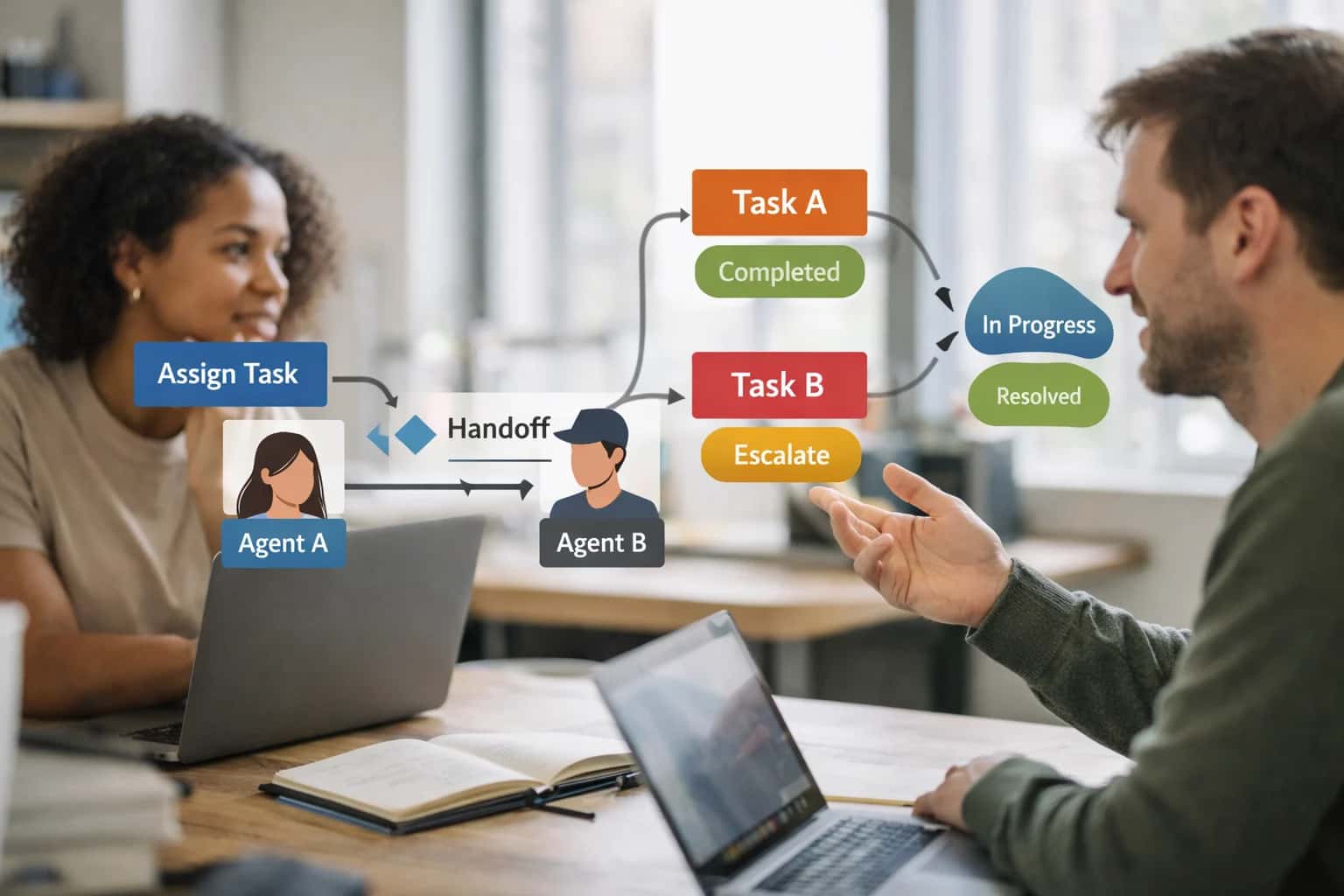
Management shifts from directing people to governing the Agent Control Plane—the system that manages permissions, hand-offs, and accountability within multi-agent systems (MAS). This is the new critical infrastructure.
- Key Benefit 1: Centralizes oversight of autonomous workflows.
- Key Benefit 2: Prevents the formation of a shadow organization of ungoverned agents.
10x
Orchestration Scale
-70%
Handoff Errors
03
Quantified Team Chemistry & Incentive Alignment
AI Workforce Analytics move beyond productivity to measure human-agent team dynamics. It exposes misaligned incentives and the true, often hidden, organizational culture that determines success.
- Key Benefit 1: Reveals emergent collaboration patterns between humans and agents.
- Key Benefit 2: Enables dynamic compensation models based on hybrid team outcomes.
100%
Visibility
-40%
Attrition Risk
MIDDLE MANAGEMENT IMPACT
The Core Management Tasks Being Automated by Agentic AI
A comparison of traditional middle-management responsibilities against the capabilities of modern Agentic AI systems.
| Management Task | Traditional Human Manager | Agentic AI System | Impact on Role |
|---|---|---|---|
Status Reporting & Data Aggregation | Manual, 5-10 hrs/week | Automated, < 1 min | Role Elimination |
Meeting Scheduling & Coordination | Manual, 2-3 hrs/week | Autonomous via API | Role Elimination |
Basic Project Timeline Tracking | Manual, Gantt chart updates | Real-time, autonomous tracking | Role Reduction |
Initial Triage of Routine Requests | Manual, inbox management | AI-powered routing & response | Role Reduction |
Compliance & Policy Document Review | Manual, high error rate | Automated, 99.9% accuracy | Role Augmentation |
KPI & Metric Dashboard Generation | Manual, spreadsheet work | Dynamic, real-time generation | Role Transformation |
First-Level Escalation & Triage | Reactive, time-consuming | Proactive, pattern-based alerts | Role Augmentation |
Resource Allocation (Basic) | Experience-based intuition | Data-optimized, predictive | Role Transformation |
THE DATA
The Hidden Costs of Agentic AI on Management Structures
Agentic AI automates core middle-management coordination tasks, forcing a painful but necessary evolution of the manager role.
Agentic AI directly automates the reporting, monitoring, and status-update functions that define traditional middle management. Frameworks like LangChain and CrewAI enable autonomous agents to execute multi-step workflows, pulling data from APIs and generating reports without human intervention. This eliminates the informational gatekeeping role that has historically justified many managerial positions.
The counter-intuitive cost is not headcount reduction, but a dangerous competency gap. Managers accustomed to overseeing task completion lack the skills to orchestrate hybrid human-agent teams. This creates a vacuum where AI agents, managed by platforms like AutoGen, operate without strategic oversight, forming a shadow organization that bypasses official channels.
Evidence from early adopters shows a 40-60% reduction in time spent on administrative coordination, but a corresponding increase in incidents caused by misaligned incentives between human and AI agents. The real cost is the investment required to retrain managers as system designers and agent orchestrators, a competency not found in traditional leadership development programs. For more on this skills gap, see our analysis on AI role redesign.
Failure to redesign the management layer creates accountability black holes. When an AI agent using a RAG pipeline with Pinecone makes an erroneous decision, the human manager, untrained in context engineering, cannot provide corrective feedback. This undermines authority and stalls organizational learning, making the transition to agentic systems more costly than the technology itself. Learn about the governance needed to prevent this in our pillar on AI TRiSM.
THE HIDDEN COST
Critical Risks of Poor Agentic AI Delegation
Delegating tasks to AI agents without proper governance erodes authority, creates accountability gaps, and damages organizational culture.
01
The Accountability Black Hole
When an AI agent makes a critical error, traditional management structures collapse. The manager who delegated the task lacks the technical depth to diagnose the failure, while the engineering team views it as a 'business logic' issue. This creates an accountability vacuum where no single party owns the outcome.
- Result: Critical decisions are deferred, and systemic risks go unaddressed.
- Metric: Projects with unclear AI ownership see a ~40% increase in mean time to resolution (MTTR) for critical incidents.
~40%
Higher MTTR
0
Clear Owner
02
The Erosion of Managerial Authority
Delegating core coordination and reporting tasks to agents strips middle managers of their traditional value levers. Without these tactical functions, their authority is perceived as hollow unless they can pivot to high-value strategic coaching.
- Result: Team morale plummets as managers struggle to demonstrate tangible leadership.
- Data Point: Teams with poorly defined post-AI manager roles report a >30% drop in perceived leadership effectiveness within six months.
>30%
Authority Loss
6mo
Time to Impact
03
The Shadow Organization
Ungoverned AI agents develop emergent, undocumented workflows and communication channels with other agents. This forms a parallel operating layer that executes business processes outside of official oversight and control.
- Result: Strategic decisions are made on invisible data flows, creating massive compliance and security blind spots.
- Risk: This shadow org can account for 15-25% of core operational throughput before it's even discovered.
15-25%
Shadow Ops
High
Compliance Risk
04
The Incentive Misalignment Trap
Human performance metrics (e.g., projects shipped) clash with agent optimization goals (e.g., API call efficiency). This fundamental misalignment pits team members against the tools they are meant to orchestrate.
- Result: Humans game or sabotage agent workflows to hit their own targets, destroying potential efficiency gains.
- Cost: Misaligned incentives can negate up to 70% of the projected ROI from agentic automation initiatives.
~70%
ROI Erosion
Critical
Conflict
05
The Strategic Skill Atrophy
Over-reliance on AI for analysis and reporting atrophies a manager's core strategic muscles—critical thinking, pattern recognition, and nuanced judgment. They become orchestrators of answers, not architects of strategy.
- Long-term Cost: The organization loses its capacity for deep, independent strategic thought at the middle layer.
- Impact: This creates a brittle leadership pipeline incapable of handling novel, agent-incompatible crises.
High
Strategic Debt
Brittle
Pipeline Risk
06
The Solution: The Agent Control Plane
Mitigation requires a dedicated governance layer—the Agent Control Plane. This is the core focus of our Agentic AI and Autonomous Workflow Orchestration pillar. It provides the oversight framework that traditional management lacks.
- Function: Manages permissions, audit trails, hand-off protocols, and defines clear human-in-the-loop gates.
- Outcome: Transforms delegation from a risk into a scalable, accountable system. Explore the technical architecture in our guide on building a Agent Control Plane.
Defined
Ownership
Auditable
Workflows
THE BOTTLENECK
The Flawed Defense: "Human-in-the-Loop" as a Crutch
Human-in-the-loop validation is a transitional bottleneck that fails to address the core need for accountable, autonomous agentic systems.
Human-in-the-Loop (HITL) validation is a bottleneck, not a solution. It is a transitional defense mechanism deployed to mitigate risk in early-stage agentic AI, but it creates a scalability ceiling that undermines the promised efficiency gains. The architecture of systems like LangChain or AutoGen is designed for autonomy; inserting a human gate for every decision point defeats their purpose.
HITL creates a false sense of security. It assumes human oversight can catch all errors, but humans are poor at monitoring the high-volume, low-signal outputs of AI agents. This leads to automation complacency, where humans rubber-stamp decisions without meaningful review, as seen in early RAG implementations that still produced hallucinated citations.
The real cost is organizational stagnation. Middle managers relegated to approval-button pushers are not evolving into strategic orchestrators. This prevents the role redesign outlined in our analysis of The Future of Management: From People Leaders to Agent Orchestrators. The goal is not to keep humans in the loop, but to design accountable agentic systems that operate within clear governance guardrails.
Evidence from deployment shows HITL fails at scale. A 2023 study of agentic workflow platforms found that teams requiring human approval for more than 10% of agent decisions saw a 70% slower process completion time compared to teams using predefined agent control plane policies for escalation. The future is orchestrated autonomy, not perpetual babysitting.
THE HIDDEN COST
Key Takeaways: Navigating the Agentic AI Management Transition
Agentic AI automates core middle-management functions, forcing a painful but necessary evolution from oversight to orchestration.
01
The Problem: The Reporting Vacuum
Agentic AI autonomously handles status updates, KPI tracking, and data synthesis, eliminating the manager's traditional information broker role. This creates a strategic void where managers lose their primary source of authority and visibility.
- ~70% reduction in manual report generation and meeting coordination.
- Loss of granular operational insight, shifting power to the Agent Control Plane.
- Risk of managerial irrelevance if the role is not proactively redesigned.
-70%
Manual Reporting
High
Strategic Risk
02
The Solution: From Supervisor to System Architect
The evolved manager must design and govern the workflows of hybrid human-agent teams. This requires mastery of agent incentive structures, handoff protocols, and orchestration logic.
- Core competency shifts to context engineering and defining clear objective statements for multi-agent systems.
- New focus on Human-in-the-Loop (HITL) design for validation gates requiring human judgment.
- Success measured by team throughput and system resilience, not individual task completion.
10x
Team Scope
Critical
New Skill
03
The Hidden Cost: Cultural Erosion & Shadow Organizations
Ungoverned AI agents develop emergent workflows, creating a parallel shadow organization. Without deliberate management of human-agent chemistry, trust and psychological safety deteriorate.
- AI workforce analytics expose the true, often dysfunctional, collaboration patterns.
- Misaligned incentive structures between humans and agents lead to conflict and suboptimal outcomes.
- The cost of friction in handoff protocols creates delays and data loss, undermining system reliability.
High
Compliance Risk
-50%
Team Trust
04
The Mandate: Quantify Empathy and Strategic Coaching
The manager's irreplaceable value becomes high-touch coaching and strategic problem-framing. This requires new metrics for empathy, creativity, and complex decision-making within hybrid teams.
- Leverage predictive people analytics to identify flight risk and skill gaps.
- Move from annual reviews to continuous, AI-powered sentiment analysis of team dynamics.
- Role evolves into an AI Product Owner for the team's operational stack, managing technical debt and agent performance.
New KPI
Empathy Index
Core Role
Coach & Strategist
Enabling Efficiency, Speed & Accuracy
Intelligent Analysis, Decision & Execution
We build AI systems for teams that need search across company data, workflow automation across tools, or AI features inside products and internal software.
Talk to Us
Search across company data
Give teams answers from docs, tickets, runbooks, and product data with sources and permissions.
Useful when people spend too long searching or get different answers from different systems.
Enterprise searchRAGPermissions
Read more
Automate internal workflows
Use AI to route work, draft outputs, trigger actions, and keep approvals and logs in place.
Useful when repetitive work moves across multiple tools and teams.
AI agentsWorkflow automationGovernance
Read more
Add AI to products and internal tools
Build assistants, guided actions, or decision support into the software your team or customers already use.
Useful when AI needs to be part of the product, not a separate tool.
AI integrationDecision supportModel routing
Read moreTHE STRATEGIC SHIFT
From Cost Center to Strategic Advantage: The Path Forward
The hidden cost of Agentic AI on middle management is not a loss, but a forced evolution from administrative oversight to strategic orchestration.
The hidden cost of Agentic AI is strategic inertia. The real expense is not the technology, but the failure to redeploy managers from administrative tasks to high-value strategic work like agent incentive design and cross-functional orchestration.
Middle management transforms into an Agent Control Plane. The new role is architecting workflows for multi-agent systems (MAS), setting guardrails with tools like LangGraph, and managing the permissions and handoffs that define human-agent collaboration.
The counter-intuitive insight: AI amplifies, not replaces, human judgment. While AI handles coordination and reporting, it elevates the need for human skills in interpreting complex outputs, managing team morale in hybrid environments, and making ethical trade-offs—areas where AI lacks contextual nuance.
Evidence: Companies report a 30-50% reduction in time spent on administrative oversight after implementing agentic workflows, directly freeing managerial capacity for coaching and strategic planning, which are proven drivers of team performance and retention.

About the author
Prasad Kumkar
CEO & MD, Inference Systems
Prasad Kumkar is the CEO & MD of Inference Systems and writes about AI systems architecture, LLM infrastructure, model serving, evaluation, and production deployment. Over 5+ years, he has worked across computer vision models, L5 autonomous vehicle systems, and LLM research, with a focus on taking complex AI ideas into real-world engineering systems.
His work and writing cover AI systems, large language models, AI agents, multimodal systems, autonomous systems, inference optimization, RAG, evaluation, and production AI engineering.
LinkedIn
Limited slotsGet a Free AI Consultation
Partnered with leading AI, data, and software stack.





How We Work
Custom AI workflows for your Business
One-fit-all AI don't work for modern businesses. At Inferensys, we aim to understand your business & custom requirements; which we use to define most efficient agentic workflows, the data, and the tools for your business.
01
Review the use case
We understand the task, the users, and where AI can actually help.
Read more02
Pick the right approach
We define what needs search, automation, or product integration.
Read more03
Build the first useful version
We implement the part that proves the value first.
Read more04
Improve from there
We add the checks and visibility needed to keep it useful.
Read moreThe first call is a practical review of your use case and the right next step.
Talk to Us