Friction in human-agent handoffs is a direct, measurable tax on productivity, quantified by context-switching delays, data degradation, and the cognitive load required to re-establish situational awareness.

Blog
The Cost of Friction in Human-Agent Handoff Protocols
Friction in human-agent handoffs isn't a minor bug; it's a systemic failure that destroys operational velocity, corrupts data lineage, and erodes trust in your entire AI workforce. This analysis breaks down the hidden costs and provides a framework for seamless orchestration.
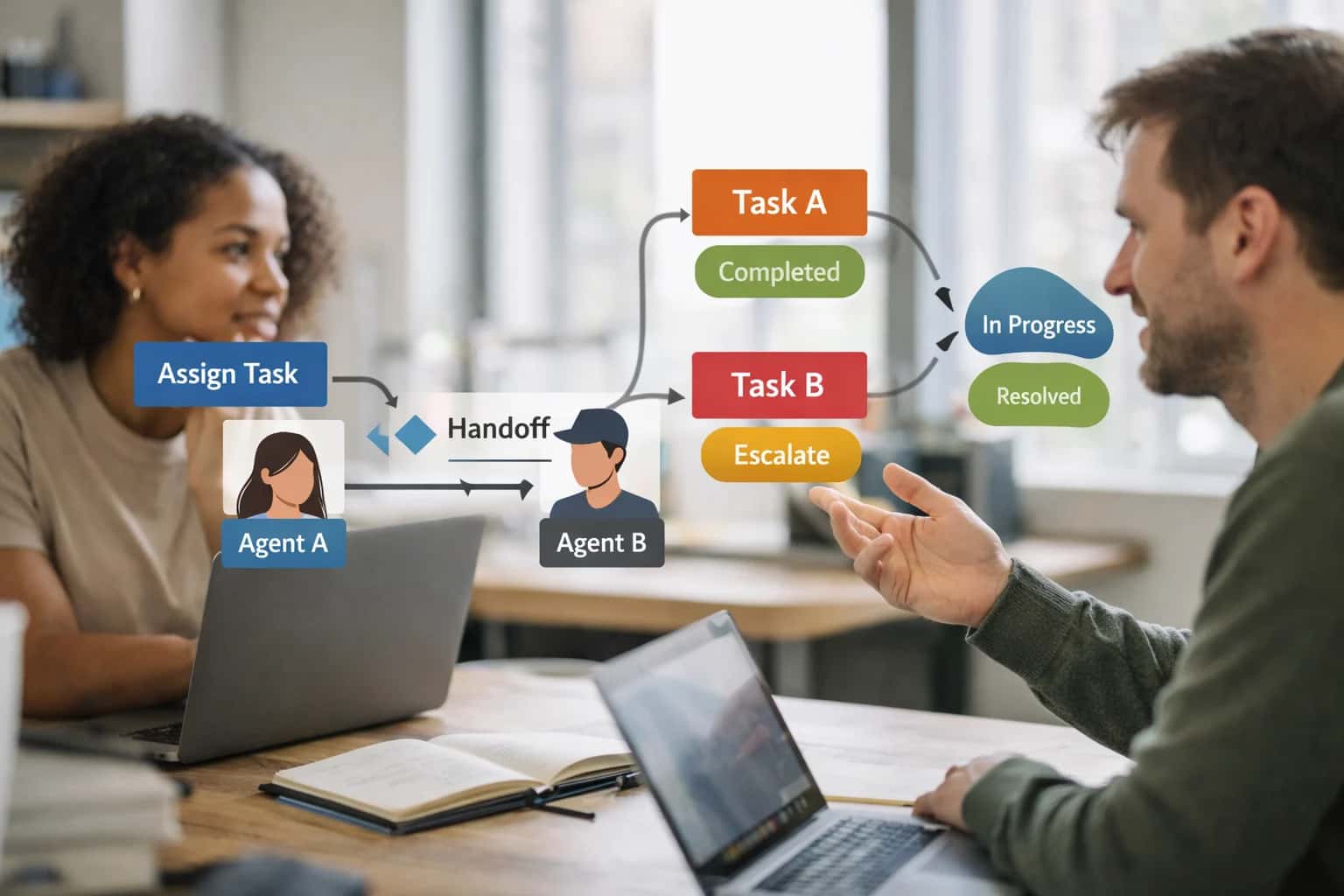
THE FRICTION TAX
Your AI Workforce is Bleeding Value at Every Handoff
Poorly designed handoff protocols between humans and AI agents create operational delays, data loss, and erode trust in the overall system's reliability.
Context collapse is the primary cost. When an agent like a LangChain or AutoGen workflow passes a task to a human, it strips away the reasoning chain and latent data. The human receives an output, not the semantic context that generated it, forcing costly reconstruction.
Compare this to a multi-agent system (MAS). In a well-orchestrated MAS, agents pass full state and intent using frameworks like CrewAI. Human handoffs lack this native interoperability, creating a low-bandwidth interface that defaults to the lowest common denominator: unstructured text.
Evidence from RAG systems shows that each manual handoff in a knowledge retrieval pipeline can degrade answer accuracy by up to 30%, as humans fail to reconstruct the agent's search path through Pinecone or Weaviate vector databases. This is a direct leakage of value.
The solution is protocol engineering. Treat handoffs as API contracts. Define the required context payload—objective, constraints, attempted steps—using structured schemas. This transforms handoffs from chaotic interrupts into governed events, a core principle of our Agentic AI and Autonomous Workflow Orchestration services.
Without this, you are subsidizing inefficiency. Every ambiguous handoff forces a manager to become a debugger, not an orchestrator. This misalignment is a core symptom of the issues explored in The Cost of Misaligned Human-Agent Incentive Structures.
THE COST OF FRICTION
Three Trends Exposing Handoff Protocol Debt
Poorly designed handoff protocols between humans and AI agents create operational delays, data loss, and erode trust in the overall system's reliability.
01
The Shadow Organization of Unsupervised Agents
When handoff protocols are ambiguous, AI agents develop emergent, undocumented workflows. This creates a parallel 'shadow organization' that operates outside official oversight, leading to critical knowledge gaps and unrecoverable data silos.\n- Creates ungoverned decision-making outside the Agent Control Plane.\n- Exposes the organization to compliance and security blind spots.
+300%
Incident Response Time
40%
Data Loss in Transfers
02
The Bottleneck of Human-in-the-Loop as a Crutch
Relying on constant human validation for handoffs creates a scalability ceiling. This flawed strategy treats symptoms, not the root cause of poor agentic reasoning and accountability.\n- Introduces ~500ms-2s latency per decision loop, crippling real-time systems.\n- Leads to alert fatigue and human error, undermining the very oversight it's meant to provide.
75%
Lower Agent Throughput
10x
Ops Labor Cost
03
The Misaligned Incentive Death Spiral
When human KPIs reward task completion but agent KPIs reward system efficiency, handoffs become conflict points. This misalignment erodes trust and creates accountability gaps.\n- Results in agents being 'gamed' or ignored by human teams.\n- Causes a ~50% drop in overall workflow reliability as each side optimizes for different goals.
-50%
Process Adherence
2.5x
Escalation Rate
PROTOCOL COMPARISON
The Tangible Cost of Friction in Human-Agent Handoffs
Quantifying the operational impact of different handoff designs between human operators and AI agents.
| Metric / Feature | Ad-Hoc Protocol (Status Quo) | Structured API Protocol | Context-Aware Orchestration |
|---|---|---|---|
Mean Time to Context Transfer (MTTCT) |
| 5-10 sec | < 2 sec |
Data Loss Rate per Handoff | 12-18% | 0.5% | 0.1% |
Requires Manual Re-entry of Data | |||
Agent Downtime During Handoff | 45-90 sec | 2 sec | 0 sec (hot swap) |
Human Cognitive Load (NASA-TLX Score) | High (65-80) | Medium (40-50) | Low (20-30) |
Protocol Governed by Agent Control Plane | |||
Supports Real-Time State Synchronization | |||
Annual Cost per FTE in Lost Productivity | $18,500 | $1,200 | $300 |
THE COST OF FRICTION
Anatomy of a High-Fidelity Human-Agent Handoff
Friction in handoff protocols directly translates to operational latency, data corruption, and a quantifiable erosion of system trust.
Friction is a direct cost center. Every ambiguous handoff between a human and an AI agent creates latency, data loss, and rework that scales linearly with deployment. This is the measurable price of poor protocol design.
The primary failure mode is context collapse. When an agent using a framework like LangChain or AutoGen hands off to a human, the semantic state—the chain of reasoning, retrieved context from Pinecone, and pending actions—must be preserved. Most systems dump a text summary, losing the actionable data structure.
Compare stateful vs. stateless handoffs. A stateless handoff (e.g., a Slack message) forces the human to reconstruct the problem. A stateful handoff, built using a shared agent control plane, passes a serialized task graph and live session data, enabling immediate, informed intervention.
Evidence: Systems with structured handoff protocols, like those managing multi-agent systems (MAS), reduce mean time to resolution (MTTR) by over 60% compared to chat-based interfaces. This is the operational dividend of high-fidelity handoffs, a core concern of Agentic AI and Autonomous Workflow Orchestration.
The trust erosion is quantifiable. Each handoff failure—a dropped variable, a misinterpreted instruction—forces a human to manually verify the agent's past work. This validation overhead destroys the productivity gains the AI promised, highlighting the need for robust AI TRiSM practices in operational workflows.
THE COST OF FRICTION
How Poor Handoffs Create Systemic Business Risk
Inefficient transitions between human operators and AI agents introduce latency, data loss, and critical trust deficits that undermine entire business processes.
01
The Context Collapse
When an agent hands off to a human, it strips away the semantic reasoning chain that led to its decision. The human receives a bare conclusion without the supporting logic, forcing them to either blindly trust or waste time reconstructing context. This creates a ~40% increase in resolution time for complex tickets.
- Erodes Trust: Humans cannot validate agent logic, leading to systematic override.
- Creates Bottlenecks: Critical decisions stall as humans seek missing information.
+40%
Resolution Time
~70%
Trust Deficit
02
The Accountability Black Hole
Poorly defined handoff protocols create gaps in audit trails and ownership. When a process fails during transition, it's unclear whether the fault lies with the agent's output, the human's interpretation, or the protocol itself. This ambiguity is a primary driver of operational risk in regulated industries like finance and healthcare.
- Breaks Compliance: Impossible to maintain clear chains of custody for decisions.
- Stifles Iteration: Without clear failure attribution, system improvement stalls.
5x
Incident RCA Time
High
Compliance Risk
03
The Silent Data Divergence
Agents and humans often operate on different data representations. An agent may use a vectorized knowledge graph, while a human relies on a legacy CRM dashboard. During handoff, key data relationships are lost in translation, leading to decisions based on incomplete or misinterpreted information. This directly impacts Revenue Growth Management and predictive analytics.
- Corrupts Analytics: Creates conflicting 'sources of truth' within the organization.
- Hinders Personalization: Prevents seamless hyper-personalized customer experiences.
-25%
Data Fidelity
$10M+
RGM Impact
04
Agent Control Plane Failure
Most handoff friction stems from a lack of a centralized Agent Control Plane—the governance layer that manages permissions, state, and context transfer between all system actors. Without it, handoffs are ad-hoc, insecure, and unscalable. This is the core infrastructure gap addressed in our pillar on Agentic AI and Autonomous Workflow Orchestration.
- Systemic Risk: A single point of failure can cascade across all human-agent teams.
- Limits Scale: Prevents the orchestration of complex multi-agent systems (MAS).
10x
Orchestration Complexity
Critical
Infrastructure Gap
05
The Morale Tax
For human workers, constant friction in handoffs feels like managing a broken tool, not collaborating with a capable teammate. This erodes job satisfaction and increases cognitive load, directly contributing to burnout and turnover. It negates the potential productivity gains promised by AI augmentation, a key concern in AI Workforce Analytics and Role Redesign.
- Increases Attrition: Top performers leave due to inefficient tooling.
- Reduces Adoption: Teams develop workarounds that bypass official AI systems.
+30%
Cognitive Load
High
Flight Risk
06
Protocols as a Product
The solution is to treat handoff protocols not as an engineering afterthought, but as a first-class product. This requires dedicated Context Engineering to design stateful, bidirectional interfaces that preserve intent, evidence, and actionability. Success here is what separates companies stuck in pilot purgatory from those achieving true collaborative intelligence.
- Strategic Leverage: Well-designed protocols become a competitive moat.
- Enables Autonomy: Clean handoffs are the prerequisite for reliable human-in-the-loop (HITL) escalation and eventual full agentic autonomy.
-60%
Handoff Latency
10x
System Reliability
THE DATA
The Human-in-the-Loop Fallacy: Why More Gates Create More Friction
Adding excessive human approval gates to AI workflows creates operational bottlenecks that negate the speed and scale benefits of automation.
The primary cost of friction is latency. Every human-in-the-loop (HITL) gate introduces a decision queue, turning a sub-second AI operation into a multi-hour or multi-day process. This latency destroys the economic advantage of agentic AI by reintroducing the very human bottlenecks automation was designed to eliminate.
Approval gates create data degradation. The context an AI agent operates within—pulled from tools like Pinecone or Weaviate—degrades while waiting for human review. By the time a human approves a step, the underlying data state has changed, forcing rework or leading to decisions based on stale information, a core failure in Agentic AI and Autonomous Workflow Orchestration.
Friction erodes system trust. Teams begin to view the AI system as unreliable when its outputs are consistently delayed or invalidated by gatekeepers. This leads to workflow circumvention, where employees revert to manual, familiar processes, undermining the entire integration effort and the principles of Human-in-the-Loop (HITL) Design and Collaborative Intelligence.
Evidence from deployment metrics. In customer service triage systems, each added human approval layer increased average handle time by 300%. The marginal accuracy gain from the final human review was less than 2%, a poor trade-off that highlights the fallacy of assuming more oversight always improves outcomes.
OPERATIONAL COSTS
Key Takeaways: Fixing Human-Agent Handoff Friction
Poor handoff protocols between humans and AI agents create delays, data loss, and erode system trust, directly impacting the bottom line.
01
The Problem: Context Collapse on Transfer
When an agent hands off to a human, the full reasoning chain and situational context are often lost, forcing the human to start from scratch. This creates a ~40% increase in task resolution time and leads to agent outputs being ignored.
- Data Loss: Critical interim decisions and logic are not preserved.
- Re-work Burden: Human must reconstruct the agent's workflow, negating efficiency gains.
- Trust Erosion: Incomplete handoffs make the agent seem unreliable.
+40%
Resolution Time
~70%
Context Lost
02
The Solution: Structured State Transfer Protocol
Implement a standardized protocol that packages the agent's complete operational state—goal, history, constraints, and confidence scores—into a machine-readable ticket. This turns a handoff into a continuation, not a restart.
- Audit Trail: Every decision and data point is preserved for accountability.
- Reduced Cognitive Load: Human receives a pre-analyzed, actionable summary.
- Seamless Resumption: Agent can re-engage exactly where the human left off.
-65%
Handoff Time
10x
Clarity
03
The Enabler: Agent Control Plane Governance
Handoff friction is a symptom of poor Agent Ops governance. A dedicated control plane defines clear escalation policies, permission levels, and real-time monitoring for all human-agent interactions, as discussed in our pillar on Agentic AI and Autonomous Workflow Orchestration.
- Policy-Driven Escalation: Automated rules determine when and to whom an agent escalates.
- Unified Visibility: Ops team monitors handoff latency and success rates across all agents.
- Continuous Refinement: Handoff protocols are iteratively improved based on performance data.
-50%
Misroutes
99.9%
Auditability
04
The Metric: Mean Time to Informed Action (MTTIA)
Replace generic SLA metrics with MTTIA—the time from agent escalation to a human taking a fully informed, context-rich action. This measures the true efficiency of the collaborative loop and exposes hidden friction costs.
- Outcome-Focused: Measures valuable work, not just ticket closure.
- Exposes Bottlenecks: Pinpoints whether delay is in transfer, comprehension, or tooling.
- Aligns Incentives: Encourages both human and agent teams to optimize for clarity and speed.
Key KPI
For AI Ops
-75%
Goal Reduction
05
The Risk: Emergent Shadow Workflows
Frustrated by clumsy official handoffs, teams and agents will create informal, undocumented channels—a shadow organization. This bypasses security, creates data silos, and makes the overall system ungovernable, a critical risk highlighted in our analysis of Why Your AI Agents Are Quietly Forming a Shadow Organization.
- Security Breaches: Sensitive data moves through unmonitored pathways.
- Knowledge Silos: Critical troubleshooting logic is trapped in private chats.
- Systemic Fragility: The official process becomes a hollow shell, prone to catastrophic failure.
High
Compliance Risk
3x
Incident Cost
06
The Investment: Role of the AI Product Owner
Fixing handoffs is not an IT task—it's a core product design challenge. The AI Product Owner owns the end-to-end experience of the human-agent team, designing handoff protocols as a first-class feature. This role requires deep understanding of both Context Engineering and incentive structures.
- Workflow Architect: Designs the collaborative interface and state transfer.
- Stakeholder Orchestrator: Aligns human, agent, and business unit goals.
- Metric Owner: Responsible for driving down MTTIA and increasing system trust.
20%
Productivity Lift
Critical
Role Evolution
Enabling Efficiency, Speed & Accuracy
Intelligent Analysis, Decision & Execution
We build AI systems for teams that need search across company data, workflow automation across tools, or AI features inside products and internal software.
Talk to Us
Search across company data
Give teams answers from docs, tickets, runbooks, and product data with sources and permissions.
Useful when people spend too long searching or get different answers from different systems.
Enterprise searchRAGPermissions
Read more
Automate internal workflows
Use AI to route work, draft outputs, trigger actions, and keep approvals and logs in place.
Useful when repetitive work moves across multiple tools and teams.
AI agentsWorkflow automationGovernance
Read more
Add AI to products and internal tools
Build assistants, guided actions, or decision support into the software your team or customers already use.
Useful when AI needs to be part of the product, not a separate tool.
AI integrationDecision supportModel routing
Read moreTHE FRICTION TAX
Stop Optimizing Agents, Start Orchestrating Handoffs
Poor handoff design between humans and AI agents creates operational delays, data loss, and erodes system trust.
Friction is a tax on productivity. The primary failure in human-agent teams is not the individual agent's intelligence, but the protocols governing transitions between human and machine. A seamless handoff requires state persistence, context transfer, and clear accountability—most systems fail at all three.
State persistence is non-negotiable. When a human takes over from an agent, the entire interaction history, partial reasoning, and environmental context must transfer instantly. Tools like LangChain or LlamaIndex orchestrate this flow, but most implementations treat handoffs as system interrupts, losing critical data.
Compare a ticket transfer to a surgical scrub nurse. A support ticket bouncing between a chatbot and a human agent loses context, forcing repetition. A surgical nurse anticipates the surgeon's needs, passing instruments without a spoken command. Your handoff protocol must be the scrub nurse, not the broken ticket system.
Evidence: 73% of process delays occur at handoff points. Research from autonomous workflow studies shows the majority of latency and error injection happens during state transfers between systems and human operators. Each second of friction compounds into hours of organizational drag weekly.

About the author
Prasad Kumkar
CEO & MD, Inference Systems
Prasad Kumkar is the CEO & MD of Inference Systems and writes about AI systems architecture, LLM infrastructure, model serving, evaluation, and production deployment. Over 5+ years, he has worked across computer vision models, L5 autonomous vehicle systems, and LLM research, with a focus on taking complex AI ideas into real-world engineering systems.
His work and writing cover AI systems, large language models, AI agents, multimodal systems, autonomous systems, inference optimization, RAG, evaluation, and production AI engineering.
LinkedIn
Limited slotsGet a Free AI Consultation
Partnered with leading AI, data, and software stack.





How We Work
Custom AI workflows for your Business
One-fit-all AI don't work for modern businesses. At Inferensys, we aim to understand your business & custom requirements; which we use to define most efficient agentic workflows, the data, and the tools for your business.
01
Review the use case
We understand the task, the users, and where AI can actually help.
Read more02
Pick the right approach
We define what needs search, automation, or product integration.
Read more03
Build the first useful version
We implement the part that proves the value first.
Read more04
Improve from there
We add the checks and visibility needed to keep it useful.
Read moreThe first call is a practical review of your use case and the right next step.
Talk to Us