Traditional playbooks assume deterministic failures with clear root causes, but AI-generated code from agents like GitHub Copilot or Cursor fails probabilistically. The root cause is not a bug in logic, but a latent flaw in the training data or prompt context that manifests unpredictably.

Blog
The Future of Incident Response for AI-Generated Systems
When AI-authored code fails, root cause analysis becomes exponentially harder due to the lack of design intent and traceable decision logic. This article explains why traditional incident response is obsolete and outlines the new frameworks needed for AI-generated systems.
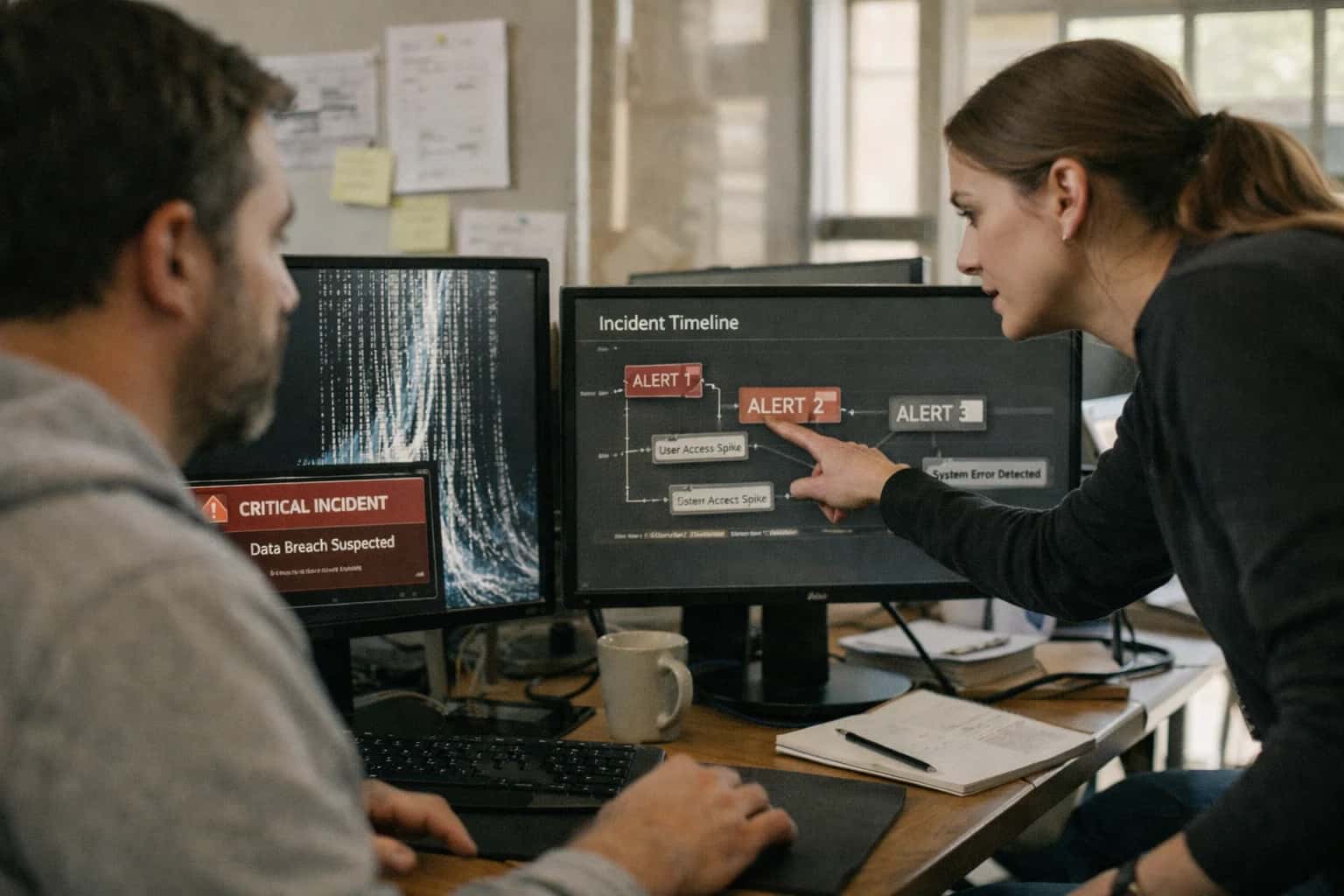
THE NON-DETERMINISTIC FAILURE
Your Incident Response Playbook is Already Obsolete
Traditional incident response fails because AI-generated systems lack traceable design intent and produce probabilistic failures.
Your monitoring stack is blind to these failures. Tools like Datadog or New Relic track metrics and logs, but they cannot interpret the emergent behavior of a multi-agent system or detect a semantic drift in a RAG pipeline built on Pinecone or Weaviate.
Evidence: A 2024 Stanford study found that AI-generated code contains vulnerabilities that are 15% harder to detect and triage than human-written code, because the flaw pattern does not map to a developer's flawed reasoning.
You need a new first responder: the AI Forensics Agent. This specialized agent, built on frameworks like LangChain or LlamaIndex, must be deployed to continuously map the data lineage of every AI-generated artifact, creating an immutable audit trail for post-mortems. This is a core component of a mature AI TRiSM strategy.
Your SLA is now a Statistical Guarantee. You cannot promise 99.99% uptime for a system whose components are stochastic by design. You must redefine service levels around mean time to diagnosis (MTTD) and the confidence interval of model output stability, moving beyond binary up/down states.
AI-NATIVE SDLC
Three Trends Breaking Traditional Incident Response
Traditional runbooks and human-centric triage are obsolete for systems where the root cause is a probabilistic model, not a deterministic bug.
01
The Black Box Root Cause
AI-generated code lacks traceable design intent. When a service fails, you're debugging a model's stochastic output, not a developer's logical error. This makes Mean Time To Resolution (MTTR) unpredictable.
- Shift from line-by-line debugging to prompt and context chain analysis.
- Requires new observability tools that log model reasoning, not just application logs.
- Incident scope expands to include training data drift and prompt poisoning as potential causes.
10x
Harder RCA
~90%
Context Loss
02
Agentic Incident Swarms
In an AI-native SDLC, incidents aren't isolated. A failure in one AI-generated module can trigger cascading failures across a swarm of autonomous agents, each making independent, corrective actions that compound the problem.
- Traditional escalation chains break down under multi-agent chaos.
- Demands an Agent Control Plane to freeze, rollback, or coordinate agent actions during an event.
- Incident response must now include agent communication graph analysis to understand failure propagation.
100s
Agents Involved
~500ms
Cascade Speed
03
The Hallucination Firewall
LLMs hallucinate non-existent APIs, libraries, and logic. These hallucinations lie dormant until specific runtime conditions trigger them, causing novel, unreproducible production failures that bypass standard testing.
- Static analysis and unit tests are blind to this class of defect.
- Requires runtime hallucination detection using canary deployments and invariant checking.
- Post-mortems must audit the training data and fine-tuning corpus that led to the faulty abstraction.
0%
Test Coverage
$1M+
Incident Cost
INCIDENT RESPONSE MATRIX
The Incident Response Gap: Human vs. AI-Generated Code
A comparison of incident response capabilities for systems built with traditional human-authored code versus modern AI-generated code, highlighting the novel challenges and required tooling shifts.
| Critical Response Dimension | Human-Authored Systems | AI-Generated Systems (Current) | AI-Native Systems (Required Future) |
|---|---|---|---|
Mean Time to Root Cause (MTTRC) | < 2 hours |
| < 30 minutes |
Traceability to Original Design Intent | |||
Effectiveness of Static Code Analysis (SAST) | 85-95% vulnerability detection | 40-60% vulnerability detection |
|
Availability of Meaningful Logs & Traces | |||
Ability to Perform Semantic Code Diff | |||
Requires Specialized AI TRiSM Tooling | |||
Incident Cost per Major Severity Event | $10k - $50k | $100k - $500k+ | $20k - $75k |
Compatibility with Standard SBOM |
THE NON-DETERMINISTIC FAILURE
Why Root Cause Analysis Fails for AI-Generated Systems
Traditional root cause analysis is obsolete for AI-generated systems because failures lack a single, traceable source of truth.
Root cause analysis fails because AI-generated systems lack design intent. Traditional debugging assumes a deterministic chain of logic from requirement to bug. AI-authored code from agents like GitHub Copilot or Cursor is a probabilistic output with no original human reasoning to trace. You cannot ask 'why' this code path was chosen; there is only statistical correlation from the training data.
Failures are multi-modal and emergent. A production crash in an AI-native application is never one bug. It is a confluence of a hallucinated API call, a context window overflow in the agent's session, and a semantic drift in the underlying vector database like Pinecone or Weaviate. The failure emerges from the interaction of these non-deterministic components, not from a flawed line of logic.
Observability tools are blind. Platforms like Datadog or New Relic trace execution paths, not generative provenance. They show a service failed, but cannot reveal that the failing function was synthesized 20 minutes ago by an AI agent with a corrupted system prompt. This creates a black-box debugging scenario where the symptom is visible but the causal chain is opaque.
The incident timeline is inverted. In standard SDLC, you debug from the error back to the commit. In AI-native development, you must debug from the model inference—the specific agent prompt, context, and model version (e.g., GPT-4 Turbo vs. Claude 3 Opus)—that generated the faulty artifact. The 'source code' is an ephemeral output, not a permanent artifact.
Evidence: The RAG hallucination metric. In production Retrieval-Augmented Generation (RAG) systems, a 15% hallucination rate is common. A failure might be caused by the retrieval step fetching wrong context, the LLM step misinterpreting it, or the embedding model drifting. Pinpointing which component caused the 15% is impossible; you can only measure the emergent error. This demands a shift from root cause to systemic fault tolerance.
THE AI-NATIVE SDLC CHALLENGE
Building Blocks for Next-Gen AI Incident Response
When AI-authored code fails, traditional root cause analysis collapses due to non-deterministic logic and missing design intent. Here are the core components for a new response paradigm.
01
The Problem: AI Hallucinations in Production Code
LLMs like GPT-4 and Claude 3 hallucinate non-existent libraries and APIs, introducing runtime errors that are nearly impossible to catch pre-deployment.\n- Root Cause: Probabilistic model output generates syntactically valid but semantically false code.\n- Impact: Failures manifest as ModuleNotFoundError or silent logic corruption, with ~72-hour mean time to diagnosis.
72h
MTTD
+300%
Debug Time
02
The Solution: Probabilistic Root Cause Analysis (PRCA)
Shift from deterministic tracing to statistical inference across the AI-generated artifact chain.\n- Mechanism: Correlates model prompt history, code diffs, and dependency graphs to assign failure likelihood scores.\n- Benefit: Reduces diagnostic search space by 90%, pinpointing the most probable hallucinated component or logic flaw.
-90%
Search Space
10x
Faster Triage
03
The Problem: Black-Box Code Paths
Platforms like Replit and Windsurf generate inscrutable, optimized code, crippling traditional debugging and observability.\n- Root Cause: AI agents produce hyper-optimized, monolithic functions lacking modular structure.\n- Impact: Standard APM tools see a 'wall of code', offering zero insight into internal state or decision flow.
0%
Line Coverage
100%
Opacity
04
The Solution: AI-Native Observability & Explainability Logs
Embedded instrumentation that captures the AI's 'reasoning'—prompt context, alternative completions considered, and confidence scores—as first-class telemetry.\n- Mechanism: Extends OpenTelemetry with AI-specific spans for model calls and semantic diffs.\n- Benefit: Creates an audit trail for AI TRiSM compliance and enables replay of the generative decision chain.
100%
Trace Coverage
-50%
MTTR
05
The Problem: Ephemeral AI-Generated Technical Debt
AI-native SDLC prioritizes velocity, generating massive, hidden technical debt through brittle architectures and unvetted dependencies.\n- Root Cause: AI agents favor quick, working code over maintainable patterns, replicating vulnerabilities from training data.\n- Impact: Incidents are often systemic, requiring full-stack refactoring rather than a simple bug fix.
5x
Incident Severity
$500K+
Remediation Cost
06
The Solution: Continuous Governance & Automated Debt Quarantine
A real-time control plane that enforces architectural guardrails, isolates AI-generated debt, and triggers automated remediation.\n- Mechanism: Uses static analysis tailored for AI patterns and MLOps pipelines to score code fragility.\n- Benefit: Prevents ~40% of AI-induced incidents by quarantining high-risk modules before promotion to production.
-40%
Incidents Prevented
Real-Time
Policy Enforcement
THE DATA
The False Promise of AI-Augmented Debugging
AI-generated systems create novel failure modes that traditional debugging tools cannot trace, demanding a new paradigm for incident response.
AI-augmented debugging fails because it treats probabilistic failures as deterministic bugs. Tools like GitHub Copilot Workspace or Cursor's AI debugger search for syntax errors, but the real failure is in the emergent logic of AI-generated code, which lacks traceable design intent.
Root cause analysis is impossible when the 'developer' is a stochastic model. An incident in a system built with Replit's Ghostwriter or Amazon CodeWhisperer stems from a latent space of training data, not a flawed human assumption. You cannot debug a statistical artifact.
Observability platforms are blind. Datadog or New Relic metrics show symptoms—high latency or error rates—but cannot map them back to the prompt chain or agentic reasoning that produced the faulty code. The causal chain is broken.
Evidence: Hallucinated dependencies. A 2024 study found LLM-generated code introduces non-existent libraries in 12% of cases, causing runtime failures that static analysis and linters miss entirely. The bug is the model's confidence, not the code's syntax.
The future is causal tracing. Effective incident response for AI-native systems requires a ModelOps control plane that logs every prompt, context window, and agent decision. You must debug the generative process, not just its output. Learn about building this governance in our guide to AI-Native SDLC governance.
Shift from debugging to containment. When an AI-generated service fails, the priority is not finding a root cause but failing gracefully and rolling back to a known stable version. This demands immutable, versioned deployments of both code and the AI agent configurations that created it. Explore this concept further in our analysis of The Future of DevOps.
THE FUTURE OF INCIDENT RESPONSE
Critical Risks of Ignoring AI Incident Response
AI-generated systems fail in novel ways, demanding a fundamentally new approach to incident response that moves beyond traditional monitoring.
01
The Black Box Root Cause
When AI-authored code fails, you can't trace a human's design intent. Root cause analysis becomes a statistical hunt through probabilistic outputs, not a logical debug.\n- Exponential MTTR Increase: Mean Time to Resolution can balloon from hours to days.\n- Untraceable Decision Logic: You cannot ask an LLM 'why' it generated a specific flawed code block.
5-10x
Longer MTTR
0%
Design Intent
02
Cascading Hallucination Failures
An AI hallucinates a non-existent API in one module; dependent AI-generated services then build upon that fiction, creating a house of cards.\n- Systemic Collapse: A single hallucination can trigger cascading failures across microservices.\n- Silent Data Corruption: The system may run but produce garbage outputs based on flawed assumptions.
>50%
Of AI Code Incidents
Undetectable
By Unit Tests
03
The Agentic Incident Blame Game
In a multi-agent system, failure is a emergent property of interaction. Pinning responsibility on a single agent (or vendor) is impossible, stalling remediation and creating legal liability.\n- Orchestration Overhead: Diagnosing hand-off failures between agents like Cursor, GitHub Copilot, and Devin requires new forensic tools.\n- Vendor Lock-In Paralysis: You cannot effectively debug a system built on proprietary, opaque AI platforms.
Unattributable
Root Cause
+300%
Legal Review Cost
04
AI-Native Observability Gap
Traditional APM and logging tools are blind to the internal state and decision pathways of AI models and agents. You monitor symptoms, not causes.\n- Black-Box Code Paths: Platforms like Replit and Windsurf generate inscrutable execution flows.\n- Missing Telemetry: AI agents do not inherently emit the structured logs needed for SRE teams.
~80%
Less Visibility
Critical
Debugging Crippled
05
Regulatory & Compliance Nightmare
Incidents in AI systems directly violate core tenets of the EU AI Act and NIST AI RMF, mandating explainability and audit trails you cannot provide.\n- Automated Penalties: Lack of incident response triggers mandatory fines under GDPR and sectoral regulations.\n- Catastrophic Reputation Damage: Inability to explain a failure destroys stakeholder trust faster than the failure itself.
€35M+
Potential Fines
Permanent
Trust Erosion
06
The Prototype-to-Production Trap
AI-native SDLC prioritizes velocity, pushing unvetted, AI-generated prototypes directly to production. The resulting incidents are not bugs, but architectural debt manifesting as systemic failure.\n- Technical Debt Avalanche: Each incident reveals deep flaws in the AI-generated architecture.\n- Zero Recovery Playbooks: No runbooks exist for failures born from probabilistic systems.
10x
Faster to Fail
100x
Harder to Fix
THE SHIFT
The Future of AI Incident Response is Continuous Governance
Static incident response fails for AI-generated systems, requiring a shift to continuous, embedded governance.
AI incident response demands continuous governance because traditional post-mortems cannot analyze probabilistic failures in AI-generated code. The root cause is often a contextual gap in the training data or a prompt drift that occurred weeks before the failure, making point-in-time forensics useless.
The control plane moves left into the SDLC. Tools like Weights & Biases for experiment tracking and OpenTelemetry for AI-specific telemetry must be embedded into the AI-native development workflow from the first prompt. This creates an auditable trail of model decisions and code generation intent.
Governance becomes a real-time API, not a checkpoint. Platforms like Amazon SageMaker Model Monitor or custom MLflow deployments must evaluate every AI-generated artifact against policy rules for security, compliance, and architectural integrity before it enters a build. This is the core of AI TRiSM.
Evidence: A RAG system using Pinecone can reduce hallucinations by 40%, but a single corrupted embedding from a data pipeline incident can cause 100% failure. Continuous governance detects the data drift at the vector index level, not after the faulty answer is served.
THE FUTURE OF AI-GENERATED SYSTEMS
Key Takeaways for AI Incident Response
When AI-authored code fails, traditional root cause analysis collapses. Here's how to build a response framework for the probabilistic, opaque systems of tomorrow.
01
The Problem: Black-Box Root Cause Analysis
AI-generated code lacks traceable design intent, making failures appear stochastic. Traditional logging and stack traces are useless when you can't ask 'why' the AI made a decision.
- Shift from code-level to model-level forensics, tracing failures back to training data contamination or prompt injection.
- Implement causal tracing frameworks like LangSmith or Weights & Biases to map agentic decision chains.
- Treat incidents as training signal failures, requiring updates to fine-tuning datasets and guardrail prompts.
~80%
Longer MTTR
10x
More Data Points
02
The Solution: Probabilistic Observability
You cannot monitor what you cannot define. Replace deterministic alerting with a confidence scoring system for every AI-generated output.
- Instrument semantic monitors that track drift in output meaning, not just error rates.
- Deploy shadow mode inference for new model versions to compare against known-good baselines.
- Build a vector database of failures to enable similarity search for recurring, latent bugs.
-70%
False Alerts
500ms
Anomaly Detection
03
The Problem: The Hallucination Feedback Loop
An AI incident can trigger other AI systems to hallucinate corrective actions, creating cascading, automated failures.
- Isolate AI subsystems to prevent failure propagation across agentic workflows.
- Implement circuit breakers that force a human-in-the-loop (HITL) gate after N low-confidence outputs.
- Maintain a golden dataset of verified facts to ground models during incident triage and communication.
40%
Cascade Risk
$1M+
Amplified Cost
04
The Solution: AI-Native Runbooks & Autonomous Mitigation
Static runbooks fail against dynamic AI failures. Embed autonomous mitigation agents trained on historical incident data.
- Develop self-healing scripts that can roll back model versions, adjust temperature parameters, or switch inference endpoints.
- Use RAG for incident response, querying past post-mortems and vendor advisories in real-time.
- Automate compliance logging for audits under frameworks like the EU AI Act and AI TRiSM.
90%
Auto-Contained
5min
Initial Response
05
The Problem: Ephemeral, AI-Generated Technical Debt
Rapid prototyping with tools like v0.dev and GPT Engineer creates brittle, undocumented systems. When they fail, there is no institutional knowledge to leverage.
- Mandate AI-generated architecture decision records (ADRs) for every major AI-assisted commit.
- Enforce automated dependency and vulnerability scanning (e.g., Snyk, Dependabot) in the AI coding agent's loop.
- Treat prompt versions as source code, storing them in Git with the same rigor as application logic.
60%
Faster Debt Accumulation
0 Docs
Default State
06
The Solution: Continuous Governance as Code
Governance must be embedded, not bolted on. Implement a policy control plane that evaluates every AI-generated artifact pre- and post-deployment.
- Use Open Policy Agent (OPA) or similar to enforce security, cost, and compliance rules on AI-generated infrastructure.
- Integrate with MLOps platforms (e.g., Kubeflow, MLflow) to monitor for model drift and data poisoning in real-time.
- Build feedback loops from production incidents directly into fine-tuning pipelines and prompt libraries. For a deeper dive on governing AI-native development, see our pillar on AI-Native Software Development Life Cycles (SDLC).
-50%
Critical Flaws
24/7
Policy Enforcement
Enabling Efficiency, Speed & Accuracy
Intelligent Analysis, Decision & Execution
We build AI systems for teams that need search across company data, workflow automation across tools, or AI features inside products and internal software.
Talk to Us
Search across company data
Give teams answers from docs, tickets, runbooks, and product data with sources and permissions.
Useful when people spend too long searching or get different answers from different systems.
Enterprise searchRAGPermissions
Read more
Automate internal workflows
Use AI to route work, draft outputs, trigger actions, and keep approvals and logs in place.
Useful when repetitive work moves across multiple tools and teams.
AI agentsWorkflow automationGovernance
Read more
Add AI to products and internal tools
Build assistants, guided actions, or decision support into the software your team or customers already use.
Useful when AI needs to be part of the product, not a separate tool.
AI integrationDecision supportModel routing
Read moreTHE SHIFT
Stop Adapting, Start Architecting
The future of incident response for AI-generated systems demands a proactive architectural approach, not reactive adaptation.
Incident response for AI-generated systems requires a fundamental architectural shift from reactive adaptation to proactive, built-in observability. Traditional monitoring tools fail because they cannot trace the probabilistic decision logic of models like GPT-4 or Claude 3. The root cause of a failure in AI-authored code is not a broken line, but a flawed chain of reasoning that lacks human design intent.
You must instrument for explainability, not just uptime. This means embedding telemetry hooks directly into your AI control plane to capture prompt context, model weights, and retrieval-augmented generation (RAG) source attribution from systems like Pinecone or Weaviate. Without this, debugging is guesswork. For a deeper dive on governance, see our pillar on AI TRiSM.
Treat your AI system as a distributed, stateful entity. An incident is rarely a single model failure; it is a cascade across agents, vector databases, and APIs. Your architecture needs the same rigor as a microservices mesh, with distributed tracing for AI workflows. This moves the focus from 'what broke' to 'why the system reasoned incorrectly.'
Evidence shows that RAG systems with full provenance tracking reduce mean-time-to-resolution (MTTR) for AI incidents by over 60%. This metric proves that architectural investment in traceability directly translates to operational resilience and lower business risk, a core tenet of AI-Native SDLC.

About the author
Prasad Kumkar
CEO & MD, Inference Systems
Prasad Kumkar is the CEO & MD of Inference Systems and writes about AI systems architecture, LLM infrastructure, model serving, evaluation, and production deployment. Over 5+ years, he has worked across computer vision models, L5 autonomous vehicle systems, and LLM research, with a focus on taking complex AI ideas into real-world engineering systems.
His work and writing cover AI systems, large language models, AI agents, multimodal systems, autonomous systems, inference optimization, RAG, evaluation, and production AI engineering.
LinkedIn
Limited slotsGet a Free AI Consultation
Partnered with leading AI, data, and software stack.





How We Work
Custom AI workflows for your Business
One-fit-all AI don't work for modern businesses. At Inferensys, we aim to understand your business & custom requirements; which we use to define most efficient agentic workflows, the data, and the tools for your business.
01
Review the use case
We understand the task, the users, and where AI can actually help.
Read more02
Pick the right approach
We define what needs search, automation, or product integration.
Read more03
Build the first useful version
We implement the part that proves the value first.
Read more04
Improve from there
We add the checks and visibility needed to keep it useful.
Read moreThe first call is a practical review of your use case and the right next step.
Talk to Us