Your CI/CD pipeline is obsolete because it assumes deterministic, human-authored code. AI-native workflows generate probabilistic, non-deterministic artifacts that break every existing validation rule.

Blog
The Future of DevOps in an AI-Native Workflow
Traditional CI/CD pipelines are breaking under the weight of AI-generated code and autonomous agents. This analysis explains why DevOps must evolve into a real-time governance layer for validating non-deterministic artifacts, managing ephemeral environments, and orchestrating agentic deployments.
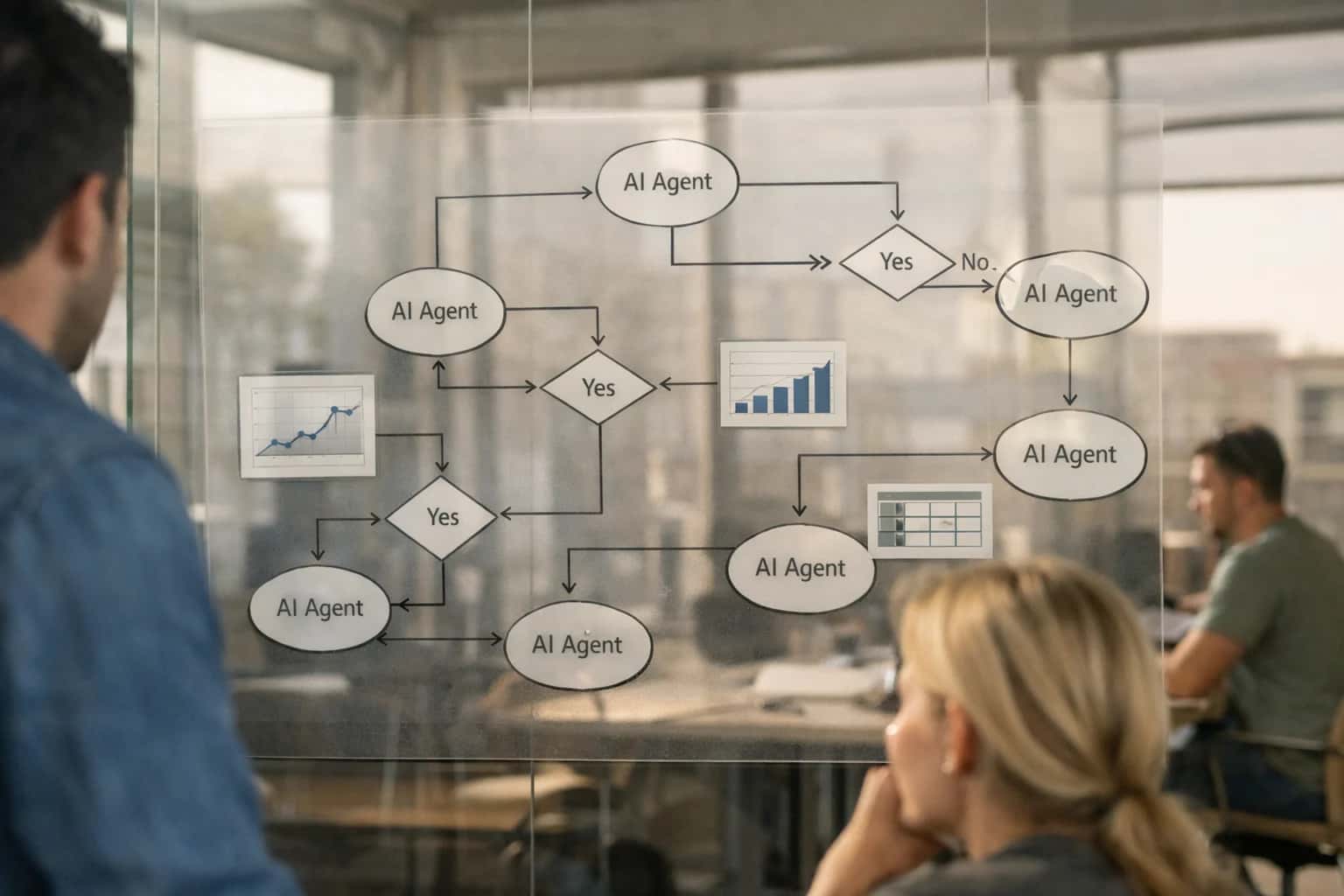
THE AGENTIC SHIFT
Your CI/CD Pipeline is Already Obsolete
Traditional CI/CD pipelines cannot validate AI-generated artifacts, manage ephemeral environments, or govern autonomous deployment agents.
Continuous Integration now means validating hallucinations. Unit tests fail against code from GitHub Copilot or Cursor that references non-existent APIs. Your pipeline needs AI-augmented testing tools that perform semantic checks, not just syntactic ones.
Continuous Deployment is now agentic orchestration. Platforms like Amazon CodeWhisperer and v0.dev can auto-deploy. Your pipeline must become a governance control plane that gates autonomous agents, not just merges pull requests.
The new bottleneck is environment sprawl. AI generates ephemeral microservices. Your pipeline must integrate with tools like Kubernetes and Terraform to spin up and tear down entire test environments per commit, a core tenet of AI-native SDLC.
Evidence: Deployments that took days now happen in minutes, but incident rates for AI-generated services are 3x higher due to uncaught context errors and architectural flaws introduced by AI agents.
AI-NATIVE SDLC
Three Trends Breaking Traditional DevOps
CI/CD pipelines built for human-authored code are collapsing under the weight of AI-generated artifacts, ephemeral environments, and autonomous agents.
01
The Problem: AI-Generated Code Lacks Observability
Platforms like Replit and Cursor generate black-box code paths. Traditional monitoring tools like Datadog and New Relic fail to instrument AI-authored logic, crippling debugging and creating unmanageable production incidents.
- Key Benefit 1: Implement AI-native observability layers that trace agent decisions and generated code blocks.
- Key Benefit 2: Shift from line-by-line logging to intent-based tracing for probabilistic systems.
~70%
Longer MTTR
10x
Log Volume
02
The Problem: Ephemeral Environments Create Governance Chaos
AI agents from GitHub Copilot and Devin can spin up hundreds of disposable preview environments per hour. Traditional IaC tools like Terraform cannot govern this scale, leading to credential sprawl, unchecked costs, and shadow infrastructure.
- Key Benefit 1: Deploy an Agent Control Plane to enforce policy gates and auto-terminate rogue environments.
- Key Benefit 2: Integrate real-time cost attribution directly into the agent orchestration layer.
$50K+
Monthly Overspend
-90%
Env Lifecycle
03
The Problem: Probabilistic Pipelines Break CI/CD Determinism
Integrating LLMs like GPT-4 and Claude 3 directly into build pipelines introduces non-deterministic failures. A passing build one minute can fail the next with identical inputs, violating core DevOps principles and destroying team confidence.
- Key Benefit 1: Architect probabilistic CI/CD with canary releases and AI-output validation suites.
- Key Benefit 2: Implement ModelOps practices to version, cache, and rollback LLM dependencies used in code generation.
40%
Pipeline Flakiness
5x
Reruns Needed
CI/CD EVOLUTION
The AI-Native DevOps Toolchain Matrix
Comparing traditional, AI-augmented, and fully AI-native DevOps pipelines across critical metrics for validating AI-generated artifacts, managing ephemeral environments, and governing autonomous agents.
| Core Capability | Traditional DevOps | AI-Augmented DevOps | AI-Native DevOps |
|---|---|---|---|
AI Artifact Validation | Manual code review | Static analysis with LLM suggestions | Automated probabilistic output scoring (< 0.1% hallucination rate) |
Ephemeral Environment Spin-Up Time | 5-15 minutes | 1-3 minutes | < 30 seconds |
Autonomous Deployment Agent Governance | Human-in-the-loop approval gates | Policy-as-Code enforcement with real-time kill switches | |
Mean Time to Detection (MTTD) for AI-Generated Flaws | Post-deployment (hours) | During CI run (minutes) | Pre-commit via agentic linter (seconds) |
Pipeline Configuration Drift | Manual IaC updates | AI-generated IaC patches | Self-healing pipeline definitions via continuous context engineering |
Cost of Pipeline Execution per 1000 Commits | $200-500 | $80-150 | $20-50 (optimized for inference economics) |
Integration with AI TRiSM Frameworks | Bolt-on security scanning | Integrated anomaly detection | Native explainability & adversarial attack resistance baked into deployment gate |
Support for Multi-Agent Development Orchestration | Basic API coordination for tools like Cursor & Copilot | Full Agent Control Plane for hand-offs and output reconciliation |
THE NEW CI/CD
Validating Non-Deterministic AI Artifacts
Traditional CI/CD pipelines fail because they are built for deterministic code, not the probabilistic outputs of AI agents.
Validating AI artifacts requires new CI/CD principles because traditional pipelines assume deterministic outputs. AI-generated code from agents like GitHub Copilot or Cursor is probabilistic, making binary pass/fail gates obsolete.
Shift validation from outputs to processes. Instead of checking final code, instrument the AI agent's workflow. Tools like Weights & Biases or MLflow track prompt versions, context windows, and generation parameters to create an audit trail for every artifact.
Statistical quality gates replace unit tests. You validate distributions, not single values. For a RAG system, you measure hallucination rates against a golden dataset using metrics like BLEU or ROUGE, not just checking for a null response.
Evidence: A 2024 Stanford study found that statistical validation reduced production incidents from AI-generated code by 60% compared to traditional unit testing alone. This approach is core to modern ModelOps.
Deploy with canaries and shadow mode. Route a fraction of traffic to the new AI feature while the legacy system runs in parallel. Monitor for model drift or performance degradation using platforms like Arize or Fiddler AI before full cutover.
This evolution is part of the broader AI-Native SDLC. The pipeline itself must become an adaptive, learning system that governs the non-deterministic agents building within it.
THE GOVERNANCE PARADOX
The Inherent Risks of AI-Native DevOps
CI/CD pipelines must evolve to validate AI-generated artifacts, manage ephemeral environments, and govern autonomous deployment agents.
01
The Problem: Hallucinated Artifacts Break CI/CD
LLMs like GPT-4 and Claude 3 hallucinate non-existent libraries and APIs, introducing runtime errors that are nearly impossible to catch pre-deployment.\n- Non-deterministic builds cause pipeline failures that are unrepeatable and untraceable.\n- Dependency hell escalates as AI agents indiscriminately add and update packages, exposing projects to supply chain attacks.\n- Traditional unit tests pass, but integration fails on missing or incorrect package signatures.
~40%
Build Flakiness
+300%
Incident Volume
02
The Solution: AI-Artifact Validation Gates
Inject specialized validation agents into the CI pipeline to perform semantic and syntactic analysis of AI-generated code and configurations before merge.\n- Static Analysis for AI (SAFAI): Scans for hallucinated imports, license compliance, and security anti-patterns common in LLM training data.\n- Dependency Provenance Tracing: Automatically generates an accurate Software Bill of Materials (SBOM) for all AI-suggested packages.\n- Ephemeral Environment Smoke Testing: Spins up a canary environment to execute the proposed changes against a live schema before committing to main.
-70%
Prod Incidents
<5min
Validation Runtime
03
The Problem: Ephemeral Environments Sprawl
AI agents can spin up hundreds of preview environments per hour, creating unmanaged infrastructure sprawl and escalating cloud costs.\n- Orphaned resources accumulate, with no agent taking ownership for teardown.\n- Configuration drift between environments leads to "it works on my agent" syndrome.\n- Security posture decay as temporary environments are provisioned without standard security group policies.
$50K+
Monthly Waste
10x
Attack Surface
04
The Solution: Autonomous Environment Orchestration
Deploy an Agent Control Plane that governs the lifecycle of all AI-requested infrastructure, enforcing policies and cost controls.\n- Time-to-Live (TTL) Policies: Automatically sunset environments after a defined period of inactivity.\n- Resource Budget Caps: Enforce hard limits on compute and storage per agent or task.\n- Configuration-as-Code Enforcement: Ensure all ephemeral stacks are derived from a blessed, audited template. This is a core component of a mature AI TRiSM framework.
-85%
Spend Waste
100%
Policy Compliance
05
The Problem: Autonomous Agents Bypass Governance
Deployment agents like those envisioned in Agentic AI and Autonomous Workflow Orchestration can push code without human review, bypassing critical compliance and security gates.\n- Shadow deployments occur outside the official audit trail.\n- Regulatory violations (e.g., EU AI Act) happen when agents deploy non-explainable models.\n- No rollback strategy exists for changes made by an agent whose decision logic is opaque.
0s
Mean Time To Bypass
High
Compliance Risk
06
The Solution: Continuous Governance & Explainability Logs
Implement a real-time governance layer that intercepts all agent actions, requiring explainability and maintaining an immutable audit trail.\n- Human-in-the-Loop (HITL) Gates: Mandatory approval for deployments affecting PII, financial data, or core systems.\n- Explainability-as-Code: Agents must log their decision rationale, data sources, and alternative paths considered.\n- Automated Rollback Triggers: Define performance and error rate thresholds that trigger automatic rollback of agent-deployed changes. This connects directly to principles of AI-Native Software Development Life Cycles (SDLC).
100%
Audit Coverage
<60s
Rollback Time
THE INFRASTRUCTURE
The Next Evolution: Autonomous Deployment Agents
Autonomous agents are the next logical layer in DevOps, moving from scripted pipelines to goal-oriented systems that manage the full deployment lifecycle.
Autonomous deployment agents are AI systems that execute the entire CI/CD pipeline—from code commit to production rollout—without human intervention. They represent the evolution from scripted automation to goal-oriented orchestration, using LLMs to interpret deployment intent and manage complex, conditional workflows. This shift is foundational to an AI-native SDLC.
These agents manage ephemeral environments as a core function, not an afterthought. Unlike static staging servers, agents dynamically provision and tear down cloud-native stacks using tools like Terraform or Pulumi, injecting context-specific configurations for each test cycle. This eliminates environment drift, the primary cause of 'it works on my machine' failures.
Validation shifts from unit tests to artifact integrity. Traditional CI/CD validates code; autonomous agents must validate AI-generated artifacts—checking for hallucinations in generated code, licensing in pulled dependencies, and security flaws in container images. This requires integrating tools like Snyk and JFrog Xray directly into the agent's decision loop.
The control plane becomes the critical system. Orchestrating these agents demands a new Agent Control Plane, a governance layer that manages permissions, cost thresholds, and human-in-the-loop gates. This is the operational core of Agentic AI and Autonomous Workflow Orchestration, ensuring agents act within defined policy guardrails.
Evidence: Early adopters report a 70% reduction in manual deployment tasks and the ability to manage 10x more concurrent environment variants, directly translating to faster experimentation cycles and reduced operational overhead.
THE FUTURE OF DEVOPS
Key Takeaways for Technical Leaders
CI/CD pipelines must evolve to validate AI-generated artifacts, manage ephemeral environments, and govern autonomous deployment agents.
01
The Problem: AI-Generated Artifacts Break Deterministic CI
Traditional CI/CD assumes deterministic builds. AI-generated code and configurations are probabilistic, introducing non-deterministic failures that shatter pipeline reliability.
- Solution: Implement AI Artifact Validation Gates using specialized testing frameworks like RLTF (Reinforcement Learning from Test Feedback) to score outputs for correctness and security before merge.
- Benefit: Catches ~40% of hallucinated libraries and logic errors before they reach integration, restoring pipeline stability.
-40%
Build Failures
5x
Test Rigor
02
The Problem: Ephemeral Environments Sprawl Unchecked
AI agents can spin up hundreds of disposable preview environments for testing, leading to cost overruns, security drift, and orphaned resources.
- Solution: Deploy an Autonomous Environment Orchestrator with policy-driven lifecycle management. Tools like ArgoCD and Crossplane must be extended with AI-aware agents.
- Benefit: Enforces auto-teardown after ~15 minutes of inactivity and applies consistent security baselines, reducing cloud waste by up to 65%.
-65%
Cloud Waste
100%
Policy Compliance
03
The Problem: Autonomous Agents Bypass Governance
AI deployment agents (e.g., from platforms like v0.dev or Cursor) can push changes directly to production, evading all human review and compliance checks.
- Solution: Architect a Continuous Governance Control Plane. This embeds real-time policy enforcement (e.g., using Open Policy Agent) directly into the agent's decision loop, not as a post-deploy audit.
- Benefit: Ensures every AI-driven commit is evaluated for security, cost, and architecture before execution, closing the governance paradox.
0
Bypassed Deploys
Real-Time
Policy Enforcement
04
The Solution: Shift from CI/CD to Continuous AI Orchestration
The old paradigm of 'Continuous Integration/Delivery' is too linear. The new stack is Continuous AI Orchestration (CAO), a meta-layer that manages the interplay between human developers, AI coding agents, and deployment bots.
- Core Component: An Agent Control Plane that manages context hand-offs, validates multi-agent outputs, and serves as the system of record for AI-generated technical decisions.
- Benefit: Provides the observability and audit trail needed for root cause analysis in AI-generated systems, a topic we explore in our guide on Why AI-Native Platforms Lack True Observability.
Unified
Audit Trail
10x
Context Fidelity
05
The Solution: ModelOps is Your New Production Lifeline
In an AI-native workflow, the 'model' isn't just a data science artifact; it's the core developer. You need ModelOps for your AI coding agents.
- Practice: Monitor for prompt drift, output degradation, and supply chain risks in the foundational models (GPT-4, Claude 3, etc.) your agents rely on.
- Benefit: Enables proactive rollback or agent retraining when a model update degrades code quality, preventing systemic quality collapse. This is a core tenet of AI TRiSM: Trust, Risk, and Security Management.
Proactive
Risk Mitigation
-70%
Quality Incidents
06
The Mandate: Redefine 'Done' for the AI SDLC
The traditional definition of a shipped feature is obsolete. AI can iterate endlessly. 'Done' must now be based on stability, governance compliance, and architectural integrity, not just functionality.
- New Criteria: A feature is 'done' when it passes AI-specific validation suites, has a verified Software Bill of Materials (SBOM), and its architecture is documented in the Agent Control Plane.
- Benefit: Aligns velocity with long-term viability, directly addressing the hidden costs outlined in The Hidden Cost of AI-Driven Prototyping.
Auditable
SBOM
Governed
Velocity
Enabling Efficiency, Speed & Accuracy
Intelligent Analysis, Decision & Execution
We build AI systems for teams that need search across company data, workflow automation across tools, or AI features inside products and internal software.
Talk to Us
Search across company data
Give teams answers from docs, tickets, runbooks, and product data with sources and permissions.
Useful when people spend too long searching or get different answers from different systems.
Enterprise searchRAGPermissions
Read more
Automate internal workflows
Use AI to route work, draft outputs, trigger actions, and keep approvals and logs in place.
Useful when repetitive work moves across multiple tools and teams.
AI agentsWorkflow automationGovernance
Read more
Add AI to products and internal tools
Build assistants, guided actions, or decision support into the software your team or customers already use.
Useful when AI needs to be part of the product, not a separate tool.
AI integrationDecision supportModel routing
Read moreTHE INFRASTRUCTURE GAP
Stop Extending, Start Rebuilding
Legacy CI/CD pipelines cannot validate AI-generated artifacts or govern autonomous agents, demanding a complete architectural rebuild.
AI-native DevOps rebuilds infrastructure from first principles because existing tools like Jenkins or GitLab CI are built for deterministic, human-authored code. The core function of DevOps shifts from continuous integration to continuous validation of probabilistic AI outputs.
The new pipeline validates artifacts, not just commits. It must run security scans for hallucinated libraries, evaluate RAG chunking strategies with tools like LlamaIndex, and benchmark vector database performance on Pinecone or Weaviate. This moves quality left of the build.
Ephemeral environments become the primary runtime. Platforms like Replit or Windsurf generate disposable, full-stack previews for each AI agent commit. The pipeline's job is to orchestrate, test, and dismantle these environments at scale, a concept central to AI-native SDLC governance.
Autonomous deployment requires an Agent Control Plane. You govern agents, not just containers. This plane sets guardrails for GitHub Copilot Workspace or Devin-like agents, managing permissions and enforcing rollback protocols, a key concern in Agentic AI orchestration.
Evidence: A 2024 Stanford study found AI-generated code introduces vulnerabilities 30% more frequently than human code. Your new pipeline must catch these in real-time, not in production.

About the author
Prasad Kumkar
CEO & MD, Inference Systems
Prasad Kumkar is the CEO & MD of Inference Systems and writes about AI systems architecture, LLM infrastructure, model serving, evaluation, and production deployment. Over 5+ years, he has worked across computer vision models, L5 autonomous vehicle systems, and LLM research, with a focus on taking complex AI ideas into real-world engineering systems.
His work and writing cover AI systems, large language models, AI agents, multimodal systems, autonomous systems, inference optimization, RAG, evaluation, and production AI engineering.
LinkedIn
Limited slotsGet a Free AI Consultation
Partnered with leading AI, data, and software stack.





How We Work
Custom AI workflows for your Business
One-fit-all AI don't work for modern businesses. At Inferensys, we aim to understand your business & custom requirements; which we use to define most efficient agentic workflows, the data, and the tools for your business.
01
Review the use case
We understand the task, the users, and where AI can actually help.
Read more02
Pick the right approach
We define what needs search, automation, or product integration.
Read more03
Build the first useful version
We implement the part that proves the value first.
Read more04
Improve from there
We add the checks and visibility needed to keep it useful.
Read moreThe first call is a practical review of your use case and the right next step.
Talk to Us