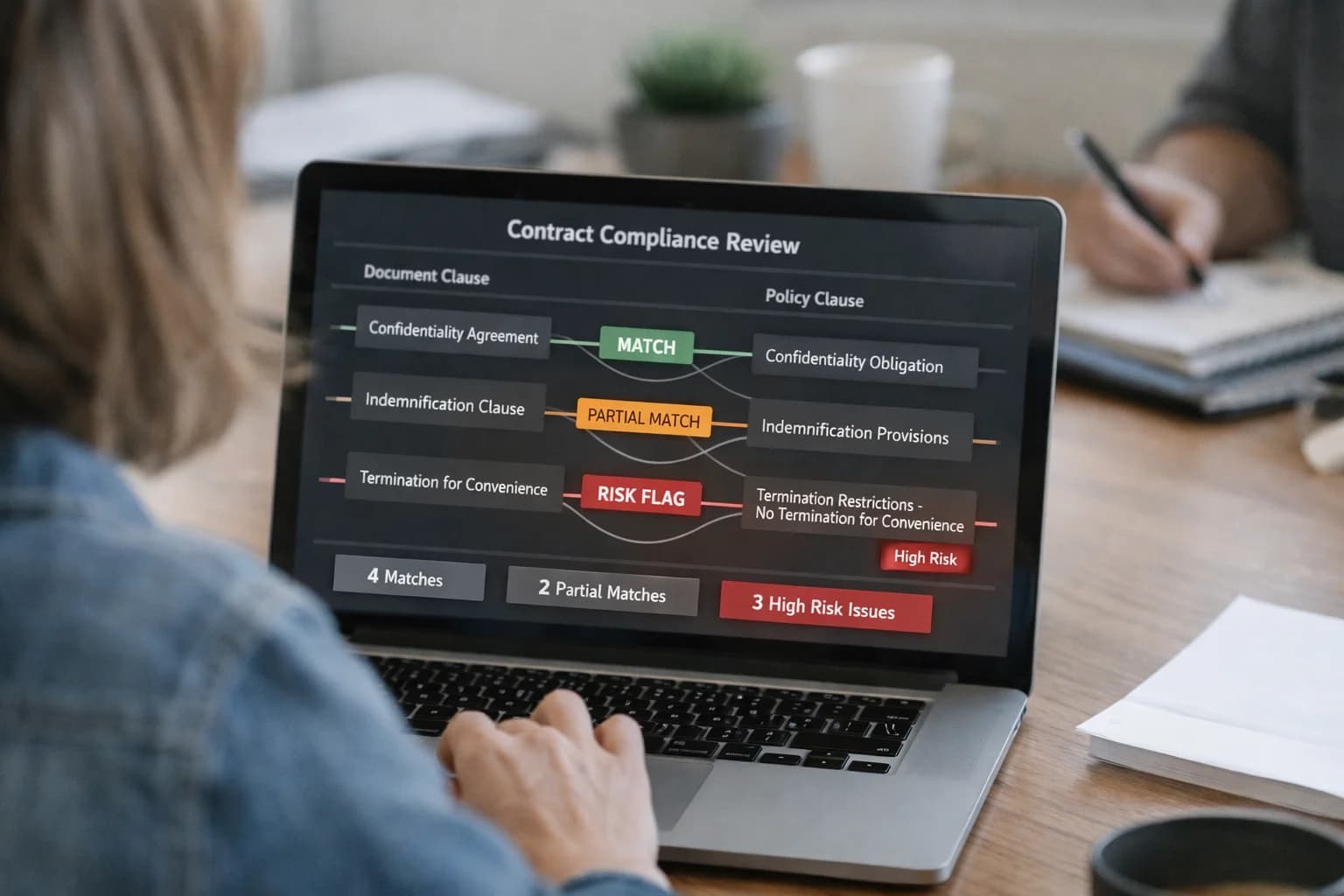
Automated policy checks instantly cross-reference RFP requirements against thousands of regulatory clauses, enabling firms to bid with confidence and avoid costly compliance failures. This is the core function of vertical AI agents for legal tech.

Blog
Architecture review before implementation
Implementation scope and rollout planning
Clear next-step recommendation
Manual compliance review in government contracting is a massive, inefficient tax on businesses, which AI-powered automated policy checks eliminate.
Automated policy checks instantly cross-reference RFP requirements against thousands of regulatory clauses, enabling firms to bid with confidence and avoid costly compliance failures. This is the core function of vertical AI agents for legal tech.
The $700 billion figure represents the annual global cost of manual compliance labor and the revenue lost to abandoned bids due to risk uncertainty. AI systems built on semantic search engines like Pinecone or Weaviate slash this cost by automating document analysis.
Static rule engines are obsolete. SQL-based queries cannot interpret the nuanced language of the Federal Acquisition Regulation (FAR). Modern systems use fine-tuned transformer models to understand intent and context, moving beyond keyword matching.
Evidence: A 2023 Deloitte study found that AI-driven compliance review reduces the time to prepare a compliant government bid by 70%, directly translating to a 15-20% increase in bid submission volume for qualified firms.
The strategic shift is from reactive checking to proactive risk modeling. AI doesn't just flag non-compliance; it predicts how contract language could create future liability, a function of advanced knowledge engineering.
Implementation requires a new stack. Legacy systems lack the API-first architecture for integration. Success depends on an agentic workflow where specialized AI agents for research, clause extraction, and validation collaborate, a concept explored in our Agentic AI pillar.
Automated policy checks are not just about speed; they are a fundamental re-architecture of compliance, built on new data and AI paradigms.
Legacy compliance systems rely on brittle SQL rules and keyword matching, which cannot adapt to novel money laundering patterns or complex regulatory changes. This creates a false positive factory, overwhelming analysts with alerts while missing sophisticated threats.
A fully instrumented AI system provides an immutable, queryable audit trail of every decision, satisfying regulators and shifting the burden of proof from manual sampling. This is the core of AI TRiSM—explainable, auditable, and governed AI.
Fragmented data across legacy CLM, CRM, and financial systems prevents AI models from achieving a unified risk profile. Automated policy checks fail without a semantic data layer that connects obligations, entities, and transactions.
Single-model systems are insufficient for complex policy analysis. Agentic AI frameworks enable specialized agents for research, clause extraction, and risk scoring to collaborate, automating end-to-end due diligence.
Black-box models fail EU AI Act and bar compliance requirements. For government contracting, agencies and auditors demand transparency into why a bid was flagged or approved.
While automating RFP review saves ~500 analyst hours per major bid, the strategic value is in identifying non-standard clauses that create existential liability. This shifts the value proposition from cost reduction to enterprise risk management.
AI-powered verification systems are replacing manual review, enabling real-time compliance for government contracts.
Automated policy checks will reshape government contracting by replacing slow, error-prone manual review with instantaneous, autonomous verification against live regulatory databases. This shift eliminates compliance guesswork and allows firms to bid with confidence.
The core technology is RAG, but specialized for legal reasoning. Systems built on frameworks like LangChain or LlamaIndex ingest thousands of RFP clauses and regulatory documents into vector databases like Pinecone or Weaviate. This creates a semantic search foundation that cross-references requirements in milliseconds, not weeks.
Static rule engines are obsolete. Legacy SQL-based systems fail because regulations constantly evolve. Modern systems use continuous learning pipelines that ingest new rulings and legislation, dynamically updating risk models without manual intervention, a concept central to AI TRiSM.
The ROI is in risk avoidance, not just efficiency. While automation saves hours, the strategic value is identifying non-standard clauses that create existential liability. This requires moving beyond simple content generation to knowledge amplification, a key principle of our Retrieval-Augmented Generation (RAG) and Knowledge Engineering pillar.
Evidence: Early adopters report a 70% reduction in manual review time and a 40% decrease in compliance-related bid disqualifications. The future of procurement is AI-native verification, where compliance is a continuous, auditable process, not a final gate.
Quantitative comparison of traditional manual review versus AI-powered automated systems for RFP and regulatory compliance analysis.
| Key Performance Metric | Manual Human Review | AI-Powered Automated Check | Strategic Implication |
|---|---|---|---|
Average Time per RFP Analysis | 40-120 hours | < 5 minutes | Bid preparation cycles shrink from weeks to hours. |
Regulatory Corpus Coverage | 100-500 clauses (practitioner-dependent) | 10,000+ clauses (entire CFR/DFARS) | Eliminates blind spots from incomplete manual research. |
Consistency of Review | 0.65 (Inter-rater Reliability Score) | 1.0 (Deterministic Output) | Removes subjective interpretation and reviewer fatigue. |
Cost per Compliance Check | $2,500 - $7,500 (billable hours) | $50 - $200 (compute cost) | Transforms compliance from a high-cost barrier to a scalable utility. |
Error Rate (Missed Critical Clauses) | 5-15% (industry audit data) | < 0.5% (validated on test suites) | Directly reduces risk of bid disqualification and contractual penalties. |
Audit Trail Completeness | Partial (email, notes) | Complete (immutable, queryable log) | Provides defensible evidence for proposal audits and regulatory inquiries. |
Adaptation to Regulatory Change | Weeks (manual research & training) | Real-time (continuous pre-training pipeline) | Ensures bids are always aligned with the latest FAR amendments and agency supplements. |
Integration with CLM & ERP Systems | Enables automated obligation tracking and risk scoring within existing procurement workflows. |
Automated policy checks are not chatbots; they are deterministic systems built on a specialized stack for parsing, reasoning, and validating regulatory text.
Automated policy checks are deterministic systems that cross-reference a Request for Proposal (RFP) against thousands of regulatory clauses to ensure compliance before a bid is submitted. This eliminates the manual review bottleneck and the catastrophic risk of non-compliant proposals.
The foundation is a semantic data layer built on vector databases like Pinecone or Weaviate. This layer ingests and indexes all relevant policy documents—FAR, DFARS, agency supplements—transforming unstructured text into queryable knowledge. Without this, an AI system lacks the necessary context for accurate validation, a core principle of Knowledge Amplification.
Retrieval-Augmented Generation (RAG) is insufficient alone. A naive RAG pipeline using LangChain can retrieve relevant text but fails at the logical reasoning required to determine if a clause satisfies a complex RFP requirement. The system needs a specialized reasoning agent that applies formal logic to the retrieved evidence.
The critical component is a validation engine. This engine, often built using frameworks like Haystack, executes a series of checks: it parses the RFP's Statement of Work, extracts mandatory compliance points, and matches them against the indexed regulatory corpus. It then generates a definitive pass/fail report with citations, not just a summary.
This architecture enables continuous compliance. Unlike static rule engines, these AI systems integrate with continuous learning pipelines to ingest new policy updates, ensuring the validation logic never drifts out of date with the latest regulatory changes.
Automated policy checks promise efficiency but introduce new classes of strategic, technical, and regulatory risk that can derail government bids.
Overly conservative AI models flag minor deviations as critical failures, creating alert fatigue and causing teams to miss genuine disqualifying clauses. This paradox undermines the core value proposition of automation.
Using general-purpose LLMs for compliance creates an unexplainable decision trail. When a bid is challenged, you cannot defend why a clause was approved or rejected, failing EU AI Act and FAR transparency mandates.
Compliance is a moving target. A model trained on last year's FAR clauses will silently fail as policies evolve, creating undetected liability. Traditional MLOps does not monitor for semantic regulatory shift.
Processing sensitive Controlled Unclassified Information (CUI) on third-party AI clouds violates CMMC and ITAR requirements. Vendor lock-in with proprietary platforms creates an irreversible compliance breach.
Retrieval-Augmented Generation (RAG) systems without rigorous grounding can confabulate compliance evidence, generating fake references to non-existent standards like ISO 27001 clauses. This is a direct path to bid disqualification and fraud allegations.
Automating a single policy check is trivial. Automating the end-to-end RFP response lifecycle—from ingestion to submission—requires a multi-agent system that most CLM platforms cannot support. Fragmented tools create process gaps and inconsistent outputs.
AI agents will autonomously evaluate RFPs, predict compliance risks, and submit bids, fundamentally reshaping the procurement landscape.
Automated policy checks will evolve from static validation to predictive compliance engines. These systems will use Retrieval-Augmented Generation (RAG) architectures, built on frameworks like LangChain and vector databases like Pinecone or Weaviate, to cross-reference bid requirements against a live corpus of regulatory updates, predicting potential compliance failures before submission.
The future is autonomous bidding, not just automated checking. Agentic AI frameworks will orchestrate specialized agents for cost analysis, risk assessment, and document assembly, creating a Multi-Agent System (MAS) that operates within a defined Agent Control Plane. This moves beyond simple task automation to end-to-end workflow execution.
This shift dismantles the traditional bid/no-bid decision matrix. Legacy processes rely on manual, periodic reviews. Predictive compliance agents provide continuous, real-time risk scoring, enabling firms to pursue opportunities with quantified confidence and avoid costly post-award disputes.
Evidence: Early adopters report RAG systems reduce compliance oversights by over 40% compared to manual review, while agentic workflows cut bid preparation time from weeks to hours. The strategic value lies not in speed, but in the systemic de-risking of the entire contract portfolio. For a deeper dive into the agentic systems enabling this, see our pillar on Agentic AI and Autonomous Workflow Orchestration.
The endpoint is a closed-loop system of continuous learning. Each bid outcome—win, loss, or audit finding—feeds back into the AI's training data, using MLOps platforms like Weights & Biases to monitor for model drift and refine its predictive algorithms. This creates a defensible, explainable AI audit trail, a core requirement under frameworks like the EU AI Act. Learn more about building trustworthy systems in our coverage of AI TRiSM.
Government contracting is shifting from a manual, high-risk compliance gamble to a data-driven, AI-powered precision discipline.
Human review of RFPs against thousands of regulatory clauses is slow, error-prone, and creates existential bid risk.\n- Manual review misses ~15-20% of critical non-compliant clauses, leading to failed bids or post-award penalties.\n- The average bid and proposal (B&P) cost for a major contract can exceed $500k, with compliance checks consuming ~40% of that time.\n- This process creates a massive asymmetry of information between contractors and agencies.
Vertical AI agents ingest RFPs and instantly map requirements against a live corpus of FAR, DFARS, and agency-specific clauses.\n- Systems achieve >99% recall on clause identification, eliminating human oversight gaps.\n- They provide attributable citations for every compliance check, creating an audit trail for proposal defense.\n- This transforms compliance from a cost center into a competitive differentiator, enabling firms to bid on more complex contracts.
Accurate policy checks require more than simple RAG; they demand a domain-specific knowledge graph.\n- This involves entity linking between regulatory texts, past contracts, and case law to understand clause interdependencies.\n- Multi-agent systems orchestrate specialized agents for extraction, mapping, and risk scoring, as detailed in our pillar on Agentic AI and Autonomous Workflow Orchestration.\n- The system must be built on explainable AI (XAI) principles to satisfy the coming mandates of frameworks like the EU AI Act, a core tenet of our AI TRiSM pillar.
Automated policy checks reshape the fundamental business model of government contracting.\n- Firms can quantify compliance risk in dollar terms before bidding, enabling data-driven go/no-go decisions.\n- It enables a shift from competing on cost-plus margins to competing on demonstrable compliance assurance.\n- This creates a virtuous cycle: more data from analyzed contracts improves the AI's predictive accuracy on future bid success, a concept explored in our Context Engineering and Semantic Data Strategy pillar.
Enabling Efficiency, Speed & Accuracy
We build AI systems for teams that need search across company data, workflow automation across tools, or AI features inside products and internal software.
Automated policy checks will create a winner-take-all dynamic in government contracting, where only AI-native firms can compete.
Automated policy checks are a competitive moat. Firms that deploy AI systems to instantly cross-reference RFP requirements against thousands of regulatory clauses will submit compliant, winning bids while others face disqualification. This is not an efficiency tool; it is a fundamental shift in how contracts are won.
The displacement mechanism is speed and accuracy. Manual compliance reviews take weeks and miss critical updates. AI-powered systems using Retrieval-Augmented Generation (RAG) on platforms like Pinecone or Weaviate, combined with fine-tuned models, parse entire regulatory corpuses in seconds. The bid deadline is the same for everyone; your process determines if you meet it.
Legacy consulting firms are the primary target. Their business model relies on armies of junior analysts conducting manual reviews—a process that is now obsolete. AI-native startups and forward-thinking incumbents using agentic workflows will undercut them on cost and outperform them on reliability, capturing market share.
Evidence: In pilot deployments, AI systems reduced compliance review time for federal RFPs by 92% and increased clause identification accuracy from an estimated 70% to over 99%, virtually eliminating the risk of costly post-award compliance failures. For a deeper technical dive on building these systems, see our guide on why RAG alone fails for accurate contract review.
The build decision is binary. You either construct an in-house capability using open-source frameworks like LangChain and specialized fine-tuning techniques, or you procure a vertical AI platform. Outsourcing to traditional service providers is a path to irrelevance. To understand the full scope of required capabilities, explore our analysis of the future of corporate legal departments as AI-native.

About the author
CEO & MD, Inference Systems
Prasad Kumkar is the CEO & MD of Inference Systems and writes about AI systems architecture, LLM infrastructure, model serving, evaluation, and production deployment. Over 5+ years, he has worked across computer vision models, L5 autonomous vehicle systems, and LLM research, with a focus on taking complex AI ideas into real-world engineering systems.
His work and writing cover AI systems, large language models, AI agents, multimodal systems, autonomous systems, inference optimization, RAG, evaluation, and production AI engineering.
How We Work
One-fit-all AI don't work for modern businesses. At Inferensys, we aim to understand your business & custom requirements; which we use to define most efficient agentic workflows, the data, and the tools for your business.
The first call is a practical review of your use case and the right next step.









