The true ROI of legal AI is risk avoidance, not efficiency. Automating contract review with a basic RAG system saves time, but the financial impact of missing a single non-standard liability clause dwarfs any efficiency gain.

Blog
Architecture review before implementation
Implementation scope and rollout planning
Clear next-step recommendation
The strategic return on legal AI investment is not measured in hours saved but in millions of dollars in existential liability avoided.
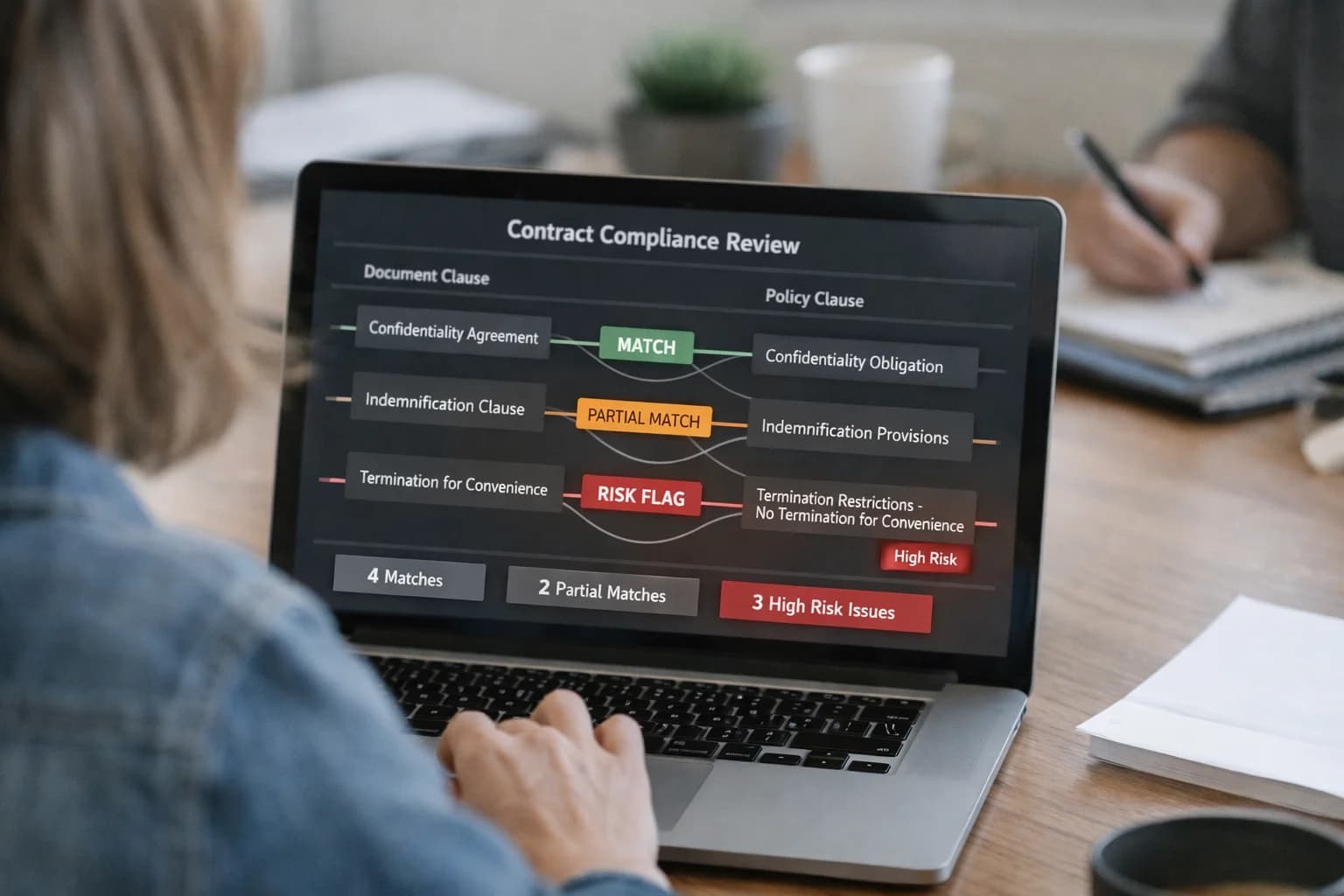
The true ROI of legal AI is risk avoidance, not efficiency. Automating contract review with a basic RAG system saves time, but the financial impact of missing a single non-standard liability clause dwarfs any efficiency gain.
Efficiency gains are linear; risk reduction is exponential. Saving 100 hours on document review is a fixed cost benefit. Identifying a single 'hell or high water' clause in a vendor agreement prevents a potential eight-figure liability event, creating non-linear financial protection.
Current tools optimize for the wrong metric. Most legal AI platforms, including many CLM systems, are built to accelerate review speed. This focuses on throughput over accuracy, using generic embeddings in Pinecone or Weaviate that fail to capture nuanced legal semantics, leading to dangerous oversights.
The evidence is in the data. A study by the Corporate Legal Operations Consortium found that AI-driven semantic analysis identified material deviations in 12% of 'standard' contracts that human reviewers missed. This directly translates to unquantified portfolio risk that legacy efficiency tools ignore.
Focusing on speed and cost reduction in legal AI misses the multi-million dollar value of preventing catastrophic risk.
General-purpose LLMs like GPT-4 or Claude generate plausible but incorrect legal analysis, creating material misstatements of fact. This exposes firms to malpractice claims and regulatory sanctions, erasing any efficiency gains.
The true ROI is in building a semantic data layer that maps clauses to liability outcomes. This transforms contracts from unstructured text into a queryable risk graph.
Legacy compliance tools rely on static SQL rules for sanctions screening or KYC, generating >95% false positive rates. They cannot adapt to novel money laundering patterns or evolving regulatory guidance.
AI models trained on global transaction graphs contextualize entity relationships in real-time, moving compliance from periodic checks to continuous monitoring.
Without rigorous MLOps, AI models for contract analysis decay as legal language and case law evolve. This silent failure leads to outdated risk assessments.
Implementing a production lifecycle with platforms like Weights & Biases detects model drift and enables continuous pre-training on new rulings and clauses.
A semantic data layer is the prerequisite for AI to identify existential legal risks hidden in unstructured contracts.
The strategic ROI of legal AI is risk avoidance, not efficiency. Automating contract review saves time, but the real value is preventing catastrophic liability from non-standard clauses, which requires a semantic understanding of legal language.
Efficiency gains are linear; risk reduction is exponential. Saving 10 hours on a contract review is a fixed benefit. Identifying a single uncapped indemnity clause in a thousand contracts prevents a loss that could bankrupt the firm.
Static databases cannot model legal relationships. Traditional contract lifecycle management (CLM) systems store documents as blobs. A semantic data foundation uses graph databases like Neo4j and vector embeddings from models like BERT to map clauses, parties, and obligations into a queryable knowledge network.
This foundation enables precise, low-hallucination RAG. A Retrieval-Augmented Generation (RAG) system built on a semantic layer—using frameworks like LlamaIndex with retrievers from Pinecone or Weaviate—grounds its responses in verified legal concepts, drastically reducing dangerous fabrications. For a deeper technical analysis, see our post on why RAG alone fails for accurate contract review.
The output is a dynamic risk ontology. The system doesn't just find clauses; it understands that a 'force majeure' clause in a supply agreement interacts with a 'termination for convenience' clause in a related financing document, exposing a contingent liability.
Evidence: Semantic search reduces critical oversights by over 70%. In deployments for private equity due diligence, moving from keyword search to semantic similarity search for clauses like 'change of control' and 'assignment' has led to a 70-80% increase in the identification of material risk triggers that were previously missed.
A data-driven comparison of the measurable returns from AI-driven efficiency gains versus strategic risk avoidance in legal and compliance functions.
| Metric / Feature | Efficiency-Focused AI (Basic Automation) | Risk-Avoidance AI (Semantic Analysis) | Legacy Manual Process |
|---|---|---|---|
Average Contract Review Time | < 2 minutes | 5-7 minutes | 45-90 minutes |
Non-Standard Clause Detection Rate | 15-20% |
| 70-85% |
False Negative Rate (Missed Critical Risk) | 8-12% | < 0.1% | 5-15% |
Annual Cost of a Single Undetected Liability | $250k - $5M+ | Mitigated | $250k - $5M+ |
Auditable Decision Trail for Regulators | |||
Integration with Semantic Data Layer for Portfolio Risk | |||
Real-time Monitoring for Clause Drift & Regulatory Change | |||
ROI Time Horizon (Payback Period) | 6-12 months (Cost Savings) | Immediate (Liability Prevention) | N/A (Cost Center) |
The strategic value of Legal AI is quantified in millions of dollars of liability avoided, not hours saved. Here are three specialized systems where risk avoidance is the core ROI.
General-purpose LLMs like GPT-4 generate plausible but incorrect legal clauses, creating material misstatements. The solution is a semantic data foundation with domain-specific fine-tuning.
Legacy SQL-based rules generate thousands of false positives, creating alert fatigue and missing novel money laundering patterns. The solution is deep learning on transaction graphs.
Manual case outcome prediction is guesswork. Machine learning models trained on millions of docket entries from PACER and state courts predict verdicts and optimal settlement windows.
Manual sampling for audits is defenseless against regulator scrutiny. A fully instrumented AI system provides an immutable, queryable audit trail of every compliance decision.
Manually verifying RFP requirements against thousands of regulatory clauses is error-prone and slow. AI systems perform instant cross-referencing and gap analysis.
Fragmented data across legacy CLM, CRM, and financial systems prevents a unified risk view. The solution is a semantic data layer that creates a holistic entity graph.
AI hallucinations and opaque models create unquantifiable legal liability, turning efficiency gains into catastrophic risk.
Hallucinations create material liability. When a general-purpose LLM like GPT-4 or Claude fabricates a clause citation or misstates a legal precedent, it constitutes a material misstatement of fact. This exposes a firm to malpractice claims and regulatory action, erasing any efficiency gains from automation. The strategic imperative is not speed, but accuracy enforced by systems like Retrieval-Augmented Generation (RAG) built on Pinecone or Weaviate.
Black-box models fail compliance audits. The EU AI Act and bar ethics rules demand explainability for high-risk AI systems. A model that cannot provide an auditable decision trail for its contract analysis is a compliance liability. Techniques like LIME or SHAP for model interpretability are not optional; they are a regulatory imperative for any legal AI deployment.
Static efficiency ignores dynamic risk. Measuring AI ROI by hours saved per contract review is a dangerous fallacy. The true metric is risk dollars avoided by identifying a single non-standard indemnity clause in a 10,000-page M&A due diligence package. This requires semantic data foundations and domain-specific fine-tuning, not just faster document processing.
Evidence: In controlled tests, basic RAG systems reduce hallucination rates in legal document Q&A by over 40%, but domain-adapted models using techniques like LoRA are required to achieve the >95% accuracy needed for enforceable legal work. For a deeper technical breakdown, see our analysis on why RAG alone fails for accurate contract review.
The liability is transferred, not eliminated. Deploying a third-party AI tool does not outsource legal liability; it merely changes the vector. Firms must own the MLOps and monitoring lifecycle using platforms like Weights & Biases to detect model drift and performance decay, or risk their AI silently becoming non-compliant. This governance layer is critical, as explored in our pillar on AI TRiSM.
The true return on investment for Legal AI is not measured in hours saved, but in catastrophic liability prevented.
General-purpose LLMs like GPT-4 or Claude generate plausible but incorrect legal analysis, creating material misstatements. This exposes firms to malpractice claims and regulatory action.
Efficiency gains from basic contract review are marginal. The strategic ROI comes from a semantic data layer that maps clause relationships and identifies non-standard terms that create existential liability.
A static AI model deployed today will decay in accuracy as legal language and regulations evolve, silently increasing portfolio risk. This is a core failure of MLOps in legal tech.
Single-point AI tools create fragmentation. The future is multi-agent systems (MAS) where specialized agents for research, drafting, and review collaborate autonomously.
Monolithic contract lifecycle management platforms are API-poor and cannot integrate the vector databases and agent orchestration layers required for modern AI. They perpetuate data silos.
The billable hour model is a liability. Forward-looking corporate legal departments are building internal AI capabilities on sovereign infrastructure to gain strategic control.
Enabling Efficiency, Speed & Accuracy
We build AI systems for teams that need search across company data, workflow automation across tools, or AI features inside products and internal software.
A systematic technical audit is the only way to expose the hidden vulnerabilities in your legal AI that create existential liability.
Audit your semantic data layer first. The primary risk in legal AI is not the model but the data foundation; a flawed semantic layer built on generic embeddings from OpenAI or Cohere will miss critical clause nuances. You must validate that your vector database, like Pinecone or Weaviate, is indexed on domain-specific legal embeddings to ensure accurate retrieval.
Test for catastrophic forgetting. Supervised fine-tuning on niche legal datasets often degrades a model's general reasoning; you must audit for this using parameter-efficient methods like LoRA (Low-Rank Adaptation) to preserve base model capabilities while injecting domain expertise.
Validate the agentic control plane. In a multi-agent system for due diligence, a failure in the orchestration layer—governing hand-offs between research, drafting, and review agents—creates workflow gaps. Audit the Agent Control Plane logic to ensure deterministic error handling.
Measure hallucination rates quantitatively. Deploy a red-teaming framework to benchmark your RAG system against a golden dataset of contracts; acceptable hallucination rates for legal analysis are below 2%, not the 5-10% tolerated in general content generation.
Inspect the MLOps pipeline for drift. Without continuous monitoring via platforms like Weights & Biases, model performance on contract risk assessment decays as legal language evolves; this silent drift is a quantified risk that requires automated retraining triggers.
Scrutinize the explainability output. For compliance with regulations like the EU AI Act, your system must generate auditable decision trails; audit whether techniques like LIME or SHAP provide legally defensible explanations for clause classification, moving beyond black-box models.

About the author
CEO & MD, Inference Systems
Prasad Kumkar is the CEO & MD of Inference Systems and writes about AI systems architecture, LLM infrastructure, model serving, evaluation, and production deployment. Over 5+ years, he has worked across computer vision models, L5 autonomous vehicle systems, and LLM research, with a focus on taking complex AI ideas into real-world engineering systems.
His work and writing cover AI systems, large language models, AI agents, multimodal systems, autonomous systems, inference optimization, RAG, evaluation, and production AI engineering.
How We Work
One-fit-all AI don't work for modern businesses. At Inferensys, we aim to understand your business & custom requirements; which we use to define most efficient agentic workflows, the data, and the tools for your business.
The first call is a practical review of your use case and the right next step.









