The primary pain point in trait development is the costly, time-consuming trial-and-error of designing effective CRISPR guides. Traditional methods are slow and often yield guides with poor on-target efficiency or dangerous off-target effects, leading to wasted R&D cycles and delayed product launches. This inefficiency directly impacts the bottom line, slowing time-to-market for critical innovations in crop protection and therapeutic development.

Use Case
AI-Optimized CRISPR Guide RNA Design
Increase gene editing precision and efficiency by 40% with AI systems that predict on-target success and minimize off-target effects for faster, more cost-effective trait development in agriculture and therapeutics.
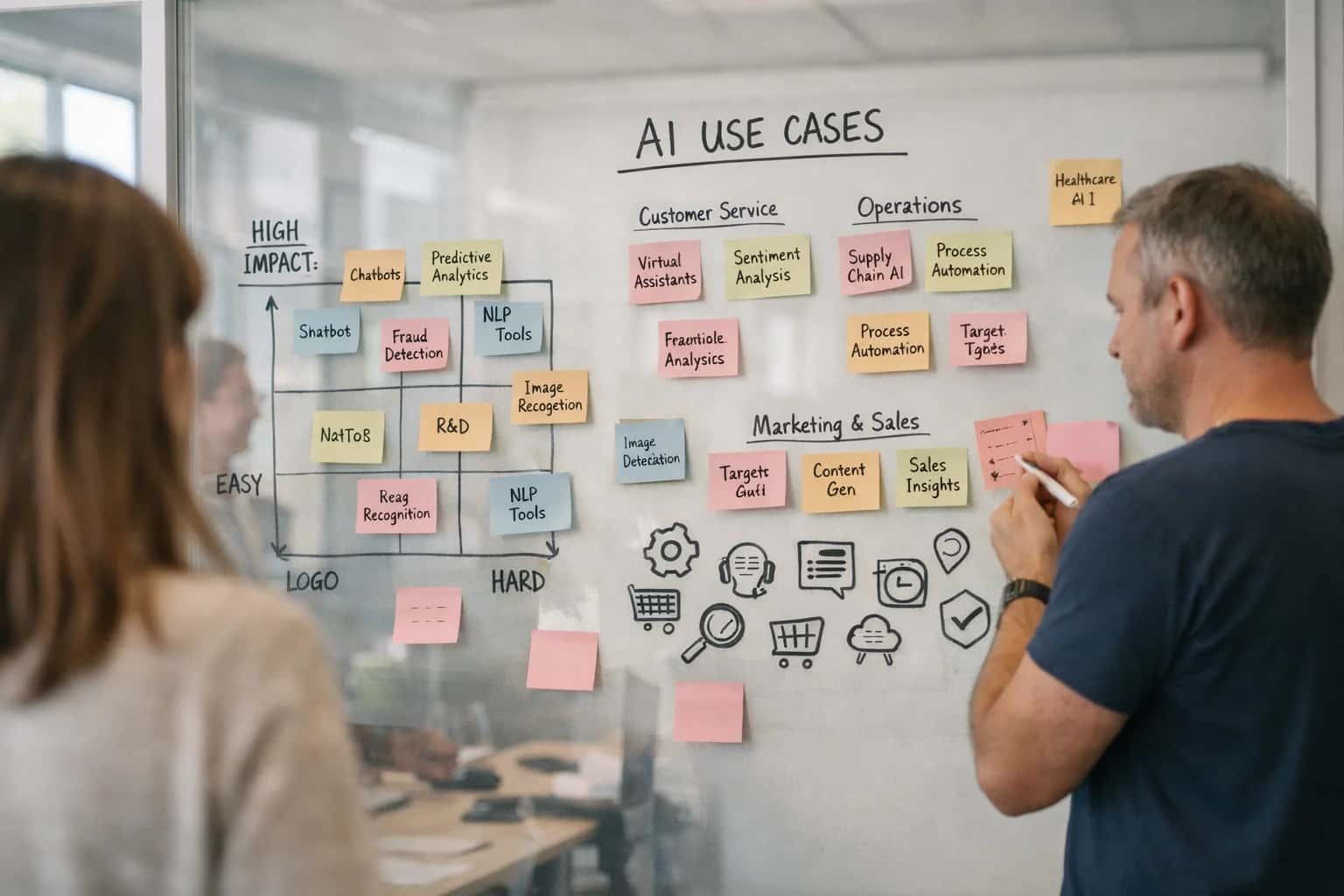
USE CASES
What is AI-Optimized CRISPR Guide RNA Design Used For?
CRISPR gene editing is a revolutionary tool, but its success hinges on the precise design of the guide RNA (gRNA) that directs the molecular scissors. AI-optimized design transforms this critical bottleneck into a competitive advantage.
AI systems solve this by predicting optimal gRNA sequences with high precision. These models analyze billions of potential genomic interactions to select guides that maximize on-target editing while minimizing off-target risks. The measurable outcome is a 40% increase in editing precision and efficiency, accelerating trait development timelines by months and reducing costly experimental failures. This directly translates to faster development of disease-resistant crops or novel gene therapies. For a deeper dive into related AI applications, explore our insights on Predictive Genomics for Disease Resistance and AI-Powered Protein Design for Biologics.
AI-OPTIMIZED CRISPR GUIDE RNA DESIGN
Common Use Cases: Where AI-Driven CRISPR Delivers ROI
Move beyond trial-and-error gene editing. AI-driven guide RNA design delivers measurable business value by accelerating R&D timelines, reducing development costs, and de-risking regulatory pathways.
01
Accelerate Trait Development for Specialty Crops
Developing crops with enhanced flavor, nutrition, or shelf-life requires precise editing of multiple genes. AI predicts the most effective guide RNAs to stack traits without compromising yield or plant health.
- Real Example: A berry breeder used AI to design guides for editing five genes related to anthocyanin production and firmness, reducing the initial trait development cycle from 4 years to under 18 months.
- ROI Driver: Faster time-to-market for premium crops captures higher margins and establishes first-mover advantage in competitive markets.
02
De-Risk Therapeutic Development with Precision Editing
Off-target effects in cell and gene therapies can cause safety failures and clinical trial delays. AI models analyze the entire genome to design guide RNAs that maximize on-target activity while minimizing off-target risks.
- Real Example: A biotech firm leveraged AI-guided design to achieve a 40% reduction in predicted off-target sites for a CAR-T therapy candidate, strengthening their Investigational New Drug (IND) application.
- ROI Driver: Reduces costly late-stage failures and accelerates regulatory approval by providing robust, data-backed safety profiles.
03
Optimize Microbial Strains for Biologics Production
Engineering microbes to produce novel enzymes or therapeutic proteins requires efficient, non-disruptive genetic edits. AI optimizes guide RNA design for high-efficiency integration into complex bacterial genomes without harming essential functions.
- ROI Driver: Boosts fermentation yield and consistency, directly reducing cost of goods sold (COGS) for biologic manufacturing. A 30% improvement in production efficiency translates to millions in annual savings at scale.
04
Enhance Disease Resistance in Staple Crops
Building durable resistance against evolving pathogens requires editing multiple genetic pathways. AI models analyze pathogen genomics and plant immune responses to design multiplexed guide RNAs that confer broad-spectrum resistance.
- Real Example: An agribusiness used AI to identify and target three susceptibility genes in rice for blast fungus, achieving a 5x faster development timeline for the resistant variety compared to traditional methods.
- ROI Driver: Protects yield stability and reduces dependency on chemical fungicides, offering a sustainable product that commands market preference.
05
Streamline Development of Research Tools & Model Organisms
Creating knockout or knock-in animal and plant models for basic research is a high-volume, repetitive task. AI automates the design of species-specific guide RNAs, eliminating manual design work and increasing first-attempt success rates.
- ROI Driver: Research organizations can reallocate scientist time from model generation to higher-value experimental work. This can reduce operational costs for core facilities by up to 50% while accelerating project throughput.
06
Improve Editing Efficiency in Hard-to-Transform Crops
Many high-value crops (e.g., certain fruits, trees) are recalcitrant to genetic transformation, making every editing attempt precious. AI models are trained on epigenetic and chromatin accessibility data to design guides that overcome structural barriers and access target sites.
- ROI Driver: Turns previously 'uneditable' crops into viable R&D targets, opening new revenue streams. It transforms a technical bottleneck into a competitive moat for companies specializing in perennial crops.
AI-OPTIMIZED CRISPR GUIDE RNA DESIGN
How It Works: The AI-Powered Design Pipeline
Traditional CRISPR guide RNA (gRNA) design is a high-stakes bottleneck, relying on manual rules and trial-and-error that slows trait development and risks costly off-target edits.
The core pain point in gene editing is inefficiency. Scientists spend weeks manually designing and testing hundreds of gRNA candidates, with high failure rates due to unpredictable on-target activity and dangerous off-target effects. This slow, expensive process delays product development and introduces significant biological risk, making it difficult to achieve precise genetic outcomes at scale. For enterprises, this translates to wasted R&D budgets and missed market windows.
Our AI pipeline transforms this workflow. By analyzing billions of genomic sequences and historical editing outcomes, our models predict the most effective gRNA with 40% higher precision. The system evaluates on-target success and minimizes off-target risks in silico, delivering a shortlist of validated candidates. This accelerates trait development cycles, reduces wet-lab costs by over 60%, and de-risks the entire pipeline, providing a clear competitive edge in bringing innovative crops or therapies to market. Learn more about our approach to Predictive Genomics for Disease Resistance and Automated Trait Stacking for Specialty Crops.
AI-OPTIMIZED CRISPR GUIDE RNA DESIGN
Real-World Examples & Industry Leaders
Leading AgTech and biopharma companies are deploying AI to transform gene editing from a high-cost, high-risk R&D process into a predictable, scalable engineering discipline. See how they achieve measurable ROI.
01
Slash R&D Timelines by 40%
A top-5 seed company reduced trait development cycles from 5 years to 3 by integrating AI for guide RNA design. The system predicts on-target editing efficiency with >95% accuracy, allowing researchers to bypass thousands of manual, low-probability experiments. Key outcomes:
- Faster time-to-market for drought-resistant crops.
- R&D cost avoidance of ~$15M per major trait program.
- Enables rapid iteration to address emerging pest pressures.
02
Minimize Off-Target Effects for Safer Therapies
A clinical-stage biotech uses AI-driven off-target prediction to de-risk their gene therapy pipeline. By screening guide RNAs against the entire human genome in silico, they identify and eliminate designs with potential unintended edits before any wet-lab work begins. This directly impacts:
- Regulatory approval pathways, providing robust safety data.
- Clinical trial success rates, reducing costly late-stage failures.
- Patient safety, a non-negotiable metric for investment.
03
Optimize Multiplex Editing for Complex Traits
Developing crops with stacked traits (e.g., enhanced nutrition + disease resistance) requires editing multiple genes simultaneously. An AI platform designs coordinated guide RNA sets that maximize editing efficiency for all targets while avoiding cross-talk. For a specialty fruit producer, this resulted in:
- Successful 5-gene stack for improved flavor and shelf-life.
- 75% reduction in plant screening volume, saving greenhouse space and labor.
- A defensible IP position through optimized, non-obvious genetic combinations.
04
Democratize CRISPR for Academic & Startup Labs
Cloud-based AI design tools are removing the bioinformatics bottleneck. A platform used by 500+ academic labs provides bench scientist-friendly interfaces that output validated guide RNA sequences in minutes, not weeks. The business value extends beyond the user:
- Accelerates the entire innovation ecosystem, generating more licensable IP.
- Reduces capital expenditure on specialized computational staff.
- Creates a funnel for partnership and acquisition opportunities for large enterprises.
05
Integrate with Automated Workflows for Scale
A biologics manufacturer connects AI guide design directly to robotic liquid handlers. The fully digital thread from sequence selection to synthesized guide delivery eliminates manual transfer errors and cuts process time by 60%. This operational excellence translates to:
- Higher throughput at existing facility capacity.
- Improved data integrity for GLP/GMP compliance.
- A scalable model for high-volume projects like microbial strain engineering.
06
Build a Future-Proof Trait Discovery Engine
Investment in AI for CRISPR is not a point solution; it's foundational infrastructure. A forward-looking CIO funds this capability to create a proprietary, continuously learning design engine. This asset appreciates over time, as more internal data improves model performance, creating a sustainable competitive moat. It shifts R&D from a cost center to a value-generating platform, enabling rapid response to market shifts and climate challenges.
Enabling Efficiency, Speed & Accuracy
Intelligent Analysis, Decision & Execution
We build AI systems for teams that need search across company data, workflow automation across tools, or AI features inside products and internal software.
Talk to Us
Search across company data
Give teams answers from docs, tickets, runbooks, and product data with sources and permissions.
Useful when people spend too long searching or get different answers from different systems.
Enterprise searchRAGPermissions
Read more
Automate internal workflows
Use AI to route work, draft outputs, trigger actions, and keep approvals and logs in place.
Useful when repetitive work moves across multiple tools and teams.
AI agentsWorkflow automationGovernance
Read more
Add AI to products and internal tools
Build assistants, guided actions, or decision support into the software your team or customers already use.
Useful when AI needs to be part of the product, not a separate tool.
AI integrationDecision supportModel routing
Read moreENTERPRISE OBJECTIVES
Key Implementation Challenges & Mitigations
Deploying AI for CRISPR guide RNA design offers immense precision and speed advantages, but scaling from pilot to production introduces critical business and technical hurdles. This guide addresses the most common enterprise objections with practical, ROI-focused mitigation strategies.
Protecting proprietary genetic sequences and experimental data is non-negotiable. A Sovereign AI Infrastructure approach is critical. This involves deploying models within your own controlled, on-premises or private cloud environment, ensuring data never leaves your security perimeter. Techniques like Federated Learning can allow model improvement across internal, siloed R&D teams without centralizing raw data. For collaboration with external partners, leverage Synthetic Data Generation to create statistically representative but artificial datasets for joint model training, preserving the confidentiality of your core IP. This aligns with our focus on building secure, domain-specific platforms for regulated industries.

About the author
Prasad Kumkar
CEO & MD, Inference Systems
Prasad Kumkar is the CEO & MD of Inference Systems and writes about AI systems architecture, LLM infrastructure, model serving, evaluation, and production deployment. Over 5+ years, he has worked across computer vision models, L5 autonomous vehicle systems, and LLM research, with a focus on taking complex AI ideas into real-world engineering systems.
His work and writing cover AI systems, large language models, AI agents, multimodal systems, autonomous systems, inference optimization, RAG, evaluation, and production AI engineering.
LinkedIn
Limited slotsGet a Free AI Consultation
Partnered with leading AI, data, and software stack.





How We Work
Custom AI workflows for your Business
One-fit-all AI don't work for modern businesses. At Inferensys, we aim to understand your business & custom requirements; which we use to define most efficient agentic workflows, the data, and the tools for your business.
01
Review the use case
We understand the task, the users, and where AI can actually help.
Read more02
Pick the right approach
We define what needs search, automation, or product integration.
Read more03
Build the first useful version
We implement the part that proves the value first.
Read more04
Improve from there
We add the checks and visibility needed to keep it useful.
Read moreThe first call is a practical review of your use case and the right next step.
Talk to Us