An autonomous procurement agent operates on a recursive task loop, a core pattern in Autonomous Workflow Design and Logic Routing. The loop begins when the agent executes a primary task, such as submitting a purchase order to an ERP system like SAP. It then enters a monitoring phase, polling vendor APIs for status updates. This design moves the system from a static, linear process to a dynamic one capable of self-correction based on real-time signals like shipment delays or stock shortages.

Guide
How to Design Recursive Task Loops for Autonomous Procurement
A developer guide to architecting self-correcting procurement workflows. You'll implement recursive loops where an AI agent monitors order fulfillment and autonomously triggers re-routing or supplier negotiation.
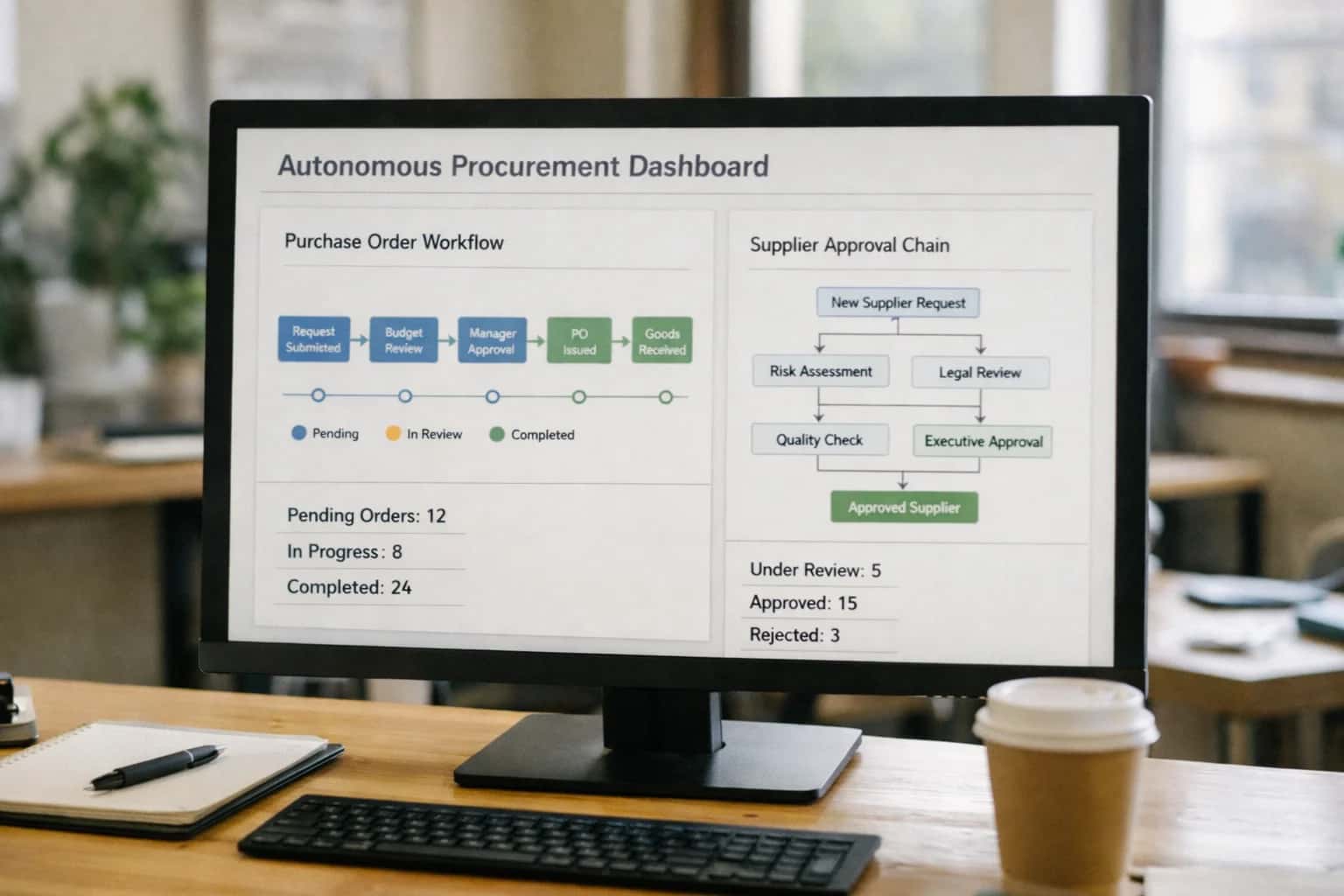
This guide details the architecture for self-correcting procurement workflows. You'll implement loops where an AI agent places an order, monitors fulfillment status via APIs, and recursively triggers re-routing or supplier negotiation if delays occur.
To build this, you must define clear success criteria (e.g., 'order confirmed and shipped') and implement a recursion depth limit to prevent infinite loops. The agent's logic must include conditional branches: on success, the loop terminates; on failure, it triggers a recursive call to an alternative action, such as negotiating with a backup supplier. This creates a resilient system that autonomously manages volatility, a fundamental shift from traditional, brittle procurement scripts.
AUTONOMOUS PROCUREMENT
Key Concepts
Master the core architectural patterns for building self-correcting procurement workflows. These concepts enable AI agents to place orders, monitor fulfillment, and recursively trigger corrective actions without human intervention.
01
Recursive Loop Design
A recursive task loop is a control flow where an AI agent executes a task, evaluates the outcome against success criteria, and re-executes a modified version of the task if needed. For procurement, this creates a self-correcting cycle.
- Base Case: The loop terminates when an order is successfully fulfilled or a maximum recursion depth is reached.
- Recursive Case: If a delay or failure is detected (e.g., via supplier API), the agent triggers a new sub-task like supplier negotiation or order re-routing.
- State Management: Each loop iteration must persist context (order ID, attempt count, failure reason) to avoid redundant actions.
02
Success Criteria & Halting Conditions
Define precise, measurable conditions that determine if a procurement task is complete or requires recursion. Without clear halting logic, loops can run infinitely.
- Positive Criteria: Order status is 'delivered', invoice is paid, quality check passes.
- Negative Triggers: API returns a 'backordered' status, shipment tracking shows no movement for 48 hours.
- Depth Limit: Implement a counter (e.g.,
max_retries = 3) to force termination and escalate to a human operator. This is a critical safety mechanism.
03
ERP & API Integration Layer
Autonomous procurement requires deep, real-time integration with enterprise systems like SAP S/4HANA or Oracle NetSuite. The agent interacts through a dedicated integration layer.
- Idempotent Operations: Ensure purchase order creation or status checks can be safely retried.
- Webhook Listeners: Subscribe to ERP events (e.g., 'goods receipt posted') to trigger the next loop evaluation.
- Error Handling: Map common ERP error codes (like 'material not found') to specific remediation actions within the loop.
04
Dynamic Logic Routing
Based on real-time evaluation, the system must route the workflow to the appropriate corrective action. This moves beyond static if-then rules.
- Routing Matrix: Use a decision function that considers failure type, supplier history, and cost impact. For example, a minor delay might trigger a notification, while a critical stock-out initiates a multi-supplier auction.
- Tool Integration: The router calls different tools or agents, such as a negotiation agent using a language model or a sourcing agent that queries alternative supplier catalogs.
- Learn more about this foundational pattern in our guide on Setting Up Dynamic Logic Routing for Real-Time Data.
05
Reasoning-Based Exception Handling
When a loop recurses, use a reasoning model to diagnose the root cause and select the best remediation, rather than following a fixed script.
- Causal Analysis: A small language model (SLM) fine-tuned on procurement logs can classify if a delay is due to logistics, quality, or payment issues.
- Action Generation: Based on the diagnosis, the system generates the next step, such as 'request expedited shipping from supplier X' or 'initiate a quality inspection'.
- Audit Trail: Log the model's reasoning chain (input, diagnosis, chosen action) for compliance and continuous improvement. This aligns with techniques in Implementing Reasoning-Based Error Handling in Claims Processing.
06
Human-in-the-Loop (HITL) Escalation
Design clear escalation protocols to inject human oversight when autonomous loops exceed their limits or encounter novel scenarios.
- Escalation Triggers: Max recursion depth reached, cost of proposed action exceeds a threshold, or the reasoning model's confidence score is low.
- Context Preservation: When escalating, provide the human operator with the complete loop history, diagnosis, and suggested actions.
- Approval Integration: Use a platform like LangChain's HumanApprovalCallbackHandler to pause execution and wait for a human decision via a ticketing system like Jira.
FOUNDATION
Step 1: Define the Workflow State and Success Criteria
Before writing a single line of code, you must formally define the data structure representing your procurement workflow's progress and the precise conditions that signal its completion or failure. This creates the single source of truth for your autonomous agent.
The workflow state is a structured object that captures the current snapshot of a procurement task. For an autonomous loop, this must include immutable identifiers (e.g., order_id, supplier_id), mutable status fields (e.g., current_status: 'pending_fulfillment'), timestamps, and a history of actions taken. This state object is passed between each recursive iteration, enabling the agent to reason about what has happened and decide what to do next. Tools like Pydantic are ideal for defining this schema with validation.
Success criteria are Boolean or multi-class conditions evaluated against the state. Define explicit, measurable outcomes: is_complete: unit_received == quantity_ordered, is_failed: days_delayed > max_allowed. Also define intermediate success for sub-tasks, like negotiation_successful: price <= target_price. These criteria act as the exit conditions for your recursive loop, preventing infinite execution. Integrate this logic with your Human-in-the-Loop (HITL) Governance Systems for critical approvals.
ARCHITECTURE COMPARISON
ERP Integration Patterns for Recursive Procurement Loops
Comparison of integration approaches for connecting autonomous procurement agents to Enterprise Resource Planning (ERP) systems like SAP S/4HANA or Oracle Fusion.
| Integration Feature | Direct API Integration | Event-Driven Middleware | Database Replication |
|---|---|---|---|
Real-Time Data Latency | < 1 sec | 1-5 sec |
|
Transaction Atomicity | |||
Built-in Error Retry Logic | |||
Support for Complex Business Logic | |||
Decoupling from ERP Upgrades | |||
Initial Implementation Complexity | High | Medium | Low |
Operational Maintenance Overhead | High | Medium | Low |
Suitable for High-Frequency Recursion |
Enabling Efficiency, Speed & Accuracy
Intelligent Analysis, Decision & Execution
We build AI systems for teams that need search across company data, workflow automation across tools, or AI features inside products and internal software.
Talk to Us
Search across company data
Give teams answers from docs, tickets, runbooks, and product data with sources and permissions.
Useful when people spend too long searching or get different answers from different systems.
Enterprise searchRAGPermissions
Read more
Automate internal workflows
Use AI to route work, draft outputs, trigger actions, and keep approvals and logs in place.
Useful when repetitive work moves across multiple tools and teams.
AI agentsWorkflow automationGovernance
Read more
Add AI to products and internal tools
Build assistants, guided actions, or decision support into the software your team or customers already use.
Useful when AI needs to be part of the product, not a separate tool.
AI integrationDecision supportModel routing
Read moreAUTONOMOUS PROCUREMENT
Common Mistakes in Recursive Task Loop Design
Recursive loops are powerful for building self-correcting procurement agents, but common pitfalls can lead to infinite loops, budget overruns, or system failure. This guide addresses the key mistakes developers make and how to fix them.
An infinite loop occurs when your agent fails to reach a terminal state and has no mechanism to stop. This is the most critical failure mode.
Define a recursion depth limit. This is a non-negotiable safety parameter. Implement a counter that increments with each loop iteration and forces a Human-in-the-Loop (HITL) Governance Systems escalation when the limit is reached.
pythonMAX_RECURSION_DEPTH = 5 def execute_procurement_loop(task_state, depth=0): if depth >= MAX_RECURSION_DEPTH: return escalate_to_human(task_state, reason="Max depth exceeded") # ... core loop logic ... if not task_state.is_complete(): return execute_procurement_loop(new_state, depth + 1)
Additionally, ensure your success criteria are measurable, binary, and verifiable via API (e.g., order_status == 'DELIVERED'). Vague criteria like "supplier is responsive" will cause loops to run indefinitely.

About the author
Prasad Kumkar
CEO & MD, Inference Systems
Prasad Kumkar is the CEO & MD of Inference Systems and writes about AI systems architecture, LLM infrastructure, model serving, evaluation, and production deployment. Over 5+ years, he has worked across computer vision models, L5 autonomous vehicle systems, and LLM research, with a focus on taking complex AI ideas into real-world engineering systems.
His work and writing cover AI systems, large language models, AI agents, multimodal systems, autonomous systems, inference optimization, RAG, evaluation, and production AI engineering.
LinkedIn
Limited slotsGet a Free AI Consultation
Partnered with leading AI, data, and software stack.





How We Work
Custom AI workflows for your Business
One-fit-all AI don't work for modern businesses. At Inferensys, we aim to understand your business & custom requirements; which we use to define most efficient agentic workflows, the data, and the tools for your business.
01
Review the use case
We understand the task, the users, and where AI can actually help.
Read more02
Pick the right approach
We define what needs search, automation, or product integration.
Read more03
Build the first useful version
We implement the part that proves the value first.
Read more04
Improve from there
We add the checks and visibility needed to keep it useful.
Read moreThe first call is a practical review of your use case and the right next step.
Talk to Us