For CFOs and compliance officers, regulatory reporting is a persistent drain. Manual data aggregation from siloed systems like ERP and CRM is slow and error-prone. Teams waste weeks each quarter wrestling with complex templates from the SEC, FINRA, or ESMA, living in fear of missed deadlines, fines, and reputational damage. This isn't just an administrative headache—it's a direct hit to operational efficiency and a significant business risk that distracts from strategic priorities.

Use Case
Automated Regulatory Reporting Agent
An AI agent that autonomously gathers data, populates templates, and files reports with agencies like the SEC or FINRA, ensuring 100% accuracy and on-time submission while cutting costs by 70%.
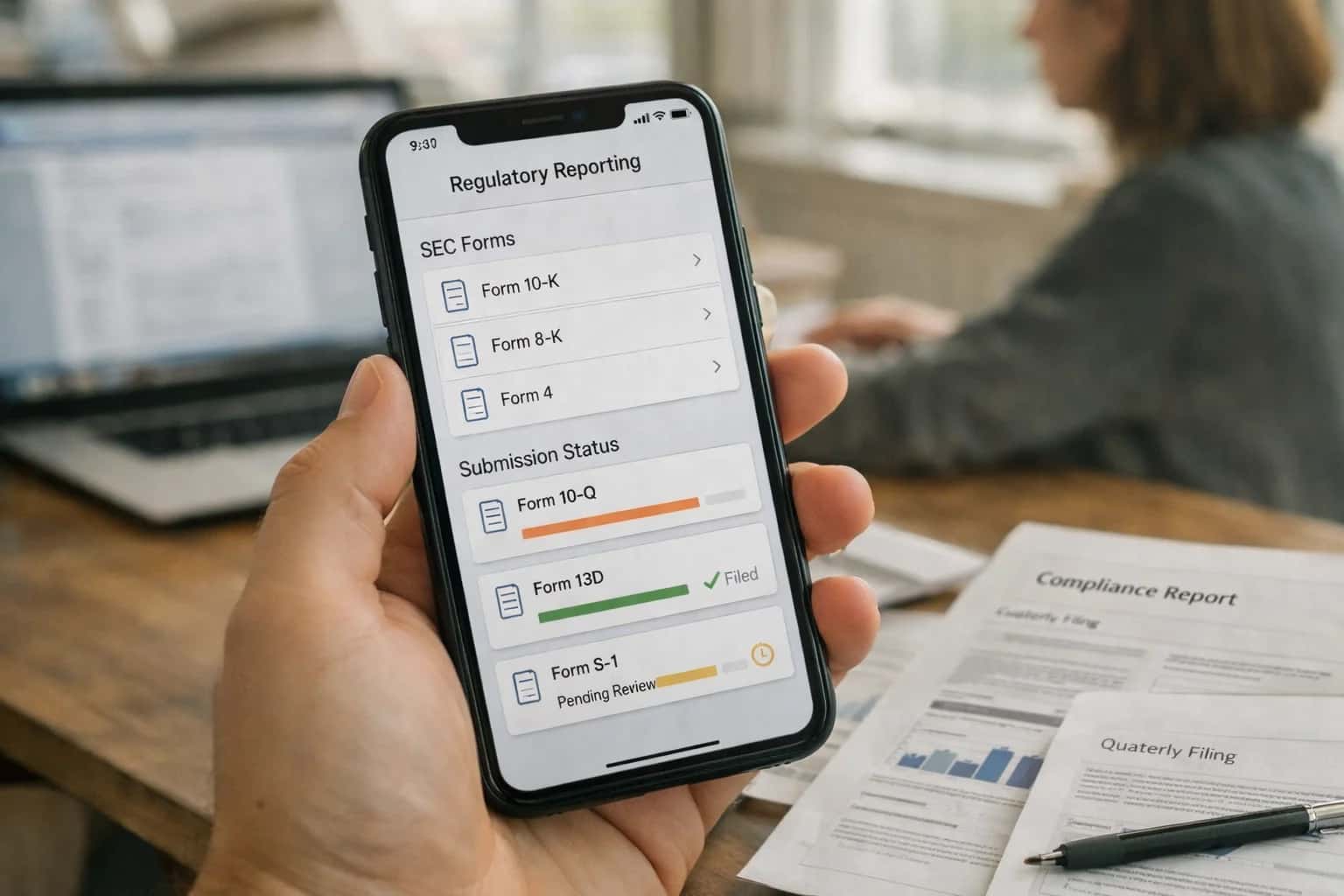
FROM MANUAL BURDEN TO AUTONOMOUS COMPLIANCE
What is an Automated Regulatory Reporting Agent Used For?
An Automated Regulatory Reporting Agent is a virtual employee that transforms a costly, high-risk administrative function into a reliable, zero-error business process.
The AI fix is an autonomous agent that acts as your dedicated reporting department. It orchestrates the entire workflow: connecting to data sources, applying business logic, populating mandated templates, and filing reports with 100% accuracy. The measurable outcome is a 70% reduction in manual effort, the elimination of late fees, and the conversion of a cost center into a predictable, audit-ready operation. This allows your team to shift from data wrangling to analysis, as explored in our guide on Agentic Enterprise Orchestration.
AUTOMATED REGULATORY REPORTING
Common Use Cases: Where AI Reporting Agents Deliver ROI
Manual reporting is a high-cost, high-risk bottleneck. These AI agents act as virtual compliance officers, autonomously ensuring 100% accuracy and on-time submission.
01
SEC & FINRA Financial Reporting
An autonomous agent that gathers data from ERPs and data lakes, populates mandated templates (10-K, 10-Q, FOCUS reports), and files directly with regulatory bodies. It ensures 100% accuracy by cross-referencing source documents and applying complex accounting rules, eliminating manual errors and late filing penalties.
- Real Example: A mid-sized investment bank reduced its quarterly reporting cycle from 12 person-days to 2 hours.
- ROI Driver: Avoids average SEC late filing fines of $150k+ and reduces internal labor costs by over 70%.
70%
Labor Cost Reduction
100%
On-Time Filing
02
Banking Compliance (Basel III, CCAR)
This agent automates the collection and validation of risk-weighted assets, capital adequacy, and stress testing data required for Basel III and Comprehensive Capital Analysis and Review (CCAR) submissions. It performs automated reasonableness checks and generates audit-ready documentation.
- Real Example: A regional bank compressed its CCAR data aggregation and validation process from 6 weeks to 5 days.
- ROI Driver: Mitigates regulatory capital misallocation risks and frees senior risk analysts for strategic modeling instead of data wrangling.
85%
Faster Data Aggregation
03
ESG & Sustainability Disclosure Agent
With new mandates like the EU's CSRD, manual ESG reporting is unsustainable. This agent autonomously pulls data from IoT sensors, supply chain systems, and HR platforms to calculate Scope 1, 2, and 3 emissions, populating frameworks like SASB and GRI.
- Real Example: A manufacturing firm automated its annual sustainability report, cutting preparation time from 3 months to 2 weeks.
- ROI Driver: Prevents non-compliance fines (up to 2% of global turnover under CSRD) and enhances brand equity with accurate, verifiable reporting.
80%
Report Prep Time Saved
04
Healthcare HIPAA & CMS Reporting
Automates the generation and submission of complex reports to Centers for Medicare & Medicaid Services (CMS) and ensures HIPAA compliance audits are pre-populated and accurate. The agent extracts data from EHRs, billing systems, and patient portals while maintaining strict data governance.
- Real Example: A hospital network automated its Quality Payment Program (QPP) submissions, improving accuracy scores and maximizing reimbursement.
- ROI Driver: Directly impacts revenue by ensuring optimal reimbursement rates and avoids HIPAA violation penalties starting at $50,000 per incident.
$50k+
Penalty Avoidance per Incident
05
Insurance Solvency II & State Filings
Handles the intensive data requirements for Solvency II (European) and state-by-state regulatory filings in the US. The agent autonomously calculates technical provisions, solvency capital requirement (SCR), and prepares the Own Risk and Solvency Assessment (ORSA) report.
- Real Example: A global insurer reduced its quarterly solvency reporting timeline by 60%, improving capital deployment decisions.
- ROI Driver: Reduces operational risk, ensures capital efficiency, and prevents regulatory sanctions that can restrict business operations.
60%
Faster Reporting Cycle
06
Global Trade & Customs Compliance
For multinationals, this agent automates the generation of customs declarations, Intrastat reports, and other cross-border trade documentation. It integrates with logistics and ERP data to ensure classification accuracy and calculate duties in real-time.
- Real Example: An automotive parts supplier eliminated manual customs errors, reducing shipment delays by 95% and avoiding six-figure duty miscalculations.
- ROI Driver: Prevents costly customs holds, fines for incorrect declarations, and optimizes duty payments through accurate classification.
95%
Reduction in Shipment Delays
AUTOMATED REGULATORY REPORTING
How It Works: The 5-Step Agentic Workflow
Manual regulatory reporting is a high-risk, low-efficiency drain. This narrative details how an agentic AI transforms this critical compliance function into a source of strategic advantage.
The pain point is immense: finance teams waste hundreds of hours monthly manually gathering data, populating complex templates, and racing deadlines for agencies like the SEC or FINRA. A single error can trigger fines, reputational damage, and audit nightmares. This isn't just an administrative task; it's a significant operational risk and a costly diversion of skilled talent from strategic analysis. The manual process is inherently fragile, creating a constant state of compliance anxiety.
The AI fix is an Automated Regulatory Reporting Agent. It functions as a virtual employee, autonomously executing a five-step workflow: data extraction from disparate ERPs, validation against source systems, intelligent population of regulatory templates, generation of audit-ready documentation, and secure, on-time filing. The measurable outcome is 100% accuracy, zero late submissions, and a 70% reduction in manual effort, transforming compliance from a cost center into a reliable, automated operation. Explore our broader vision for autonomous finance in Agentic Enterprise Orchestration.
COST & RISK ANALYSIS
ROI Calculator: Manual vs. Agentic Reporting
A direct comparison of the operational and financial impact of traditional manual reporting versus an Automated Regulatory Reporting Agent.
| Key Metric / Feature | Manual Reporting Process | Agentic Reporting (Inference Systems) | Business Impact |
|---|---|---|---|
Average Time per Report | 40-80 hours | < 2 hours | Cycle time reduced by 95% |
Annual Labor Cost (FTE) | $120,000 - $180,000 | $15,000 - $30,000 (Ops Oversight) | Direct labor savings: 75-85% |
Error Rate (Data & Filing) | 5-15% | < 0.1% | Eliminates rework & penalties |
On-Time Submission Rate | 85-90% |
| Virtually eliminates late filing risk |
Audit Preparation Time | Weeks | Hours | Dramatically reduces audit burden |
Scalability (Volume Increase) | Linear cost increase | Marginal cost increase | Enables growth without proportional headcount |
Process Visibility & Control | Low (spreadsheets, email) | High (centralized dashboard) | Enables proactive management & forecasting |
Regulatory Change Adaptation | Months (manual updates) | Days (automated ingestion) | Reduces compliance lag & vulnerability |
Enabling Efficiency, Speed & Accuracy
Intelligent Analysis, Decision & Execution
We build AI systems for teams that need search across company data, workflow automation across tools, or AI features inside products and internal software.
Talk to Us
Search across company data
Give teams answers from docs, tickets, runbooks, and product data with sources and permissions.
Useful when people spend too long searching or get different answers from different systems.
Enterprise searchRAGPermissions
Read more
Automate internal workflows
Use AI to route work, draft outputs, trigger actions, and keep approvals and logs in place.
Useful when repetitive work moves across multiple tools and teams.
AI agentsWorkflow automationGovernance
Read more
Add AI to products and internal tools
Build assistants, guided actions, or decision support into the software your team or customers already use.
Useful when AI needs to be part of the product, not a separate tool.
AI integrationDecision supportModel routing
Read moreAUTOMATED REGULATORY REPORTING
Key Implementation Challenges & Mitigations
Implementing an autonomous agent for regulatory reporting delivers immense ROI but faces specific technical and operational hurdles. This guide addresses the most common enterprise objections with proven mitigation strategies.
The primary ROI is derived from cost avoidance and risk reduction. Quantifiable benefits include:
- 70-80% reduction in manual labor for data gathering, template population, and filing.
- Elimination of late filing penalties, which can exceed six figures per incident for major agencies like the SEC.
- Near-zero error rates, preventing costly restatements and reputational damage.
- Reallocation of skilled compliance staff from repetitive tasks to strategic analysis and exception handling. The business case is strongest for organizations filing high-volume, complex reports (e.g., 10-K/10-Q, MiFID II, Basel III) where manual processes are a significant cost center and single point of failure.

About the author
Prasad Kumkar
CEO & MD, Inference Systems
Prasad Kumkar is the CEO & MD of Inference Systems and writes about AI systems architecture, LLM infrastructure, model serving, evaluation, and production deployment. Over 5+ years, he has worked across computer vision models, L5 autonomous vehicle systems, and LLM research, with a focus on taking complex AI ideas into real-world engineering systems.
His work and writing cover AI systems, large language models, AI agents, multimodal systems, autonomous systems, inference optimization, RAG, evaluation, and production AI engineering.
LinkedIn
Limited slotsGet a Free AI Consultation
Partnered with leading AI, data, and software stack.





How We Work
Custom AI workflows for your Business
One-fit-all AI don't work for modern businesses. At Inferensys, we aim to understand your business & custom requirements; which we use to define most efficient agentic workflows, the data, and the tools for your business.
01
Review the use case
We understand the task, the users, and where AI can actually help.
Read more02
Pick the right approach
We define what needs search, automation, or product integration.
Read more03
Build the first useful version
We implement the part that proves the value first.
Read more04
Improve from there
We add the checks and visibility needed to keep it useful.
Read moreThe first call is a practical review of your use case and the right next step.
Talk to Us