The traditional due diligence process is a major pain point, creating a costly bottleneck that can derail deals. Manual review of thousands of contracts, financial statements, and compliance documents is slow, expensive, and prone to human error. Critical risks—like hidden liabilities, non-standard clauses, or regulatory exposures—are easily missed in the volume, turning post-merger integration into a nightmare of unexpected costs and legal disputes. This manual grind delays deal closure, erodes competitive advantage, and inflates advisory fees.

Use Case
AI-Powered Due Diligence for M&A
Accelerate merger and acquisition reviews by 80% and surface critical risks by automatically analyzing thousands of contracts, financial reports, and compliance documents.
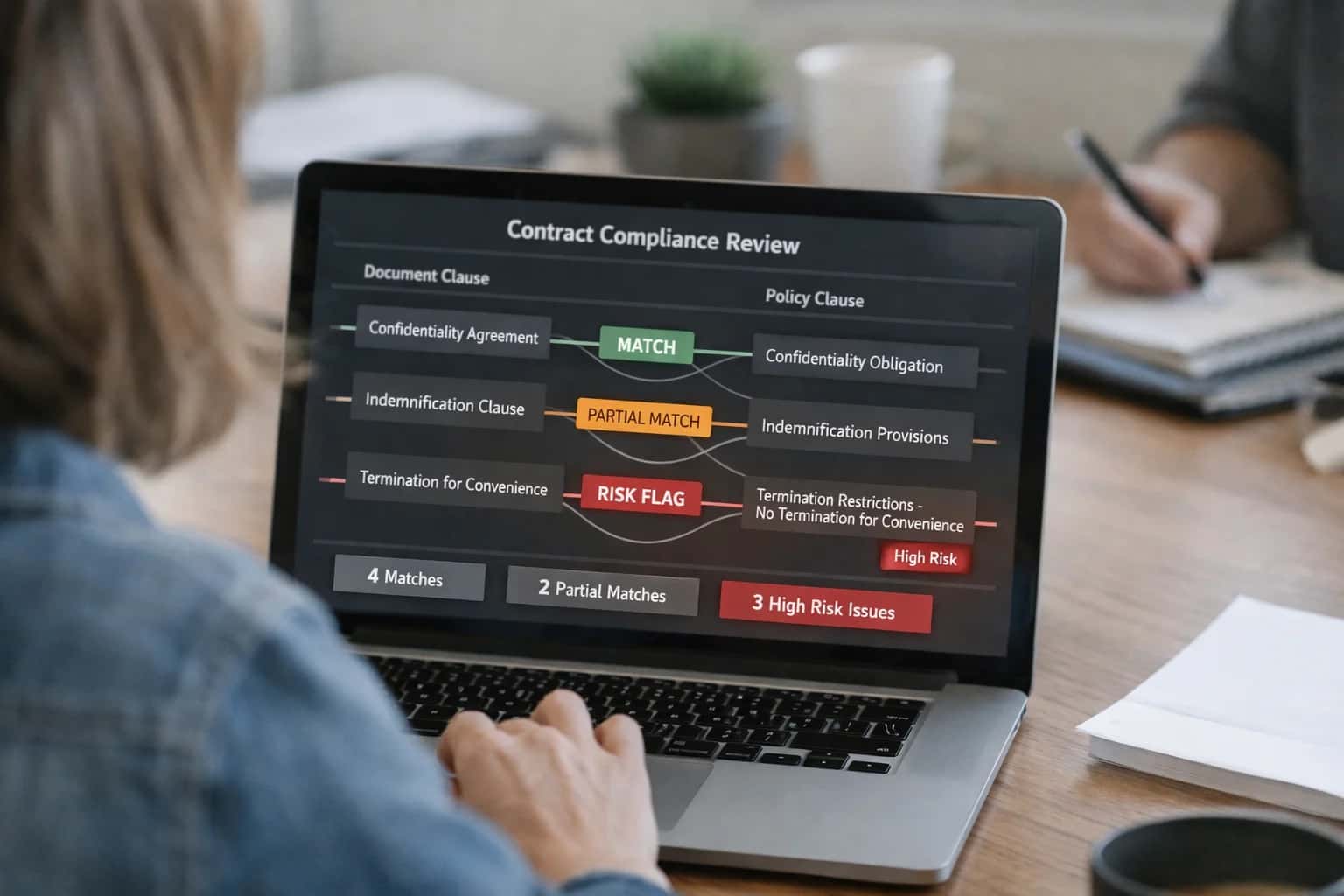
FROM MANUAL REVIEW TO AUTOMATED INSIGHT
What is AI-Powered Due Diligence for M&A Used For?
Traditional M&A due diligence is a high-stakes, high-cost bottleneck. AI transforms this process by automating the analysis of thousands of documents to surface critical risks and opportunities, turning a compliance exercise into a strategic advantage.
AI-powered due diligence provides the fix. Our Intelligent Content Management platform acts as a tireless analyst, using natural language processing to instantly extract and analyze key terms, obligations, and red flags from massive document sets. It quantifies risks, highlights anomalies, and generates executive summaries, accelerating review cycles by up to 80%. This transforms due diligence from a cost center into a value driver, enabling faster, more informed decisions and protecting deal value. For deeper insights, explore our solutions for Automated Contract Analysis for Risk Scoring and Automated Legal E-Discovery Acceleration.
AI-POWERED M&A
Common AI Due Diligence Use Cases
Transform the high-stakes, high-pressure process of merger and acquisition reviews. AI automates the analysis of thousands of documents to surface critical risks, obligations, and opportunities, turning months of manual work into weeks of strategic insight.
FROM MANUAL REVIEW TO AUTOMATED INSIGHT
How AI-Powered Due Diligence Works: A 4-Step Process
Traditional M&A due diligence is a high-stakes, high-cost bottleneck. This process transforms it into a strategic, data-driven advantage.
The traditional due diligence process is a manual, high-risk bottleneck. Teams spend weeks manually reviewing thousands of contracts, financials, and reports, struggling with inconsistent formats and unstructured data. This leads to missed liabilities, inflated legal costs, and deal fatigue that can kill momentum or result in catastrophic post-merger surprises. The pain point isn't just speed—it's the accuracy and completeness of risk assessment under extreme time pressure.
AI-powered due diligence automates this grind. Our Intelligent Content Management platform ingests all document types—PDFs, scans, emails—to automatically extract key clauses, obligations, and financial data. It surfaces hidden risks like change-of-control provisions, exclusivity terms, and compliance gaps, presenting a quantified risk score. This transforms a 6-week review into a 48-hour analysis, reducing due diligence costs by up to 70% and providing a clear, auditable trail for negotiations. Explore our core platform capabilities in Intelligent Content Management (ICM) and Document Intelligence and see a related application in Automated Contract Analysis for Risk Scoring.
AI-POWERED DUE DILIGENCE FOR M&A
Key Implementation Challenges & How to Overcome Them
While AI promises to accelerate M&A reviews by 80%, successful implementation faces significant hurdles around data quality, compliance, and ROI justification. This guide addresses the top enterprise objections with pragmatic, ROI-focused solutions.
The 'garbage in, garbage out' principle is critical. AI models require clean, structured data to identify risks accurately. The primary challenge is integrating fragmented data from disparate sources—data rooms, legacy ERP systems, and scanned PDFs.
Solution: Implement a pre-processing pipeline using our Intelligent Content Management (ICM) platform. This system:
- Automates ingestion from all source formats (PDFs, emails, databases).
- Standardizes and enriches data, filling gaps with entity recognition.
- Creates a single source of truth before analysis begins, ensuring the AI works with complete, contextualized information. This foundational step is non-negotiable for reliable outputs.
Enabling Efficiency, Speed & Accuracy
Intelligent Analysis, Decision & Execution
We build AI systems for teams that need search across company data, workflow automation across tools, or AI features inside products and internal software.
Talk to Us
Search across company data
Give teams answers from docs, tickets, runbooks, and product data with sources and permissions.
Useful when people spend too long searching or get different answers from different systems.
Enterprise searchRAGPermissions
Read more
Automate internal workflows
Use AI to route work, draft outputs, trigger actions, and keep approvals and logs in place.
Useful when repetitive work moves across multiple tools and teams.
AI agentsWorkflow automationGovernance
Read more
Add AI to products and internal tools
Build assistants, guided actions, or decision support into the software your team or customers already use.
Useful when AI needs to be part of the product, not a separate tool.
AI integrationDecision supportModel routing
Read moreAI-POWERED DUE DILIGENCE
Phased Implementation Roadmap to ROI
Transform your M&A process from a high-risk, manual slog into a data-driven, accelerated engine for value creation. This phased approach delivers measurable ROI at each step.
01
Phase 1: Rapid Risk Surface
Deploy AI to instantly analyze thousands of contracts, financial statements, and compliance documents. The system identifies and flags critical risks—such as change-of-control clauses, exclusivity agreements, and regulatory non-compliance—within days, not months. This provides immediate visibility into deal-breakers and allows your team to focus on high-priority issues.
- Real Example: A private equity firm used this phase to review 12,000 vendor contracts in 72 hours, uncovering $45M in potential hidden liabilities that were factored into the purchase price.
80%
Faster Initial Review
>95%
Clause Detection Accuracy
02
Phase 2: Quantified Obligation Mapping
Move beyond identification to quantification. AI extracts and structures key obligations, termination dates, and renewal terms into a dynamic, queryable database. This creates a single source of truth for post-merger integration planning, enabling precise forecasting of future costs and operational impacts.
- Key Benefit: Enables accurate modeling of integration synergies and reveals hidden operational burdens buried in service-level agreements (SLAs) and lease documents.
60%
Reduction in Integration Surprises
03
Phase 3: Competitive Intelligence & Benchmarking
Leverage AI to analyze the target's public filings, news, and market data alongside the internal document corpus. The system provides contextual intelligence on market position, competitive threats, and strategic alignment that human teams might miss under time pressure.
- Real Example: For a tech acquisition, AI cross-referenced patent portfolios with product roadmaps, identifying a critical IP gap that became a key point of negotiation, securing a 15% price reduction.
04
Phase 4: Continuous Portfolio Monitoring
The AI model becomes an ongoing asset. Post-acquisition, it continuously monitors the newly integrated entity's document flow for compliance drift, contract renewals, and risk triggers. This turns due diligence from a one-time event into a persistent competitive advantage, protecting your investment.
- ROI Driver: Automates the monitoring of thousands of ongoing obligations, freeing legal and compliance teams for strategic work and ensuring contractual value is captured.
05
The Bottom-Line ROI
A structured AI implementation delivers compound returns:
- Cost Avoidance: Identifies deal-breaking risks before capital is committed.
- Value Capture: Uncovers hidden synergies and negotiation leverage.
- Speed to Value: Cuts diligence timeline by 50-70%, allowing you to act on opportunities faster than competitors.
- Operational Efficiency: Reduces manual legal review costs by over 60%, reallocating high-cost talent to strategic analysis.
50-70%
Timeline Reduction
>10:1
Typical ROI
06
Getting Started: The 90-Day Pilot
Minimize upfront risk with a focused pilot on a single deal stream or document type (e.g., customer contracts). We deliver a working model in 30 days, followed by a 60-day validation period where ROI is measured against traditional methods. This proves value with a limited scope before enterprise-wide rollout.
- Measurable Outcome: A clear benchmark on time saved, risks surfaced, and cost reduction, providing the hard data needed for full budgetary approval.

About the author
Prasad Kumkar
CEO & MD, Inference Systems
Prasad Kumkar is the CEO & MD of Inference Systems and writes about AI systems architecture, LLM infrastructure, model serving, evaluation, and production deployment. Over 5+ years, he has worked across computer vision models, L5 autonomous vehicle systems, and LLM research, with a focus on taking complex AI ideas into real-world engineering systems.
His work and writing cover AI systems, large language models, AI agents, multimodal systems, autonomous systems, inference optimization, RAG, evaluation, and production AI engineering.
LinkedIn
Limited slotsGet a Free AI Consultation
Partnered with leading AI, data, and software stack.





How We Work
Custom AI workflows for your Business
One-fit-all AI don't work for modern businesses. At Inferensys, we aim to understand your business & custom requirements; which we use to define most efficient agentic workflows, the data, and the tools for your business.
01
Review the use case
We understand the task, the users, and where AI can actually help.
Read more02
Pick the right approach
We define what needs search, automation, or product integration.
Read more03
Build the first useful version
We implement the part that proves the value first.
Read more04
Improve from there
We add the checks and visibility needed to keep it useful.
Read moreThe first call is a practical review of your use case and the right next step.
Talk to Us