HR teams drown in manual paperwork for I-9s, visas, policy acknowledgments, and audit trails. This process is slow, error-prone, and exposes the organization to significant compliance fines and operational risk. Every misplaced form or missed deadline is a liability, consuming specialist time better spent on strategic initiatives like employee experience or talent development.

Use Case
Automated Compliance Document Processing
AI that extracts, validates, and files I-9s, visas, and policy acknowledgments, eliminating manual errors and audit preparation time by up to 90%.
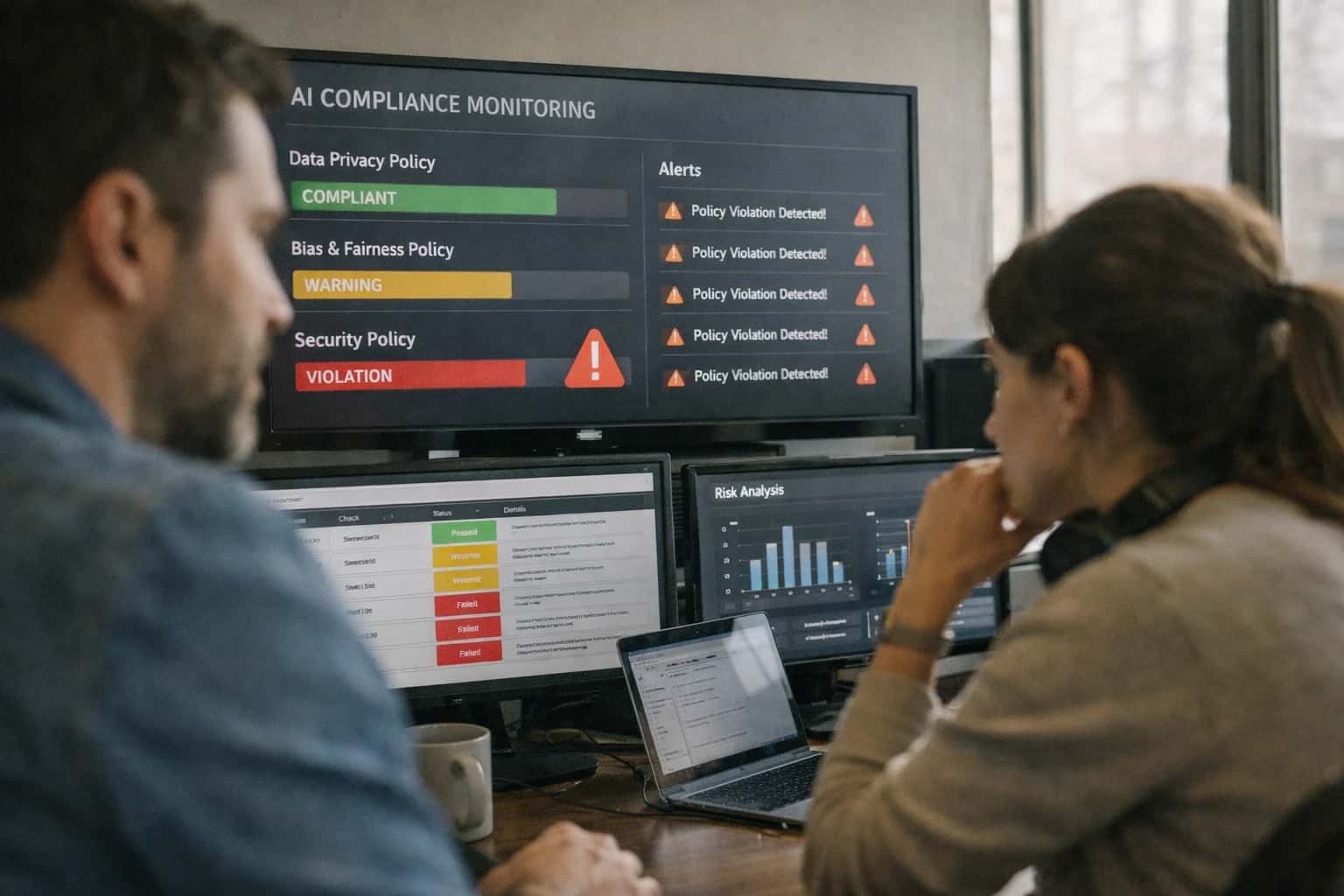
HR TECH USE CASE
What is Automated Compliance Document Processing Used For?
Manual HR compliance is a high-cost, high-risk bottleneck. Automated document processing uses AI to eliminate this friction, turning a liability into a strategic asset.
AI-powered automation extracts, validates, and files documents with near-perfect accuracy. It creates an immutable, searchable audit trail, slashing audit preparation from weeks to hours. This transforms compliance from a cost center into a controlled, efficient operation. For a deeper dive into how AI agents orchestrate multi-step workflows, explore our pillar on Agentic Enterprise Orchestration and Workflow Autonomy.
AUTOMATED COMPLIANCE DOCUMENT PROCESSING
Common Use Cases
Transform HR's most manual, high-risk process into a strategic asset. AI-driven document intelligence eliminates errors, slashes audit prep time, and ensures continuous compliance.
01
Eliminate I-9 & Visa Processing Errors
Manual data entry for I-9s and work visas is a primary source of costly compliance fines. Our AI agents extract, validate, and cross-reference data directly from uploaded documents against government databases in real-time.
- Automated error flagging for mismatched names, expired documents, or incorrect visa types.
- Seamless E-Verify integration to confirm employment eligibility instantly.
- Real-world impact: A global retailer reduced I-9 correction notices by 92% and cut processing time from 15 minutes per form to under 60 seconds.
92%
Reduction in Correction Notices
< 60 sec
Per-Form Processing Time
02
Automate Policy Acknowledgment & Audit Trails
Prove every employee received, read, and acknowledged critical policies (e.g., Code of Conduct, Harassment Prevention). AI creates an immutable, searchable audit trail for regulators or litigation.
- Intelligent extraction of employee signatures and timestamps from any document format.
- Automated follow-up workflows for employees who haven't completed acknowledgments.
- One-click audit reporting generates compliance proof packs in minutes, not days.
03
Slash Audit Preparation from Weeks to Hours
Internal and government audits (OFCCP, ICE) require pulling thousands of documents. AI pre-indexes and classifies all compliance documents upon ingestion.
- Natural language queries (e.g., "Show all I-9s for engineers hired in Q3") retrieve precise records.
- Automated gap detection identifies missing documents or incomplete sections before the auditor arrives.
- ROI Example: A financial services firm reduced its annual audit prep effort from 3 weeks of full-team work to a 4-hour review by a single specialist.
3 weeks → 4 hours
Audit Prep Time Reduction
04
Centralize Global Compliance in One System
Manage disparate labor laws and document requirements across the US, EU, and APAC from a single dashboard. AI classifies documents by jurisdiction and applies the correct validation rules.
- Continuous monitoring for regulatory changes that impact document requirements.
- Automated alerts when local policies need updating based on new laws.
- Mitigates risk of six- and seven-figure fines for multinational corporations.
05
Integrate Seamlessly with Your HCM & VMS
Deploy AI as a layer over your existing HR tech stack—Workday, SAP SuccessFactors, Oracle HCM, or vendor management systems (VMS).
- Pre-built connectors for major platforms ensure rapid deployment without disrupting workflows.
- Agentic orchestration triggers downstream actions (e.g., onboarding tasks, system access) only after document compliance is verified.
- Eliminates data silos, creating a single source of truth for all workforce documentation.
06
Quantify ROI: Hard Cost Savings & Risk Mitigation
Justify the investment with clear, measurable financial outcomes.
- Direct Labor Savings: Automate 80% of manual HR admin time spent on document chasing, filing, and verification.
- Fine Avoidance: Proactive compliance monitoring prevents penalties that average $25,000 per I-9 error for companies.
- Audit Cost Reduction: Cut external legal and consulting fees by up to 65% through automated evidence gathering.
- Strategic Upskilling: Free HR specialists from manual work to focus on talent strategy and employee experience.
$25k
Avg. Fine per I-9 Error
65%
Potential Audit Cost Reduction
AUTOMATED DOCUMENT PROCESSING
How It Works: The AI Compliance Agent
Manual handling of I-9s, visas, and policy acknowledgments is a high-risk, low-value drain on HR. Our AI agent transforms this burden into a secure, automated workflow.
HR teams waste hundreds of hours annually manually processing I-9s, visa forms, and policy documents. This manual work is error-prone, leading to costly compliance fines and frantic, last-minute audit preparation. The risk isn't just financial—it's reputational. In regulated environments, a single misfiled document can trigger significant penalties and operational disruption, making manual processes a critical business liability.
Our AI Compliance Agent acts as a virtual HR specialist. It automatically extracts, validates, and files data from uploaded documents against government databases and internal rules. The system flags discrepancies in real-time and maintains a perfect, audit-ready digital trail. This eliminates manual errors, reduces audit preparation from weeks to hours, and allows your team to focus on strategic initiatives like employee retention and internal mobility.
COST & TIME ANALYSIS
ROI Calculator: Manual vs. AI-Powered Compliance
Quantifying the operational and financial impact of automating I-9, visa, and policy acknowledgment processing.
| Key Metric | Manual Processing | AI-Powered Processing (Inference Systems) | ROI Impact |
|---|---|---|---|
Average Processing Time per Document | 15-20 minutes | < 1 minute | 95% reduction |
Error Rate in Data Entry | 5-8% | < 0.5% | 90%+ reduction in audit risk |
Annual Labor Cost (FTE per 10k docs) | $65,000 | $15,000 (oversight) | $50,000 saved |
Audit Preparation Time | 40-80 hours | 2-4 hours (automated reports) | Weeks to hours |
Compliance Violation Risk | High | Low (continuous monitoring) | Mitigates six-figure fines |
Scalability (Volume Surge Handling) | Requires overtime/hiring | Instant, linear scaling | No marginal cost increase |
Employee Onboarding Delay | 3-5 days | Same-day | Faster productivity |
System Integration Capability | Manual data transfer | Native API to HRIS & ATS | Eliminates data silos |
Enabling Efficiency, Speed & Accuracy
Intelligent Analysis, Decision & Execution
We build AI systems for teams that need search across company data, workflow automation across tools, or AI features inside products and internal software.
Talk to Us
Search across company data
Give teams answers from docs, tickets, runbooks, and product data with sources and permissions.
Useful when people spend too long searching or get different answers from different systems.
Enterprise searchRAGPermissions
Read more
Automate internal workflows
Use AI to route work, draft outputs, trigger actions, and keep approvals and logs in place.
Useful when repetitive work moves across multiple tools and teams.
AI agentsWorkflow automationGovernance
Read more
Add AI to products and internal tools
Build assistants, guided actions, or decision support into the software your team or customers already use.
Useful when AI needs to be part of the product, not a separate tool.
AI integrationDecision supportModel routing
Read moreROI & IMPLEMENTATION
Automated Compliance Document Processing: Key Questions for Leaders
AI-driven compliance document processing eliminates manual errors and audit preparation time. Below, we address the most common questions from executives about risk, ROI, and integration.
Automated Compliance Document Processing uses specialized AI to extract, validate, and file sensitive HR documents like I-9s, visas, and policy acknowledgments. Unlike basic OCR, this system understands context, cross-references data for accuracy, and flags discrepancies in real-time. It transforms a manual, error-prone process into a streamlined, auditable workflow. For example, it can validate an I-9 by checking the employee's name against the supporting document's expiration date and form section, reducing the risk of costly fines from simple oversights. This is a core component of modern Agentic HCM, where autonomous agents handle multi-step administrative tasks.

About the author
Prasad Kumkar
CEO & MD, Inference Systems
Prasad Kumkar is the CEO & MD of Inference Systems and writes about AI systems architecture, LLM infrastructure, model serving, evaluation, and production deployment. Over 5+ years, he has worked across computer vision models, L5 autonomous vehicle systems, and LLM research, with a focus on taking complex AI ideas into real-world engineering systems.
His work and writing cover AI systems, large language models, AI agents, multimodal systems, autonomous systems, inference optimization, RAG, evaluation, and production AI engineering.
LinkedIn
Limited slotsGet a Free AI Consultation
Partnered with leading AI, data, and software stack.





How We Work
Custom AI workflows for your Business
One-fit-all AI don't work for modern businesses. At Inferensys, we aim to understand your business & custom requirements; which we use to define most efficient agentic workflows, the data, and the tools for your business.
01
Review the use case
We understand the task, the users, and where AI can actually help.
Read more02
Pick the right approach
We define what needs search, automation, or product integration.
Read more03
Build the first useful version
We implement the part that proves the value first.
Read more04
Improve from there
We add the checks and visibility needed to keep it useful.
Read moreThe first call is a practical review of your use case and the right next step.
Talk to Us