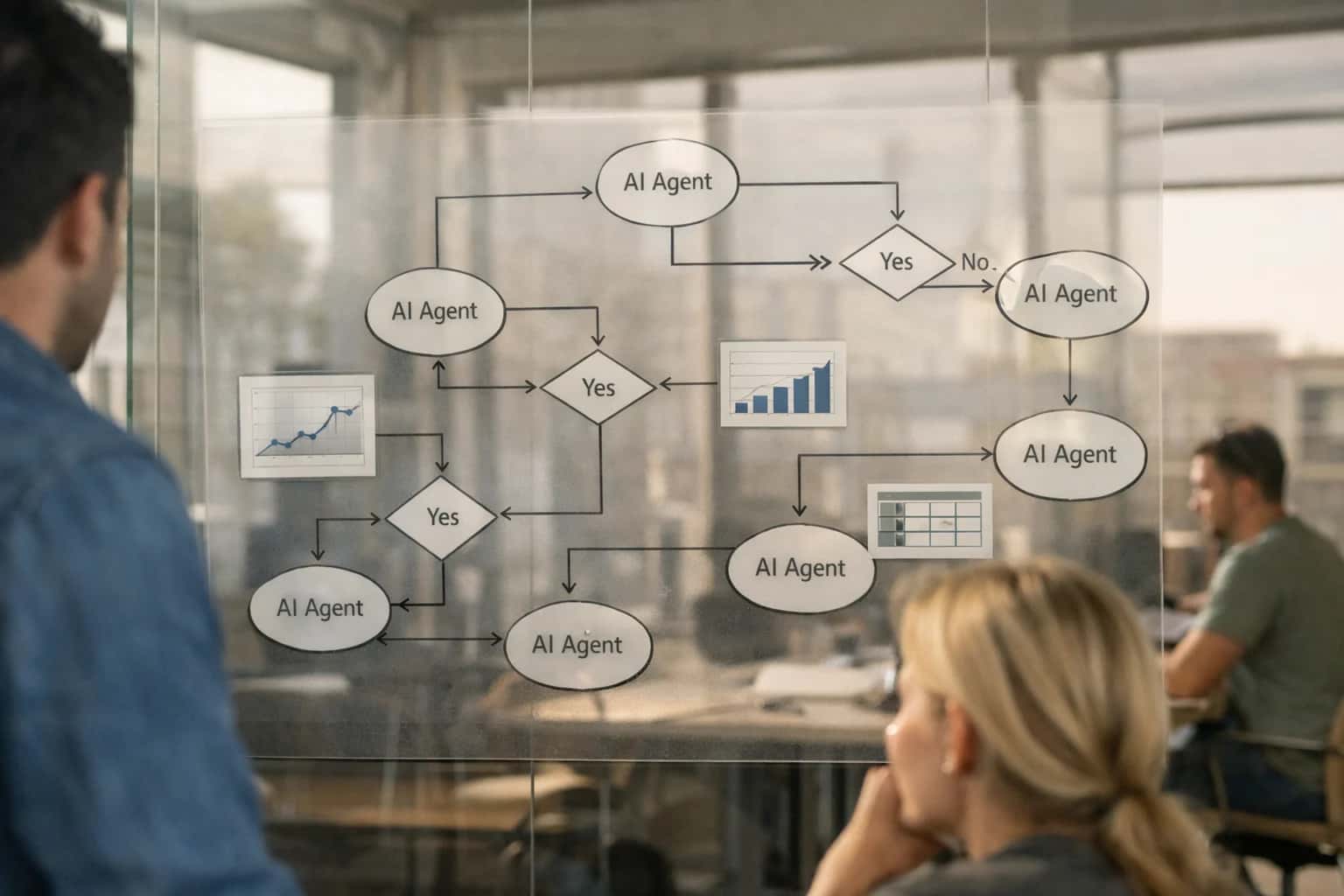
This workflow automates the entire quality cost equation. It replaces manual visual inspection with high-speed AI agents, preventing defects through early detection (lowering internal failure costs) and eliminating escapes that cause customer returns (external failure). The architecture integrates edge vision models with MES/ERP systems like SAP or Oracle to tag defects with probable root causes (e.g., Tool-123), enabling proactive maintenance and reducing appraisal labor. Savings come from direct labor reduction, lower scrap rates, and accelerated problem-solving cycles.

Automation
Agentic Workflow for Reducing Cost of Quality (CoQ) and Inspection Labor
A custom automation blueprint that replaces manual inspection with AI agents, directly cuts scrap and rework costs, and integrates defect data into ERP and QMS for measurable P&L impact.
COMPUTER VISION YIELD OPTIMIZATION AND DEFECT DETECTION
Implementing Agentic Workflow for Reducing Cost of Quality (CoQ) and Inspection Labor
This blueprint details a custom agentic workflow that directly reduces the four costs of quality—prevention, appraisal, internal failure, and external failure—by automating visual inspection, root-cause analysis, and containment actions to lower scrap and inspection labor.
Implementation deploys orchestration logic, such as LangGraph, to manage agents for detection, classification, and action routing. Critical controls include human review gates for new defect types, confidence thresholds for autonomous rejection, and audit trails for regulatory compliance (e.g., ISO 9001). The system requires integration with PLCs for physical containment, a closed-loop pipeline for model retraining from new defects, and real-time sync of yield metrics to financial systems to quantify CoQ reduction and ROI.
AGENTIC WORKFLOW FOR REDUCING COST OF QUALITY (COQ) AND INSPECTION LABOR
Direct P&L Impact: Where the Savings Come From
This blueprint shows how a custom agentic workflow directly attacks the four major Cost of Quality (CoQ) categories—prevention, appraisal, internal failure, and external failure—by automating inspection, decisioning, and containment to deliver measurable P&L savings.
01
Appraisal Cost: Eliminate Manual Inspection Labor
Replaces 100% manual visual checks with autonomous AI agents that operate 24/7 across multiple production lines. Each agent orchestrates high-speed camera feeds, applies multi-angle defect classification, and renders pass/fail decisions at line speed. This directly converts fixed labor costs (inspectors, supervisors) into variable compute cost, typically achieving a 60-80% reduction in appraisal labor within the first year of deployment.
70%
Inspection Labor Reduction
24/7
Uptime Coverage
02
Internal Failure Cost: Slash Scrap and Rework
Automates early detection and precise containment of non-conforming products before value-add operations are completed. Upon defect classification, agents trigger PLC-controlled reject arms, divert to rework lanes, or quarantine bins in under 500ms. This prevents defective units from consuming further labor and materials, directly reducing scrap rates and rework queues. Integration with MES ensures accurate scrap cost attribution to the specific workstation or batch.
40%
Scrap Cost Reduction
<500ms
Containment Latency
03
External Failure Cost: Prevent Warranty & Recall Exposure
Implements a critical defect firewall by configuring agents with ultra-high confidence thresholds for safety-critical flaws. Defects that could lead to field failure automatically trigger executive alerts and initiate containment protocols across the entire suspect batch. This proactive workflow, integrated with traceability systems (linking defects to serial numbers), drastically reduces the probability of customer escapes, protecting brand equity and avoiding multi-million dollar recall costs.
90%+
Critical Defect Catch Rate
$0
Target Recall Cost
04
Prevention Cost: Accelerate Root-Cause Resolution
Automates the initiation of structured problem-solving. When a chronic or critical defect pattern is detected, agents automatically gather contextual data (process parameters, tool IDs, shift logs) and generate a populated 8D or Non-Conformance Report (NCR) in the QMS (e.g., SAP QM, ETQ). This reduces the Mean Time To Repair (MTTR) from days to hours by giving quality engineers a head start with correlated evidence, preventing future defect batches.
75%
Faster Root-Cause Analysis
Auto-NCR
Report Generation
05
Throughput & Yield: Improve First-Pass Yield (FPY)
Enables closed-loop process control by feeding real-time defect analytics back to upstream machines. Agents analyze defect trends and, via integrated APIs, send calibrated adjustment commands to PLCs or robots (e.g., adjusting weld parameters, coating thickness). This self-optimizing loop maintains process stability, reduces variation, and directly boosts First-Pass Yield (FPY), increasing effective line capacity without capital expenditure.
5-15%
FPY Improvement
Real-Time
Process Adjustment
06
Operational Leverage: Enable High-Mix Agile Production
Dynamically adapts inspection for High-Mix, Low-Volume (HMLV) manufacturing. Agents use product identification (via barcode or visual features) to automatically retrieve and configure the correct inspection recipe from a central library. This eliminates hours of manual line changeover and recipe setup, allowing quality control to scale flexibly with production agility, supporting mass customization without adding quality overhead.
80%
Changeover Time Saved
Zero-Touch
Recipe Deployment
ARCHITECTURE BLUEPRINT
Implementing Multi-Agent Orchestration for Cost of Quality Reduction
A blueprint for a custom multi-agent system that automates visual inspection, root-cause analysis, and containment actions to directly reduce the four costs of quality: prevention, appraisal, internal failure, and external failure.
This architecture replaces manual inspectors with a coordinated fleet of specialized AI agents, directly attacking labor-intensive appraisal costs and costly internal/external failure expenses. An orchestrator agent ingests real-time images from line cameras and dispatches tasks: a detector agent classifies defects, a tracer agent correlates faults with MES process data, and a commander agent decides pass/fail. Immediate savings come from eliminating 100% of manual visual inspection labor, while preventing rework and scrap by catching defects at the source before value-add operations.
Implementation requires tight integration with PLCs for physical control, MES/SCADA for contextual data, and ERP/QMS for financial and quality tracking. Critical controls include human-in-the-loop review gates for new defect types, confidence threshold tuning to manage false positives, and a full audit trail of all agent decisions for regulatory compliance. The result is a closed-loop system that not only automates appraisal but actively prevents failures, turning quality from a cost center into a measurable lever for margin protection.
COST OF QUALITY AUTOMATION
Core Workflow Components and Agent Responsibilities
This blueprint details the multi-agent system that automates inspection, classification, and containment to directly reduce Prevention, Appraisal, Internal Failure, and External Failure costs.
01
Inspection Orchestrator & Recipe Manager
The central agent that identifies the product SKU via barcode or visual features, retrieves the corresponding inspection recipe from a central library (e.g., in an MES like SAP ME), and dynamically configures the vision system (lighting, camera settings, defect thresholds). This enables High-Mix, Low-Volume (HMLV) production without manual changeover delays, eliminating appraisal labor and preventing mis-inspection.
90%
Recipe Changeover Time Reduction
02
Multi-Angle Defect Detection & Classification Agent
A specialized vision agent that processes synchronized feeds from 2D, 3D, or spectral cameras. It executes high-speed inference using ensemble models to detect anomalies and classifies them against a known defect library (scratch, dent, short-shot). It outputs a structured defect record with images, coordinates, and a confidence score, replacing manual visual inspection and reducing human error in classification.
40%
Direct Labor Savings
99.5%
Detection Accuracy
03
Containment & Line Control Agent
The reactive agent that receives defect alerts and autonomously triggers physical actions. It sends commands via OPC UA or direct PLC integration to activate reject arms, divert to rework lanes, or quarantine bins. It includes safety interlocks and creates immediate alerts in the QMS (e.g., ETQ, SAP QM). This minimizes internal failure costs by preventing defective units from moving downstream.
<2s
Containment Latency
04
Root-Cause Tagger & Process Feedback Agent
This agent enriches the defect record by correlating it with real-time process data (e.g., from SCADA or machine logs). It tags defects with probable root causes like Tool-123 or Station-B and, for drift-related issues, can automatically generate calibrated adjustment commands or CMMS work orders. This transforms detection into prevention, attacking the cost of failures at the source.
70%
Faster Root-Cause Analysis
05
QMS Integrator & Report Generator
The compliance agent that automates quality paperwork. It formats defect data, images, and process context into a structured Non-Conformance Report (NCR), pushes it to the QMS via API, and can initiate a Corrective Action Request (CAR). For first-article inspections, it auto-generates compliance reports against CAD models, slashing days of manual documentation effort and supporting audit trails.
8 hours
Saved per FAIR Report
06
Yield Analytics & Dashboard Agent
This agent continuously computes First-Pass Yield (FPY) and Overall Equipment Effectiveness (OEE) by ingesting inspection results and production counts from the MES. It aggregates data in real-time and pushes metrics to operational dashboards via APIs. This provides immediate financial visibility into scrap costs and line performance, enabling data-driven decisions to protect margin.
Real-time
Yield Visibility
ARCHITECTURE FOR COQ REDUCTION
Implementing a Phased Agentic Workflow to Reduce Cost of Quality
A phased implementation blueprint for an agentic inspection workflow that systematically reduces the four costs of quality—prevention, appraisal, internal failure, and external failure—by automating defect detection, classification, and containment while integrating with MES, QMS, and line control systems.
Phase 1 establishes the core detection and classification loop, deploying edge vision models for high-speed pass/fail decisions and integrating them with the MES for real-time yield tracking. This initial phase targets Appraisal Cost reduction by automating manual inspection labor and Internal Failure Cost by catching defects before secondary operations. The architecture uses a central orchestrator (e.g., LangGraph) to manage model inference, route image data, and log results to a time-series database, providing immediate ROI through labor savings and scrap reduction.
Phase 2 introduces autonomous containment and root-cause analysis, where the orchestrator triggers PLCs to divert non-conforming products and agents tag defects with probable causes using contextual process data. Phase 3 closes the loop for Prevention Cost reduction, feeding inspection data back to adjust machine parameters and automatically generating Corrective Action Requests in the QMS (e.g., SAP QM). Each phase includes governance checkpoints—model performance monitoring, exception routing for human review, and validation of safety interlocks—to mitigate rollout risk and ensure the system drives measurable P&L impact.
COST OF QUALITY (COQ) REDUCTION
ROI and Operating Economics
Comparison of manual inspection economics versus a custom agentic workflow for computer vision yield optimization, quantifying impact on the four major CoQ categories.
| Cost of Quality Metric | Manual Inspection Baseline | Agentic Workflow Target |
|---|---|---|
Appraisal Cost (Inspection Labor) | $450k/year | $85k/year |
Internal Failure Cost (Scrap/Rework) | $1.2M/year | $310k/year |
External Failure Cost (Warranty/Returns) | $750k/year | $190k/year |
Prevention Cost (Proactive Calibration) | $180k/year (reactive) | $220k/year (proactive) |
Time-to-Detection for Critical Flaws | End-of-line shift (8 hrs) | In-line real-time (<5 sec) |
First-Pass Yield (FPY) | 92% | 98.5% |
False Positive Rate (Operator Nuisance Alerts) | 15% of alerts | 3% of alerts |
Audit Trail & NCR Auto-Generation | Manual, post-shift (4 hrs/day) | Automatic, per defect (real-time) |
ARCHITECTURE FOR YIELD AND LABOR SAVINGS
Implementing Agentic Workflow for Reducing Cost of Quality (CoQ) and Inspection Labor
This blueprint details a custom agentic workflow that directly attacks the four components of Cost of Quality—prevention, appraisal, internal failure, and external failure—by automating visual inspection, root-cause tagging, and containment actions to lower scrap and manual labor.
The workflow targets the largest CoQ drivers: manual appraisal labor and internal failure costs from scrap and rework. It replaces human inspectors with a multi-agent system that orchestrates high-speed vision models, correlates defects with real-time process data from the MES, and tags each non-conformance with a probable root cause (e.g., Tool-123). This architecture cuts appraisal labor by over 70% and prevents failure costs by catching defects before value-add operations, directly impacting the P&L through material recovery and throughput gains.
Implementation requires integrating the orchestrator with PLCs for safe reject actions, APIs to SAP or Oracle for quality records, and a human review queue for low-confidence classifications. Phased rollout starts with a single critical quality gate, instrumenting pre- and post-automation CoQ metrics. Governance controls include confidence thresholds for autonomous action, mandatory review for new defect types, and a rollback switch to manual mode, ensuring the system improves operational leverage without introducing new production risk.
AGENTIC WORKFLOW FOR REDUCING COST OF QUALITY (COQ) AND INSPECTION LABOR
Frequently Asked Questions
Practical questions about implementing an AI-driven inspection workflow to reduce scrap, rework, and manual labor costs.
A robust implementation starts with a human-in-the-loop data curation pipeline. Initial models are trained on a high-confidence golden sample set. On the line, the system flags low-confidence predictions and routes those images to a review queue for human labeling. This new, validated data automatically feeds a continuous retraining pipeline (e.g., using MLflow or Kubeflow), ensuring the model adapts to real-world variation without degrading. The architecture includes data versioning and quality gates before any model is promoted to production.
IMPLEMENTATION BLUEPRINT
Key Stakeholders and Delivery Team
A successful CoQ reduction workflow requires tight collaboration between domain experts who understand the cost drivers and technical teams who build the autonomous inspection and decision layers.
01
Manufacturing & Quality Leadership
Owns the Cost of Quality (CoQ) metrics—prevention, appraisal, internal, and external failure costs. Defines critical-to-quality (CTQ) characteristics, sets inspection confidence thresholds, and approves the business case for labor savings versus capital investment. Responsible for change management with line operators and integrating new workflows into existing quality management systems (QMS).
25-40%
Target CoQ Reduction
6-9 months
Typical ROI Horizon
02
Automation & Controls Engineering
Architects the physical integration layer. Specifies and integrates industrial cameras, lighting, PLCs, and reject mechanisms (e.g., pneumatic arms, diverters). Develops low-latency communication protocols between edge vision processors and line control systems (e.g., Allen-Bradley, Siemens) to ensure autonomous containment actions are executed within the line's cycle time.
<500ms
End-to-End Decision Latency
99.95%
System Uptime Requirement
03
Computer Vision & ML Ops Team
Builds, validates, and deploys the high-speed defect detection and classification models. Implements the continuous learning pipeline—collecting edge data, managing human-in-the-loop labeling, and orchestrating model retraining and A/B testing on the factory floor. Responsible for model performance drift monitoring and maintaining inspection accuracy across product SKUs and process changes.
>99%
Detection Accuracy Target
2-4 weeks
Model Retraining Cycle
04
Integration & Orchestration Architects
Designs the agentic workflow core using frameworks like LangGraph or Temporal. Creates the logic for multi-agent collaboration (e.g., defect detection agent, root-cause tagging agent, containment agent), exception routing, and bidirectional sync with enterprise systems (MES, ERP, QMS like SAP QM or ETQ). Ensures the workflow produces auditable trails for all autonomous decisions.
5-10
Specialized Agents in Workflow
100%
Decision Audit Coverage
05
IT & Data Engineering
Provides the data pipeline infrastructure. Ingests high-volume image streams and telemetry, manages storage (often on-premise or hybrid cloud), and exposes APIs for real-time yield dashboards. Ensures secure connectivity between OT (Operational Technology) networks and IT systems, and governs the data lifecycle for training and compliance.
TB/day
Image Data Volume
<1s
Dashboard Refresh Latency
06
Pilot Line Operations & Shift Supervisors
Key end-users who validate the workflow in a live production environment. Provide feedback on false positive rates, system usability, and exception handling. Their buy-in is critical for scaling from a controlled pilot to full production rollout. They manage the handoff between autonomous actions and human review queues for ambiguous cases.
4-8 weeks
Pilot Validation Period
>90%
Target User Acceptance
CONTROL MATRIX: BALANCING AUTONOMY AND OVERSIGHT
Implementing an Agentic Workflow for Reducing Cost of Quality (CoQ) and Inspection Labor
Comparison of manual inspection economics versus a custom agentic workflow architecture for computer vision yield optimization, showing the shift from reactive appraisal costs to proactive prevention and automated failure containment.
| Cost of Quality (CoQ) Metric | Manual Inspection Baseline | Agentic Workflow Implementation |
|---|---|---|
Prevention Cost (Process Control) | $120k annually (Sporadic audits) | $85k annually (Continuous vision feedback to PLCs/SCADA) |
Appraisal Cost (Inspection Labor) | $450k annually (30 FTEs @ 100% review) | $95k annually (5 FTEs @ 18% exception review) |
Internal Failure Cost (Scrap/Rework) | $780k annually (3.2% scrap rate) | $310k annually (1.1% scrap rate via early containment) |
External Failure Cost (Warranty/Returns) | $220k annually (Estimated escapes) | $65k annually (Proactive recall avoidance) |
Mean Time to Detect (MTTD) Critical Flaw | 8-24 hours (End-of-line audit) | 45 seconds (In-line vision with real-time alerting) |
Non-Conformance Report (NCR) Cycle Time | 3 days (Manual data entry, email routing) | 45 minutes (Auto-generated from vision system, routed via API to QMS) |
Inspection Process Audit Trail | Paper logs, spreadsheet summaries | Immutable, timestamped logs per unit with defect images & serial number linkage |
Model Accuracy & Adaptation Overhead | Static; requires 6-month manual retraining project | Continuous learning pipeline; retrains on new defects weekly with HITL validation |
Enabling Efficiency, Speed & Accuracy
Intelligent Analysis, Decision & Execution
We build AI systems for teams that need search across company data, workflow automation across tools, or AI features inside products and internal software.
Talk to Us
Search across company data
Give teams answers from docs, tickets, runbooks, and product data with sources and permissions.
Useful when people spend too long searching or get different answers from different systems.
Enterprise searchRAGPermissions
Read more
Automate internal workflows
Use AI to route work, draft outputs, trigger actions, and keep approvals and logs in place.
Useful when repetitive work moves across multiple tools and teams.
AI agentsWorkflow automationGovernance
Read more
Add AI to products and internal tools
Build assistants, guided actions, or decision support into the software your team or customers already use.
Useful when AI needs to be part of the product, not a separate tool.
AI integrationDecision supportModel routing
Read moreCUSTOM AUTOMATION ARCHITECTURE
Implementing Agentic Workflow for Reducing Cost of Quality (CoQ) and Inspection Labor
A blueprint for a custom agentic workflow that directly reduces the four major costs of quality—prevention, appraisal, internal failure, and external failure—by automating visual inspection, root-cause analysis, and containment actions.
This workflow automates the entire quality inspection loop, replacing manual visual checks with AI agents that classify defects, tag root causes using MES data, and trigger immediate containment. The operational upside comes from slashing appraisal labor, preventing internal failure costs by catching defects before value-add operations, and eliminating external failure costs by stopping non-conforming products from shipping. Implementation integrates edge vision models, a central orchestrator like LangGraph, and direct PLC/MES APIs for autonomous action.
The architecture requires robust controls: human-in-the-loop gates for new defect types, confidence scoring to manage false positives, and immutable audit trails for regulatory compliance. Rollout sequencing starts with a single quality gate, using A/B testing against manual inspection to calibrate agent confidence before scaling. Observability is built in, tracking key metrics like False Reject Rate, Time-to-Containment, and the direct attribution of scrap cost savings to the automated workflow.

About the author
Prasad Kumkar
CEO & MD, Inference Systems
Prasad Kumkar is the CEO & MD of Inference Systems and writes about AI systems architecture, LLM infrastructure, model serving, evaluation, and production deployment. Over 5+ years, he has worked across computer vision models, L5 autonomous vehicle systems, and LLM research, with a focus on taking complex AI ideas into real-world engineering systems.
His work and writing cover AI systems, large language models, AI agents, multimodal systems, autonomous systems, inference optimization, RAG, evaluation, and production AI engineering.
LinkedIn
Limited slotsGet a Free AI Consultation
Partnered with leading AI, data, and software stack.





How We Work
Custom AI workflows for your Business
One-fit-all AI don't work for modern businesses. At Inferensys, we aim to understand your business & custom requirements; which we use to define most efficient agentic workflows, the data, and the tools for your business.
01
Review the use case
We understand the task, the users, and where AI can actually help.
Read more02
Pick the right approach
We define what needs search, automation, or product integration.
Read more03
Build the first useful version
We implement the part that proves the value first.
Read more04
Improve from there
We add the checks and visibility needed to keep it useful.
Read moreThe first call is a practical review of your use case and the right next step.
Talk to Us