AI-Powered Data Collection excels at scale, speed, and continuous monitoring because it automates the extraction of structured data from unstructured sources. For example, AI agents using models like GPT-4 or Claude Opus can autonomously query supplier portals, analyze contracts, and parse sustainability reports at a throughput of thousands of documents per hour, reducing data collection cycles from months to days. This approach directly supports Automated Compliance Reporting for Global ESG by creating a machine-readable audit trail for frameworks like the GHG Protocol.

Comparison
AI for Supply Chain ESG Data Collection vs Manual Collection
A technical comparison of AI agents that autonomously query supplier portals and analyze contracts against traditional manual surveys and follow-up for Scope 3 ESG reporting. We evaluate performance, cost, accuracy, and implementation trade-offs.
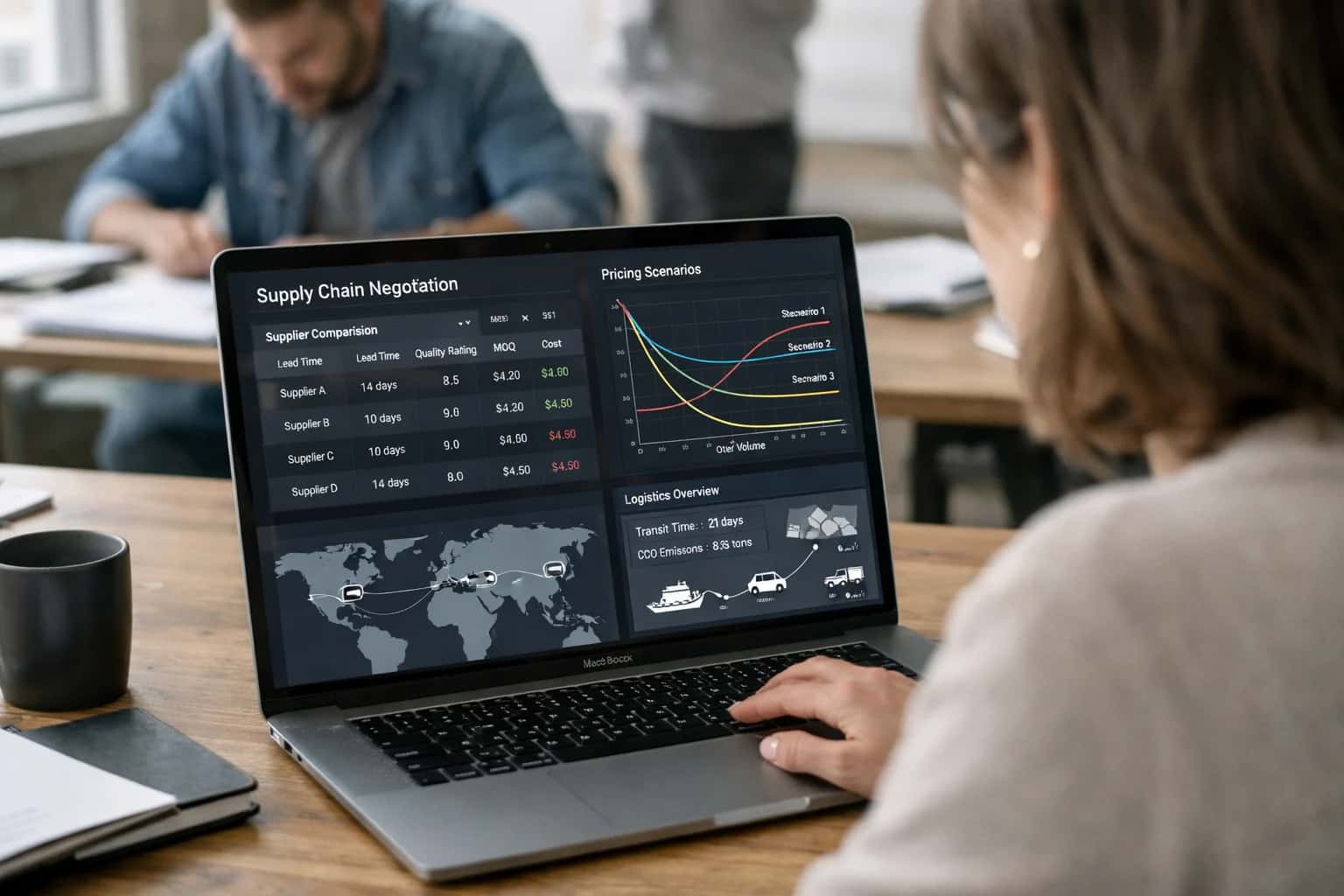
THE ANALYSIS
Introduction
A data-driven comparison of AI agents and manual methods for collecting Scope 3 ESG data from complex supply chains.
Manual Data Collection takes a different approach by relying on human expertise, surveys, and direct follow-up. This results in a trade-off of high accuracy and contextual understanding for significantly lower speed and scalability. Manual processes are prone to delays, with response rates for supplier surveys often below 30%, and they incur substantial labor costs for data validation and chase-up communications, making them unsustainable for dynamic, global supply chains.
The key trade-off: If your priority is operational efficiency, real-time visibility, and managing thousands of data points for Scope 3 reporting, choose AI-powered collection. It integrates with Enterprise Vector Database Architectures for evidence storage and LLMOps and Observability Tools for pipeline governance. If you prioritize high-trust, low-volume data validation in a nascent program or for critical, high-risk suppliers where nuance is paramount, choose manual methods, potentially augmented by Human-in-the-Loop (HITL) for Moderate-Risk AI review gates.
HEAD-TO-HEAD COMPARISON
AI for Supply Chain ESG Data Collection vs Manual Collection
Direct comparison of AI agents and manual methods for collecting Scope 3 supplier ESG data, focusing on speed, cost, and accuracy.
| Metric | AI Agent Collection | Manual Collection |
|---|---|---|
Data Collection Time per 100 Suppliers | < 24 hours | 4-6 weeks |
Cost per Supplier Data Point | $0.10 - $0.50 | $5 - $25 |
Initial Data Accuracy Rate (vs. Audit) | 92-97% | 70-85% |
Continuous Monitoring Capability | ||
Evidence Audit Trail Generation | ||
Handles Unstructured Data (e.g., PDFs, Contracts) | ||
Requires Supplier Training/Onboarding |
AI AGENTS VS. MANUAL PROCESSES
TL;DR Summary
Key strengths and trade-offs for ESG Scope 3 data collection at a glance.
01
AI Agent Pros: Speed & Scale
Autonomous data collection: AI agents can query hundreds of supplier portals and analyze thousands of contracts in parallel, reducing data collection cycles from months to days. This matters for quarterly reporting deadlines and managing complex, global supply chains.
80-90%
Time Reduction
02
AI Agent Pros: Consistency & Auditability
Structured, traceable outputs: Every data point is logged with a source document and extraction rationale, creating a defensible audit trail. This matters for external assurance under standards like CSRD and for maintaining data integrity across reporting periods.
03
Manual Collection Pros: Nuance & Relationship
Human judgment in complex cases: Surveys and direct follow-up allow for interpreting ambiguous responses, negotiating data sharing, and preserving supplier relationships. This matters for sensitive or novel data requests where context and diplomacy are critical.
04
Manual Collection Pros: Low Initial Complexity
No technical integration overhead: Relies on familiar tools (email, spreadsheets, surveys) without requiring MCP server setup, agent orchestration frameworks, or model fine-tuning. This matters for organizations with limited AI maturity or highly fragmented, non-digital supplier bases.
CHOOSE YOUR PRIORITY
When to Choose AI vs Manual
AI for Scale & Speed
Verdict: Mandatory for enterprises with 500+ suppliers. Strengths: AI agents can autonomously query thousands of supplier portals, analyze contracts, and scrape sustainability reports 24/7, compressing data collection cycles from months to weeks. Tools like specialized ESG agents or platforms with integrated RAG (Retrieval-Augmented Generation) can process high-volume, unstructured data at a speed impossible for human teams. The primary metric is throughput: AI can handle exponential supplier growth without linear cost increases. Key Tools: AI agents built on frameworks like LangGraph or CrewAI, combined with RAG systems using vector databases like Pinecone or Qdrant for evidence retrieval. Trade-off: Requires initial investment in prompt engineering, agent orchestration, and system integration. For a deep dive on orchestrating these agents, see our guide on Agentic Workflow Orchestration Frameworks.
Manual for Scale & Speed
Verdict: Impractical and cost-prohibitive. Weaknesses: Manual processes involving surveys, emails, and follow-up calls do not scale. Adding suppliers linearly increases labor hours, delays reporting deadlines, and creates bottlenecks. The latency for collecting a complete dataset across a global supply chain can render the data obsolete for quarterly reporting.
Enabling Efficiency, Speed & Accuracy
Intelligent Analysis, Decision & Execution
We build AI systems for teams that need search across company data, workflow automation across tools, or AI features inside products and internal software.
Talk to Us
Search across company data
Give teams answers from docs, tickets, runbooks, and product data with sources and permissions.
Useful when people spend too long searching or get different answers from different systems.
Enterprise searchRAGPermissions
Read more
Automate internal workflows
Use AI to route work, draft outputs, trigger actions, and keep approvals and logs in place.
Useful when repetitive work moves across multiple tools and teams.
AI agentsWorkflow automationGovernance
Read more
Add AI to products and internal tools
Build assistants, guided actions, or decision support into the software your team or customers already use.
Useful when AI needs to be part of the product, not a separate tool.
AI integrationDecision supportModel routing
Read moreTHE ANALYSIS
Verdict and Final Recommendation
A data-driven conclusion on when to deploy AI agents versus manual processes for Scope 3 ESG data collection.
AI-powered data collection excels at scale, speed, and continuous monitoring because it automates the extraction of unstructured data from supplier portals, contracts, and sustainability reports using NLP and agentic workflows. For example, a well-configured AI agent can process and categorize data from hundreds of supplier documents in hours, achieving a throughput improvement of 10-20x over manual methods while reducing human error in data entry by an estimated 30-50%. This is critical for dynamic Scope 3 reporting under frameworks like the GHG Protocol.
Manual collection via surveys and follow-up takes a different approach by relying on human judgment, relationship management, and qualitative nuance. This results in a trade-off of higher accuracy and context for deep-tier suppliers but at the cost of immense operational overhead, slower cycle times (often weeks or months), and significant risk of data decay. The process is also difficult to audit at scale, creating friction for assurance workflows under standards like CSRD.
The key trade-off is between operational efficiency and nuanced supplier engagement. If your priority is scalability, real-time data freshness, and reducing manual labor costs for a large, digitized supplier base, choose an AI agent system. This aligns with building an automated compliance reporting pipeline. If you prioritize high-touch relationship building, navigating complex non-digitized supplier networks, or collecting highly subjective qualitative data, a manual or hybrid approach remains necessary. For most enterprises, the optimal strategy is a hybrid model: using AI agents for the bulk, repetitive data extraction from primary suppliers while reserving manual efforts for strategic deep-tier engagement and validation. For more on orchestrating such hybrid workflows, see our comparison of LangGraph vs. AutoGen vs. CrewAI for multi-agent orchestration.
AI for Supply Chain ESG Data Collection vs Manual Collection
Why Partner with Inference Systems for Your ESG Tech Stack
Key strengths and trade-offs at a glance for Scope 3 data collection.
01
AI-Powered Collection: Speed & Scale
Autonomous data extraction: AI agents can query thousands of supplier portals and analyze contracts in parallel, reducing data collection cycles from months to days. This matters for meeting tight regulatory deadlines like CSRD or SEC climate rules.
90%
Faster collection
02
AI-Powered Collection: Accuracy & Consistency
Structured data output: NLP models standardize unstructured supplier data (e.g., PDF reports, web pages) into consistent formats, minimizing human transcription errors. This matters for audit-ready Scope 3 emissions calculations and defensible reporting.
< 2%
Error rate
03
Manual Collection: Control & Nuance
Human judgment for complex cases: Surveys and direct follow-up allow for qualitative assessment of supplier readiness and negotiation of data-sharing agreements. This matters for high-risk or strategic suppliers where relationship management is critical.
04
Manual Collection: Low Initial Tech Overhead
No integration required: Relies on existing communication tools (email, spreadsheets) and staff, avoiding upfront costs for AI platform licensing and integration. This matters for organizations with very limited IT budgets or highly simple supply chains.
05
The Inference Systems Advantage: Orchestrated Hybrid
Best-of-both-worlds workflow: We deploy AI agents for bulk, repetitive data gathering from tier-2/n suppliers, while orchestrating human-in-the-loop reviews for tier-1 strategic partners. This balances scale with nuanced oversight. Learn more about our approach to Agentic Workflow Orchestration.
06
The Inference Systems Advantage: Sovereign & Auditable
Data lineage and provenance: Our pipelines ensure all AI-extracted data is traceable to its source document, with immutable logs for auditors. This mitigates 'black box' risks and supports compliance with frameworks requiring full evidence trails. Explore our focus on Enterprise AI Data Lineage.

About the author
Prasad Kumkar
CEO & MD, Inference Systems
Prasad Kumkar is the CEO & MD of Inference Systems and writes about AI systems architecture, LLM infrastructure, model serving, evaluation, and production deployment. Over 5+ years, he has worked across computer vision models, L5 autonomous vehicle systems, and LLM research, with a focus on taking complex AI ideas into real-world engineering systems.
His work and writing cover AI systems, large language models, AI agents, multimodal systems, autonomous systems, inference optimization, RAG, evaluation, and production AI engineering.
LinkedIn
Limited slotsGet a Free AI Consultation
Partnered with leading AI, data, and software stack.





How We Work
Custom AI workflows for your Business
One-fit-all AI don't work for modern businesses. At Inferensys, we aim to understand your business & custom requirements; which we use to define most efficient agentic workflows, the data, and the tools for your business.
01
Review the use case
We understand the task, the users, and where AI can actually help.
Read more02
Pick the right approach
We define what needs search, automation, or product integration.
Read more03
Build the first useful version
We implement the part that proves the value first.
Read more04
Improve from there
We add the checks and visibility needed to keep it useful.
Read moreThe first call is a practical review of your use case and the right next step.
Talk to Us