The core pain point is information overload. Analysts spend 70-80% of their time manually collecting, cleaning, and summarizing data from disparate sources—earnings calls, SEC filings, news feeds, and alternative datasets. This leaves minimal time for high-value analysis, creating a bottleneck that delays decisions and misses market-moving signals buried in unstructured text and complex financial models. The cost is missed opportunities and slower time-to-insight.

Use Case
AI-Driven Investment Research Assistant
Accelerate equity research and due diligence by 70% with an AI copilot that synthesizes earnings calls, financial filings, and global news into actionable insights.
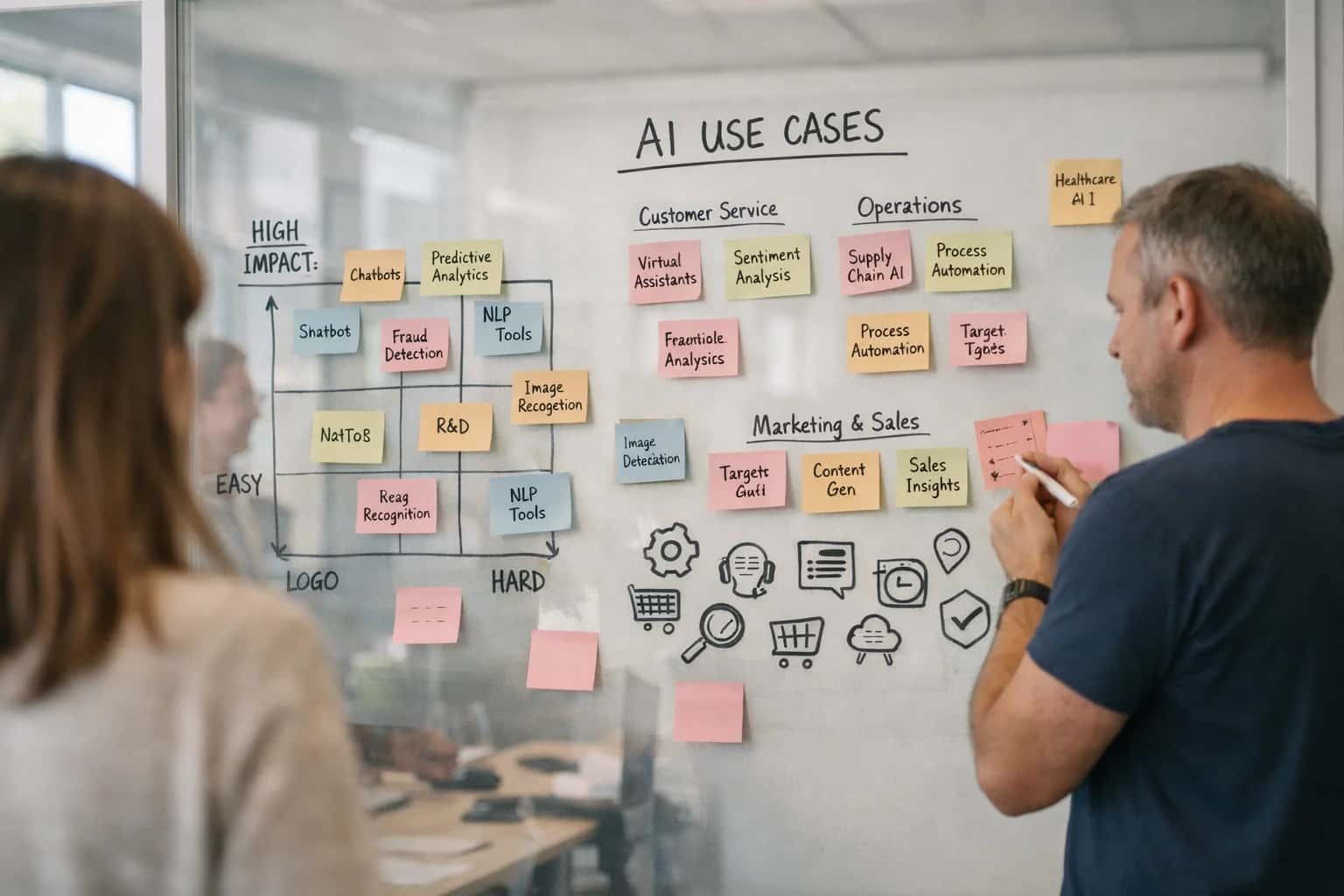
USE CASES
What is an AI-Driven Investment Research Assistant Used For?
An AI-Driven Investment Research Assistant transforms how analysts and portfolio managers uncover alpha, moving from manual data wrangling to strategic insight generation.
The AI fix is a high-fidelity decision intelligence copilot. It automates data synthesis, providing instant summaries of key themes from earnings calls, extracting critical metrics from 10-K filings, and flagging sentiment shifts in global news. This accelerates the research cycle by over 70%, allowing teams to focus on hypothesis testing and strategy. The measurable outcome is faster, evidence-based investment decisions and a quantifiable edge in portfolio performance. For deeper context, see our pillar on FinTech and High-Fidelity Decision Intelligence and related solutions like our Algorithmic Trading Signal Generation.
AI-DRIVEN INVESTMENT RESEARCH
Common Use Cases
Move beyond manual data gathering. These use cases demonstrate how an AI research assistant delivers quantifiable ROI by accelerating analysis, uncovering hidden insights, and empowering investment teams.
01
Accelerated Equity Research
Transform a multi-day research process into hours. The AI assistant ingests and synthesizes thousands of pages of earnings call transcripts, 10-K/Q filings, and analyst reports to produce a consolidated, evidence-backed investment thesis.
- Real Example: A hedge fund analyst reduced initial due diligence on a mid-cap stock from 40 hours to 12, freeing capacity to evaluate three additional opportunities.
- Key Benefit: 70% faster research cycles enable analysts to cover more securities and react to market-moving events in near real-time.
70%
Faster Research Cycles
02
Sentiment & Risk Signal Detection
Go beyond financials to quantify market sentiment and emerging risks. The AI continuously monitors global news, social media, and regulatory filings to detect shifts in narrative, executive tone, or supply chain disruptions that may impact valuation.
- Real Example: An asset manager identified negative sentiment clustering around a key supplier in niche forums six weeks before a profit warning, enabling proactive portfolio adjustment.
- Key Benefit: Proactive risk management and alpha generation through non-traditional, unstructured data analysis.
03
Automated Competitive Landscape Analysis
Instantly map a company's position relative to its peers. The AI extracts and compares KPIs, growth strategies, and market commentary across an entire sector, generating a dynamic competitive matrix.
- Real Example: A private equity firm conducting due diligence used AI to benchmark a target company's R&D spend and patent activity against five competitors in <2 hours, a task previously requiring a week.
- Key Benefit: Enables data-driven, objective comparisons at scale, improving the quality of investment committee decisions.
04
Thematic Investment & Trend Spotting
Systematically identify companies exposed to high-growth themes like AI infrastructure or decarbonization. The AI scans business descriptions, product launches, and partnership announcements to tag and score companies based on thematic relevance.
- Real Example: A thematic ETF provider uses AI to maintain and rebalance its 'Future of Mobility' index, ensuring constituent companies derive significant revenue from autonomous, electric, or shared transport.
- Key Benefit: Powers systematic, repeatable investment strategies and ensures portfolio alignment with long-term thematic theses.
05
Earnings Call Q&A Intelligence
Surface what matters most from quarterly earnings. The AI analyzes the Q&A session—where the most revealing insights often emerge—to highlight management's confidence, evasion on key topics, and changes in narrative versus prior quarters.
- Real Example: An analyst identified a subtle but consistent shift in a CEO's language regarding margin guidance over four consecutive quarters, signaling underlying cost pressures before they appeared in financials.
- Key Benefit: Extracts nuanced, forward-looking signals that are often missed in standard transcript reviews.
06
ROI Justification for CIOs
Quantify the business case for AI-powered research. Justification is built on tangible efficiency gains and alpha potential.
- Cost Savings: Reduces reliance on expensive third-party data terminals and external research subscriptions by 20-30%.
- Capacity Creation: Enables each analyst to effectively cover 30-50% more securities, deferring hiring costs.
- Risk Mitigation: Provides an auditable, consistent research process that reduces reliance on individual analyst bias or oversight.
This transforms the research desk from a cost center into a scalable, technology-driven alpha engine.
FROM PILOT TO PRODUCTION
How It Works: The Implementation Roadmap
Transitioning from manual research to an AI copilot is a strategic operational shift. This roadmap outlines the phased, low-risk path to achieving a 70% acceleration in equity research and due diligence.
The core pain point is information overload. Analysts spend up to 80% of their time manually sifting through earnings calls, 10-K filings, and news feeds, struggling to synthesize disparate data into a coherent investment thesis. This manual process is slow, prone to human bias, and creates a bottleneck that delays critical decisions, allowing competitors to act first. The business cost is measured in missed alpha and inefficient allocation of high-cost talent.
The solution is a phased deployment of an AI research assistant. Phase 1 automates data ingestion and summarization of key documents. Phase 2 introduces cross-source synthesis, where the AI identifies contradictions and correlations across filings and news. The measurable outcome is a 70% reduction in initial research time, freeing analysts to focus on high-judgment strategy and client engagement. This directly translates to faster trade execution and improved portfolio performance. For a deeper dive on the underlying decision intelligence, explore our pillar on FinTech and High-Fidelity Decision Intelligence.
Enabling Efficiency, Speed & Accuracy
Intelligent Analysis, Decision & Execution
We build AI systems for teams that need search across company data, workflow automation across tools, or AI features inside products and internal software.
Talk to Us
Search across company data
Give teams answers from docs, tickets, runbooks, and product data with sources and permissions.
Useful when people spend too long searching or get different answers from different systems.
Enterprise searchRAGPermissions
Read more
Automate internal workflows
Use AI to route work, draft outputs, trigger actions, and keep approvals and logs in place.
Useful when repetitive work moves across multiple tools and teams.
AI agentsWorkflow automationGovernance
Read more
Add AI to products and internal tools
Build assistants, guided actions, or decision support into the software your team or customers already use.
Useful when AI needs to be part of the product, not a separate tool.
AI integrationDecision supportModel routing
Read moreENTERPRISE ADOPTION
Key Challenges & Mitigations
Deploying an AI research assistant requires navigating critical hurdles around data, compliance, and ROI. This section addresses the most common enterprise objections with practical, business-focused solutions.
Financial AI operates under strict regulations like MiFID II, FINRA, and SEC guidelines. Our approach embeds compliance into the system's architecture, not as an afterthought.
Key mitigations include:
- Audit Trails & Attribution: Every insight generated by the AI is fully traceable, linking back to the source documents (e.g., specific paragraphs in a 10-K filing) for human verification and auditability.
- Controlled Data Sourcing: The system is configured to only ingest and process data from pre-approved, vetted sources, preventing the use of unverified or non-compliant information.
- Human-in-the-Loop (HITL) Gates: Critical outputs, such as investment theses or risk assessments, are flagged for mandatory review by a licensed analyst before dissemination, ensuring final human accountability.
This structured governance transforms the AI from a 'black box' into a compliant, auditable research tool that enhances, rather than replaces, analyst judgment.

About the author
Prasad Kumkar
CEO & MD, Inference Systems
Prasad Kumkar is the CEO & MD of Inference Systems and writes about AI systems architecture, LLM infrastructure, model serving, evaluation, and production deployment. Over 5+ years, he has worked across computer vision models, L5 autonomous vehicle systems, and LLM research, with a focus on taking complex AI ideas into real-world engineering systems.
His work and writing cover AI systems, large language models, AI agents, multimodal systems, autonomous systems, inference optimization, RAG, evaluation, and production AI engineering.
LinkedIn
Limited slotsGet a Free AI Consultation
Partnered with leading AI, data, and software stack.





How We Work
Custom AI workflows for your Business
One-fit-all AI don't work for modern businesses. At Inferensys, we aim to understand your business & custom requirements; which we use to define most efficient agentic workflows, the data, and the tools for your business.
01
Review the use case
We understand the task, the users, and where AI can actually help.
Read more02
Pick the right approach
We define what needs search, automation, or product integration.
Read more03
Build the first useful version
We implement the part that proves the value first.
Read more04
Improve from there
We add the checks and visibility needed to keep it useful.
Read moreThe first call is a practical review of your use case and the right next step.
Talk to Us