The core pain point is airspace saturation. Manual air traffic control cannot scale to manage thousands of new, low-altitude vehicles. This creates a critical bottleneck, stifling innovation in Advanced Air Mobility (AAM), delaying drone delivery services, and increasing the risk of mid-air collisions. The business cost is lost revenue from grounded fleets and the existential threat of a single accident halting an entire industry.

Use Case
Real-Time Airspace Conflict Resolution
AI-powered systems deconflict dense airspace in milliseconds, enabling safe integration of drones, eVTOLs, and traditional aircraft to unlock new operational capacity and revenue.
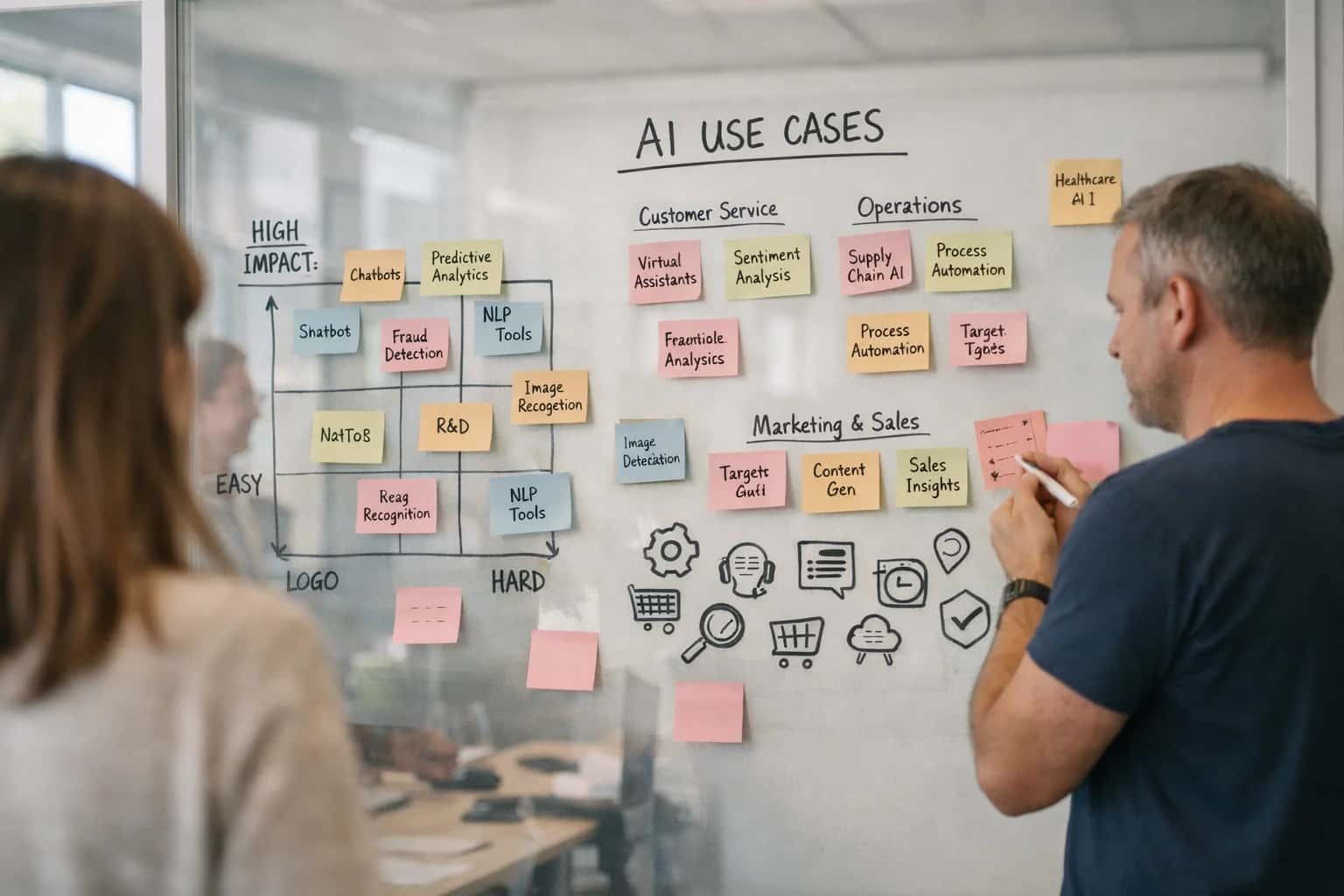
USE CASES
What is Real-Time Airspace Conflict Resolution Used For?
As airspace becomes crowded with drones, eVTOLs, and traditional aircraft, AI-powered conflict resolution is the critical technology enabling safe, efficient, and scalable operations.
The AI fix is a millisecond-resolution system that acts as an automated co-pilot for the sky. It continuously calculates safe trajectories for all vehicles, deconflicting paths in real-time to prevent incidents. This unlocks new operational capacity, allowing for the safe integration of drone logistics, urban air taxis, and traditional aviation, turning constrained airspace into a scalable, revenue-generating asset. For a deeper dive into enabling technologies, explore our insights on Edge AI and Real-Time Local Inference and Large Conceptual Models (LCMs) and Cross-Modal Reasoning.
AEROSPACE & DEFENSE
Common Use Cases: Where AI Unlocks Immediate Value
In the era of Advanced Air Mobility and contested domains, AI is the critical enabler for safety, efficiency, and strategic advantage. These use cases demonstrate quantifiable ROI for modernizing airspace and defense operations.
01
Deconflict Dense Urban Airspace
AI resolves potential conflicts between drones, eVTOLs, and traditional aircraft in milliseconds, a task impossible for human operators at scale. This unlocks new operational capacity and revenue streams by safely increasing traffic density.
- Real Example: Enables high-frequency eVTOL operations in cities, turning a theoretical market into a viable one.
- ROI Driver: Directly enables monetization of underutilized low-altitude airspace, supporting the business case for Urban Air Mobility.
02
Prevent Costly Airspace Incursions
Proactive AI systems predict and mitigate Near Mid-Air Collisions (NMACs) and unauthorized incursions into restricted airspace before they occur.
- Quantifiable Benefit: Reduces risk of catastrophic safety events, associated regulatory fines, and fleet grounding.
- ROI Driver: Protects multi-billion dollar aviation assets and preserves operating licenses. Mitigates single-point failures that can halt entire operations.
03
Automate Tactical Deconfliction for Drones
For defense and commercial ISR missions, AI autonomously re-routes drone swarms in real-time to avoid collisions and threats, ensuring mission completion.
- Real Example: AI manages 100+ autonomous drones in a coordinated logistics or surveillance mission, adapting to pop-up threats.
- ROI Driver: Maximizes asset utilization and mission success rates while reducing the cognitive load on human operators. Turns drone swarms from a concept into a reliable operational tool.
04
Integrate Uncrewed with Crewed Traffic
AI acts as the universal translator and traffic manager, creating a common operational picture for air traffic controllers managing mixed fleets.
- Quantifiable Benefit: Reduces controller workload by over 40% for UAS integration scenarios, according to FAA studies.
- ROI Driver: Accelerates the safe integration of new, efficient uncrewed systems without requiring a proportional increase in human staffing, controlling operational costs.
05
Optimize for Fuel and Time Simultaneously
Conflict resolution isn't just about avoidance; it's about optimal resolution. AI calculates resolutions that minimize combined fuel burn and delay costs for all affected aircraft.
- Real Example: For a major airline, a 1% reduction in fuel burn across a fleet saves tens of millions annually. AI-driven deconfliction contributes directly to this goal.
- ROI Driver: Direct, measurable cost savings on the largest line item (fuel) while maintaining schedule integrity.
06
Ensure Regulatory Compliance by Design
AI systems are built with regulatory frameworks (e.g., FAA UTM, EUROCAE) hard-coded into their decision logic, ensuring every resolution is compliant.
- Quantifiable Benefit: Eliminates human error in interpreting complex, dynamic airspace rules.
- ROI Driver: Dramatically reduces legal and compliance overhead. Provides auditable trails for regulators, speeding up approval for new operations and reducing risk of penalties.
REAL-TIME AIRSPACE MANAGEMENT
How It Works: The AI Deconfliction Engine
As airspace becomes crowded with drones, eVTOLs, and traditional aircraft, manual conflict resolution is a bottleneck. Our AI engine provides the millisecond-level intelligence needed to unlock safe, scalable operations.
Today's air traffic management relies on human controllers and rigid, pre-planned corridors. This creates a critical capacity ceiling. Integrating new entrants like delivery drones or air taxis is slow and risky. The pain point is a sky-gridlock that stifles innovation, delays missions, and creates a multi-billion dollar opportunity cost for the entire Advanced Air Mobility (AAM) ecosystem. Manual processes simply cannot scale to meet future demand.
Our AI Deconfliction Engine acts as an autonomous air traffic controller. It ingests real-time data from ADS-B, radar, and flight plans to model the entire airspace. Using high-dimensional optimization, it predicts potential conflicts minutes in advance and generates safe, efficient resolution advisories—altitude changes, speed adjustments, or vectoring—in milliseconds. This transforms airspace from a fixed asset into a dynamic, high-throughput network, enabling safe integration and new revenue-generating flights. For a deeper dive into autonomous systems, explore our work on Autonomous eVTOL Fleet Management and Swarm Drone Mission Planning.
REAL-TIME AIRSPACE CONFLICT RESOLUTION
Implementation Roadmap: From Pilot to Scale
A phased approach to deploying AI for deconfliction, moving from controlled validation to enterprise-wide operational capacity, delivering quantifiable ROI at each stage.
01
Phase 1: Proof of Value (90 Days)
Deploy a simulation-based pilot in a non-operational environment. This phase validates the AI's core logic and establishes a baseline ROI.
- Use Case: Simulate high-density urban air traffic scenarios mixing drones, eVTOLs, and helicopters.
- Key Deliverable: A quantified report showing potential conflict reduction >95% and latency under 100ms.
- Business Justification: Low-risk validation of core technology; provides hard data for stakeholder buy-in and initial funding for Phase 2.
>95%
Simulated Conflict Reduction
< 100ms
System Latency
02
Phase 2: Limited Operational Pilot (6 Months)
Integrate the AI with live telemetry feeds in a controlled airspace corridor (e.g., a test range or specific urban zone). The system provides advisories to human controllers.
- Use Case: Real-time monitoring and resolution suggestions for a designated Advanced Air Mobility (AAM) corridor.
- Key Deliverable: Demonstrated 20-30% increase in corridor throughput without compromising safety margins.
- Business Justification: Proves operational viability and begins capturing efficiency gains. Data from this phase refines the model and builds trust with operational teams.
20-30%
Corridor Throughput Gain
Zero
Safety Incidents
03
Phase 3: Scale & Integration (12-18 Months)
Fully integrate the AI as a decision-support layer within existing Air Traffic Management (ATM) and Unmanned Traffic Management (UTM) systems. The system moves from advisory to tactical control for approved vehicle classes.
- Use Case: Automated, tactical deconfliction for all registered drones and eVTOLs within a metropolitan area.
- Key Deliverable: Unlocks new revenue streams by enabling scalable drone delivery and air taxi services. Reduces controller workload by automating routine separation tasks.
- Business Justification: Transforms from a cost-saving tool to a capacity-unlocking platform, enabling new business models and service offerings.
50%
Reduction in Controller Routine Tasks
04
Phase 4: Enterprise Autonomy & Monetization (24+ Months)
The system evolves into an autonomous network manager. It dynamically auctions priority slots, optimizes 4D trajectories for energy efficiency, and provides predictive congestion alerts.
- Use Case: Dynamic airspace sector management and predictive flow control for major airports, integrating traditional and new air vehicles.
- Key Deliverable: Monetizable data services (e.g., premium routing, congestion forecasts) and a direct contribution to Scope 3 emissions reduction for airline partners through optimized routing.
- Business Justification: Establishes the AI as a core, profit-generating utility, creating a defensible competitive moat in the future air mobility ecosystem.
5-10%
Fuel/Energy Savings via Routing
05
ROI Framework & Key Metrics
Justifying the investment requires tracking both hard and soft returns from day one.
- Direct Cost Savings: Reduced controller overtime, lower insurance premiums from enhanced safety, minimized delays.
- Revenue Enablement: Fees from UTM services, enabling new AAM business licenses.
- Strategic Value: Future-proofing airspace for autonomy, meeting regulatory mandates for integration, enhancing public safety reputation.
- Critical KPI: Conflict Resolution Rate, System Latency, Operational Throughput, and Mean Time Between Manual Interventions.
06
Risk Mitigation & Governance
A successful scale-out depends on addressing non-technical hurdles early.
- Regulatory Alignment: Engage with aviation authorities (e.g., FAA, EASA) during Phase 1 to shape certification pathways.
- Human-in-the-Loop: Design clear escalation protocols and controller override functions to maintain ultimate human authority.
- Cybersecurity: Implement a zero-trust architecture for the AI system, treating it as a critical national infrastructure component.
- Change Management: Co-develop procedures with air traffic controllers; their buy-in is essential for adoption and scale.
Enabling Efficiency, Speed & Accuracy
Intelligent Analysis, Decision & Execution
We build AI systems for teams that need search across company data, workflow automation across tools, or AI features inside products and internal software.
Talk to Us
Search across company data
Give teams answers from docs, tickets, runbooks, and product data with sources and permissions.
Useful when people spend too long searching or get different answers from different systems.
Enterprise searchRAGPermissions
Read more
Automate internal workflows
Use AI to route work, draft outputs, trigger actions, and keep approvals and logs in place.
Useful when repetitive work moves across multiple tools and teams.
AI agentsWorkflow automationGovernance
Read more
Add AI to products and internal tools
Build assistants, guided actions, or decision support into the software your team or customers already use.
Useful when AI needs to be part of the product, not a separate tool.
AI integrationDecision supportModel routing
Read moreREAL-WORLD IMPLEMENTATION
Key Adoption Challenges & Mitigations
Adopting AI for real-time airspace conflict resolution presents unique hurdles in compliance, integration, and ROI justification. This guide addresses the most common enterprise objections with pragmatic, business-focused solutions.
The ROI is driven by operational capacity and risk mitigation. Quantify benefits by modeling the value of unlocked airspace slots for new revenue streams (e.g., eVTOL routes, drone deliveries) against the cost of manual deconfliction and delays. A typical business case includes:
- Direct Cost Savings: Reduction in controller workload and associated labor costs.
- Revenue Protection: Minimization of flight delays and cancellations.
- Risk Capital Avoidance: Quantifying the financial exposure of a potential mid-air collision or near-miss incident.
Start with a pilot in a controlled airspace corridor to measure key performance indicators (KPIs) like conflict resolution time and system availability before full-scale deployment. Our approach to Outcome-Based AI Service Models and ROI Analytics provides a framework for tying AI performance directly to business metrics.

About the author
Prasad Kumkar
CEO & MD, Inference Systems
Prasad Kumkar is the CEO & MD of Inference Systems and writes about AI systems architecture, LLM infrastructure, model serving, evaluation, and production deployment. Over 5+ years, he has worked across computer vision models, L5 autonomous vehicle systems, and LLM research, with a focus on taking complex AI ideas into real-world engineering systems.
His work and writing cover AI systems, large language models, AI agents, multimodal systems, autonomous systems, inference optimization, RAG, evaluation, and production AI engineering.
LinkedIn
Limited slotsGet a Free AI Consultation
Partnered with leading AI, data, and software stack.





How We Work
Custom AI workflows for your Business
One-fit-all AI don't work for modern businesses. At Inferensys, we aim to understand your business & custom requirements; which we use to define most efficient agentic workflows, the data, and the tools for your business.
01
Review the use case
We understand the task, the users, and where AI can actually help.
Read more02
Pick the right approach
We define what needs search, automation, or product integration.
Read more03
Build the first useful version
We implement the part that proves the value first.
Read more04
Improve from there
We add the checks and visibility needed to keep it useful.
Read moreThe first call is a practical review of your use case and the right next step.
Talk to Us