Traditional supply chain planning is static, based on forecasts that are instantly outdated by port closures, demand spikes, or supplier failures. This creates a cascade of pain points: excess safety stock tying up capital, emergency air freight burning margin, and missed sales from stockouts. The financial impact is severe, with logistics costs consuming 10-15% of revenue and customer loyalty eroding with every delayed shipment.

Use Case
Dynamic Supply Chain Optimization
AI models solve complex logistics problems in seconds, rerouting shipments and reallocating inventory to minimize costs and delays, delivering measurable ROI.
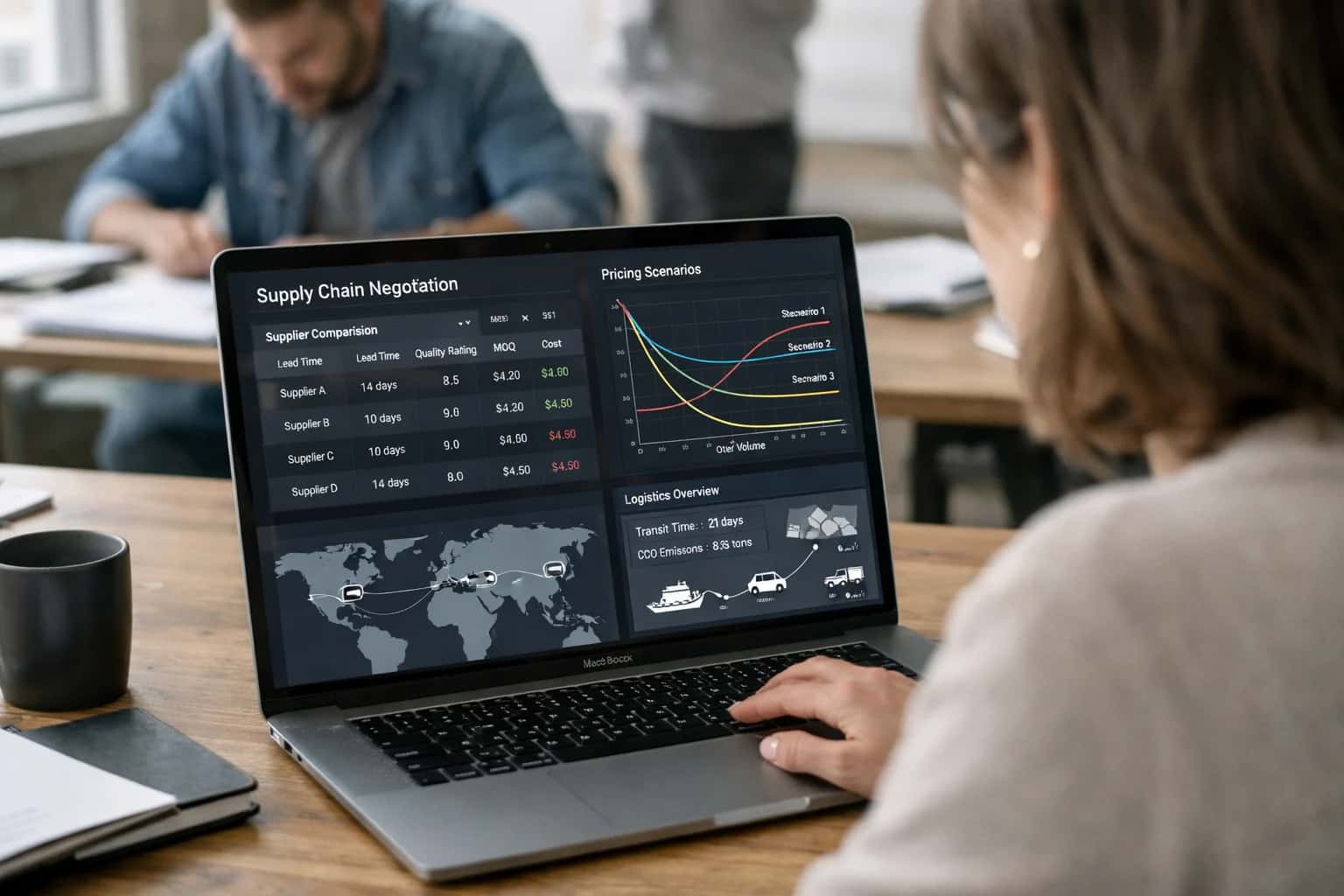
FROM REACTIVE TO PROACTIVE
What is Dynamic Supply Chain Optimization Used For?
Modern supply chains are fragile, reacting to disruptions with costly delays and excess inventory. Dynamic optimization uses AI to transform them into resilient, self-correcting networks.
AI-powered dynamic optimization acts as a Logistics Control Tower, processing thousands of variables—weather, GPS telemetry, carrier rates, warehouse capacity—in seconds. It provides prescriptive actions: reroute a shipment from a congested port, reallocate inventory between distribution centers, or switch transportation modes. The outcome is measurable: 15-20% lower logistics costs, 30% faster lead times, and inventory reductions of up to 25%, directly boosting EBITDA and competitive agility. For a deeper dive, explore our pillar on High-Dimensional Optimization or the related topic of Real-Time Logistics Network Optimization.
DYNAMIC SUPPLY CHAIN OPTIMIZATION
Common Use Cases: Where AI Delivers Immediate ROI
In today's volatile market, static supply chains are a liability. These AI-driven solutions deliver measurable ROI by transforming logistics from a cost center into a competitive weapon.
01
Predictive Inventory Rebalancing
AI forecasts demand shifts with 95%+ accuracy, triggering autonomous inventory transfers between warehouses before stockouts or overstock occur. This reduces carrying costs by up to 30% and improves service levels.
- Real Example: A global retailer uses this to maintain optimal stock across 500+ stores, cutting lost sales by 18%.
- ROI Driver: Capital is freed from stagnant inventory and redeployed.
02
Autonomous Carrier Selection & Negotiation
An AI Logistics Control Tower evaluates real-time rates, capacity, and performance data across hundreds of carriers. It automatically books and reroutes shipments, securing the best cost-service balance instantly.
- Real Example: A manufacturer saved 22% on annual freight spend by automating spot-market negotiations.
- ROI Driver: Direct reduction in transportation costs, the second-largest supply chain expense.
03
Real-Time Multi-Modal Route Optimization
AI solves the 'traveling salesman problem' at scale, dynamically replanning routes for thousands of vehicles. It factors in traffic, weather, fuel costs, and delivery windows to cut miles and delays.
- Real Example: A logistics provider reduced route planning from 4 hours to seconds, lowering fuel consumption by 15%.
- ROI Driver: Lower fuel and labor costs, plus increased asset utilization.
04
AI-Powered Risk Mitigation & Rerouting
Continuously monitors global events—port closures, strikes, weather—and simulates hundreds of contingency plans in seconds. It prescribes optimal reroutes to avoid disruptions before they cause delays.
- Real Example: An automotive company avoided a 2-week plant shutdown by rerouting a critical component shipment around a hurricane.
- ROI Driver: Prevents millions in lost production and expedited shipping fees.
05
Dynamic Warehouse Slotting & Task Optimization
AI analyzes order patterns and product dimensions to dynamically reassign storage locations, minimizing picker travel. It also sequences and assigns tasks to robots and humans for maximum throughput.
- Real Example: A 3PL operator increased picks per hour by 35% without adding staff.
- ROI Driver: Higher labor productivity and warehouse capacity from existing footprint.
06
Integrated Demand-Supply Orchestration
Moves beyond siloed planning. AI creates a single, synchronized plan across procurement, production, and distribution. It balances customer service goals with working capital constraints across thousands of SKUs.
- Real Example: A consumer goods company reduced forecast error by 40% and improved on-time-in-full (OTIF) to 98.5%.
- ROI Driver: Perfect order fulfillment drives revenue, while optimized inventory cuts costs.
HOW IT WORKS: THE AI IMPLEMENTATION JOURNEY
Dynamic Supply Chain Optimization
Traditional supply chains are brittle, reacting to disruptions with costly, manual interventions. AI transforms this into a resilient, self-optimizing system that senses and adapts in real-time.
The core pain point is volatility. A single port closure or supplier delay creates a cascade of manual re-planning, expedited shipping costs, and stockouts. Legacy systems operate on static schedules, unable to process the thousands of interacting variables—from weather and traffic to demand spikes and carrier capacity—that define modern logistics. This reactive posture erodes margins and customer trust.
Our AI solution acts as a Logistics Control Tower, ingesting real-time data from across your ecosystem. It runs continuous simulations, solving complex routing and allocation problems in seconds. The outcome is a dynamic, resilient network: shipments are proactively rerouted, inventory is rebalanced autonomously, and costs are minimized. This translates to a 15-20% reduction in logistics expenses and a 25% improvement in on-time delivery, turning your supply chain into a competitive weapon. For related insights, explore our work on Real-Time Logistics Network Optimization and Automated Fleet Route Optimization.
Enabling Efficiency, Speed & Accuracy
Intelligent Analysis, Decision & Execution
We build AI systems for teams that need search across company data, workflow automation across tools, or AI features inside products and internal software.
Talk to Us
Search across company data
Give teams answers from docs, tickets, runbooks, and product data with sources and permissions.
Useful when people spend too long searching or get different answers from different systems.
Enterprise searchRAGPermissions
Read more
Automate internal workflows
Use AI to route work, draft outputs, trigger actions, and keep approvals and logs in place.
Useful when repetitive work moves across multiple tools and teams.
AI agentsWorkflow automationGovernance
Read more
Add AI to products and internal tools
Build assistants, guided actions, or decision support into the software your team or customers already use.
Useful when AI needs to be part of the product, not a separate tool.
AI integrationDecision supportModel routing
Read moreDYNAMIC SUPPLY CHAIN OPTIMIZATION
Implementation Roadmap: From Pilot to Scale
A phased approach to deploying AI for logistics intelligence, moving from a contained proof-of-concept to enterprise-wide orchestration that delivers measurable ROI.
01
Phase 1: The Strategic Pilot
Start with a contained, high-impact problem to prove value and build internal buy-in. This phase focuses on data unification and a single optimization objective, such as minimizing shipping costs for a specific lane or reducing stockouts for a top-selling SKU.
- Example: A consumer goods company uses AI to optimize last-mile delivery routes for a single metropolitan area, achieving a 15% reduction in fuel costs within 90 days.
- Key Deliverable: A clear ROI calculation and a stakeholder-approved business case for scaling.
02
Phase 2: Integrated Network Optimization
Expand the AI's scope to optimize across multiple, interdependent variables. Integrate real-time data feeds for demand sensing, inventory levels, and carrier performance.
- Core Benefit: The system moves from solving isolated problems to performing multi-echelon inventory optimization, dynamically reallocating stock across warehouses to prevent overstock and shortages simultaneously.
- Real-World Impact: A global manufacturer used this phase to reduce safety stock by 22% while improving service levels, freeing up $50M+ in working capital.
03
Phase 3: Autonomous Control Tower
Deploy an agentic orchestration layer that makes prescriptive decisions and executes workflows. The system acts as a Logistics Control Tower, automatically rerouting shipments during disruptions, negotiating with carrier APIs, and triggering purchase orders.
- How it Works: AI agents monitor for exceptions (port closures, weather delays) and execute pre-defined playbooks or generate new recovery plans in seconds, not days.
- Business Justification: Reduces manual firefighting, cuts premium freight costs by up to 35%, and provides customers with proactive, accurate delivery updates.
04
Phase 4: Predictive & Prescriptive Scaling
Leverage the unified data platform and AI models for forward-looking intelligence. This phase shifts from reactive optimization to predictive resilience.
- Key Capabilities:
- Predictive Delay Forecasting: Models geopolitical, weather, and capacity data to flag risks weeks in advance.
- Prescriptive Sourcing: AI recommends dual-sourcing or nearshoring strategies based on total landed cost and risk scores.
- Carbon-Aware Logistics: Optimizes routes and modes not just for cost and speed, but also to meet Scope 3 emissions targets, a growing board-level priority.
05
Measuring ROI: The CIO's Dashboard
Justification requires hard metrics. A successful Dynamic Supply Chain Optimization program should deliver against these KPIs within 18-24 months:
- Cost Savings: 15-25% reduction in total logistics costs (transport, warehousing, inventory carrying).
- Working Capital: 20-30% reduction in cycle stock and safety inventory.
- Service Level: Improvement in on-time, in-full (OTIF) delivery rates by 5-15 percentage points.
- Resilience: 50% faster recovery time from major supply chain disruptions.
06
Overcoming Common Scaling Hurdles
Acknowledge and plan for these challenges to ensure a smooth scale-up.
- Data Silos: Legacy ERP and TMS systems create friction. Budget for a lightweight data unification layer as a prerequisite for Phase 2.
- Change Management: Warehouse and logistics staff may resist AI-prescribed workflows. Implement AI-human collaboration frameworks where the AI suggests and the expert validates.
- Model Governance: As the system scales, establish MLOps practices for continuous retraining, monitoring for data drift, and ensuring model decisions remain explainable to auditors.

About the author
Prasad Kumkar
CEO & MD, Inference Systems
Prasad Kumkar is the CEO & MD of Inference Systems and writes about AI systems architecture, LLM infrastructure, model serving, evaluation, and production deployment. Over 5+ years, he has worked across computer vision models, L5 autonomous vehicle systems, and LLM research, with a focus on taking complex AI ideas into real-world engineering systems.
His work and writing cover AI systems, large language models, AI agents, multimodal systems, autonomous systems, inference optimization, RAG, evaluation, and production AI engineering.
LinkedIn
Limited slotsGet a Free AI Consultation
Partnered with leading AI, data, and software stack.





How We Work
Custom AI workflows for your Business
One-fit-all AI don't work for modern businesses. At Inferensys, we aim to understand your business & custom requirements; which we use to define most efficient agentic workflows, the data, and the tools for your business.
01
Review the use case
We understand the task, the users, and where AI can actually help.
Read more02
Pick the right approach
We define what needs search, automation, or product integration.
Read more03
Build the first useful version
We implement the part that proves the value first.
Read more04
Improve from there
We add the checks and visibility needed to keep it useful.
Read moreThe first call is a practical review of your use case and the right next step.
Talk to Us