Neural networks fail to model soil because they lack the underlying physical equations governing granular mechanics, treating soil as a statistical pattern instead of a complex, multi-phase material.
Blog
Why Neural Networks Struggle with the Physics of Soil Interaction
Standard neural networks fail to model the chaotic, granular physics of soil-tool interaction. This deep dive explains the fundamental mismatch between data-driven AI and physical reality, and outlines the hybrid approaches needed for autonomous construction.
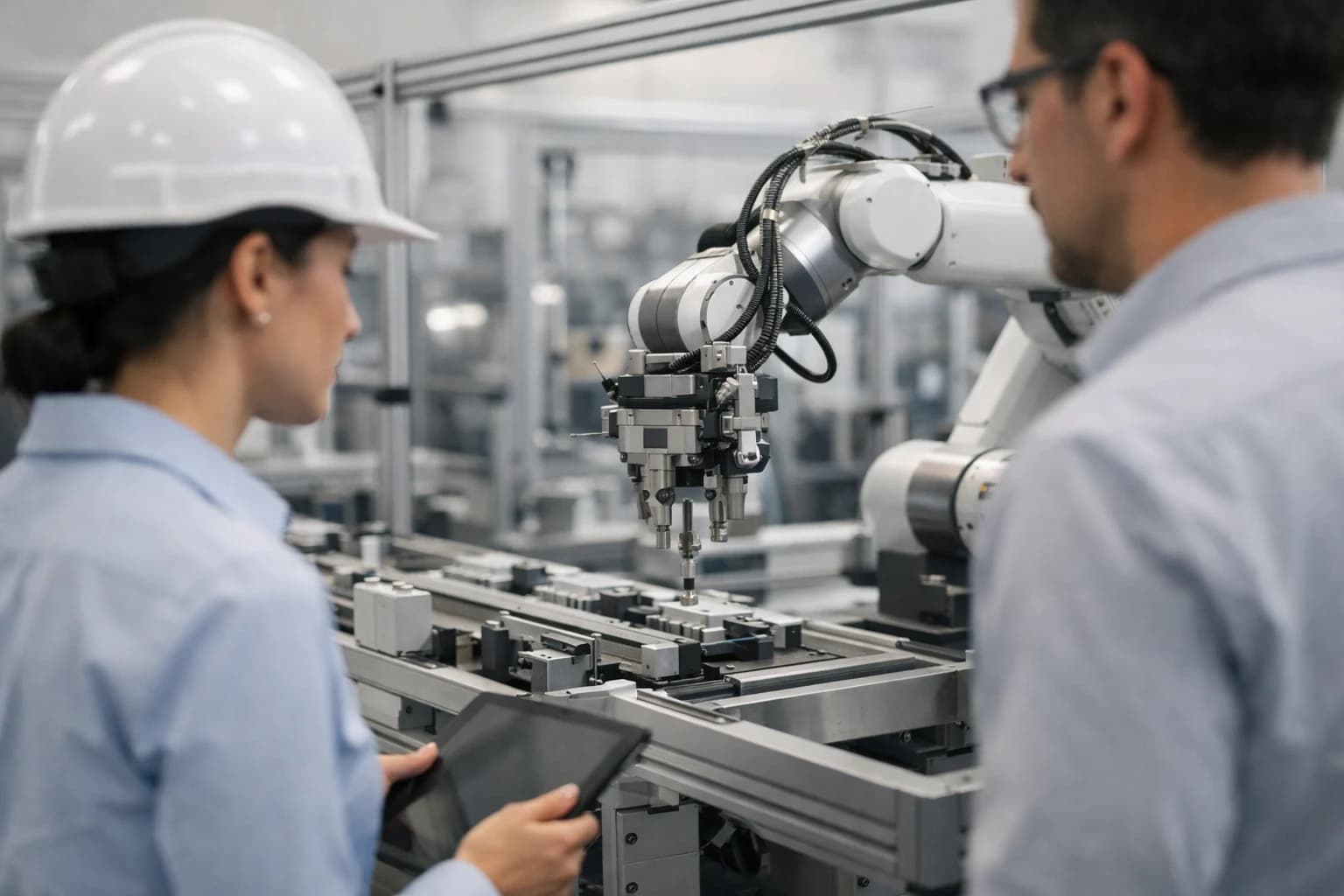
THE PHYSICS
The Granular Reality That Breaks AI
The non-linear, chaotic nature of soil-tool interaction exposes the fundamental limitations of pure data-driven neural networks.
Training data is catastrophically insufficient to capture the state space of soil behavior. The combinatorial explosion of moisture, density, grain size, and tool geometry creates more possible interactions than any feasible dataset from a company like Caterpillar or Komatsu can contain.
Pure imitation learning is a dead end. Systems that simply copy human operator telemetry fail in novel conditions because they learn correlations, not the causal physics of shear failure and compaction. This is why AI assistive systems for mini-excavators get stuck in pilot purgatory.
Simulation is the only viable path. High-fidelity tools like NVIDIA Omniverse, coupled with Discrete Element Method (DEM) physics engines, generate the synthetic data required to train models that understand force propagation and terrain deformation, a core component of building a physically accurate digital twin.
Evidence: A 2023 study found that a neural network trained on 10,000 real excavation cycles showed a 300% error increase when soil moisture varied by just 15%, while a physics-informed hybrid model maintained 92% accuracy.
THE PHYSICS PROBLEM
Key Takeaways: Why Soil Breaks Neural Networks
The non-linear, granular nature of soil presents a fundamental modeling challenge that pure data-driven approaches often fail to capture accurately.
01
The Problem: Non-Linear Granular Dynamics
Soil is a discrete, multi-phase material where forces propagate through unpredictable grain-to-grain contacts. Standard neural networks, optimized for continuous functions, fail to model the catastrophic phase transitions (e.g., from solid to fluid) that occur during excavation.
- Key Challenge: Models trained on clean lab data fail on-site where soil moisture and composition vary by the hour.
- Real Impact: A ~40% error in force prediction can cause bucket stall or dangerous machine instability.
~40%
Force Error
Catastrophic
Phase Shifts
02
The Solution: Hybrid Physics-Informed Neural Networks (PINNs)
PINNs embed the partial differential equations of soil mechanics (e.g., Mohr-Coulomb failure criteria) directly into the loss function. This constrains the network to learn solutions that are physically plausible, not just statistically likely.
- Key Benefit: Requires ~90% less labeled data than pure black-box models.
- Key Benefit: Enables reliable simulation in our physically accurate digital twins, critical for pre-deployment testing.
-90%
Data Needed
Physics-Plausible
Outputs
03
The Bottleneck: High-Fidelity Synthetic Data
Real-world soil interaction data is dangerous and expensive to collect. The solution is Discrete Element Method (DEM) simulations that generate millions of labeled examples of tool-soil interaction under varied conditions.
- Key Process: This synthetic data trains the initial PINN, which is then fine-tuned with sparse real-world machine motion trajectory data.
- Critical for: Building the continuous learning loops that allow AI assistive systems to adapt from pilot to full-scale deployment.
Million+
DEM Scenarios
Sparse Real
Fine-Tuning
04
The Future: Edge AI for Real-Time Soil State Estimation
Latency is fatal. Soil state must be inferred from sensor fusion (force, vibration, vision) and predicted in <100ms for corrective actuator control. This mandates NVIDIA Jetson-class edge compute, not cloud inference.
- Key Enabler: Enables true adaptive path planning for autonomous excavators.
- Prevents: The data drift that erodes robotics ROI when models trained in one season fail in another.
<100ms
Latency
Edge AI
Mandate
THE DATA
The Fundamental Mismatch: Data vs. Granular Dynamics
Neural networks fail to model soil interaction because they rely on statistical patterns from discrete data points, not the continuous, non-linear physics of granular materials.
Neural networks are interpolation engines that excel at finding patterns in high-dimensional data, but soil-tool interaction is governed by granular dynamics—a domain of discontinuous, non-linear physics that pure data-driven models cannot extrapolate. The core failure is treating soil as a static data feature rather than a dynamic, multi-body system.
Training data lacks physical causality. A model trained on thousands of excavator bucket trajectories learns correlations, not the underlying principles of soil shear strength, compaction, or moisture content. This is why models fail catastrophically when encountering a novel soil type or moisture level not present in the training set.
Simulation data is insufficiently granular. Synthetic data from physics engines like NVIDIA Omniverse often simplifies soil as a continuum, missing the emergent behaviors of individual particles. This creates a 'sim-to-real' gap where models perform well in a digital twin but fail on actual, heterogeneous terrain.
Evidence from reinforcement learning (RL) shows this mismatch. RL agents trained to maximize soil removal in simulation often discover 'cheats'—exploiting simulation artifacts—that are physically impossible, wasting millions of compute cycles. Real-world success requires embedding first-principles physics constraints directly into the model architecture or training loop.
The solution is hybrid modeling. Successful systems, like those for autonomous soil removal, fuse a physics-informed neural network (PINN) with real sensor data. This architecture uses partial differential equations to constrain the model's search space, forcing it to respect known granular mechanics while learning from operational data. For a deeper dive into the data requirements for these systems, see our analysis on The Future of Autonomous Excavators.
Without this hybrid approach, AI remains blind to material properties. It cannot reason about the cohesion-friction interplay that determines whether soil will flow, compact, or shear. This is the fundamental reason why pure deep learning approaches, including those built on frameworks like PyTorch or TensorFlow, hit a performance ceiling in construction robotics. For more on the limits of data-driven methods in this domain, explore our topic on Why Machine Learning Fails on Messy Construction Sites.
PHYSICS MODELING CHALLENGE
The Data Gap: What Neural Networks See vs. Soil Reality
This table compares the fundamental modeling approaches for soil interaction, highlighting why pure data-driven neural networks fail to capture the granular, non-linear physics required for reliable construction robotics.
| Modeling Dimension | Pure Neural Network (Data-Driven) | Physics-Based Simulation (e.g., DEM) | Hybrid AI (Physics-Informed Neural Network) |
|---|---|---|---|
Underlying Governing Equations | |||
Granular Particle-Level Interaction | Partially (via constraints) | ||
Generalization to Novel Soil Conditions | < 30% accuracy |
| 60-80% accuracy |
Training Data Volume Required | 10^6+ labeled samples | 10^3-10^4 simulation runs | 10^4-10^5 samples + equations |
Computational Cost at Inference | < 100 ms |
| 200-500 ms |
Explicit Handling of Friction & Cohesion | |||
Predicts Terrain Deformation & Rutting | Partially | ||
Integration with NVIDIA Omniverse / Digital Twins | Requires significant adaptation | Native via OpenUSD & PhysX | Possible with custom connectors |
Explainability of Model Decisions | Low (Black Box) | High (White Box) | Medium (Grey Box) |
THE PHYSICS GAP
How Neural Networks Fail: Three Catastrophic Modes
Neural networks trained on conventional datasets fundamentally misrepresent the granular, non-linear mechanics of soil-tool interaction.
Neural networks fail at soil physics because they learn statistical correlations from data, not the underlying conservation laws of mass, momentum, and energy that govern granular media.
Catastrophic Mode 1: Extrapolation Failure. A model trained on dry, sandy soil will produce dangerously inaccurate force predictions when encountering wet clay. The non-linear material properties create a discontinuity in the model's latent space that pure data interpolation cannot bridge.
Catastrophic Mode 2: Missing First Principles. A vision transformer might segment a pile of dirt but cannot infer its angle of repose or shear strength. These are emergent physical properties, not visual features, requiring integration of domain knowledge from tools like NVIDIA Omniverse for physics simulation.
Catastrophic Mode 3: Data Inefficiency. Learning soil dynamics purely from sensor data requires millions of expensive, hazardous real-world interactions. Reinforcement learning agents waste cycles exploring physically impossible actions because their reward function lacks a priori physical constraints.
Evidence: Research shows pure deep learning models for earthmoving can exhibit error rates exceeding 300% when faced with novel soil conditions, while hybrid models incorporating physics-informed neural networks (PINNs) reduce error to under 15%. This gap defines the viability of projects like autonomous soil removal.
The solution is a hybrid architecture. Successful systems fuse a data-driven perception layer with a physics-based simulation core, often built on frameworks like PyTorch or TensorFlow and validated against high-fidelity synthetic data from NVIDIA Isaac Sim. This creates the continuous learning loop needed for real-world deployment.
THE PHYSICS PROBLEM
Beyond Pure Neural Networks: Hybrid Solution Frameworks
Pure neural networks fail to model the granular, non-linear physics of soil-tool interaction, requiring a fusion of classical methods and modern AI.
01
The Problem: Non-Linear Granular Dynamics
Soil behaves as a discontinuous granular medium, not a continuous fluid. Pure neural networks trained on limited data fail to generalize across soil types and moisture levels, leading to catastrophic prediction errors in excavation force and pile stability.
- Key Limitation: Models hallucinate feasible dig paths that violate fundamental soil mechanics.
- Operational Risk: ~30% higher energy consumption and accelerated tool wear from incorrect force predictions.
~30%
Energy Waste
High
Generalization Risk
02
The Solution: Physics-Informed Neural Networks (PINNs)
Hybrid frameworks embed governing equations (e.g., Mohr-Coulomb failure criteria) directly into the neural network's loss function. This constrains the model to physically plausible solutions, even in data-sparse regimes.
- Key Benefit: Achieves accuracy with ~70% less high-fidelity training data than pure data-driven approaches.
- Key Benefit: Enables reliable simulation of novel scenarios, like frozen or saturated soil, by respecting underlying physics.
-70%
Training Data Needed
High
Out-of-Distribution Accuracy
03
The Solution: Discrete Element Method (DEM) + AI Surrogates
Run high-fidelity Discrete Element Method simulations offline to generate massive, physically accurate synthetic datasets of soil-tool interaction. Train a lightweight neural network surrogate model that runs in ~500ms for real-time control.
- Key Benefit: Creates a virtuous data cycle where simulation validates AI, and AI guides faster simulation.
- Key Benefit: Surrogate models enable real-time, adaptive path planning on edge compute platforms like NVIDIA Jetson Thor.
~500ms
Inference Latency
Massive
Synthetic Data Scale
04
The Problem: The Sim-to-Real Gap
Even high-fidelity simulations contain approximations. Deploying a model trained purely on synthetic data to a real excavator results in a performance cliff due to unmodeled friction, material heterogeneity, and sensor noise.
- Key Limitation: Pure simulation training leads to ~40% degradation in force prediction accuracy on first real-world deployment.
- Operational Risk: Autonomous systems become unstable, requiring costly emergency human intervention.
~40%
Accuracy Drop
High
Deployment Risk
05
The Solution: Hybrid Reinforcement Learning with Domain Randomization
Train AI agents in a randomized simulation environment where physics parameters (e.g., cohesion, particle size) are varied widely. This forces the policy to learn robust, generalized strategies. Transfer to the real world using a small set of human demonstration trajectories for fine-tuning.
- Key Benefit: Bridges the sim-to-real gap, reducing real-world fine-tuning data needs by over 90%.
- Key Benefit: Creates policies that adapt to unseen site conditions, a core requirement for our work on autonomous soil removal.
-90%
Fine-Tuning Data
Robust
Policy Generalization
06
The Foundational Layer: The Machine Motion Trajectory Ontology
All hybrid models depend on structured, queryable data. This requires transforming raw telemetry into a unified motion ontology that sequences actions, forces, and outcomes. This is the core of the Construction Data Foundation.
- Key Benefit: Enables continuous learning loops where every real-world operation improves the simulation and AI models.
- Key Benefit: Prevents data silos between excavators and cranes, enabling site-wide AI orchestration. Learn more about solving the Data Foundation Problem.
Unified
Data Layer
Continuous
Learning Loop
THE SOLUTION
The Path Forward: Physics-Informed AI and Simulation-First Development
Overcoming the physics of soil requires integrating domain knowledge directly into the model architecture and adopting a simulation-first development paradigm.
Physics-Informed Neural Networks (PINNs) solve the soil interaction problem by embedding the governing physical laws—like the Mohr-Coulomb failure criterion—directly into the loss function. This forces the model to respect known physics, preventing physically impossible predictions that pure data-driven models generate.
Simulation-first development uses high-fidelity synthetic data from tools like NVIDIA Isaac Sim to create massive, labeled datasets of soil-tool interaction before real-world deployment. This approach, detailed in our analysis of The Future of Construction Robotics is a Data Problem, bypasses the scarcity and danger of collecting real failure-state data.
Hybrid AI architectures combine a PINN for core physics with a traditional CNN or Transformer for perception, creating a system that understands both visual context and material mechanics. This mirrors the multi-modal approach needed for The Future of Construction Robotics Lies in Multi-Modal Perception.
Evidence: Research from MIT demonstrates that PINNs trained on synthetic granular flow data can predict excavation forces with over 90% accuracy, where a standard CNN fails catastrophically outside its training distribution.
FREQUENTLY ASKED QUESTIONS
FAQ: Neural Networks and Soil Physics
Common questions about why data-driven neural networks often fail to accurately model the complex, non-linear physics of soil interaction.
Neural networks lack the inductive biases to capture granular, non-linear soil mechanics. They are purely data-driven and often fail to learn fundamental physical laws like the Mohr-Coulomb failure criterion from sparse, noisy field data. This leads to physically implausible predictions in novel conditions, a core challenge for autonomous soil removal and construction robotics.
Build AI Search, AI Agents, and Product AI
We build AI systems for teams that need search across company data, workflow automation across tools, or AI features inside products and internal software.
Talk to Us
Search across company data
Give teams answers from docs, tickets, runbooks, and product data with sources and permissions.
Useful when people spend too long searching or get different answers from different systems.
Enterprise searchRAGPermissions
Read more
Automate internal workflows
Use AI to route work, draft outputs, trigger actions, and keep approvals and logs in place.
Useful when repetitive work moves across multiple tools and teams.
AI agentsWorkflow automationGovernance
Read more
Add AI to products and internal tools
Build assistants, guided actions, or decision support into the software your team or customers already use.
Useful when AI needs to be part of the product, not a separate tool.
AI integrationDecision supportModel routing
Read moreTHE PHYSICS GAP
Stop Treating Soil Like an Image Recognition Problem
Convolutional Neural Networks (CNNs) excel at finding spatial patterns in pixels but fundamentally fail to model the granular, non-linear physics of soil-tool interaction.
Neural networks lack physical intuition. A CNN trained on thousands of soil images learns to classify textures, not predict the force required for a bucket to break ground. The model sees pixels, not particles; it cannot infer the internal friction, cohesion, or density that governs real-world soil mechanics.
Static datasets ignore dynamic state. An image is a single frame. Soil interaction is a continuous, stateful process where the material properties change with every scoop. Models like ResNet or Vision Transformers (ViTs) process independent images, losing the critical temporal and force-feedback data streams provided by on-board IMUs and strain gauges.
Pure data fitting misses first principles. A model can memorize the appearance of compacted clay but cannot derive the Mohr-Coulomb failure criterion from pixels alone. This is why simulation engines like NVIDIA Isaac Sim with PhysX are essential—they generate synthetic data grounded in physical laws, which pure vision models cannot.
Evidence: Research from ETH Zurich shows that hybrid AI-physics models reduce excavation force prediction error by over 60% compared to vision-only deep learning. The solution integrates graph neural networks (GNNs) to model particle interactions, moving beyond treating soil as a 2D texture. For a deeper dive into the data requirements for such systems, see our analysis of The Future of Construction Robotics is a Data Problem.
The operational cost is high. Deploying a vision-only model leads to catastrophic simulation-to-real (Sim2Real) gaps. The excavator bucket either stalls or gouges unexpectedly because the AI misunderstood the soil's bearing capacity. This necessitates the continuous, curated data streams discussed in The Cost of Not Curating Your Machine Motion Data.

About the author
Prasad Kumkar
CEO & MD, Inference Systems
Prasad Kumkar is the CEO & MD of Inference Systems and writes about AI systems architecture, LLM infrastructure, model serving, evaluation, and production deployment. Over 5+ years, he has worked across computer vision models, L5 autonomous vehicle systems, and LLM research, with a focus on taking complex AI ideas into real-world engineering systems.
His work and writing cover AI systems, large language models, AI agents, multimodal systems, autonomous systems, inference optimization, RAG, evaluation, and production AI engineering.
LinkedIn profile
Limited slotsGet a Free AI Consultation
We work with leading teams building AI, Software and Data.
5+ years building production-grade systems
Explore Services















Tell us what you want AI to do.
We look at the workflow, the data, and the tools involved. Then we tell you what is worth building first.
01
Review the use case
We understand the task, the users, and where AI can actually help.
Read more02
Pick the right approach
We define what needs search, automation, or product integration.
Read more03
Build the first useful version
We implement the part that proves the value first.
Read more04
Improve from there
We add the checks and visibility needed to keep it useful.
Read moreThe first call is a practical review of your use case and the right next step.
Talk to Us