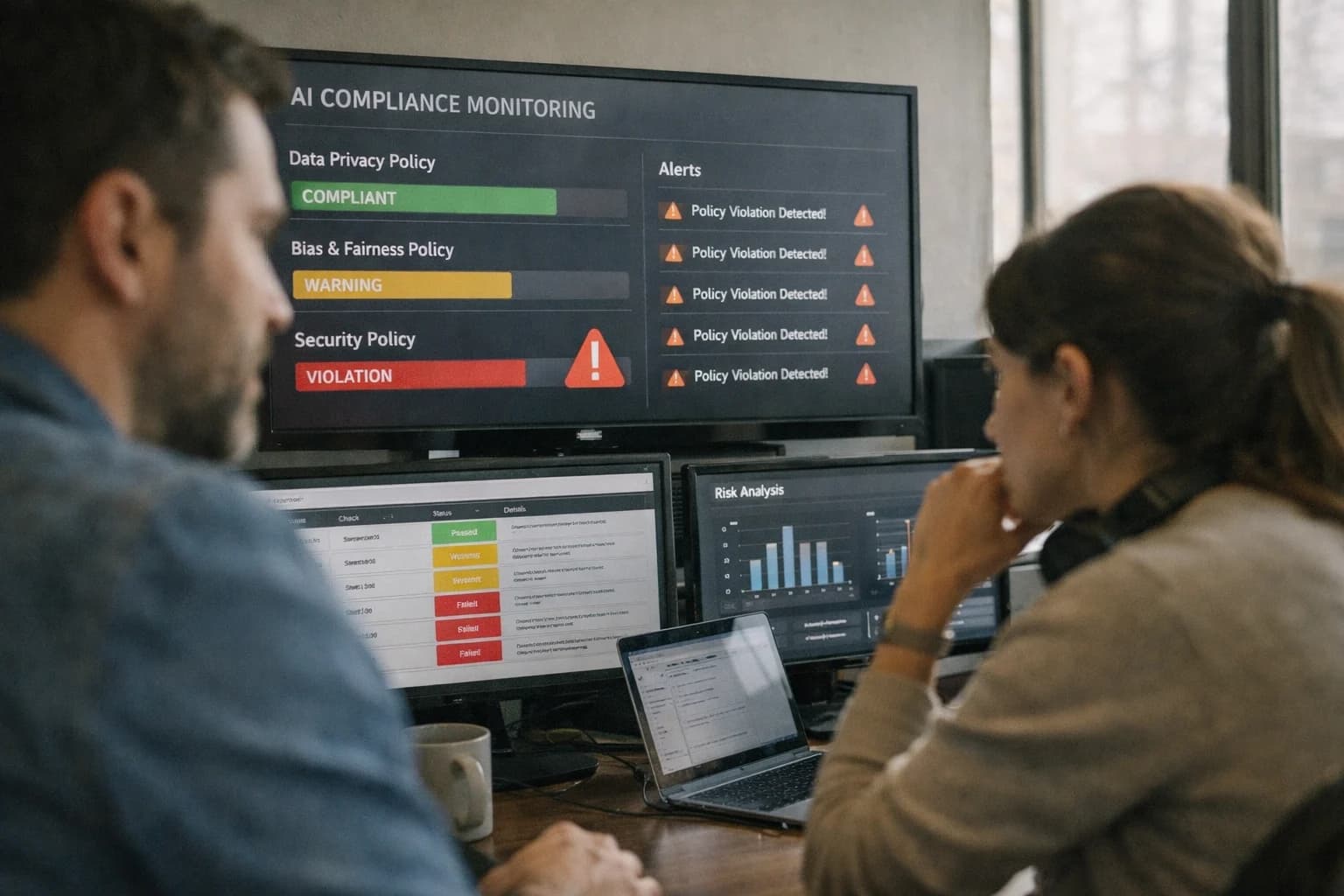
AI Integration for Suitability and Compliance Checks
A technical blueprint for implementing AI to pre-screen investment recommendations and transactions against client profiles, investment policy statements (IPS), and regulatory guidelines within wealth management platforms.
Where AI Fits into Suitability and Compliance Workflows
Integrating AI into suitability and compliance checks creates a pre-screening layer that augments human judgment, reducing manual review time and surfacing potential issues before they escalate.
AI integration for suitability and compliance checks typically connects to three primary surfaces within a wealth management platform: the investment proposal or order entry workflow, the client profile and investment policy statement (IPS) data model, and the compliance rule engine or audit log. The goal is to intercept a transaction or recommendation—before submission or approval—and run it against a set of AI-powered checks. This involves pulling relevant data objects like the client's risk tolerance, objectives, current holdings, and IPS restrictions from platforms like Addepar or Envestnet, then using an LLM to evaluate the proposed action's alignment.
A practical implementation uses a webhook or middleware layer that listens for events like proposal_created or order_submitted. The AI service receives the payload (client ID, security details, transaction type, amount), enriches it with the client's profile and portfolio context via API calls, and runs a multi-step analysis. This can include:
Suitability Scoring: Comparing the security's risk profile (e.g., volatility, asset class) to the client's stated risk score and recent portfolio drift.
Concentration Analysis: Flagging if the transaction would cause an over-concentration in a single security, sector, or asset class beyond IPS limits.
Regulatory Guideline Check: Scanning against firm-defined rules (e.g., "no cryptocurrency for retired clients") or external regulatory lists.
Narrative Justification: Drafting a plain-language explanation of why the trade fits (or doesn't fit) the client's profile, citing specific data points for the advisor or compliance officer to review.
Rollout requires a phased, human-in-the-loop approach. Start with AI as an advisor copilot, providing a "pre-flight check" report within the proposal interface, allowing the advisor to adjust before submission. Next, move to a compliance queue, where flagged proposals are automatically routed for review with the AI's analysis attached. Governance is critical: all AI evaluations must be logged with the original inputs, the model's reasoning (via traceability tools), and the final human decision. This creates an audit trail demonstrating that AI is an assistive tool, not a replacement for fiduciary judgment. The impact is operational: reducing the manual pre-screen from hours to minutes and catching subtle suitability mismatches that rule-based systems might miss.
WHERE AI CONNECTS TO THE COMPLIANCE WORKFLOW
Integration Touchpoints Across Wealth Platforms
The Foundation: IPS and Client Data
AI pre-screening begins with the foundational documents and structured data that define a client's mandate. Integration points include:
IPS Document Repositories: Connect AI to document management systems (e.g., SharePoint, NetDocuments) where IPS PDFs are stored. Use document intelligence to extract investment objectives, restrictions, risk tolerance, and liquidity requirements.
KYC/AML Profiles: Enrich the compliance context by connecting to KYC platforms to understand client source of wealth and regulatory flags.
AI uses this consolidated profile to create a dynamic, queryable "client mandate" that can be checked in real-time against proposed transactions.
WEALTH MANAGEMENT PLATFORMS
High-Value AI Suitability and Compliance Use Cases
Integrating AI into suitability and compliance workflows transforms manual, reactive checks into proactive, scalable safeguards. These patterns connect to portfolio management, CRM, and document systems to pre-screen recommendations and automate regulatory oversight.
AI agents continuously monitor proposed trades and model changes against a client's IPS stored in the planning platform. The system flags deviations in asset allocation, prohibited securities, or risk tolerance breaches before execution, creating an audit trail and prompting advisor review.
Pre-Trade -> Real-Time
Compliance check timing
02
Transaction Suitability Pre-Screening
Integrates with the order management system (OMS) or portfolio accounting platform to analyze transaction context—client concentration, cost basis, time horizon, income needs—against their profile. Generates a suitability memo highlighting potential issues for the advisor's final approval, reducing manual review load.
Batch -> Real-time
Screening workflow
03
Regulatory Communication Surveillance
Connects to email, CRM, and client portal communication logs. Uses AI to scan for potential compliance red flags: unapproved performance guarantees, complex product discussions without proper disclosures, or inappropriate financial advice. Flags high-risk conversations for compliance officer review, automating a key supervisory control.
04
Automated Best Interest (BI) Documentation
For Reg BI and fiduciary rules, AI assists in creating the required documentation. It synthesizes data from the CRM (client goals), portfolio system (alternatives considered), and planning software (cost/benefit analysis) to draft a compliant narrative justifying a recommendation, which the advisor then reviews and finalizes.
Hours -> Minutes
Draft generation
05
Concentration & Liquidity Risk Monitoring
An AI-driven dashboard integrated with the portfolio management platform (e.g., Addepar, Black Diamond) continuously analyzes holdings across all household accounts. It alerts on building concentrations in single stocks, illiquid assets, or sectors, triggering a formal review workflow to ensure client profiles and disclosures remain accurate.
06
Proactive Disclosures & Form Management
AI reviews client profiles and account activity to identify when updated ADV brochures, privacy notices, or other mandated disclosures are required. It can trigger personalized document assembly workflows, populate client-specific data, and track delivery/acknowledgment within the compliance or document management platform.
Manual -> Automated
Compliance workflow
IMPLEMENTATION PATTERNS
Example AI Screening Workflows
These workflows illustrate how AI can be embedded into the pre-trade and post-trade processes of a wealth management platform to automate suitability and compliance checks, reducing manual review time and operational risk.
Trigger: An advisor initiates a model portfolio change for a client account in the portfolio management system (e.g., Addepar, Orion).
Workflow:
Context Pull: The AI agent receives a webhook with the client ID, source model, target model, and proposed trade list.
Data Enrichment: The agent fetches the client's:
Investment Policy Statement (IPS) from a document management system.
Full portfolio holdings and recent transaction history.
Risk tolerance score and objectives from the CRM (e.g., Salesforce FSC).
AI Analysis: Using a configured LLM with retrieval-augmented generation (RAG), the agent performs a multi-point check:
IPS Compliance: Compares the target model's strategy and asset allocation against IPS guidelines.
Concentration Review: Flags if the change creates an over-concentration in a single security or sector relative to the client's profile.
Risk Alignment: Assesses if the target model's historical risk metrics (e.g., beta, standard deviation) are appropriate for the client's stated tolerance.
System Update: The agent posts a structured summary back to the platform as a note on the order, with a flag: "PASS", "REVIEW REQUIRED", or "BLOCK - VIOLATION".
Human Review Point: Orders flagged for "REVIEW REQUIRED" are routed to a senior advisor or compliance officer within the order management system for final approval before execution.
PRODUCTION-READY INTEGRATION PATTERNS
Implementation Architecture: Data Flow and Guardrails
A practical blueprint for wiring AI into suitability and compliance workflows without disrupting existing operations.
A production-ready integration for AI-powered suitability checks typically follows a pre-submission review pattern. The AI agent is inserted as a parallel workflow, triggered by events in your portfolio management or order management system (OMS). For example, when a trade recommendation is drafted in Addepar or a model change is queued in Envestnet, a webhook can send a payload—containing client profile data, investment policy statement (IPS) objectives, the proposed transaction, and relevant regulatory guidelines—to a secure inference queue. The AI system performs a multi-faceted review: it checks the transaction against the client's risk tolerance, time horizon, and income needs from the IPS; screens for potential conflicts or over-concentration; and flags items requiring manual review based on configurable thresholds. The result is a structured pre-flight check report appended to the workflow, not a blocking decision.
The core architecture relies on a decoupled, event-driven service that maintains a strict audit trail. Your platform remains the system of record; the AI service acts as an advisory layer. Data flows one-way from your wealth platform to a secure, isolated processing environment. We implement guardrails such as payload logging, explainability traces (showing which rule or data point triggered a flag), and human-in-the-loop approval gates for any high-severity flags. This design ensures compliance teams retain oversight and can audit every AI-influenced recommendation. The integration points are typically the existing approval workflow APIs in platforms like Orion or Black Diamond, allowing the AI's findings to surface as a structured note or a custom field within the native compliance queue.
Rollout is phased, starting with read-only analysis on a subset of transactions to establish baseline accuracy and calibrate confidence thresholds. Governance is maintained through a weekly review loop where compliance officers sample AI-flagged and AI-cleared transactions, providing feedback that retrains the system's prompting logic. The final state reduces manual pre-trade screening from hours to minutes for straightforward cases, allowing analysts to focus on complex, high-value exceptions. This pattern is detailed further in our guide on [/integrations/wealth-management-platforms/ai-integration-for-compliance-monitoring-systems](AI Integration for Compliance Monitoring Systems).
IMPLEMENTATION PATTERNS
Code and Payload Examples
Transaction Pre-Screening Workflow
This pattern uses an AI agent to evaluate a proposed trade against a client's Investment Policy Statement (IPS) and profile before submission to the order management system. The agent retrieves the relevant client documents, analyzes the transaction, and returns a structured suitability assessment.
Typical Flow:
A trade ticket is initiated in the portfolio management platform (e.g., Addepar, Orion).
A webhook sends the transaction details (client ID, security, quantity, action) to your AI service.
The service retrieves the client's IPS and profile from a document store or platform API.
An LLM analyzes the transaction against constraints like asset allocation limits, prohibited securities, and risk tolerance.
A JSON payload is returned with a recommendation (APPROVE, FLAG, REJECT) and a reason for the advisor.
python
# Example: AI Service Endpoint for Pre-Screening
from fastapi import FastAPI, HTTPException
from pydantic import BaseModel
import httpx
app = FastAPI()
class TradeRequest(BaseModel):
client_id: str
account_id: str
symbol: str
action: str # "BUY", "SELL"
quantity: float
estimated_value: float
@app.post("/api/v1/suitability/check")
async def check_trade_suitability(trade: TradeRequest):
"""
Orchestrates retrieval of client constraints and LLM analysis.
"""
# 1. Fetch client IPS and profile from your RAG system or platform API
client_context = await fetch_client_context(trade.client_id)
# 2. Construct a prompt for the LLM
prompt = f"""
Analyze this proposed trade for client {trade.client_id}.
Client Constraints:\n{client_context}\n\n Proposed Trade:\n- Action: {trade.action} {trade.quantity} shares of {trade.symbol}\n- Estimated Value: ${trade.estimated_value:.2f}\n\n Assess suitability. Return JSON: {"recommendation": "APPROVE|FLAG|REJECT", "reason": "string"}
"""
# 3. Call LLM (e.g., via OpenAI, Anthropic)
llm_response = await call_llm(prompt)
# 4. Parse and return structured result
return parse_llm_response(llm_response)
SUITABILITY AND COMPLIANCE WORKFLOWS
Realistic Time Savings and Business Impact
How AI-assisted review transforms manual, reactive checks into a proactive, scalable control layer, reducing operational risk and freeing up compliance teams for higher-value oversight.
Workflow Stage
Manual Process
AI-Assisted Process
Impact & Notes
Initial Transaction Screening
Batch review at EOD or next morning
Real-time pre-trade scoring & flagging
Prevents unsuitable trades before execution; shifts from detection to prevention.
IPS & Guideline Review
Manual document comparison, 30-60 mins per review
Automated policy extraction & alignment check, <5 mins
Ensures consistency; human reviews exceptions flagged by AI.
Concentration & Suitability Analysis
Spreadsheet-based analysis post-trade
Automated monitoring of client holdings vs. profile
Continuous monitoring identifies drift; alerts for manual review.
Compliance Documentation
Manual note-taking in separate log
Auto-generated audit trail with rationale
Creates defensible, searchable records for exams and audits.
Exception & Discretion Review
Ad-hoc, reliant on advisor disclosure
Systematic pre-approval workflow with AI summary
Standardizes process; provides compliance with context for faster decisions.
Periodic Account Review
Sampling-based, quarterly manual deep-dives
Continuous, AI-driven scoring of all accounts
Shifts from periodic sampling to always-on surveillance.
Regulatory Change Impact
Manual reading of releases; slow internal updates
AI summaries of new rules & automated gap analysis
Reduces time to understand and implement new requirements.
ARCHITECTING FOR COMPLIANCE AND CONFIDENCE
Governance, Security, and Phased Rollout
Implementing AI for suitability and compliance requires a secure, auditable architecture and a controlled rollout to manage risk and build trust.
A production integration for suitability checks must be built on a secure, event-driven architecture. Typically, this involves deploying an AI agent as a secure microservice that listens for events—like a new investment recommendation in Addepar or a proposed trade in Envestnet Tamarac—via webhook. The agent retrieves the relevant client profile, investment policy statement (IPS), and transaction details via the platform's APIs, then uses a governed LLM call (e.g., via Azure OpenAI with strict data policies) to evaluate the action against regulatory guidelines and internal firm rules. All inputs, the AI's reasoning chain, and the final recommendation are logged to an immutable audit trail, often in a system like Datadog or Splunk, with clear lineage back to the source system record.
Rollout should follow a phased, human-in-the-loop approach. Start in a "co-pilot" mode where the AI provides a pre-screen analysis and confidence score to a human compliance officer within the existing workflow—perhaps as a new column in a Black Diamond reporting queue or a sidebar in Orion's compliance dashboard. This allows the team to validate the AI's judgment, refine prompts, and build confidence. The next phase introduces automated blocking for clear violations, such as flagging a transaction that would exceed a client's stated risk tolerance from their IPS. The final stage enables automated approval for low-risk, routine actions that match pre-defined, firm-approved patterns, freeing up team capacity for complex exceptions.
Governance is critical. Establish a cross-functional AI Steering Committee with members from Compliance, Legal, Technology, and Advisory to oversee prompt libraries, model updates, and incident response. Implement role-based access controls (RBAC) so only authorized users can modify the AI's rule sets or override its decisions. Regularly run back-testing simulations using historical data to measure the AI's precision and recall against past human decisions, and schedule periodic reviews with your Chief Compliance Officer. This structured, incremental approach de-risks the integration, ensures regulatory adherence, and demonstrates to both advisors and clients that AI is being deployed as a responsible, augmentative tool. For related architectural patterns, see our guide on AI Governance and LLMOps Platforms.
Enabling Efficiency, Speed & Accuracy
Intelligent Analysis, Decision & Execution
We build AI systems for teams that need search across company data, workflow automation across tools, or AI features inside products and internal software.
IMPLEMENTATION AND GOVERNANCE
Frequently Asked Questions
Practical questions for architects and compliance leaders planning AI integration into suitability and compliance workflows.
The integration is event-driven and sits as a pre-screen layer before human review. A typical flow:
Trigger: A new investment recommendation or transaction order is submitted within the wealth platform (e.g., Addepar, Envestnet).
Context Pull: The AI agent is invoked via webhook or API call. It retrieves the transaction details and the associated client profile, including:
Investment Policy Statement (IPS) objectives, constraints, and restrictions.
Current portfolio holdings and asset allocation.
Client risk tolerance, time horizon, and investment goals.
Relevant regulatory guidelines and firm-specific policies.
Agent Action: The agent uses a combination of rule-based logic and an LLM to:
Check for Violations: Flag clear breaches (e.g., "single stock concentration exceeds IPS limit of 10%").
Assess Suitability: Generate a narrative analysis comparing the transaction to the client's profile ("This alternative investment increases illiquidity for a client with a 3-year time horizon").
Surface Ambiguities: Highlight areas requiring human judgment ("Client's stated risk tolerance is 'Moderate' but the proposed sector ETF has high volatility; recommend advisor confirmation").
System Update: The agent posts its analysis and a pre-populated flag (e.g., PASS, REVIEW, FLAG) back to the platform as a note or custom object, triggering the appropriate workflow queue.
Human Review Point: The compliance officer or advisor reviews the flagged case with the AI's analysis in context, making the final approval or rejection.
About the author
Prasad Kumkar
CEO & MD, Inference Systems
Prasad Kumkar is the CEO & MD of Inference Systems and writes about AI systems architecture, LLM infrastructure, model serving, evaluation, and production deployment. Over 5+ years, he has worked across computer vision models, L5 autonomous vehicle systems, and LLM research, with a focus on taking complex AI ideas into real-world engineering systems.
His work and writing cover AI systems, large language models, AI agents, multimodal systems, autonomous systems, inference optimization, RAG, evaluation, and production AI engineering.
Partnered with leading AI, data, and software stack.
How We Work
Custom AI workflows for your Business
One-fit-all AI don't work for modern businesses. At Inferensys, we aim to understand your business & custom requirements; which we use to define most efficient agentic workflows, the data, and the tools for your business.
The first call is a practical review of your use case and the right next step.