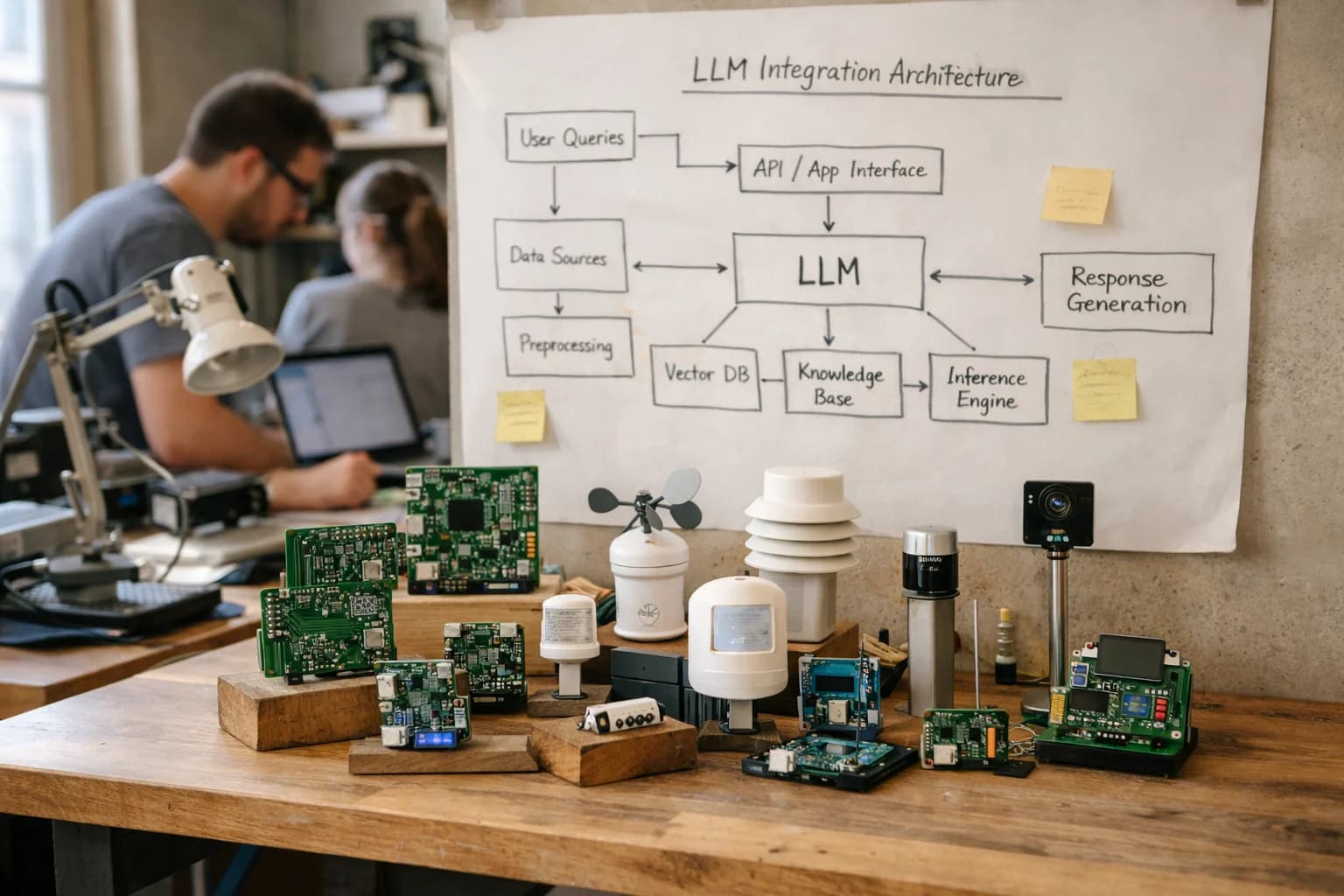
Use API gateways like Kong, Apigee, MuleSoft, and WSO2 to filter, route, and analyze high-volume IoT data streams with AI for predictive maintenance, anomaly detection, and automated response.
Use API gateways like Kong or Apigee to filter, route, and pre-process high-volume IoT data for real-time AI inference.
IoT platforms generate immense telemetry—sensor readings, device heartbeats, GPS pings—but only a fraction signals a meaningful event. An API gateway acts as the intelligent filter, applying rules to discard noise and route critical data streams to the appropriate AI service. For example, you can configure a Kong plugin to batch temperature readings from a fleet of chillers, calculate a rolling average, and only forward a payload to an anomaly detection model if the delta exceeds a threshold. This prevents wasteful inference calls on normal operation data, controlling cost and latency.
Implementation centers on the gateway's plugin architecture and its ability to call external services. A typical flow in Apigee might be: Device -> Apigee Proxy (JWT validation, spike detection) -> Message Queue (Kafka/PubSub) -> AI Model Endpoint -> Downstream System (CMMS like Fiix for a work order). The AI model, hosted on KServe or Azure ML, receives a structured JSON payload via a dedicated API product. The gateway handles authentication, rate limiting, and observability, providing a unified audit trail for both the IoT data ingestion and the AI inference call.
Rollout requires a phased approach. Start with a single device type and a high-value, low-risk prediction like predictive maintenance for non-critical assets. Use the gateway's analytics to monitor payload sizes, latency percentiles, and model error rates. Governance is critical: implement strict RBAC on the AI service API products and use the gateway's policy engine to enforce data retention, redact PII from location streams, and trigger human review workflows for high-confidence anomaly alerts before creating automated tickets. This architecture ensures AI augments IoT operations without becoming a black box.
IOT DATA STREAMS
AI Integration Points Across API Gateway Platforms
Gateway as an Intelligent Ingest Layer
API gateways like Kong, Apigee, and WSO2 act as the first line of defense and intelligence for IoT data streams. Before data reaches costly AI inference endpoints, the gateway can execute lightweight logic to filter, validate, and enrich payloads.
Key Integration Points:
Request Transformation Plugins: Use plugins (e.g., Kong's request-transformer, Apigee's JavaScript policy) to strip unnecessary metadata, normalize timestamps, or convert payload formats (e.g., Protobuf to JSON) for AI model consumption.
Data Filtering & Throttling: Implement policies to drop low-value telemetry (e.g., routine "heartbeat" signals) or aggregate high-frequency sensor readings, reducing the volume and cost of downstream AI processing.
Payload Validation: Enforce schema validation against expected IoT device payloads to prevent malformed data from triggering erroneous AI inferences.
This pre-processing ensures AI models receive clean, relevant, and cost-effective data streams.
INTELLIGENT GATEWAY PATTERNS
High-Value AI Use Cases for IoT APIs
IoT data streams are high-volume and low-latency, but raw telemetry is not insight. Use your API gateway as an intelligent control plane to filter, enrich, and route device data to AI models for real-time action. These patterns show where to inject AI logic into your IoT API flows.
01
Predictive Maintenance Triggers
Deploy lightweight anomaly detection models at the gateway to analyze device sensor streams (vibration, temperature, pressure). The gateway filters normal traffic and only routes anomalous payloads to a heavier AI service for failure prediction, reducing downstream processing costs by 70-90%. Create automated work orders in your CMMS via webhook.
Batch -> Real-time
Alerting mode
02
Dynamic Data Routing & Enrichment
Use the gateway's policy engine to inspect incoming IoT payloads (e.g., from OBD-II devices or smart meters) and route them contextually. High-priority alerts go to real-time AI for instant analysis; batch telemetry is sent to cold storage. Enrich payloads with location weather or traffic data from external APIs before forwarding to the AI model for richer context.
1 sprint
Typical implementation
03
AI-Powered API Security for Devices
IoT devices are vulnerable to credential theft and DDoS. Use AI models integrated with the gateway to profile normal device behavior (call frequency, payload size, geographic patterns). Flag and throttle anomalous devices in real-time, preventing fraudulent API calls from compromised sensors. This augments static API keys and certificates.
04
Real-Time Video & Image Stream Processing
For IoT cameras in retail, security, or manufacturing, the gateway can manage pre-processing steps: frame sampling, compression, and routing. Send key frames to vision AI models for object detection (empty shelves, safety violations) and return results to edge controllers. Use adaptive rate limiting to manage bursty video stream traffic.
Hours -> Minutes
Incident response
05
Fleet Telematics & Driver Behavior Coaching
Ingest high-frequency GPS and accelerometer data from fleet management platforms like Samsara or Geotab through a secured API gateway. Use integrated AI to score trips for harsh braking, idling, or route deviations. The gateway triggers real-time alerts to driver apps and batches summarized insights to the fleet management dashboard for weekly reviews.
06
Smart Meter Data Normalization & Forecasting
Utility smart meters generate heterogeneous data. Use the gateway to normalize units, timestamps, and schemas before ingestion. Route normalized streams to AI models for demand forecasting and grid load balancing. The gateway also manages secure, meter-specific API quotas to comply with data privacy regulations, acting as a policy enforcement point.
Same day
Insight availability
IMPLEMENTATION PATTERNS
Example IoT-to-AI Workflows
These workflows illustrate how to use an API gateway (like Kong, Apigee, or MuleSoft) to orchestrate high-volume IoT data streams, applying AI for real-time analysis and automated action. Each pattern starts with a device event, moves through the gateway for preprocessing, routes to an AI service, and triggers a downstream system update.
Trigger: A vibration sensor on a CNC machine sends a telemetry payload via MQTT, exceeding a baseline threshold.
Gateway Action:
The API gateway's MQTT plugin ingests the message.
A gateway policy validates the payload schema and enriches it with contextual metadata (asset ID, location, maintenance history fetched from a REST API).
The gateway routes the enriched payload to a dedicated predictive maintenance AI endpoint.
AI Model Action: A time-series forecasting model analyzes the enriched sensor data against historical failure patterns.
System Update:
High-Risk Prediction: The gateway receives a high-probability failure alert. It triggers two parallel actions:
Posts an alert to the CMMS (e.g., Fiix, UpKeep) via webhook to create a high-priority work order.
Sends a command back through the gateway to the IoT edge to increase diagnostic data sampling.
Low-Risk Prediction: The event is logged to a data lake for model retraining, with no immediate action.
Human Review Point: The CMMS work order is assigned to a maintenance supervisor for final review and scheduling.
FROM DEVICE TO INSIGHT
Implementation Architecture: Data Flow, Models, and Guardrails
A production-ready architecture for injecting AI into high-volume IoT data streams, using API gateways as the intelligent control plane.
The core pattern uses your API gateway (Kong, Apigee, MuleSoft, WSO2) as a smart filter and router. Instead of sending all raw telemetry directly to costly AI models, the gateway executes lightweight logic: it can filter by device type or anomaly threshold, aggregate time-series data into windows, validate payloads, and enrich events with contextual metadata from other systems. This pre-processing reduces latency, cuts AI inference costs, and ensures only relevant, clean data reaches your models. The gateway then routes this curated stream to the appropriate AI endpoint—be it a real-time anomaly detection model on AWS SageMaker, a predictive maintenance service in Azure AI, or a batch inference job in Google Vertex AI.
For model integration, we architect around two primary workflows:
Real-time Inference: For immediate actions like alerting or automated shut-off. The gateway calls a low-latency model endpoint, often returning a simple classification (normal, warning, critical). The result can trigger a webhook to a PagerDuty or ServiceNow alert, or execute a command back to the device via the gateway.
Batch & Historical Analysis: For predictive insights. The gateway writes filtered data to a time-series database like InfluxDB or data lake (Snowflake, Databricks). Scheduled jobs or change-data-capture streams then feed this historical data into training pipelines or larger models for trend forecasting and root-cause analysis, with results surfaced in Tableau or Grafana dashboards.
Governance is critical. We implement guardrails at the gateway layer:
Rate Limiting & Quotas: Prevent a malfunctioning device fleet from overwhelming AI endpoints.
Payload Inspection & PII Redaction: Scrub sensitive location or identifier data before it leaves the gateway.
Circuit Breakers & Fallbacks: If the AI service is down, the gateway can route to a default rule set or a logging queue to prevent data loss.
Audit Logging: Every decision—filter, route, inference call—is logged with a correlation ID for full traceability from device sensor to AI prediction. This audit trail is essential for model performance validation and regulatory compliance in industries like healthcare or manufacturing.
AI-ENHANCED IOT DATA PIPELINES
Code and Configuration Examples
Filtering & Enriching Device Telemetry
API gateways like Kong or Apigee act as the first line of intelligence for high-volume IoT streams. Instead of sending all raw data to expensive AI models, you configure gateway policies to filter, aggregate, and enrich payloads at the edge.
A common pattern is to use a plugin or policy to execute lightweight logic:
Filter out noise: Drop sensor readings within normal thresholds (e.g., temperature between 68-72°F).
Aggregate bursts: Convert high-frequency vibration data into 1-minute rolling averages.
Add context: Enrich payloads with device metadata (location, asset ID, maintenance history) fetched from a backend system.
This pre-processing reduces latency, cuts cloud egress costs, and ensures only meaningful, contextualized events are forwarded for AI inference.
lua
-- Example Kong Plugin Pseudocode for Threshold Filtering
local function filter_by_threshold(conf, payload)
local sensor_value = payload.readings[conf.sensor_key]
if sensor_value >= conf.min_threshold and sensor_value <= conf.max_threshold then
-- Value is normal, stop processing this request
return kong.response.exit(204) -- No Content
end
-- Value is anomalous, proceed to AI endpoint
kong.service.request.set_header("X-Anomaly-Detected", "true")
end
AI-ENHANCED IOT DATA PIPELINES
Realistic Operational Impact and Time Savings
This table illustrates the operational impact of integrating AI inference directly into your IoT API gateway layer, focusing on data reduction, decision latency, and team efficiency.
Workflow / Metric
Traditional IoT Pipeline
AI-Integrated Pipeline
Implementation Notes
Raw Telemetry Volume to Process
100% of device data sent to storage/analytics
5-20% of data flagged for deep storage; 80-95% filtered/aggregated at edge
AI models at the gateway perform real-time filtering, sending only anomalies or aggregates upstream.
Anomaly Detection Latency
Batch analysis: Hours to next-day
Real-time detection: < 100ms from ingestion
Inference runs on gateway or nearby edge node; alerts trigger immediate API calls to downstream systems.
Predictive Maintenance Alert Generation
Manual report review by engineers
Automated alert generation with confidence scoring
Gateway routes high-confidence alerts directly to CMMS (e.g., Fiix, UpKeep) via webhook; low-confidence alerts queue for review.
Data Enrichment for Context
Static rules append limited metadata
Dynamic context from LLMs (e.g., natural language failure descriptions)
Gateway calls an LLM to generate human-readable summaries from sensor codes before routing to ticketing systems.
API Call Volume to Backend Systems
High-volume, repetitive calls for all data points
Reduced, event-driven calls only for significant events
Dramatically lowers load on core ERP, data lakes, and analytics platforms, reducing cloud egress and compute costs.
Mean Time to Diagnose (MTTD)
Technician travel + manual log review: 2-4 hours
Remote diagnosis with AI-summarized incident report: 15-30 minutes
Gateway bundles relevant sensor history, AI inference, and probable root cause into a single API payload to field service apps.
Gateway Policy Configuration & Tuning
Manual, rule-based policy updates every quarter
Semi-automated tuning via AI analysis of traffic patterns
AI suggests new rate limits, filtering rules, or routing policies based on operational feedback, approved by an admin.
ARCHITECTING FOR PRODUCTION
Governance, Security, and Phased Rollout
Deploying AI on IoT data streams requires a deliberate approach to security, data governance, and operational control.
An AI integration for IoT APIs introduces new data flows and decision points that must be governed. Your API gateway (e.g., Kong, Apigee, MuleSoft) becomes the critical control plane, enforcing policies before data reaches AI models. Key governance surfaces include:
Authentication & Authorization: Enforcing OAuth 2.0 or API key validation for all devices and services publishing to or consuming from AI-enhanced endpoints.
Data Filtering & PII Redaction: Using gateway plugins or policies to strip sensitive fields (e.g., device location, personal identifiers) from telemetry payloads before they are sent for AI inference.
Payload Validation & Schema Enforcement: Ensuring incoming IoT data conforms to expected structure and size limits to prevent model poisoning or resource exhaustion.
Audit Logging: Capturing a complete trail of which device, what data, which AI model, and what inference result for compliance (e.g., ISO 27001, industry-specific regulations).
A phased rollout minimizes risk and builds operational confidence. We recommend a three-stage approach:
Stage 1: Shadow Mode & Baseline. Deploy the AI inference pipeline in parallel with your existing rules engine. The gateway routes a copy of live IoT data to the AI model, but its outputs are logged and compared to existing system decisions without acting on them. This establishes a performance baseline and tunes anomaly detection thresholds.
Stage 2: Human-in-the-Loop (HITL) for Critical Decisions. For high-stakes workflows like predictive maintenance alerts or safety shutdowns, configure the gateway to route AI-generated recommendations to a human review queue (e.g., via a webhook to ServiceNow or PagerDuty). Actions are only taken after manual approval, building trust in the AI's accuracy.
Stage 3: Automated Execution with Circuit Breakers. Once confidence is high, enable automated actions for predefined, lower-risk scenarios. Implement gateway-level circuit breakers that automatically disable AI-driven routing if error rates spike or latency exceeds SLA thresholds, falling back to rule-based logic.
Security extends beyond the gateway to the AI services themselves. For cloud-hosted models (OpenAI, Azure AI), ensure all calls use private endpoints and encrypt data in transit. For private models, deploy them within your VPC and expose them as internal APIs managed by the gateway. Use the gateway's rate limiting and bot detection capabilities to protect AI endpoints from abuse. Finally, establish a regular review cycle for AI model performance (drift detection) and update gateway policies as new device types or data schemas are onboarded. This layered governance ensures your IoT AI integration is scalable, secure, and maintainable.
Enabling Efficiency, Speed & Accuracy
Intelligent Analysis, Decision & Execution
We build AI systems for teams that need search across company data, workflow automation across tools, or AI features inside products and internal software.
IMPLEMENTATION PATTERNS
Frequently Asked Questions
Common technical questions about integrating AI models with IoT data streams through API gateways like Kong, Apigee, or MuleSoft for real-time analysis and automation.
The API gateway acts as a real-time filter and aggregator to reduce cost and latency. A typical pattern involves:
Trigger: Device telemetry hits a dedicated ingress endpoint on the gateway (e.g., /iot/telemetry).
Gateway Logic: A gateway plugin or policy executes to:
Validate & Sanitize: Check payload schema and remove malformed data.
Throttle & Sample: Apply rules to send only a subset of data if frequency is too high (e.g., send every 10th reading).
Aggregate: Window readings over a short period (e.g., 5 seconds) and compute averages or min/max values.
Enrich: Add context from a cache, like device metadata or location.
AI Routing: The transformed, condensed payload is then routed to the appropriate AI inference endpoint. This prevents sending raw, noisy data directly to more expensive and slower model APIs.
Example Kong Plugin Logic:
lua
-- Pseudocode for a Kong aggregator plugin
gateway.aggregate("device_123", payload.temperature, "avg", "5s")
if aggregation.ready then
local enriched_payload = {
avg_temp = aggregation.value,
device_model = cache.get("device_123_model"),
timestamp = ngx.now()
}
kong.service.request.set_body(enriched_payload)
kong.service.set_upstream("ai-inference-service")
end
About the author
Prasad Kumkar
CEO & MD, Inference Systems
Prasad Kumkar is the CEO & MD of Inference Systems and writes about AI systems architecture, LLM infrastructure, model serving, evaluation, and production deployment. Over 5+ years, he has worked across computer vision models, L5 autonomous vehicle systems, and LLM research, with a focus on taking complex AI ideas into real-world engineering systems.
His work and writing cover AI systems, large language models, AI agents, multimodal systems, autonomous systems, inference optimization, RAG, evaluation, and production AI engineering.
Partnered with leading AI, data, and software stack.
How We Work
Custom AI workflows for your Business
One-fit-all AI don't work for modern businesses. At Inferensys, we aim to understand your business & custom requirements; which we use to define most efficient agentic workflows, the data, and the tools for your business.
The first call is a practical review of your use case and the right next step.