Knowledge distillation is a model compression technique where a smaller, more efficient student model is trained to replicate the outputs and internal representations of a larger, more complex teacher model. The process transfers the teacher's learned generalization capabilities—often referred to as its 'dark knowledge'—enabling the student to achieve comparable performance with significantly reduced computational and memory footprints. This is particularly valuable for deploying high-quality models, such as sentence transformers, in resource-constrained environments like edge devices or high-throughput embedding serving pipelines.

Glossary
Knowledge Distillation
Knowledge distillation is a model compression technique where a smaller 'student' model is trained to mimic the behavior of a larger, more accurate 'teacher' model.
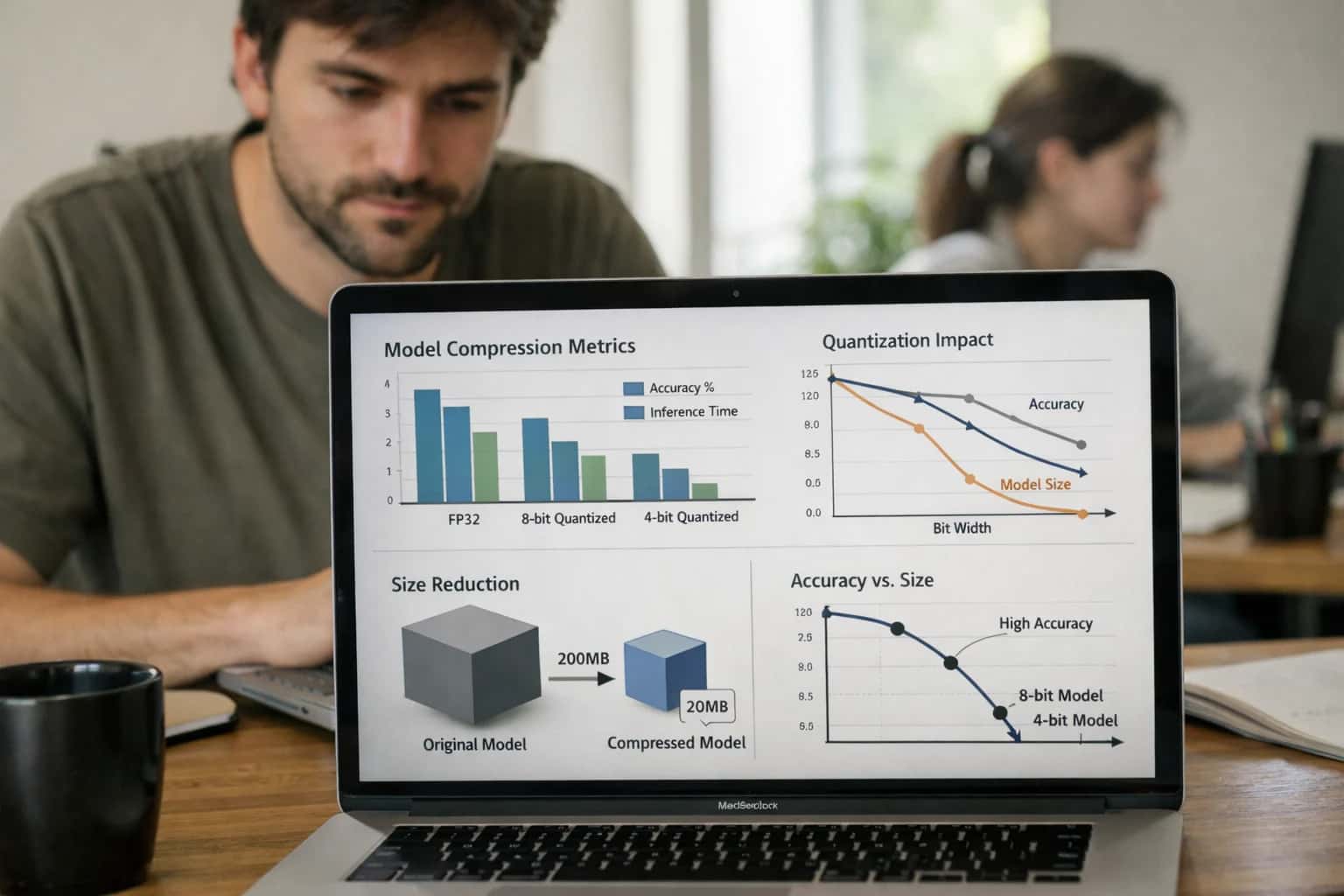
MODEL COMPRESSION
What is Knowledge Distillation?
Knowledge distillation is a model compression technique where a smaller 'student' model is trained to mimic the behavior of a larger, more accurate 'teacher' model, often used to create efficient, high-quality embedding models for production.
The technique typically uses a distillation loss that combines a standard task loss (e.g., cross-entropy with ground truth labels) with a soft target loss that minimizes the divergence between the softened output probabilities (logits) of the teacher and student. For embedding models, distillation often focuses on matching the vector representations in the embedding space, forcing the student to produce similar semantic encodings. This results in compact, high-performance models ideal for semantic search and retrieval-augmented generation (RAG) systems where latency and cost are critical.
EMBEDDING MODEL INTEGRATION
Core Components of Knowledge Distillation
Knowledge distillation is a model compression technique where a smaller 'student' model is trained to mimic the behavior of a larger, more accurate 'teacher' model. This process is central to creating efficient, high-quality embedding models for production deployment.
01
Teacher Model
The teacher model is a large, pre-trained, and highly accurate neural network (e.g., a 110M parameter BERT model) that provides the target knowledge for distillation. Its role is to generate soft labels or logits—probability distributions over output classes—which contain richer information than hard, one-hot labels. For embedding models, the teacher's knowledge is often encapsulated in the similarity scores it produces between data pairs or the intermediate layer activations of its transformer architecture.
02
Student Model
The student model is a smaller, more efficient neural network architecture (e.g., a distilled 30M parameter version) designed for deployment in resource-constrained environments. It is trained not on the original dataset labels, but to replicate the softened outputs and internal representations of the teacher. Common student architectures for embeddings include TinyBERT or DistilBERT, which use fewer transformer layers and hidden dimensions. The primary engineering goal is to maximize the performance gap closure with the teacher while minimizing parameters and latency.
03
Distillation Loss
The distillation loss is the objective function that measures how well the student mimics the teacher. It is a weighted combination of two key components:
- Soft Target Loss (Kullback-Leibler Divergence): Minimizes the difference between the student's and teacher's output probability distributions. This transfers the teacher's "dark knowledge" about class relationships.
- Hard Label Loss (e.g., Cross-Entropy): Ensures the student also learns from the original ground-truth labels.
The total loss is:
L_total = α * L_soft + (1-α) * L_hard, where α is a tuning parameter. For embedding models, a contrastive loss between teacher and student embeddings is often used.
04
Temperature Scaling
Temperature scaling is a hyperparameter technique applied to the teacher model's softmax layer to control the "softness" of its output probabilities. A temperature parameter (T) is introduced into the softmax function: softmax(z_i) = exp(z_i / T) / Σ_j exp(z_j / T).
- High T (T > 1): Produces a softer probability distribution, revealing more nuanced relationships between classes (e.g., that a 'cat' is somewhat similar to a 'dog'). This richer signal is what the student learns from.
- Low T (T = 1): Reverts to the standard softmax, producing a sharper, more confident distribution. During training, the same T is used for both teacher and student. For inference, T is set back to 1.
05
Attention Transfer
Attention transfer is a feature-based distillation method where the student is trained to mimic the attention maps of the teacher model's transformer layers. In models like BERT, attention maps represent the contextual relationships between tokens. By forcing the student's attention patterns to align with the teacher's, the method transfers the teacher's syntactic and semantic understanding.
- Implementation: A loss term (e.g., Mean Squared Error) is added between the student and teacher attention matrices, often from intermediate layers.
- Benefit: This is particularly effective for compressing transformer-based embedding models, as it preserves the crucial self-attention mechanisms responsible for capturing context.
06
Application to Embedding Models
For embedding model integration, knowledge distillation is used to create small, fast models that produce high-quality vectors for semantic search and retrieval. The process typically involves:
- Teacher: A large, high-performance sentence transformer (e.g.,
all-mpnet-base-v2). - Student: A compact model like
all-MiniLM-L12-v2. - Training Data: Millions of text pairs (query, relevant document).
- Objective: The student learns to produce embeddings where the cosine similarity between a query and a relevant document matches the teacher's similarity score. This results in a student that can be served with lower latency and reduced memory footprint while maintaining ~95%+ of the teacher's retrieval accuracy on benchmarks like MTEB.
95%+
Retrieval Accuracy Retained
5x
Typical Speedup
MODEL COMPRESSION
How Knowledge Distillation Works
Knowledge distillation is a model compression technique where a smaller 'student' model is trained to mimic the predictive behavior of a larger, more accurate 'teacher' model.
The process begins by training or selecting a large, high-capacity teacher model. This teacher's primary output is not just its final class prediction (hard label), but its full probability distribution over all classes, known as a soft label or soft target. These soft labels contain rich, dark knowledge about the relative similarity between classes—for instance, that a picture of a cat is more similar to a lynx than to a truck—which is not present in a simple one-hot encoded hard label.
The smaller student model is then trained using a composite loss function. This function typically combines a distillation loss, which minimizes the difference (e.g., KL divergence) between the student's and teacher's soft label distributions, and a standard task loss (e.g., cross-entropy) against the ground-truth hard labels. By learning to replicate the teacher's softened outputs, the student model often generalizes better and can achieve accuracy much closer to the teacher's than if trained on hard labels alone, despite having far fewer parameters.
KNOWLEDGE DISTILLATION
Frequently Asked Questions
Knowledge distillation is a core technique in model compression, enabling the creation of efficient, high-performance models for production. These questions address its core mechanisms, applications, and relationship to other key concepts in embedding model integration.
Knowledge distillation is a model compression technique where a smaller, more efficient 'student' model is trained to mimic the behavior of a larger, more accurate 'teacher' model. It works by using the teacher's output probabilities (the 'soft labels') as a training target for the student, rather than just the hard, one-hot labels from the original dataset. This transfer of 'dark knowledge'—the relative probabilities the teacher assigns to incorrect classes—allows the student to learn a more nuanced representation, often achieving accuracy closer to the teacher's while being significantly faster and smaller.
Key Components:
- Teacher Model: A large, pre-trained, high-accuracy model (e.g., BERT-large).
- Student Model: A smaller, more efficient architecture (e.g., a distilled BERT-base or a TinyBERT).
- Distillation Loss: A combination of the standard cross-entropy loss with the ground truth and a Kullback-Leibler (KL) Divergence loss that minimizes the difference between the student's and teacher's output distributions, softened by a temperature parameter
T.
Enabling Efficiency, Speed & Accuracy
Intelligent Analysis, Decision & Execution
We build AI systems for teams that need search across company data, workflow automation across tools, or AI features inside products and internal software.
Talk to Us
Search across company data
Give teams answers from docs, tickets, runbooks, and product data with sources and permissions.
Useful when people spend too long searching or get different answers from different systems.
Enterprise searchRAGPermissions
Read more
Automate internal workflows
Use AI to route work, draft outputs, trigger actions, and keep approvals and logs in place.
Useful when repetitive work moves across multiple tools and teams.
AI agentsWorkflow automationGovernance
Read more
Add AI to products and internal tools
Build assistants, guided actions, or decision support into the software your team or customers already use.
Useful when AI needs to be part of the product, not a separate tool.
AI integrationDecision supportModel routing
Read more
About the author
Prasad Kumkar
CEO & MD, Inference Systems
Prasad Kumkar is the CEO & MD of Inference Systems and writes about AI systems architecture, LLM infrastructure, model serving, evaluation, and production deployment. Over 5+ years, he has worked across computer vision models, L5 autonomous vehicle systems, and LLM research, with a focus on taking complex AI ideas into real-world engineering systems.
His work and writing cover AI systems, large language models, AI agents, multimodal systems, autonomous systems, inference optimization, RAG, evaluation, and production AI engineering.
LinkedIn
Limited slotsGet a Free AI Consultation
Partnered with leading AI, data, and software stack.





How We Work
Custom AI workflows for your Business
One-fit-all AI don't work for modern businesses. At Inferensys, we aim to understand your business & custom requirements; which we use to define most efficient agentic workflows, the data, and the tools for your business.
01
Review the use case
We understand the task, the users, and where AI can actually help.
Read more02
Pick the right approach
We define what needs search, automation, or product integration.
Read more03
Build the first useful version
We implement the part that proves the value first.
Read more04
Improve from there
We add the checks and visibility needed to keep it useful.
Read moreThe first call is a practical review of your use case and the right next step.
Talk to Us