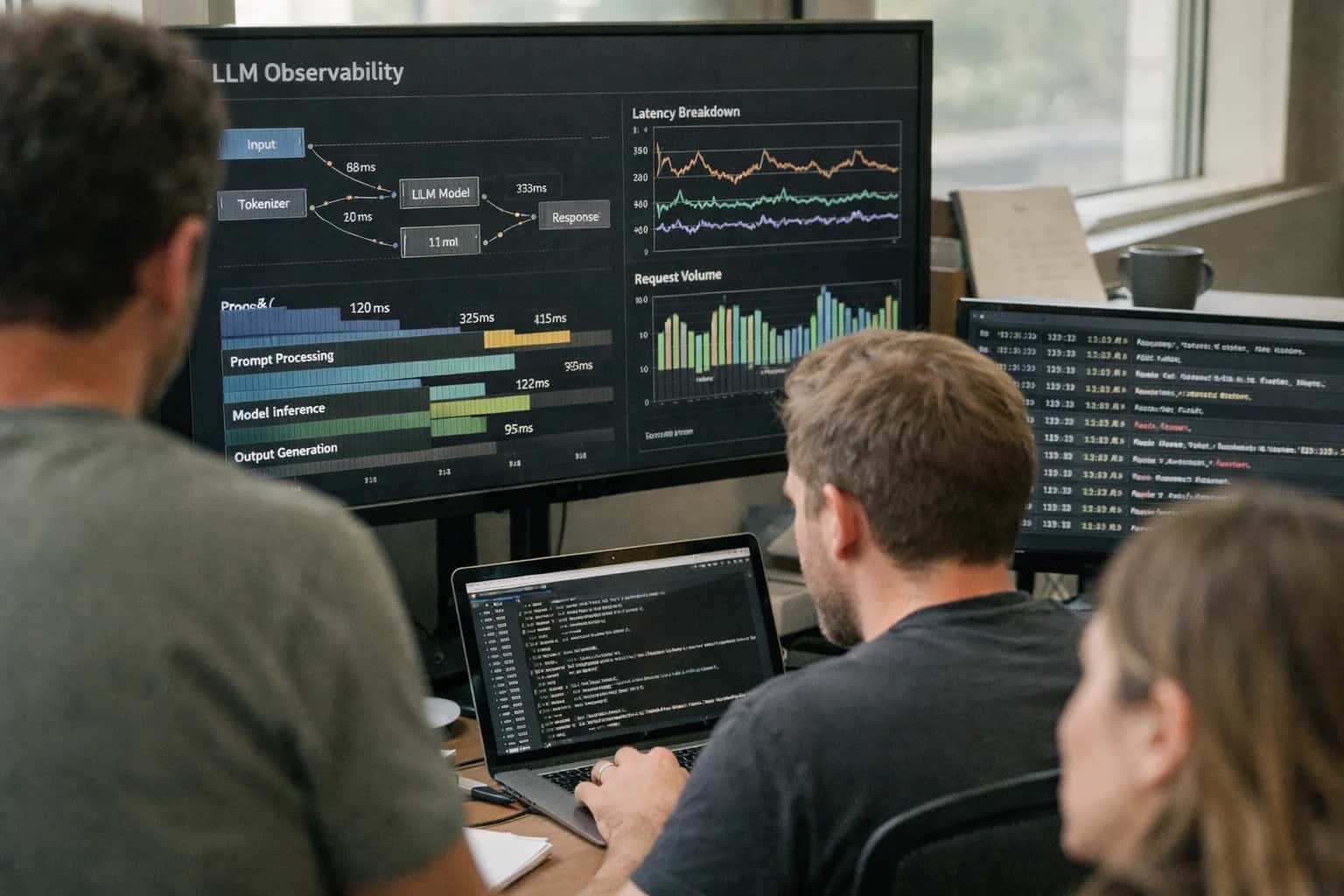
Arize Phoenix excels at developer-centric tracing and evaluation because it provides granular, code-level visibility into LLM application logic. Its strength lies in instrumenting complex workflows—like those built with LangChain or LlamaIndex—to visualize chains, agents, and retrievers as interactive traces. For example, Phoenix's llm_traces capture latency, token counts, and intermediate reasoning steps for each component, enabling precise debugging of hallucinations or retrieval failures in a RAG pipeline.

Comparison
Arize Phoenix vs. WhyLabs
A technical comparison of two leading open-source LLM observability platforms, analyzing their core approaches to tracing, evaluation, and monitoring for production AI systems.
THE ANALYSIS
Introduction
Arize Phoenix and WhyLabs represent two distinct philosophies in the open-source LLMOps observability landscape.
WhyLabs takes a different approach by focusing on automated data quality and statistical monitoring at scale. This platform is built around the concept of a WhyLogs profile, a lightweight statistical snapshot of your data (inputs, outputs, embeddings) that enables efficient drift detection and performance regression tracking across millions of inferences. This results in a trade-off: less granular, step-by-step trace visualization but superior scalability and automated alerting for data-centric issues like embedding drift or output schema violations.
The key trade-off: If your priority is deep, interactive debugging of complex LLM logic and chains, choose Arize Phoenix. It is the tool for developers building and iterating on agentic workflows. If you prioritize scalable, automated monitoring of data quality and model performance in production, where you need to track statistical drift across high-volume deployments, choose WhyLabs. For a broader view of the LLMOps tooling ecosystem, see our comparisons of Langfuse vs. Arize Phoenix and Datadog LLM Observability vs. New Relic AI Monitoring.
HEAD-TO-HEAD COMPARISON
Arize Phoenix vs. WhyLabs Feature Comparison
Direct comparison of key capabilities for LLM observability, tracing, and monitoring.
| Metric / Feature | Arize Phoenix | WhyLabs |
|---|---|---|
Primary Architecture | Open-source Python library | SaaS platform with open-source SDK |
Granular LLM Trace Visualization | ||
Automated Data Quality & Drift Detection | ||
Embeddings Analysis & Clustering | ||
Programmatic LLM Evaluation Framework | ||
Real-time Monitoring & Alerting | Via integrations (e.g., Prometheus) | Native platform feature |
Model Performance Root Cause Analysis | ||
Integration with LangChain/LlamaIndex |
Arize Phoenix vs. WhyLabs
TL;DR Summary
Key strengths and trade-offs at a glance. Phoenix excels at deep, developer-led tracing and evaluation, while WhyLabs focuses on automated, large-scale data quality and drift monitoring.
01
Choose Arize Phoenix For...
Deep, developer-centric tracing and evaluation: Phoenix provides granular, code-level visibility into LLM chain executions, tool calls, and embeddings. Its open-source SDKs integrate directly into frameworks like LangChain and LlamaIndex. This matters for debugging complex RAG pipelines or agentic workflows where understanding the exact reasoning path is critical.
02
Choose WhyLabs For...
Automated, large-scale data quality monitoring: WhyLabs uses statistical profiling to autonomously track data and model drift across millions of inferences with minimal code. Its focus is on detecting schema violations, data quality issues, and performance degradation at scale. This matters for enterprises running high-volume LLM applications who need a 'set-and-forget' safety net for data pipelines.
03
Phoenix's Key Strength
Programmatic evaluation and fine-tuning: Phoenix offers a robust toolkit for running custom evaluations (e.g., relevance, correctness) and visualizing results to pinpoint failure modes. It directly integrates with datasets for fine-tuning. This enables iterative improvement of prompts and models, a core task for LLMOps teams before and after deployment.
04
WhyLabs' Key Strength
Proactive anomaly and drift detection: The platform automatically establishes baselines and uses statistical tests to flag significant deviations in input/output distributions, embedding drift, and LLM performance metrics (like latency). This provides early warning for issues like prompt injection or context drift without manual threshold setting.
05
Phoenix's Integration Model
Library-first, embed anywhere: As a Python library, Phoenix can be embedded directly into your application code, Jupyter notebooks, or existing orchestration frameworks. This offers maximum flexibility for custom instrumentation but requires more initial developer setup compared to agent-based approaches.
06
WhyLabs' Integration Model
Agent-based, infrastructure-light: The WhyLabs observability platform typically uses a lightweight agent or direct API calls to stream data to its managed service. This reduces the instrumentation burden on developers and centralizes monitoring, aligning with platform engineering teams managing many models.
CHOOSE YOUR PRIORITY
When to Choose: User Scenarios
Arize Phoenix for RAG
Verdict: The superior choice for developers debugging and evaluating complex retrieval pipelines. Strengths: Phoenix provides granular, code-level tracing of each step in your RAG chain—query rewriting, retrieval, and synthesis. Its evaluation framework allows you to programmatically score retrieval relevance and answer correctness using custom metrics or LLM-as-a-judge. This is critical for iterating on chunking strategies, embedding models, and prompts. The open-source SDK integrates directly with frameworks like LlamaIndex and LangChain, offering deep visibility without vendor lock-in.
WhyLabs for RAG
Verdict: Best for teams prioritizing automated monitoring of data quality and drift in production. Strengths: WhyLabs excels at passively monitoring the inputs and outputs of your deployed RAG application. Its strength lies in automatically profiling text embeddings and prompt/response distributions to detect significant drift or data quality issues (e.g., sudden changes in query length or topic). It requires less manual instrumentation than Phoenix, making it suitable for teams wanting a "set-and-forget" monitoring layer that alerts on anomalies. For a deeper dive on RAG observability, see our guide on LLMOps and Observability Tools.
Enabling Efficiency, Speed & Accuracy
Intelligent Analysis, Decision & Execution
We build AI systems for teams that need search across company data, workflow automation across tools, or AI features inside products and internal software.
Talk to Us
Search across company data
Give teams answers from docs, tickets, runbooks, and product data with sources and permissions.
Useful when people spend too long searching or get different answers from different systems.
Enterprise searchRAGPermissions
Read more
Automate internal workflows
Use AI to route work, draft outputs, trigger actions, and keep approvals and logs in place.
Useful when repetitive work moves across multiple tools and teams.
AI agentsWorkflow automationGovernance
Read more
Add AI to products and internal tools
Build assistants, guided actions, or decision support into the software your team or customers already use.
Useful when AI needs to be part of the product, not a separate tool.
AI integrationDecision supportModel routing
Read moreTHE ANALYSIS
Final Verdict
A decisive comparison of Arize Phoenix's developer-centric tracing against WhyLabs' automated data quality monitoring.
Arize Phoenix excels at granular, developer-first observability for complex LLM applications because of its deep integration with popular frameworks like LangChain and LlamaIndex. It provides trace-level logging of reasoning steps, tool calls, and retrieval events, enabling detailed debugging of RAG pipelines and agentic workflows. For example, its evaluation suite allows for custom scoring of hallucination detection and answer relevance directly within a Jupyter notebook, offering immediate feedback during development.
WhyLabs takes a different approach by focusing on automated, production-scale data quality and drift detection. Its strategy centers on profiling model inputs and outputs to establish baselines and monitor for concept drift, data drift, and data quality issues like missing values or schema changes. This results in a trade-off: less granular control over individual LLM traces but stronger, automated safeguards for data integrity across high-volume inference endpoints, which is critical for maintaining model performance over time.
The key trade-off: If your priority is deep debugging, evaluation, and iterative development of complex LLM chains, choose Arize Phoenix. Its open-source toolkit is ideal for engineers needing to visualize and optimize the internal steps of their AI applications. If you prioritize scalable, automated monitoring of data health and model performance in production, choose WhyLabs. Its platform is built to catch data-related failures proactively, making it a robust choice for maintaining the reliability of deployed models. For a broader view of the LLMOps landscape, explore our comparisons of Databricks Mosaic AI vs. MLflow 3.x and Langfuse vs. Arize Phoenix.

About the author
Prasad Kumkar
CEO & MD, Inference Systems
Prasad Kumkar is the CEO & MD of Inference Systems and writes about AI systems architecture, LLM infrastructure, model serving, evaluation, and production deployment. Over 5+ years, he has worked across computer vision models, L5 autonomous vehicle systems, and LLM research, with a focus on taking complex AI ideas into real-world engineering systems.
His work and writing cover AI systems, large language models, AI agents, multimodal systems, autonomous systems, inference optimization, RAG, evaluation, and production AI engineering.
LinkedIn
Limited slotsGet a Free AI Consultation
Partnered with leading AI, data, and software stack.





How We Work
Custom AI workflows for your Business
One-fit-all AI don't work for modern businesses. At Inferensys, we aim to understand your business & custom requirements; which we use to define most efficient agentic workflows, the data, and the tools for your business.
01
Review the use case
We understand the task, the users, and where AI can actually help.
Read more02
Pick the right approach
We define what needs search, automation, or product integration.
Read more03
Build the first useful version
We implement the part that proves the value first.
Read more04
Improve from there
We add the checks and visibility needed to keep it useful.
Read moreThe first call is a practical review of your use case and the right next step.
Talk to Us