Edge Impulse excels at streamlining the entire ML workflow for embedded engineers because of its integrated, opinionated pipeline. It provides a unified web IDE for data ingestion, labeling, feature engineering, model training, and one-click deployment to over 30 hardware targets, including Arm Cortex-M microcontrollers and NVIDIA Jetson devices. For example, its built-in DSP blocks and EON Compiler can automatically generate highly optimized C++ inference code, reducing a ResNet-20 model's latency by 30-50% on a Cortex-M7 compared to generic TensorFlow Lite Micro implementations.

Comparison
Edge Impulse vs Edge AI Studio
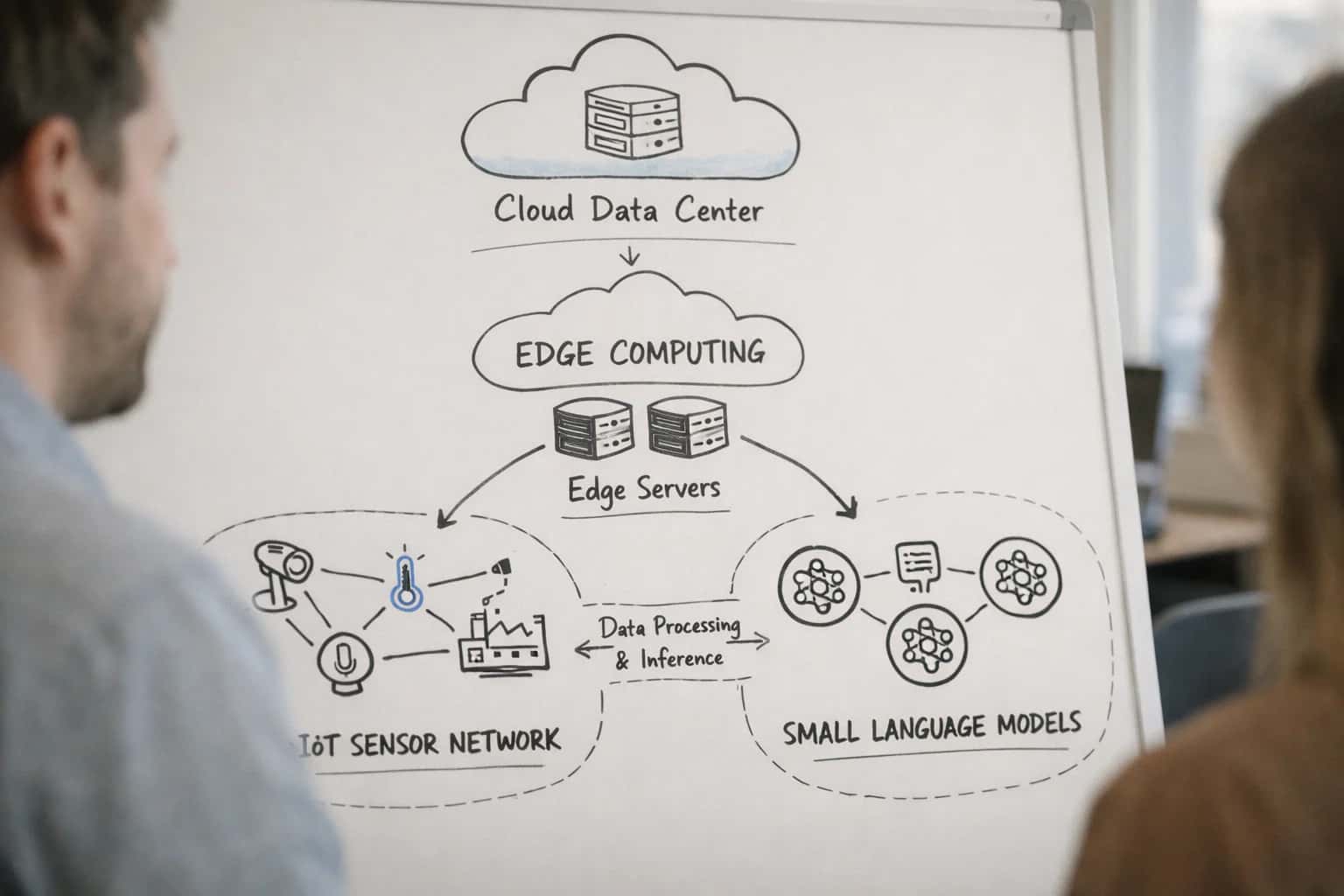
A technical comparison of Edge Impulse and Edge AI Studio, two leading platforms for building, optimizing, and deploying machine learning models to microcontrollers and Linux edge devices. We analyze features, developer experience, and use-case fit to help you select the right tool.
THE ANALYSIS
Introduction
A data-driven comparison of two leading end-to-end platforms for building and deploying machine learning models to microcontroller and Linux edge devices.
Edge AI Studio takes a different approach by offering a more flexible, cloud-native environment built on Google Cloud's Vertex AI. This strategy provides deep integration with Google's AI ecosystem, enabling easier experimentation with a wider variety of model architectures from frameworks like TensorFlow, PyTorch, and JAX. This results in a trade-off: greater flexibility and scalability for complex models and Linux-based devices, but often requiring more manual optimization and integration work for deployment to the most resource-constrained microcontrollers compared to Edge Impulse's turnkey solution.
The key trade-off: If your priority is rapid prototyping and deployment to MCUs with minimal DevOps overhead, choose Edge Impulse. Its end-to-end automation is ideal for product teams needing to move from sensor data to a deployed model quickly. If you prioritize scalability, integration with a major cloud AI platform (Google Cloud), and flexibility for complex Linux-based edge deployments, choose Edge AI Studio. This is especially true for projects already leveraging Google Cloud services or requiring advanced model architectures. For broader context on edge deployment frameworks, see our comparisons of TensorFlow Lite vs PyTorch Mobile and ONNX Runtime vs TensorRT.
HEAD-TO-HEAD COMPARISON
Edge Impulse vs Edge AI Studio
Direct comparison of key metrics and features for end-to-end edge AI development.
| Metric | Edge Impulse | Edge AI Studio |
|---|---|---|
Primary Device Target | Microcontrollers (MCUs) | Linux-based SBCs & SoCs |
Data Collection & Labeling | ||
AutoML Model Search | ||
Supported Model Formats | TensorFlow Lite, ONNX | TensorFlow Lite, TensorRT, ONNX |
Deployment Export Options | C++ Library, Arduino, WebAssembly | Docker Container, Debian Package, TFLite |
Cloud Build Queue (Free Tier) | < 5 min | ~30 min |
Enterprise Pricing (Starts at) | $2,000/month | Custom Quote |
Real-Time Data Forwarding | MQTT, WebSocket | Google Cloud IoT Core |
Edge Impulse vs Edge AI Studio
TL;DR Summary
Key strengths and trade-offs at a glance for the two leading end-to-end platforms for building and deploying machine learning to microcontrollers and Linux edge devices.
02
Edge Impulse: Stronger Microcontroller (MCU) Deployment
Specific advantage: One-click deployment to 30+ MCU architectures (Arm Cortex-M, ESP32, RISC-V) with built-in 4-bit/8-bit quantization and EON Compiler for optimal C++ inference code. This matters for ultra-low-power IoT devices where memory footprint and latency are critical.
04
Edge AI Studio: Advanced Pre-Trained Model Access
Specific advantage: Direct access to NVIDIA's catalog of high-accuracy, pre-trained vision and conversational AI models (e.g., PeopleNet, Action Recognition). This matters for teams that need production-grade models quickly and want to fine-tune them with proprietary data, reducing time-to-deployment.
CHOOSE YOUR PRIORITY
When to Choose: User Scenarios
Edge Impulse for Prototyping
Verdict: Superior for rapid proof-of-concept and data collection. Strengths: Edge Impulse excels with its no-code data ingestion tools for sensors (microphones, accelerometers) and its automated DSP block generation for feature extraction. Its web-based studio allows developers to label data, train models (using Keras or custom blocks), and test performance in minutes without deep ML expertise. The one-click deployment to over 30 hardware targets (Arduino, Nordic, ESP32) is unmatched for getting a model running quickly.
Edge AI Studio for Prototyping
Verdict: Better for teams already embedded in the Google Cloud ecosystem. Strengths: Edge AI Studio leverages Google Cloud's Vertex AI for training and pre-built industry solutions (like visual inspection, predictive maintenance). Its strength is connecting prototype data pipelines directly to cloud-scale MLOps. However, its hardware deployment is more focused on Linux-based devices (like Coral) and lacks the broad microcontroller (MCU) support of Edge Impulse, making initial physical prototyping slightly more complex.
Key Trade-off: Edge Impulse for speed and ease on MCUs; Edge AI Studio for cloud-integrated prototypes on Linux SBCs.
Enabling Efficiency, Speed & Accuracy
Intelligent Analysis, Decision & Execution
We build AI systems for teams that need search across company data, workflow automation across tools, or AI features inside products and internal software.
Talk to Us
Search across company data
Give teams answers from docs, tickets, runbooks, and product data with sources and permissions.
Useful when people spend too long searching or get different answers from different systems.
Enterprise searchRAGPermissions
Read more
Automate internal workflows
Use AI to route work, draft outputs, trigger actions, and keep approvals and logs in place.
Useful when repetitive work moves across multiple tools and teams.
AI agentsWorkflow automationGovernance
Read more
Add AI to products and internal tools
Build assistants, guided actions, or decision support into the software your team or customers already use.
Useful when AI needs to be part of the product, not a separate tool.
AI integrationDecision supportModel routing
Read moreTHE ANALYSIS
Final Verdict and Recommendation
A decisive comparison of Edge Impulse and Edge AI Studio based on their core architectural trade-offs for edge ML deployment.
Edge Impulse excels at end-to-end simplicity and rapid prototyping for microcontroller-based deployments because of its highly integrated, opinionated workflow. For example, its data acquisition SDKs, automated DSP block generation, and one-click deployment to over 30 hardware targets like the Arduino Nicla Vision or Nordic nRF5340 enable developers to go from data to a running model in hours, not weeks. Its strength is turning complex ML pipelines into a managed service, drastically reducing the barrier to entry for embedded teams.
Edge AI Studio takes a different approach by offering greater flexibility and cloud-native integration within the Google Cloud ecosystem. This strategy results in a trade-off: while it requires more MLops expertise, it provides deeper control over the training pipeline, seamless integration with Vertex AI for model management, and superior support for Linux-based edge devices and containerized deployments via Cloud Run for Anthos. Its model optimization tools, like post-training quantization and pruning, are deeply tuned for Google's TensorFlow Lite and Coral Edge TPU hardware.
The key trade-off is between developer velocity and architectural control. If your priority is speed-to-prototype for a heterogeneous fleet of resource-constrained MCUs and you value a unified, no-code/low-code experience, choose Edge Impulse. It is the definitive platform for quickly validating sensor-based AI on devices like the ESP32 or STM32. If you prioritize deep integration with a major cloud provider (GCP), require advanced model optimization for Google's Coral hardware, or are building a scalable pipeline for Linux gateways and industrial PCs, choose Edge AI Studio. For a deeper dive into edge deployment frameworks, see our comparisons of TensorFlow Lite vs PyTorch Mobile and ONNX Runtime vs TensorRT.

About the author
Prasad Kumkar
CEO & MD, Inference Systems
Prasad Kumkar is the CEO & MD of Inference Systems and writes about AI systems architecture, LLM infrastructure, model serving, evaluation, and production deployment. Over 5+ years, he has worked across computer vision models, L5 autonomous vehicle systems, and LLM research, with a focus on taking complex AI ideas into real-world engineering systems.
His work and writing cover AI systems, large language models, AI agents, multimodal systems, autonomous systems, inference optimization, RAG, evaluation, and production AI engineering.
LinkedIn
Limited slotsGet a Free AI Consultation
Partnered with leading AI, data, and software stack.





How We Work
Custom AI workflows for your Business
One-fit-all AI don't work for modern businesses. At Inferensys, we aim to understand your business & custom requirements; which we use to define most efficient agentic workflows, the data, and the tools for your business.
01
Review the use case
We understand the task, the users, and where AI can actually help.
Read more02
Pick the right approach
We define what needs search, automation, or product integration.
Read more03
Build the first useful version
We implement the part that proves the value first.
Read more04
Improve from there
We add the checks and visibility needed to keep it useful.
Read moreThe first call is a practical review of your use case and the right next step.
Talk to Us